

RYANMASCOUTING 2026 NHL DRAFT GUIDE
170+ Players. 500+ Games Tracked. 125+ T2T Prospects Analytics Cards. The most in-depth, free 2026 NHL Draft Guide available.
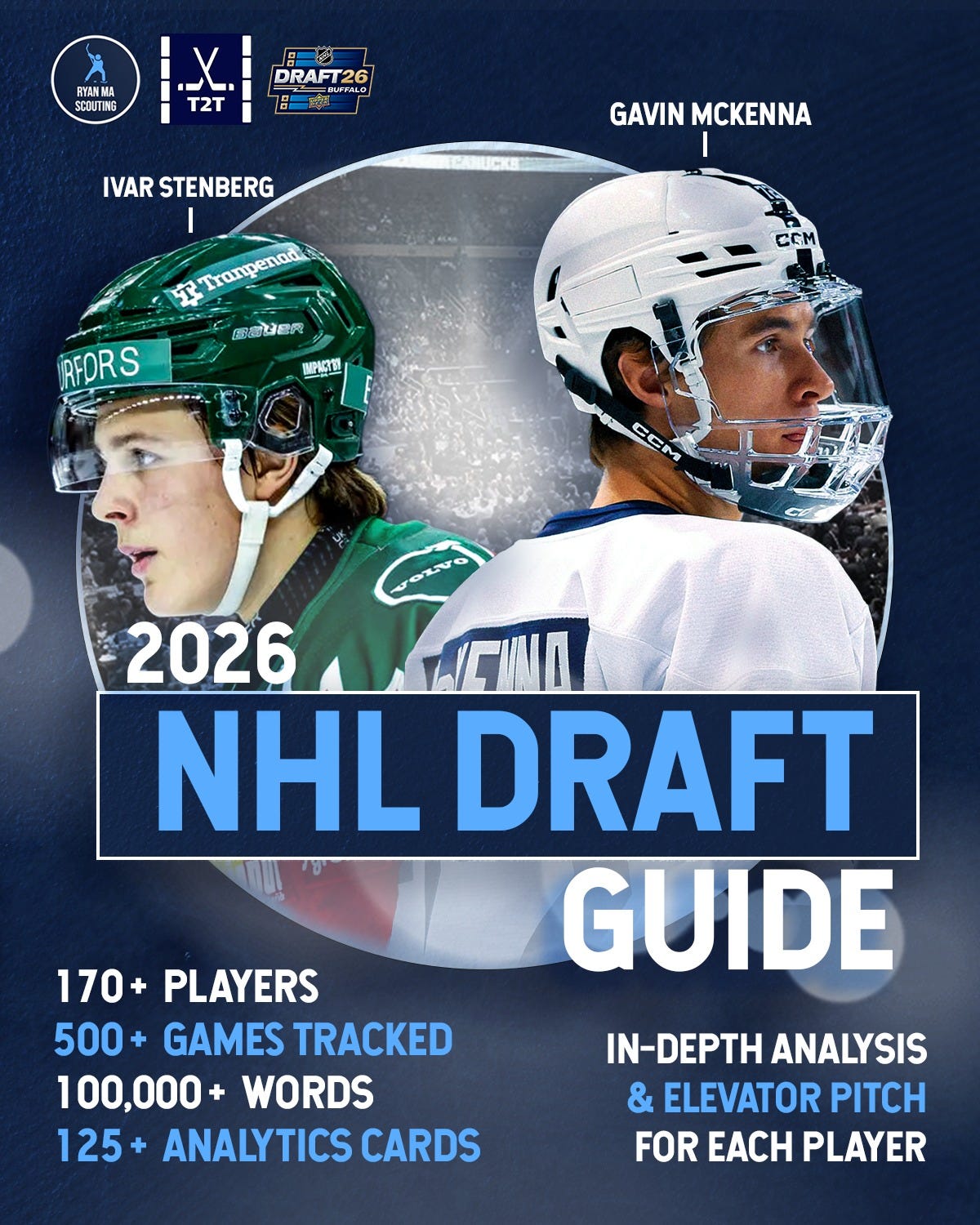
A special shoutout to Drew Ostomoen (@drewostmoen) for designing this beautiful cover page.
WELCOME (PLEASE READ THIS SECTION)
Hello everybody and welcome to my 2026 NHL Draft Guide!
This guide has been months in the making, but before we get started with the rankings and player write ups that you’ve all been waiting for, I wanted to get a few housekeeping items out of the way.
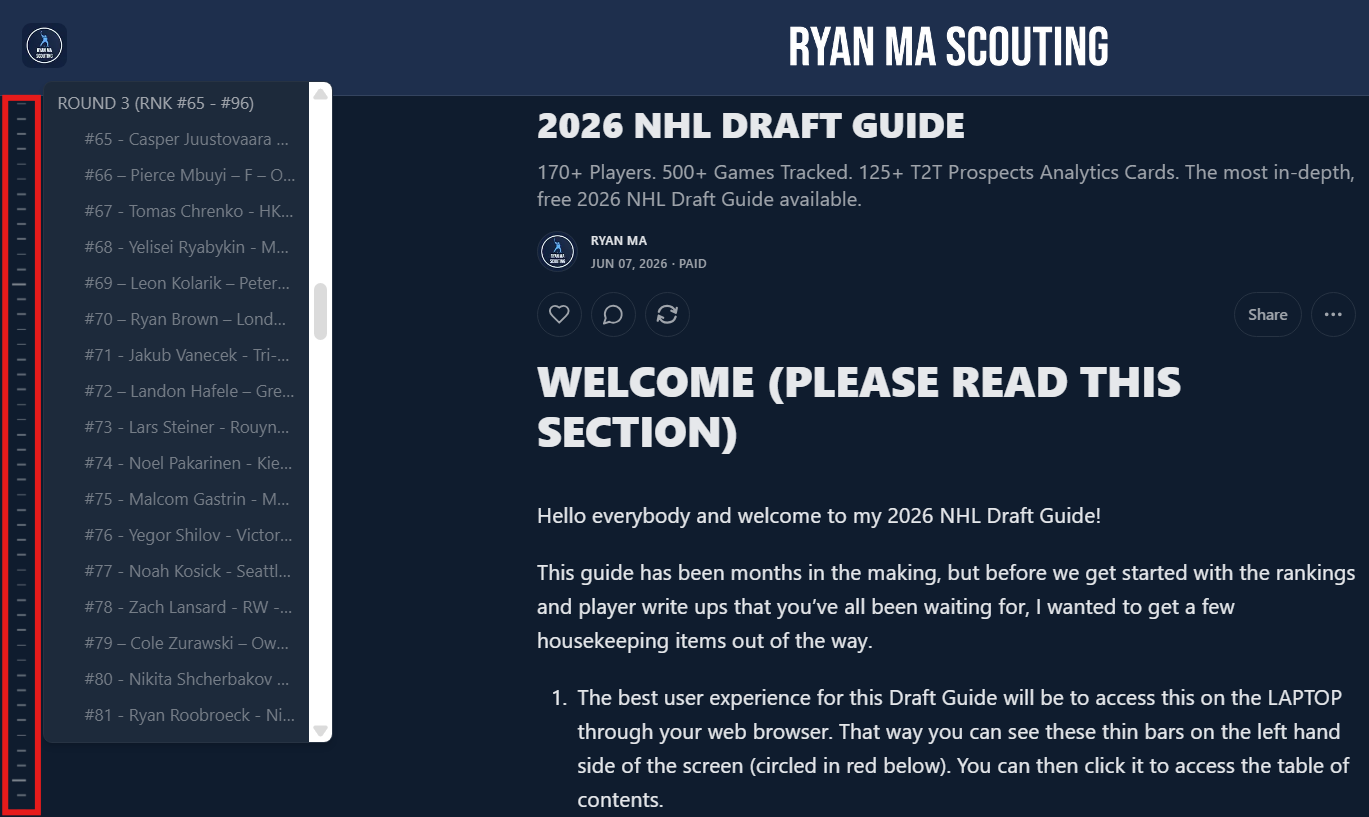
The best user experience for this Draft Guide will be to access this on the LAPTOP through your web browser. That way you can see these thin bars on the left hand side of the screen (circled in red below). You can then click it to access the table of contents.
These rankings are MY opinion based on extensive viewings of 171 players in this class and what my belief about each player’s likelihood of becoming an impact NHL player are. If you are looking for a vanilla ranking that follows consensus boards this will not be the Draft Guide for you.
Adding to the point above, you may have players ranked very differently than me, and I WELCOME any conversation you may want to have about my ranking or questions you may have about my justification. I just ask that you approach it in a respectful manner, otherwise I will ignore you.
Each player in the Top 171 will have an in-depth analysis where the write up will be anywhere from 400 to 700 words, but for those who just want a quick hitting summary each player will ALSO have an “elevator pitch” section which is a very high level summary of the player.
There will be NO goalies or overagers in this ranking. I have not yet deluded myself into thinking I can interpret what will make a good goalie at the next level and while players like Runtso, Vanhanen, Lefebvre, Kuhta and Galvas certainly deserve to be in this article, for my sake I’ve kept it just as first time draft eligibles.
With that out of the way, thank you for your support, and I hope you enjoy my 2026 NHL Draft Guide!
ROUND 1 (RNK #1 - #32)
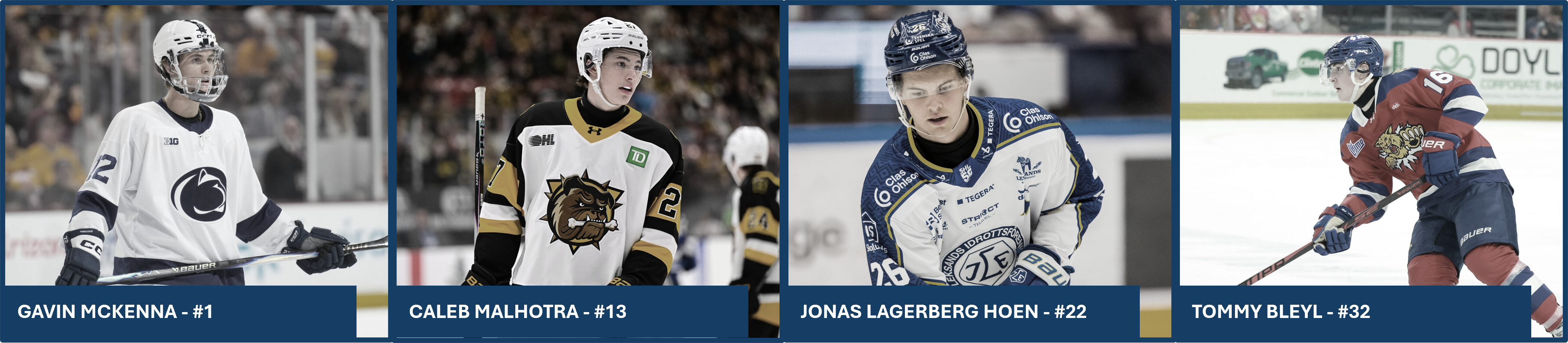
#1 - Gavin McKenna - Penn State University - LW - NCAA
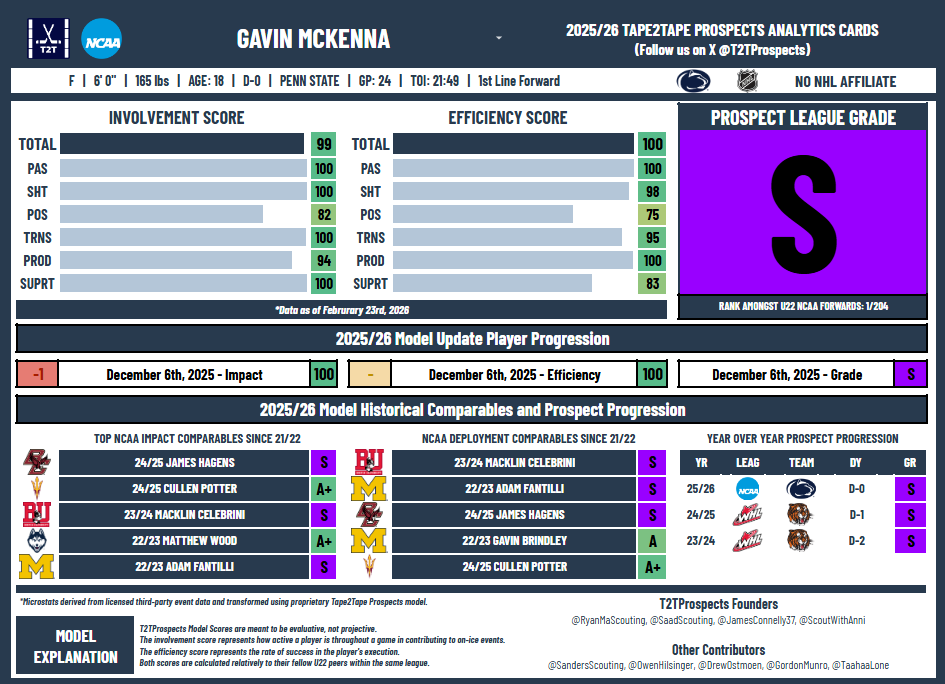
Games Tracked:
03/11/26 vs Minnesota
02/21/26 vs Ohio State
01/30/26 vs Michigan State
ELEVATOR PITCH
Gavin McKenna is an elite playmaking winger whose offensive game is defined by his rare combination of awareness, deception, and passing touch, allowing him to consistently generate high-danger chances from virtually anywhere in the offensive zone. While his physical engagement along the boards, and occasional inconsistency in puck battles remain areas for refinement, his ability to manipulate pressure, find the slot, and create offense under duress makes him one of the most dangerous and uniquely skilled forwards in recent draft cycles.
Gavin McKenna may not be the generational prospect he was hyped up to be when he was fifteen years old, but after watching him this season, I still came away convinced he’s the most talented passer I’ve evaluated in the last several draft classes. Everything in his game revolves around his ability to create offense from seemingly impossible situations, and more specifically, his ability to funnel pucks into the slot area from every conceivable angle on the ice.
What makes McKenna special isn’t just vision. Plenty of players can identify passing lanes. McKenna’s gift is his combination of awareness, deception, touch, and confidence. He processes the ice at an absurd level and consistently knows where teammates are before he even receives the puck. There were countless examples of him retrieving pucks along the wall, immediately recognizing where pressure was coming from, and turning those situations into scoring chances. One sequence perfectly summed him up: after recovering a puck off a wall battle, two defenders immediately jumped him. While facing the boards, with his back turned to the middle of the ice, he casually slipped a no-look backhand pass through two sticks into the slot. Most players don’t even see that play let alone attempt it.
His ability to get pucks into dangerous areas is genuinely elite. Whether he’s working from the half wall, below the goal line, on the rush, or even rotating high into the offensive zone, he constantly manipulates defenders into opening space before exploiting it. He’ll stop up on a rush, change pace, force defenders into uncomfortable decisions, and then either attack the newly created lane himself or slide a pass into the opening behind them. His ability to bend the defense to his will when he has the puck in open ice is special.
The manipulation skills are what separate him from other high volume playmakers. McKenna doesn’t simply react to pressure; he invites it. On breakouts he’ll hold onto the puck an extra second, bait defenders into overcommitting, then float a perfectly weighted pass over a stick to a teammate in stride. Along the walls, he’ll use little touch plays on loose pucks, knocking them into space for himself before defenders can establish body position.
I also think the skating gets undersold. The narrative that he’s merely an average skater has never fully clicked with me. Is he an explosive burner? No. But he has more than enough speed to create separation when opportunities present themselves. Without the puck, he closes space effectively and can get moving in a hurry when he decides to engage. More importantly, his edgework and change of pace are outstanding. His ability to stop, start, pivot, and maintain possession while scanning for options is a huge part of why his playmaking is so effective.
The shot deserves more attention as well. He gets pucks off quickly, has a legitimately dangerous snap shot, and does a nice job using that half-step of separation he creates to generate looks from in tight.
There are still areas I’d like to see improve. Along the boards, McKenna can be frustratingly soft. He often tries to create advantages through anticipation and stick work rather than simply engaging physically and winning the battle outright. When those little chops and spins work, they create immediate offense. When they don’t, he comes off half-hearted, low effort and disengaged.
That said, many of the concerns about his motor feel overstated. He’s a 17 year oldalready playing over 20 minutes a night in college. It’s an insane workload and even then, he doesn’t cheat for offense at the NCAA level. He tracks back, supports his defensemen low in the zone, and generally plays within structure.
Ultimately, McKenna’s value comes back to one simple fact: in a sport where the slot is the most valuable real estate on the ice, no one can create slot offense the way he can. His ability to turn what appears to be just another play into a high danger scoring chance is exceptional. The hands, awareness, manipulation, and passing touch are all elite NHL traits. Even if he falls short of the “generational” label that followed him for years, he’s still an incredibly rare offensive talent and one of the most gifted playmakers to come through the draft in recent memory.
#2 - Ivar Stenberg - Frolunda HC - LW/RW - SHL
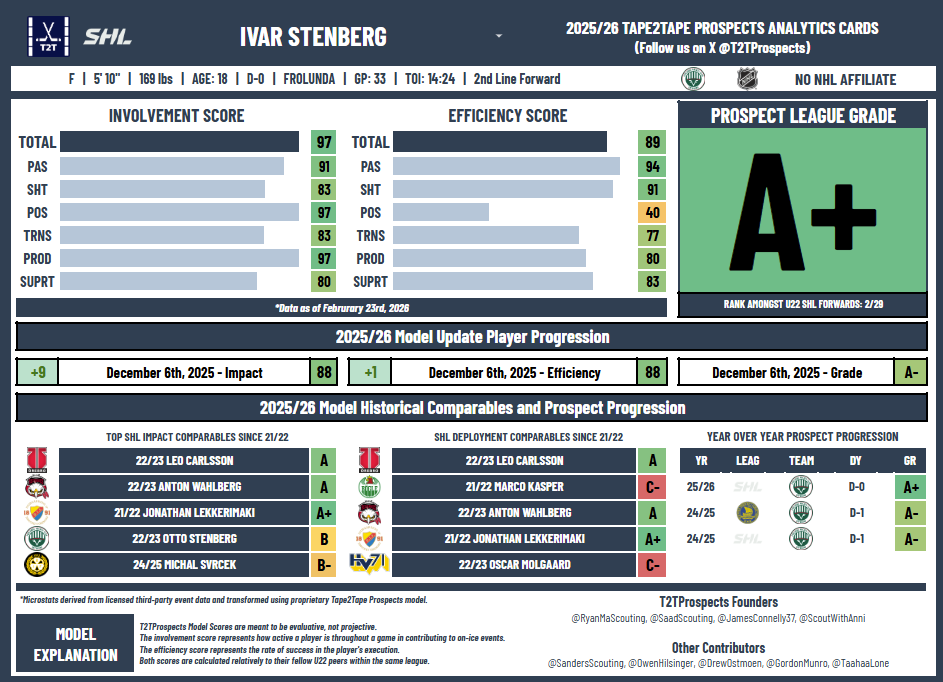
Games Tracked:
05/15/26 vs Canada (WC)
03/25/26 vs Lulea Hockey (Playoffs)
01/31/26 vs Linkoping HC
ELEVATOR PITCH
Ivar Stenberg is a physically mature, highly intelligent winger whose elite puck protection, smart connective playmaking, and strong defensive habits have already allowed him to thrive against professional competition. While he may not possess the elite dynamic creativity or offensive ceiling of Gavin McKenna, his skill is nothing to scoff at, and his combination of strength, processing ability, and translatable pro-style game makes him in my opinion, the safest and most complete forward in the draft class.
Ivar Stenberg remains one of the safest offensive bets in this draft class. While Gavin McKenna may possess the higher-end creativity and passing upside, Stenberg has spent the entire season proving that his game translates against men at a remarkably high level. He knows exactly who he is as a player, understands his strengths, and relentlessly leans into them to serve as an already elite complimentary option in the 2nd best league in the world as a teenager.
What continues to impress me most is how comfortable he is playing through contact. Stenberg is built solidly, carries a strong base, and consistently wins battles along the walls despite not being an overwhelming athlete. His puck protection ability is elite for a player his age. He uses his hips, legs, and body positioning exceptionally well to shield pucks, absorb pressure, and extend possessions. Defenders can get hands on him, lean on him, and close space quickly, but he rarely panics or loses control. Instead, he seems to thrive in those situations.
The offensive game revolves around that puck protection and his ability to manipulate pace. Stenberg isn’t the fastest player on the ice, nor does he create offense through explosive east-west movement. What he does have is a tremendous understanding of timing. He constantly finds ways to operate at a different tempo than everyone around him, slowing plays down just enough to create openings before executing under pressure.
The passing itself is excellent, though I’d describe it as smart rather than dynamic. Stenberg consistently identifies the correct play and executes it cleanly under pressure. He doesn’t have quite the same jaw-dropping manipulation skills or ridiculous slot feeds that McKenna produces, but he makes an awful lot of winning hockey plays. His ability to process pressure, protect the puck, and find teammates in dangerous areas remains one of his biggest strengths.
Defensively, Stenberg shows strong details, awareness and engagement. He scans well, drops compactly into coverage as a winger, and does a great job using his stick to disrupt plays. Whether it’s lifting sticks around the net, taking away shooting lanes, or simply arriving in the right support position, the details are very strong and he shows enough effort for me to consider it a strength.
His net-front game has also become an underrated aspect of his profile. Stenberg does an excellent job slipping underneath defenders, finding soft ice, and keeping himself available for rebounds and loose pucks. He isn’t overpowering physically, but he’s smart about how he arrives in those high danger areas and consistently finds ways to create second-chance opportunities.
The skating remains an interesting discussion point. I actually think McKenna is the better athlete and probably the better pure skater, but Stenberg’s mobility is more than adequate because of how efficiently he moves. His hips are excellent, allowing him to execute smooth cutbacks and directional changes when handling the puck along the wall, creating separation despite lacking elite explosiveness. Those little turns and adjustments help him maintain possession and extend plays when defenders think they’ve closed him off.
The biggest limitation in his offensive projection is that he can be somewhat straight-line oriented. He doesn’t consistently attack east-west through layers of defenders, and he kept it pretty simple a lot of the times in the SHL. Most of his best work occurs when he’s driving through openings, protecting pucks with his legs, and leveraging his strength and hands along the wall rather than dancing around opponents.
Overall, I completely understand why some evaluators view Stenberg as the safer bet than McKenna. He’s already succeeding in a difficult professional environment, he handles physicality exceptionally well, and his game is built around traits that tend to translate. Personally, I still lean toward McKenna because I think the offensive ceiling is simply higher. But Stenberg’s combination of puck protection, intelligence, defensive detail, and smart connective playmaking makes him the most complete forward available in this class.
#3 - Tynan Lawrence - Boston University - C - NCAA
Games Tracked:
04/23/26 vs Latvia U18
03/14/26 vs UConn
01/20/26 vs Boston College
05/20/25 vs Waterloo Black Hawks
ELEVATOR PITCH
Tynan Lawrence is a high-end two-way forward whose game is built on elite skating, relentless motor, pace, and exceptional puck disruption, allowing him to impact shifts from end to end even when the scoring doesn’t show up on the box score. While his offensive production has been inconsistent at higher levels, he’s been consistently the drivign factor of every team he’s been on. His combination of pace, defensive detail, puck-winning ability, and net-front involvement makes him one of the most complete and projectable forwards in the class, with a legitimate profile to develop into a high-end two-way centre.
A lot of draft boards seemed to have soured on Tynan Lawrence since the start of the year… and I just don’t get it. At one point a consensus Top 5 Pick , he didn’t look quite right ealy in the season, got hurt and then made the jump to Boston University where his struggles to produce on a sinking ship seems to have tanked his draft stock.
But don’t get it twisted. The counting stats may not have been there for Lawrence this season, but he was so pivotal to everything that BU did. It’s noticeable everytime you watch him step foot on the ice for BU and he translated that into being one of Canada’s best players at the U18s.
Watching multiple games of Tyanan Lawrence seems almost redundant because each viewing just reinforces what I’ve though of him all along. He’s the engine that makes everything go for his teams wherever he plays. Whether that’s in the USHL for Muskegon, the NCAA for BU or for Canada, when Lawrence is on the ice, he is pushing the envelope.
The combination of skating, motor, defensive habits, puck-winning ability, and offensive support play gives him one of the most complete profiles among his peers, and all four viewings he looked like the best player on the ice.
The foundation of Lawrence’s game is his skating. He remains one of the most effortless movers in the class, covering ground with ease and consistently arriving first on loose pucks. What makes the skating even more valuable is how hard he works. Plenty of players can skate well, but very few combine that mobility with the kind of nonstop motor Lawrence brings every shift. He’s one of the rare forwards who genuinely plays from goal line to goal line. Whether he’s tracking back through the neutral zone, supporting low in the defensive zone, or racing into a forecheck, the effort level never seems to dip.
Defensively, he’s a nightmare to play against. His stick detail is exceptional and drives a huge portion of his value. Lawrence constantly creates disruption through stick lifts, poke checks, deflections, and pressure. He blocks shots, breaks up passing lanes, and routinely turns defensive situations into offensive opportunities by immediately directing loose pucks into open ice. There were numerous sequences where he simply outworked opponents for possession, and just won pucks back through anticipation and effort. His backchecking remains among the best you’ll find from a draft-eligible forward.
What stands out most is how often he creates second opportunities in the offensive zone. Lawrence is relentless on retrievals. He hounds defenders into mistakes, pressures puck carriers along the walls, and consistently wins battles that extend offensive-zone possessions. Even when a scoring chance initially dies, he’s often the player responsible for bringing it back to life through sheer persistence.
With the puck, Lawrence continues to show more skill than I think he gets credit for. He uses his lower body extremely well to shield pucks, protecting it through contact and spinning away from defenders. His bottom-hand strength is particularly impressive. Opponents struggle to stick lift him cleanly, and even when defenders get attached to him physically, he often finds a way to maintain possession and work into more dangerous areas. There were several sequences where he absorbed pressure, spun off contact, and attacked the slot for quality scoring opportunities.
The offensive instincts are strong as well. He naturally gravitates toward dangerous areas without the puck, supports effectively within the cycle, and consistently arrives around the net at the right time. When space opens up, he attacks it immediately. His acceleration through open ice allows him to exploit defensive breakdowns quickly, and his hands are good enough to capitalize when he gets in tight. He drives the net with purpose and owns a quick release that he can use to beat goaltenders.
There is some room for refinement. At times, Lawrence can become a little too willing to settle for perimeter shots rather than continuing to work his way inside with the puck. Given how effective he is around the net and through traffic, I’d like to see him trust that part of his game more consistently when he’s trying to attack from the outside.
Still, these are relatively minor criticisms within an otherwise extremely complete profile. Lawrence affects winning in virtually every area of the ice. He skates, defends, forechecks, retrieves pucks, supports possession, attacks the net, and competes at a level few players in this class can match. The offensive ceiling may ultimately be driven more by volume than elite creativity, but the overall package is incredibly projectable. Every viewing seems to produce the same takeaway: when Lawrence is on the ice, good things happen because he simply refuses to stop impacting the game. You want the best shot at a 1C in this draft? It’s him.
#4 - Alberts Smits - Jukurit/EHC Munchen - LD - Liiga/DEL
Games Tracked:
05/21/26 vs Finland (WC)
03/21/26 vs ERC Ingolstadt (Playoffs)
02/12/26 vs USA (Olympics)
ELEVATOR PITCH
Alberts Smits is a highly projectable, mobile two-way defenseman whose skating, defensive stick detail, and composure against top-tier competition make him the strongest blue-line prospect in the class. While his offensive production lacks flash due to his pro-level development path, his ability to defend NHL-caliber talent, close space efficiently, and consistently execute under pressure gives him one of the safest and most translatable defensive profiles in the draft.
All I’ve really gathered this year is that defensemen who take the challenge and go play pro or in college end up getting punished on draft night because they don’t have those fun splash plays that their counterparts playing in junior hockey do.
Alberts Smits, my number one defenseman this year is a perfect example of this. I think his offense and skills get overlooked largely because of his development path. Spending his draft year in professional leagues meant he wasn’t putting up gaudy numbers against junior competition, but whenever I’ve gone back to watch clips of his U20 games, it was pretty clear he had already outgrown that level. The offense isn’t built around highlight-reel creativity, but the skating, puck movement, and ability to identify space are all legitimate strengths.
What really stood out this season, though, was how well he handled himself against elite competition. Not many draft eligibles can say they played meaningful minutes against the best players in the world, and even fewer can say they looked comfortable doing it. Smits not only survived against the American Olympic team, he genuinely held his own. There were multiple sequences where he defended NHL stars effectively, made the correct reads under pressure, and looked unfazed by the pace of play.
The skating is the foundation of everything. Smits is an excellent mover who covers ground effortlessly and uses his mobility well defensively. His lateral movement stands out in particular. He does a great job surfing with attackers, staying square, and taking away both the puck carrier and nearby support options simultaneously. There were several examples against the United States where he mirrored elite NHL players through the neutral zone and denied controlled entries. Whether it was forcing Charlie McAvoy into a dump-in, staying in front of Kyle Connor off the rush, or breaking up a developing Quinn Hughes-Kyle Connor sequence, his feet consistently put him in position to make plays.
Defensively, his stick work is outstanding. He disrupted plays repeatedly in the slot, poked pucks loose from dangerous attackers, and consistently won small-area battles through positioning rather than pure physicality. One sequence saw him knock a puck away from Auston Matthews in the slot before immediately finishing the play with a shoulder that sent Matthews tumbling. Another saw him recover after Brock Nelson gained a step, chop the puck loose, regain possession, and skate it out for a dump out while absorbing pressure. Those are high-level defensive plays against elite competition.
What impressed me most was his composure. Smits was frequently deployed in defensive situations, started a ton of shifts in his own zone, and spent long stretches defending. Even when trapped on the ice for extended shifts, he rarely lost structure. One particularly exhausting sequence saw him defend through multiple failed clears, block a pass intended for Matthews, disrupt a Matt Boldy chance, and then crosscheck Matthew Tkachuk at the top of the crease to the ice despite clearly being out of gas. The details never disappeared.
Offensively, I still think there’s more here than the production suggests. He’s calm under pressure at the blue line, makes quick give-and-go plays, and is comfortable activating into space when opportunities present themselves. There was a nice sequence where he attacked downhill after moving the puck, drove into the slot, and worked the puck onto his backhand for a chance. He doesn’t force offense, but he recognizes openings and has the skating ability to exploit them when they appear.
Physically, he’s the most physically mature of any defenseman in this class not just from a textbook biological perspective but his understanding of it’s application. He consistently leveraged opponents off pucks, won board battles against NHL players, and wasn’t afraid to engage along the boards. Whether it was boxing out Matthews, bodying Tage Thompson along the wall, or forcing Dylan Larkin into low-percentage plays, he showed he can compete physically already.
Let’s not get too excited, he had his losses as well, he got toasted behind the net by Kyle Connor on a play and got disconnected fom his man a few times through traffic but that single game against the US might’ve been the most impressive game I’ve watched all season given the context, even if he was a -1 and didn’t record a point.
Overall, Smits may never be the flashiest defenseman in this draft class, but he’s easily the most projectable. The skating is excellent, the defensive habits are mature, the stick detail is outstanding, and there’s enough puck-moving ability to contribute offensively. More importantly, he has already shown he can hold his own against players operating at the highest level of the sport. That’s not something many draft eligibles can say, and it makes him my number one defenseman.
#5 - Viggo Bjorck - Djurgardens IF - C - SHL
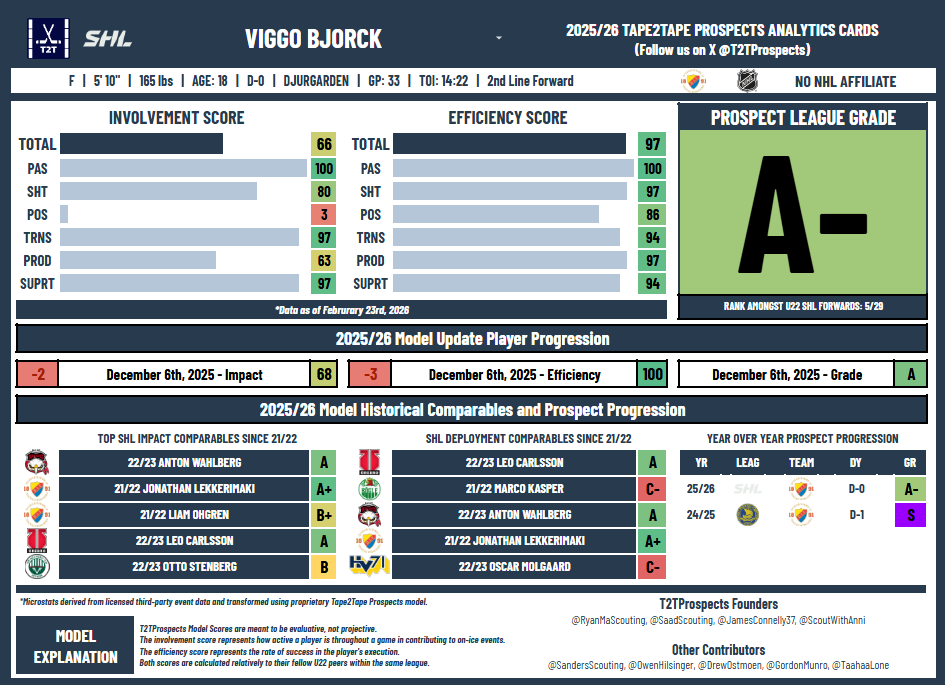
Games Tracked:
05/26/26 vs Slovakia (WC)
04/08/26 vs Leksands IF U20 (Playoffs)
03/14/26 vs Skelleftea AIK
ELEVATOR PITCH
Viggo Bjorck is a highly intelligent, detail-driven forward whose impact comes from elite positioning, strong puck support, and consistent two-way reliability rather than dynamic skill or elite skating. While he lacks a standout offensive toolset, his competitiveness, puck-winning ability, and ability to connect plays under pressure make him a strong complementary piece who drives possession and improves every line he plays on.
Viggo Bjorck is one of the smartest forwards in this class. He may not have the most dynamic skating profile or the flashiest offensive toolkit, but he consistently impacts the game through positioning, puck support, physical competitiveness, and rapid decision-making. Every viewing seemed to reinforce the same impression: he’s almost always where he should be, and he makes life easier for his teammates.
What stands out immediately is how well Bjorck handles contact. He plays with a low center of gravity, gets underneath opponents, and stays remarkably strong on his feet. Bigger players will find him surprisingly difficult to handle because of how well he establishes body position. In the corners, he does an excellent job arriving first, getting low, and using his backside to disrupt an opponent’s path to the puck before making a play. That technique allows him to win battles against players who should have a size advantage on paper. He’ll inevitably lose his fairshare of exchanges given the frame, but he doesn’t take the loss lying down and just continues to compete.
Defensively, Bjorck is extremely reliable. His head is constantly scanning, he gets to his spots quickly, and he consistently provides support. He covers for defensemen on retrievals, rotates responsibly through the defensive zone, and uses an active stick to disrupt possession. Rather than chasing hits or overcommitting, he wins pucks through anticipation, body positioning, and stick detail. There were numerous sequences where he simply chopped pucks loose to teammates and immediately transitioned play the other way.
Offensively, Bjorck’s value comes less from individual creation and more from how he connects plays. He moves pucks quickly, rarely holds onto them longer than necessary, and consistently makes the small supporting pass that sustains possession and offensive zone pressure. His awareness under pressure is particularly impressive. His ability to play one step ahead allows him to function as an outstanding connective piece in transition and in-zone play.
I also liked the physical edge in his game. He doesn’t just absorb contact, he initiates it when needed. He gets low, finishes through opponents, and competes hard in every area of the ice. The motor is consistently strong, and his willingness to battle complements the hockey sense nicely.
The main limitation is that the skating isn’t spectacular, which is a concern for a player of his size. However, because he’s so strong on his edges and processes the game quickly, that limitation doesn’t prevent him from arriving in the right places or staying involved in the play.
Overall, Bjorck projects as a high-end complementary center who can elevate a line through intelligence, support play, and relentless competitiveness. He wins battles, protects pucks, gets pucks into the middle from below the dots, and constantly keeps play moving in the right direction. Even if he doesn’t make it as a center, he’ll be a damn good winger.
#6 - Chase Reid - Soo Greyhounds - RD - OHL
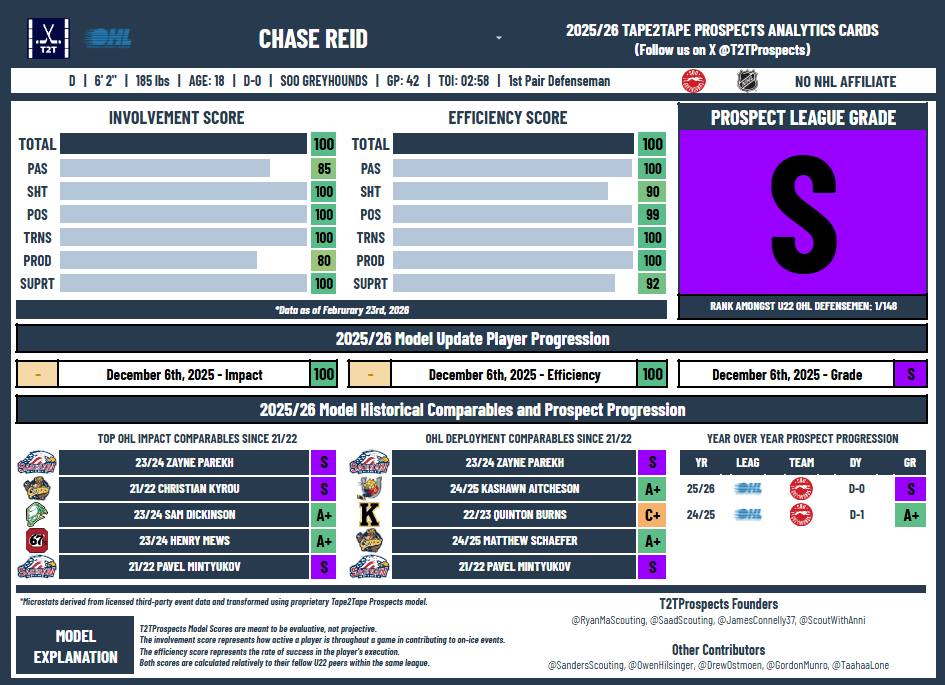
Games Tracked:
04/14/26 vs Kitchener (Playoffs)
03/27/26 vs London (Playoffs)
01/25/26 vs North Bay
ELEVATOR PITCH
Chase Reid is a smooth, highly mobile two-way defenseman whose elite skating and calm, efficient puck management allow him to consistently drive transition and maintain possession under pressure. While he lacks the high-end offensive flash you’d want to see for a player with his production, and still needs to improve his physical engagement and defensive play in tight, his composure, retrieval efficiency, and ability to cleanly move the puck make him a strong modern NHL projection on the back end.
Chase Reid is one of the smoothest defensemen I’ve watched this season, combining excellent skating ability with a calm, efficient puck-moving game that allows him to consistently drive possession and transition play. He may not be the most dynamic offensive creator in the class, but the combination of mobility, puck management, and intelligent decision-making gives him a good starting point as a high-end modern two-way defender.
The skating is the engine of his game. Reid is an exceptionally fluid mover who can generate clean zone entries, transport pucks through traffic, and change directions effortlessly. For a bigger defender, his ability to stop and start, pivot, and turn up ice on a dime is impressive. He looks completely comfortable attacking defenders at the blue line with possession and has the footwork to create his own entry lanes when options aren’t immediately available. There’s a level of explosiveness in his stride that allows him to power through open ice and gain separation even when defenders have good positioning.
His puck management is arguably his best trait. Reid consistently makes clean, efficient plays and rarely looks rushed under pressure. His retrieval habits stood out throughout my viewings. He does an excellent job pre-scanning, identifying pressure before touching the puck, and using either his skating or quick puck movement to escape forecheckers. Even his defensive-zone clears are controlled and purposeful. Rather than simply firing pucks out, he’ll softly place them into open ice or areas where teammates have a realistic chance of recovering possession.
As a passer, Reid is reliable and controlled. He moves pucks with pace but doesn’t force plays unnecessarily. Most of his offensive contributions come through quick puck movement, cycling plays, and making the correct read rather than attempting high-risk skill plays. I would like to see him become more aggressive attacking the middle of the ice as a passer, however. Much of his distribution remains perimeter-oriented, and there aren’t enough slot-threatening passes considering how often he successfully gains the offensive zone with possession.
Offensively, he picks his spots well but can occasionally become a little too aggressive activating into the play. There are times where he joins the rush or pinches down the wall with enthusiasm that leaves him vulnerable if the play breaks down. At the same time, those same aggressive instincts produce some of his best moments. Several times he perfectly timed pinches, intercepted hard rims along the boards, and immediately turned those turnovers into dangerous scoring opportunities. His shot is another asset, particularly his heavy slapshot, which he isn’t afraid to use when lanes open.
Defensively, the evaluation is a bit more mixed. He possesses a good stick and generally positions himself well, frequently getting low to take away passing lanes and centering options. However, I’d like to see greater urgency and physical engagement in certain situations. Along the boards and around the corners, there were opportunities to initiate contact and seperate the opponent from the puck that he sometimes passed up. Despite having the strength to clear the net front effectively when he chooses to, he often defaults to a more stick-oriented defensive style.
There are also moments where his feet stop moving in tight defensive situations. Rather than continuing to work underneath opponents, he’ll occasionally reach or lean on players to slow them down. Similar issues show up defending the rush. Reid will often trigger aggressively toward puck carriers initially, but instead of fully closing the gap, he’ll back off into no man’s land. He also becomes susceptible to puck watching once possession changes hands.
Overall, Reid projects as a highly mobile, intelligent two-way defender whose skating and puck management provide an excellent foundation. While there are still improvements to be made regarding physical engagement, defensive consistency, and creating more dangerous offensive opportunities, his combination of movement, composure, and transition ability gives him a strong chance to become an effective high end NHL defenseman.
#7 - Keaton Verhoeff - University of North Dakota - RD - NCAA
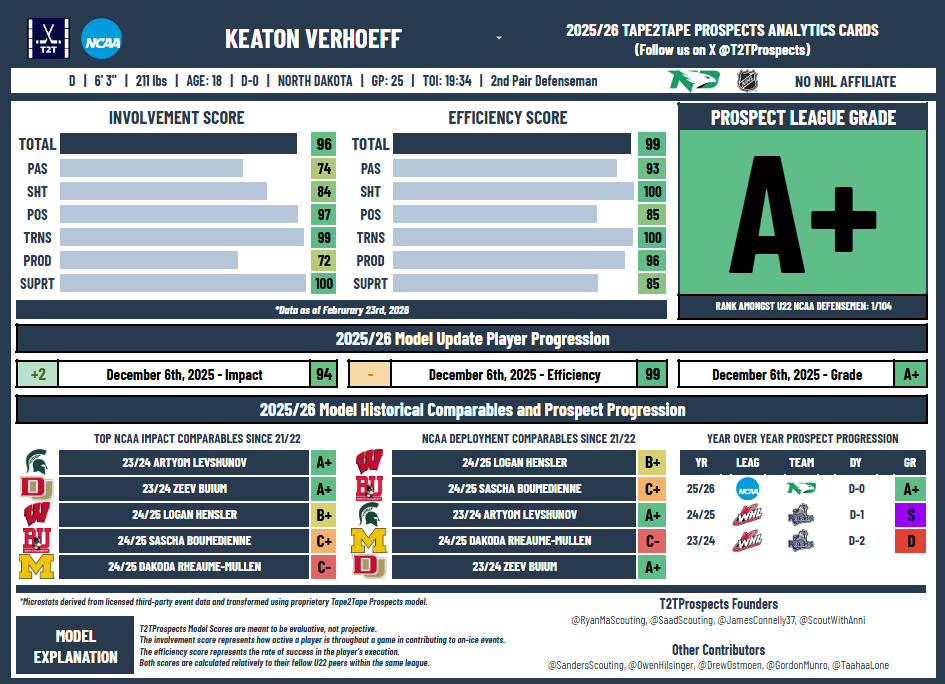
Games Tracked:
04/27/26 vs Finland U18
03/14/26 vs Minnesota Duluth
01/16/26 vs Denver
ELEVATOR PITCH
Keaton Verhoeff is an aggressive defenseman who wants to play the game on his terms. His game is built around gap control, physical engagement, and proactive play disruption, allowing him to consistently suffocate opponents when his timing is on. While his skating mechanics and reach-heavy defending raise some questions against higher-end skaters at the next level, his competitiveness, puck movement efficiency, and willingness to dictate play give him a strong projection as a potential top-four, impact two-way NHL defender.
Keaton Verhoeff is one of the more unique defensive projections in this class because so much of his effectiveness comes from how aggressively he chooses to play. He’s constantly looking to dictate the terms of engagement, whether that’s stepping up in the neutral zone, pinching down the wall, closing gaps early, or attacking loose pucks before opponents can establish possession. When he’s able to play on his front foot, Verhoeff can completely suffocate shifts. The question for me is how much of that approach will continue to work against faster and more dynamic competition.
The first thing that jumps out is the defensive aggression. Verhoeff absolutely loves killing plays before they develop. He closes gaps aggressively through the neutral zone, steps up hard on entries, and regularly triggers toward loose pucks along the boards in an effort to end possessions immediately. There were numerous examples of him pinching deep into the offensive zone when he identified an opportunity to recover a puck, and he consistently looked eager to engage physically on 50/50 battles. He wants to force opponents into mistakes rather than sitting back and reacting.
That aggressiveness extends to his physical game. Around the net, Verhoeff does a good job moving bodies, lifting sticks, and preventing attackers from establishing comfortable positioning. Along the walls, he’s willing to finish through opponents and use his frame to separate players from pucks. He’s not a punishing open-ice hitter, but he plays with enough edge and physicality to make life uncomfortable for opposing forwards.
The concern comes with how he gets to those defensive stops. Verhoeff can be extremely reachy. He often lowers his center of gravity dramatically and extends himself well out in front of his body to disrupt plays. At lower levels, it works because his timing and reach are very good. He routinely swoops in as a secondary defender, pokes pucks loose, and immediately transitions play the other way. Against elite NHL-level speed, though, I do wonder whether that technique will hold up as consistently. There are times where he appears vulnerable to explosive change-of-direction players who can attack the space he’s opening up.
Part of that concern ties into the skating. I don’t love the mobility profile. His hips look fairly tight, and he doesn’t turn particularly smoothly. There are moments where he appears a step behind when he isn’t the one dictating the pace of the play. When Verhoeff can attack forward, close space aggressively, or skate into open ice, the skating looks perfectly fine. When he’s forced into recovery situations or has to react to quick changes of direction, the movement becomes less convincing.
With the puck, Verhoeff is better than he often gets credit for. He has enough skill and puck protection ability to maintain possession through pressure, particularly when his feet haven’t had a chance to get moving yet. There are some sneaky puck-handling moments along the walls, and he’s comfortable holding possession long enough to let plays develop. His breakout passing is generally efficient, with well-placed outlets that move play north without unnecessary risk.
Offensively, he shows flashes of creativity but can be somewhat predetermined. He likes activating down the wall, looking for slot feeds, and trying to create offense through movement rather than simply firing pucks from the point. The ideas are generally good. The issue is that there are times where it feels like he’s already decided where the puck is going before he receives it, which lead to passing into lanes that are covered and wasting some offensive zone opportunities.
Overall, Verhoeff projects as an aggressive, physically engaged Top 4 two-way defenseman whose game is built around disrupting plays and forcing opponents to react to him. The defensive instincts, competitiveness, and willingness to play on the front foot are all very appealing. For me, the biggest questions center around the skating mechanics and whether his hyper-aggressive defensive style will remain as effective against higher-end speed. Even so, there is a lot to like in a defender who consistently looks to drive play rather than simply contain it.
#8 - Malte Gustafsson - HV71 - LD - SHL
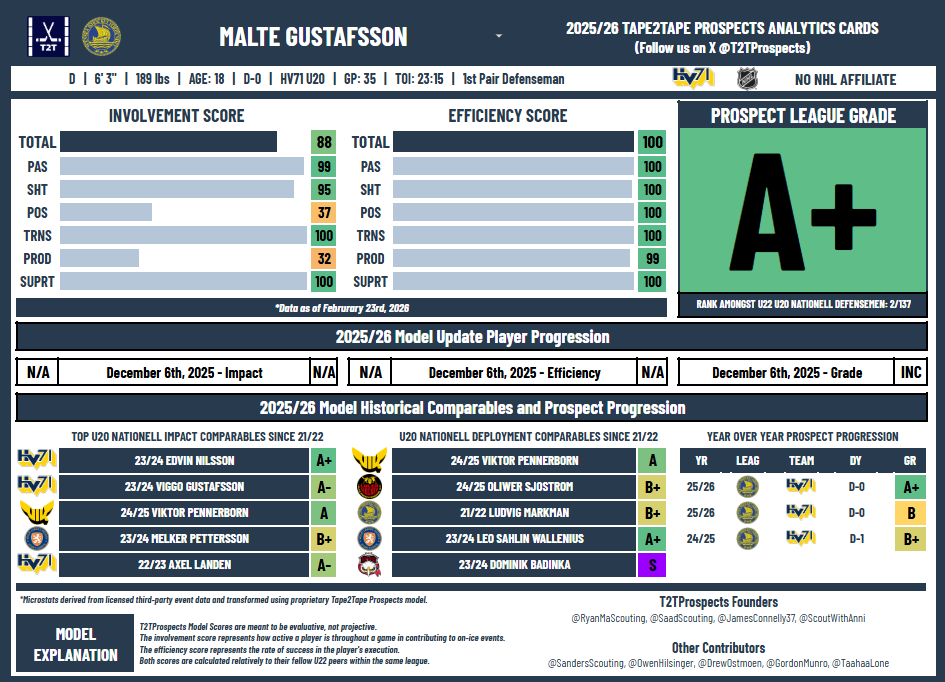
Games Tracked:
04/25/26 vs USA U18
03/22/26 vs Leksands IF (Playoffs)
01/31/26 vs Lulea Hockey
ELEVATOR PITCH
Malte Gustafsson is a highly projectable, mobile, defensive-first defenseman whose elite skating (particularly his rare hip fluidity, gap control, and ability to match attackers stride-for-stride) forms the basis of a really appealing NHL package. While his puck management and offensive involvement are still developing, his size, defensive disruption, and efficient breakout game give him a clear path as a modern top-four defender with legitimate upside if his on-puck confidence continues to grow.
Malte Gustafsson is what I think a lot of people think Carson Carels could be. He’s big, mobile, defends well, already plays meaningful minutes against professionals, and possesses the kind of skating toolkit that gives him a very straightforward path to the NHL. While there are still some rough edges in his puck management and offensive game, the overall package is just so projectable.
The defining trait is the skating. Gustafsson is an outstanding mover for a defender his size, with THE BEST hip fluidity in the entire draft. His ability to step up to challenge an attacker entering the zone, stay square to the attacker while backskating, and then be able to seamlessly slip his hips, attack the puck with his stick and force the attacker wide and around the net is easily the best in this draft class. Once he gets opponents into disadvantageous positions, he isn’t afraid to finish plays physically either, leaning into players along the boards and using his frame to close sequences out.
That combination of skating and reach drives most of his defensive value. Gustafsson consistently weaponizes his length to eliminate passing options and shrink space for puck carriers. He’s particularly aggressive when forwards receive pucks standing still near the offensive blue line, quickly jumping them before they can establish possession or build speed. His gap control is excellent, and his ability to mirror attackers makes controlled entries difficult to generate against him.
Defensively, he already looks comfortable playing against men. The reads are generally sound, and he doesn’t get caught chasing offense at the expense of structure. There are still moments where the pace of the SHL can pressure him into mistakes, particularly when retrieving pucks under heavy forechecking pressure. I’d like to see him process options a little faster in his own zone. There were a few instances where he held onto pucks too long while searching for an outlet and ultimately ran himself out of space, leading to forced passes that weren’t there.
With the puck, Gustafsson is fairly straightforward but effective. He doesn’t overcomplicate things and generally looks to move play north quickly when he can locate his teammates. The breakout game is one of the more encouraging parts of his profile. There’s a crispness to his first pass that allows his team to transition efficiently, and he consistently delivers pucks with enough pace to keep teammates moving. He isn’t an overly creative distributor, but he doesn’t need to be. The foundation of a quality transition defender is already present.
Offensively, there are flashes that suggest there may be more upside than his production currently indicates. He likes joining the rush, isn’t afraid to activate down the wall, and occasionally ventures into the half-wall areas to extend possessions. I liked seeing him turn his back to pressure and use his frame to shield pucks while attempting to start cycle sequences. The confidence to involve himself offensively is there, even if the execution is still developing.
Physically, he’s somewhat of a work in progress. Gustafsson is tall and willing to engage, but he’s still quite lanky and wiry. He competes hard and doesn’t avoid contact, but there are moments where additional strength would help him absorb pressure and win battles more consistently. Given how young he is for the draft class, that’s not particularly concerning and should improve naturally as he matures physically.
Overall, Gustafsson fits the mold of the modern defensive-first NHL defenseman. He’s big, rangy, highly mobile, and already understands how to leverage those tools to disrupt opposing attacks. The offensive game may never be the primary selling point, but there’s enough activity and puck-moving ability for cautious optimism. Right now, I see a likely second-pair defender, but if the on-puck game continues to develop and the offensive confidence grows, there’s a path toward becoming an elite complimentary skillset on a top pairing. The Gustav Forsling comparison comes to mind stylistically because of the skating. fluidity and defensive impact, although Gustafsson is noticeably bigger and lankier.
#9 - Elton Hermansson - MoDo - RW - HockeyAllsvenskan
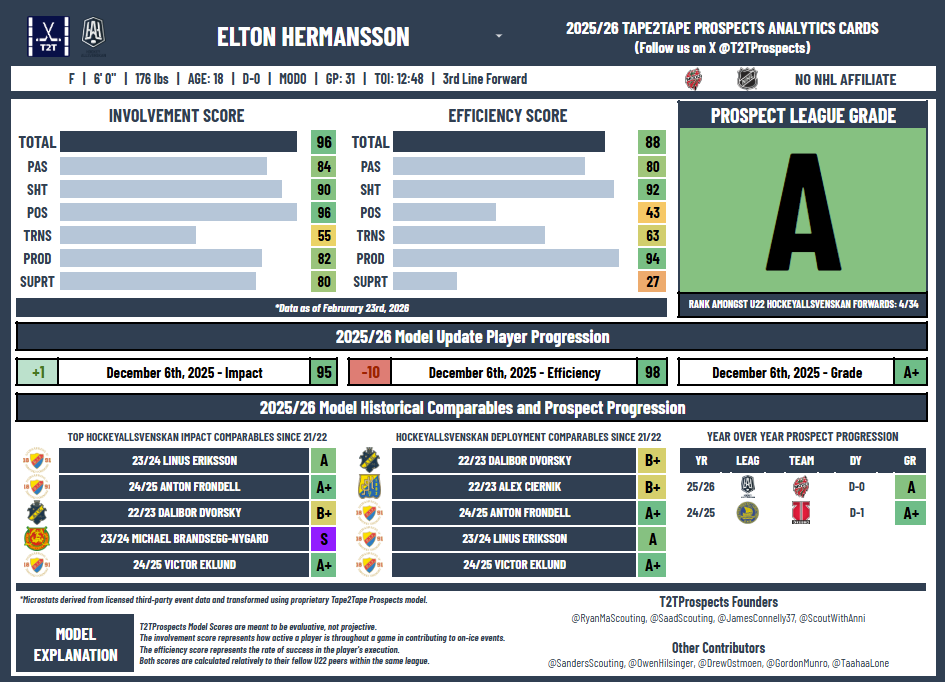
Games Tracked:
04/27/26 vs Denmark U18
04/11/26 vs BIK Karlskoga (Playoffs)
03/20/26 vs AIK IF (Playoffs)
ELEVATOR PITCH
Elton Hermansson is a high-skill winger whose value comes from elite composure, edgework, and creative puck management rather than pace or physical dominance. While his engagement and urgency are still inconsistent, his ability to process pressure, create deceptive advantages, and generate offense through passing and small-area skill gives him a strong top-six projection if his off-puck consistency and pace continue to improve.
Elton Hermansson remains one of the more fascinating skill bets in this class because so much of what he does with the puck is built around composure, deception, and manipulation rather than pure pace or overwhelming physical tools. He’s not the type of player that’s going to jump off the screen by running over defenders or relentlessly hounding pucks every shift, but when the puck finds him, that’s when the magic happens.
The first thing that stands out is how smooth he is. Hermansson is an excellent skater, not necessarily because of blazing straight-line speed, but because of his edgework, balance, and ability to stay in motion while processing the game around him. He does a great job holding onto pucks through the neutral zone, keeping his feet moving while turning away from pressure, shielding the puck, and finding support options. That unabashed confidence and calmness does lead to him making some really puzzling passing decisions at times, but man… when he’s clicking there are few players more fun to watch this season.
That poise carries over into almost every aspect of his puck game. Hermansson consistently navigates pressure well and has a knack for making little evasive plays that buy himself extra time. Whether it’s a subtle head fake, a quick change of direction, or a spin move off the wall, he routinely creates small advantages that allow him to connect the next play. There were multiple sequences where he baited pressure toward him before slipping a pass through traffic to a streaking teammate just before the next layer of defenders could attack.
The offensive creativity is legitimate. Below the circles, he regularly looks for ways to funnel pucks into dangerous areas through spin passes, backhand feeds, and small-area manipulations. He sees passing lanes that many players don’t, and more importantly, he has the patience to wait for them to develop. His awareness of traffic is particularly impressive. Time and time again, he found ways to thread pucks through layers of defenders and onto teammates’ sticks.
What has encouraged me most compared to earlier viewings is the progress away from the puck. The motor still isn’t a defining strength of his game. He’s never going to be the first player that comes to mind when you think of relentless forecheckers or high-energy puck hunters. However, there has been noticeable improvement in several areas. His backchecking effort was significantly better during the playoffs, he showed more commitment to arriving in defensive positions on time, and his off-puck routes offensively have become much more purposeful. Rather than drifting around the perimeter waiting for touches, he’s starting to work into traffic, occupy defenders in the slot, and create opportunities through movement.
Even physically, there were small signs of growth. He’s still not an overly physical player, but he’s becoming more willing to engage. There were more pushes, more cross-checks heading into board battles, and a greater willingness to fight for positioning than I had seen previously.
The biggest remaining area for improvement is pace. While Hermansson processes the game at a high level mentally, I’d still like to see him play with a little more urgency at times. There are moments where the game feels almost too comfortable for him, where an extra gear could help turn a good play into a great one.
Overall, though, I continue to see the makings of a legitimate top-six offensive player. The skill level is obvious, the puck management is improving, the off-puck habits are trending in the right direction, and the creativity remains among the better you’ll find in this class. If he continues ironing out the pace and engagement concerns, there’s a very real play-driving winger here whose game should translate well to higher levels because of how naturally he manipulates pressure and creates offense.
#10 – Wyatt Cullen – USNTDP Juniors – F – USHL
Games Tracked:
02/21/26 vs Lindenwood University
01/24/26 vs Cedar Rapids
11/26/25 vs Team CHL
ELEVATOR PITCH
Wyatt Cullen is a highly intelligent, pace-controlling playmaker whose elite vision, deceptive puckhandling, and ability to create offense through passing, transition play, and high-slot attacks make him one of the most intriguing offensive talents in the 2026 draft class. While his defensive engagement, board play, and tendency to cheat for offense remain areas for improvement, his skill level, play-driving upside, and long development runway give him the potential to be a dynamic on-puck creator at the NHL level.
Wyatt Cullen is fun, and I think this is a player who could end up going even higher than where I have him right now at #10.
Cullen’s a super-smart playmaker who really knows how to slow the game down in the offensive and neutral zones to create passing lanes to attack. His game against Cedar Rapids showed multiple high-end passing moments when at a standstill in the offensive zone; he had an assist on a power-play goal, where his eyes manipulated and opened a passing lane to the net-front player, followed up a few minutes later by a seeing-eye pass from the half wall to a teammate driving the far post.
In transition, Cullen’s ability to change pace is impressive. He shows really nice patience on the puck; he’s not afraid to hang onto it and double back, evading pressure with head fakes and cutbacks to wait for the ideal passing lanes to open up. When they do, he strikes with quick passes to his teammates, or he’ll get on his horse to knife through defenders and cut across the blueline with the puck. Once across the blue line, once again, he doesn’t rush into sticks trying to get a scoring chance off; he’ll delay, create space, attack the center lane before looking for passing opportunities (if you’re lucky, you’ll maybe get the occasional audacious between-the-legs stride deke before driving the net for a scoring chance).
When Cullen isn’t operating off the halfwall in the offensive zone, he gets a ton of touches in the high slot area for the USNTDP, where he’ll exchange spots with the defensemen, and look to attack downhill with that shot he can pick corners with, or drag defenders out of their defensive structure with the threat of his aforementioned shot. There are times when I would like Cullen to speed up the passing in the offensive zone. He loves hunting for the perfect pass, and the puck will sometimes stick on his stick as he probes the defence looking for an opening, but he generates so much offence for the USNTDP, I can’t find it in myself to get all up in arms about it.
Cullen’s got great puck protection away from the walls, using his smooth skating and vision to avoid pressure and maintain possession. Without the puck, he gets to his spots on the forecheck, where some really nice hand-eye coordination leads to some takeaways (knocking down clearing attempts), but I would certainly like to see him use that skating more consistently on the backcheck.
When defending in the defensive or neutral zone, I’ve noticed Cullen really wants to pick a pocket and turn the play the other way immediately, hoping to get on a partial break. When it works, it’s a nice splash play, but when it doesn’t, he ends up way out of position defensively. I think Cullen, overall, along the boards and in the defensive zone, can be a lot harder on pucks. I just don’t see him making the force plays along the boards or effectively pestering players with his stick. There’s a bit of a lift and coast approach to him at times in his own end that I’d like to see improved.
Overall, I think there are some defensive intensity concerns to be worked out with Cullen, but the on-puck passing intelligence, skill and change of pace management are out of this world, and as a September 2008 birthday, he’s got a really long development runway. What I will say about Cullen is that he’s clearly a player who builds confidence and gets better with his feet as the game progresses. Lots of quiet first periods until after he’s able to get a few neutral zone puck touches, and then the play driving really comes to life. As he continues to grow in confidence and hone his craft away from the puck, there’s a chance for Cullen to become one of the best play-driving talents in this class.
#11 - Oscar Hemming - Boston College - F - NCAA
Games Tracked:
02/28/26 vs Boston University
02/02/26 vs Harvard
01/17/26 vs Providence
ELEVATOR PITCH
Oscar Hemming projects as one of the safest and most translatable forwards in the class, combining explosive skating, physicality, defensive reliability, and relentless work ethic into the archetype of an ideal complementary top-six winger. While he lacks the dynamic puck skill and self-creation ability of some higher-upside peers, his ability to forecheck, win battles, support possession, and elevate skilled linemates gives him an exceptionally high floor and makes him the type of player coaches trust in every situation.
If Detroit still had their 1st Round Pick, I’d have stapled them as Oscar Hemming’s floor in this year’s draft. While Hemming may not have the upside of a Preston, Malhotra or Villeneuve below him, the overall package is so good and translatable that I don’t really care. Ther’s a reason that despite missing most of the season due to Finland’s objections to him playing for Kitchener and the BCHL that he stepped in to the line up at BC and was immediately impactful.
Oscar Hemming projects as THE complementary forward in this class for me. He isn’t the type of player who is going to dominate possession through individual skill or act as the primary offensive driver on a line, but he impacts the game in so many different areas that it’s easy to envision him becoming an extremely valuable piece alongside more offensively gifted players in an NHL Top Six. The combination of skating, physicality, defensive habits, and relentless effort gives him a very appealing package for NHL teams looking for that stud workhorse to play alongside their star playdrivers.
The first thing that stands out is how much pace he plays with. Hemming is an explosive skater who covers ground quickly both with and without the puck. His acceleration allows him to close space aggressively on the forecheck, pressure defenders into rushed decisions, and arrive first on loose pucks. He consistently fills lanes with purpose and understands where he needs to be to support the play. Even when he isn’t directly involved offensively, he’s constantly moving to create options for teammates and maintain offensive pressure.
His physical game is a major strength. Hemming doesn’t simply engage physically… he actively seeks contact and plays through opponents. Along the boards, he attacks body position aggressively and routinely finishes checks with authority. There were numerous sequences where he drove through defenders to separate them from the puck or used his frame to extend offensive-zone possessions. He protects pucks extremely well, absorbs contact without losing control, and consistently keeps plays alive in contested areas.
Defensively, he’s one of the more reliable forwards I’ve watched this season. His effort level on the backcheck is consistently strong, and he does an excellent job cutting down angles both through the neutral zone and on the forecheck. He funnels puck carriers into predictable areas, closes space efficiently, and uses his reach and stick detail effectively to disrupt possession. There is a maturity to his defensive game that should make him a coach’s favorite at higher levels.
With the puck, Hemming is more of a connector than a creator, but that’s not necessarily a criticism. He processes the game well, generally makes the correct read, and moves pucks quickly to maintain possession. His short-area passing is effective, and he understands how to support skilled teammates rather than forcing plays that aren’t available. The execution can be inconsistent at times, but the decision-making is usually sound.
What keeps him from projecting as a true offensive driver is the lack of consistent self-creation. He doesn’t frequently manufacture offense on his own, nor does he have the dynamic puck skill package that allows other players to tilt the ice. That said, there are flashes that remind you there may be a little more skill here than he’s often credited for. One sequence in particular stood out where he executed a give-and-go, recognized a defender reaching for the puck, flipped it over the defender’s stick, beat him around the outside, and generated a powerful scoring chance off the rush. Those moments aren’t the norm, but they’re encouraging that maybe with a full year of development he may find those flashes more consistently.
What I ultimately like most about Hemming is how translatable the overall game feels. He skates well, competes hard, plays physically, defends responsibly, supports possession, and consistently makes smart plays. Those are traits that tend to survive level changes. While I don’t see him becoming the primary offensive engine of a line, I do think there’s legitimate top-six complementary upside here. He’s the type of player who can make skilled linemates better by doing all of the connective work that often goes unnoticed.
Considering he’s an August birthday and effectively lost a significant chunk of development time this season, there’s still room for growth. The offensive ceiling may not be elite, but the floor feels remarkably high. Hemming looks like the kind of player coaches trust in every situation and skilled teammates love playing with, and that’s a valuable projection in its own right.
#12 - Mathis Preston - Vancouver Giants - F - WHL
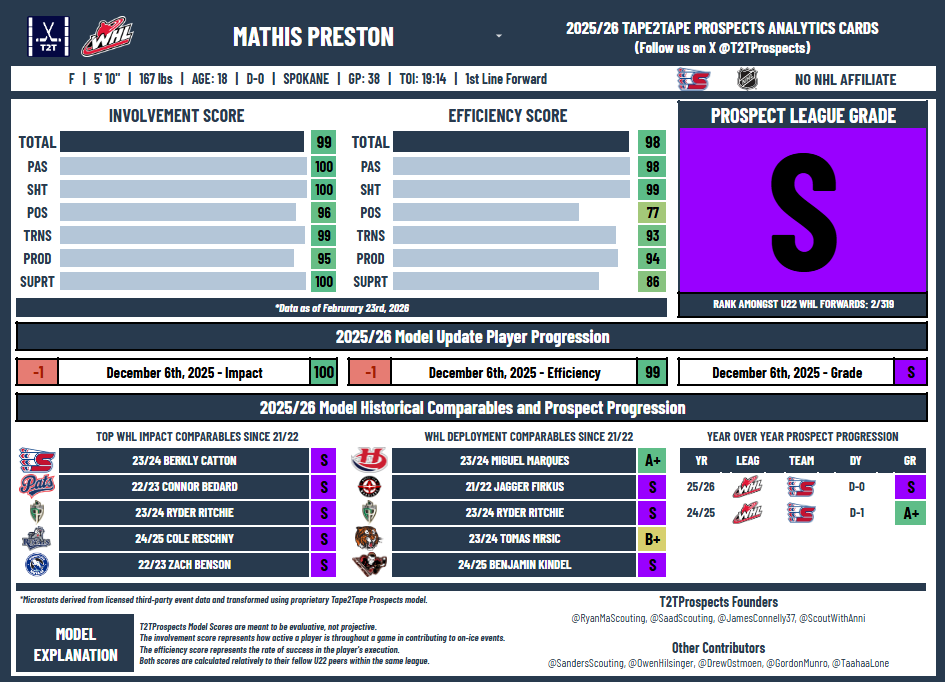
Games Tracked:
04/27/26 vs Finland U18
03/20/26 vs Kamloops
01/02/26 vs Vancouver
ELEVATOR PITCH
Mathis Preston is a dynamic, pace-driven offensive forward whose explosive skating, transition ability, and high-end playmaking vision give him legitimate top-six upside. While the flashes of creativity and offensive talent are outstanding, his projection will ultimately depend on whether he can attack the middle of the ice more consistently, refind that standout motor, and round out the details of his game to turn those flashes into a coherent package that constantly makes an impact.
Mathis Preston remains one of the more intriguing offensive players in this class because the skating, vision, and playmaking creativity are all legitimate weapons, but I’m still waiting for the complete package to show up consistently from shift to shift. The flashes can be outstanding. There are moments where he looks capable of driving transition, creating offense through pace, and finding passing lanes that most players simply don’t see. The issue is that those moments often feel disconnected rather than part of a consistently dominant performance.
Preston’s game starts with his skating. He’s a very good mover who generates speed quickly and can explode from a standstill with the puck. That acceleration makes him dangerous in transition, particularly when he has open ice to attack. Unlike some smaller forwards who rely heavily on east-west deception, Preston is much more of a north-south attacker. He wants to get play moving forward and can overwhelm defenders simply by building speed and forcing them onto their heels. There are stop-ups and curl-backs in his game, but his offensive identity is built around pace more than manipulation.
That pace translates well away from the puck too. He consistently finds opportunities to drive the net through intelligent routes and can arrive in dangerous areas with speed. His off-puck movement is one of the more underrated aspects of his game. Whether attacking off the rush or working through the cycle, he does a good job identifying soft ice and presenting himself as an option.
The passing ability is what elevates his offensive ceiling. Preston is an exceptionally talented distributor who consistently looks to funnel pucks into dangerous areas. His pre-scanning habits are noticeable, and he frequently knows where his next play is going before the puck arrives. There were multiple examples of no-look passes, quick-touch feeds, and creative slot passes that generated quality opportunities even when his teammates failed to finish. Around the net, he can be particularly deceptive, using subtle fakes, behind-the-back passes, and quick turns to create openings.
The concern is that he doesn’t always leverage those strengths aggressively enough. Too often, Preston defaults to firing pucks from the perimeter rather than attacking between the circles. He has become a little too comfortable settling for shots from the flank when there are opportunities to continue pushing into the middle of the ice. While his release can be effective, especially when using speed off the rush, I’d like to see him challenge defenders more consistently and force them into difficult decisions closer to the net.
The motor is another area where I came away wanting more. Earlier in his development, the second and third efforts felt more consistent. Those flashes still exist, there were shifts where he tied up defenders on the forecheck, won board battles against larger opponents, and created possessions through pure competitiveness, but they just don’t appear as frequently as I’d like now. The effort level isn’t poor persay, but it isn’t consistently driving his impact either.
Defensively, Preston is adequate. He generally gets to his spots and isn’t a major liability, but he doesn’t consistently come low to support breakouts and can occasionally lose track of assignments away from the puck. His defensive game feels like it’s an area that should be a priority of improvement.
Overall, Preston is a fun, pace-driven offensive player whose skating and passing ability give him legitimate upside. The vision, creativity, and transition game are all NHL-caliber traits. The challenge moving forward is putting those tools together consistently, attacking the middle of the ice more often, and bringing a more reliable motor on a nightly basis. At his size, the details matter, but if he can get those details right…. oh baby there’s a player here.
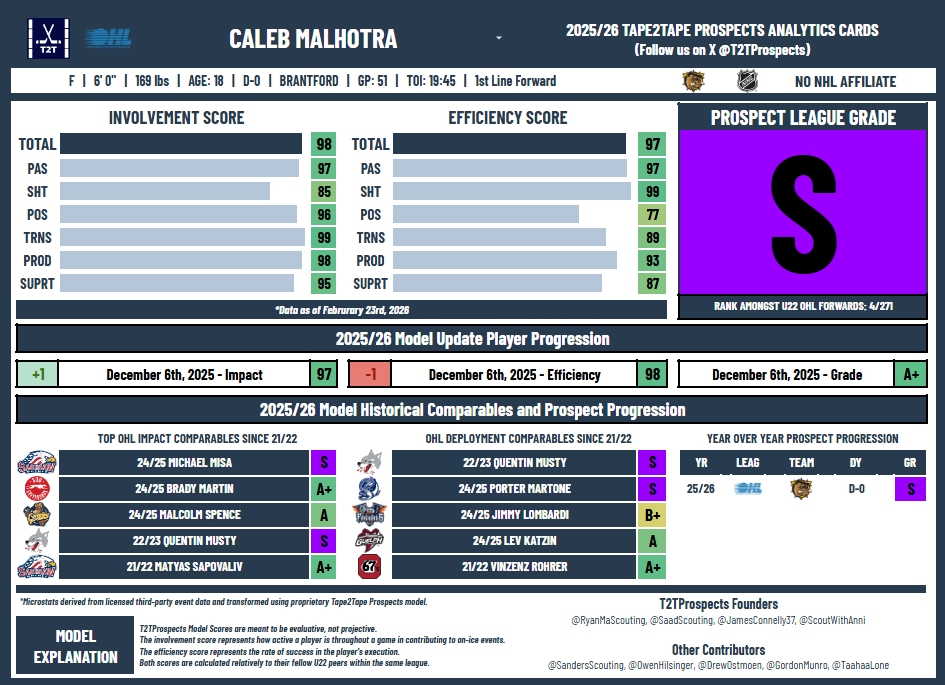
#13 - Caleb Malhotra - Brantford Bulldogs - C - OHL
Games Tracked:
04/30/26 vs Barrie (Playoffs)
03/29/26 vs Sudbury (Playoffs)
02/25/26 vs Brampton
ELEVATOR PITCH
Caleb Malhotra is a skilled, creative two-way centre whose combination of puck skill, offensive vision, and hard skill gives him legitimate upside, but whose projection is complicated by inconsistent puck management and decision-making. While the flashes of a play-driving center are evident, he too often undermines his own effectiveness with unnecessary turnovers and inconsistent off-puck engagement, making him look more like a complementary middle-six pivot than the high-end two-way cornerstone some project him to be.
This is a ranking I know a lot of people will have issues with, and while Caleb Malhotra has plenty of traits that I like, I do wonder how much of his late season hype has been a product of his environment that have helped him look better in a draft class where the other centers have their doubters for one reason or another.
Caleb Malhotra is one of the more polarizing evaluations in this class because the flashes of skill, creativity, and two-way engagement are easy to see, but the consistency of his decision-making and puck management leave me with more questions than answers at times. There are shifts where he looks like a legitimate play-driving centre capable of impacting all three zones, and others where he creates as many problems for his team as he solves.
Offensively, Malhotra has some legitimate tools to work with. He possesses good hands, solid puck dexterity, and is at his best playing off the rush with momentum in straight lines. When he has confidence, he’ll slice through traffic and can pull off some genuinely impressive sequences. There were flashes of advanced vision, including a clever behind-the-back pass to a diving defenseman following a turnover, as well as a number of connective plays that helped maintain offensive-zone possession. He also showed the ability to cut inside off the rush and create his own shooting opportunities rather than simply deferring to teammates.
The issue is that his offensive confidence frequently crosses into carelessness. Far too many of his turnovers stem from trying to do one move too many or holding onto the puck into traffic blindly. There were multiple examples of Malhotra attempting to skate laterally across the blue line through traffic only to immediately get bodied or lose possession. Whether it was trying to slip pucks through double teams in the neutral zone or carrying pucks into pressure rather than moving it earlier, the decision-making was just never consistently there in my viewings. He has the confidence to attempt difficult plays, which is certainly a positive trait, and he’s begun looking for his own shot more down the stretch which has made him a more impactful player, but right now the maturity and discipline with the puck in his own end and neutral zone are a red flag for me.
His puck protection game is somewhat similar. There are moments where he looks strong and difficult to contain, maintaining possession through contact and using his body effectively to shield defenders before making a play. One sequence stood out where he absorbed pressure, protected the puck long enough to gain the zone, and distributed effectively to a winger. At the same time, his awareness under pressure can be inconsistent. He was caught from behind multiple times by backcheckers because he failed to recognize pressure early enough, leading to avoidable turnovers.
Away from the puck, Malhotra’s game is generally more encouraging. He consistently comes low to support teammates, works back through the middle of the ice, and shows a willingness to engage defensively. His motor can be impressive when he’s hunting pucks. He swarms defenders, competes on loose pucks, and uses an active stick to disrupt possession. There were several shifts where he looked like the most engaged player on the ice, including a notable reverse hit on a 50/50 puck that demonstrated both strength and competitiveness.
That said, the motor isn’t always consistent. When he’s the primary forechecker, he can be relentless, but when operating as the high forward or free safety in the structure, he can become way too passive. There were too many situations where he seemed content to observe developing plays rather than proactively coming down to cut plays off and turn the puck over. The same inconsistency shows up in his defensive technique, where he has a tendency to lean really low and reach at puck carriers rather than keeping his feet moving and maintaining body positioning.
Skating-wise, Malhotra is a project. I think his lofty skating projections come from his highlight straight-line rush plays. I don’t love his stop-start explosiveness or ability to rapidly change gears, and his east west moments rely heavily on his puck skills and strength. There’s enough mobility and skill to create offense, but he really needs a head of steam and struggles with momentum changes.
Ultimately, I think Malhotra is a good player, but I’m not entirely sold on the idea that he’s the high-end, play-driving two-way centre some project him to be. The flashes are certainly there, but the consistency isn’t. Right now, he looks more like a skilled complementary centre whose effectiveness will depend heavily on improved puck management, skating and finding a more reliable balance between creativity and efficiency.
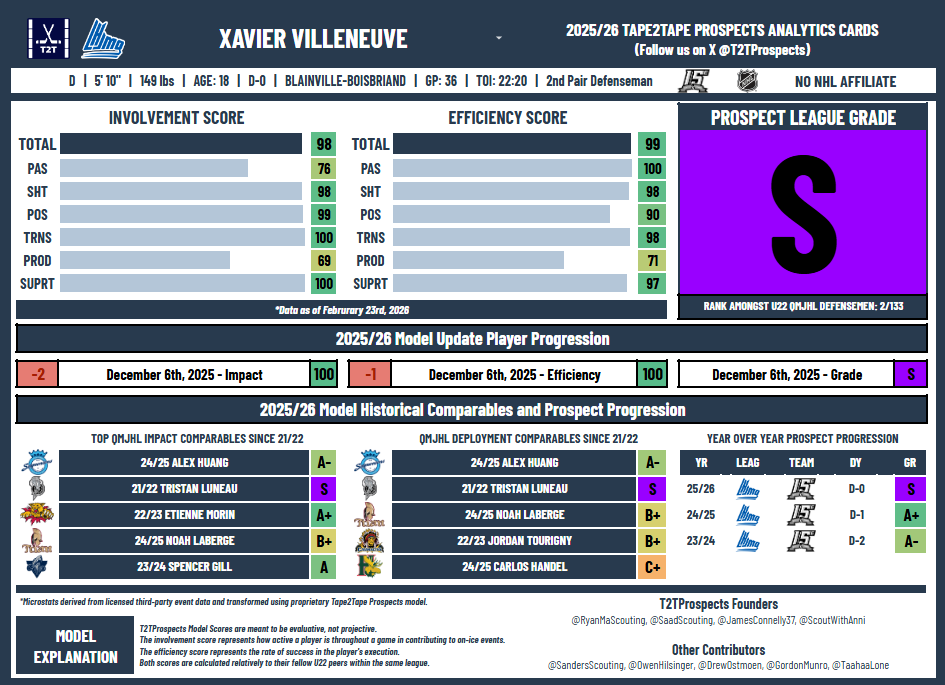
#14 - Xavier Villeneuve - Blainville-Boisbriand Armada - LD - QMJHL
Games Tracked:
05/01/26 vs Moncton (Playoffs)
04/10/26 vs Newfoundland (Playoffs)
03/20/26 vs Gatineau
ELEVATOR PITCH
Xavier Villeneuve is a highly mobile, offensively dynamic puck-moving defenseman whose elite skating and transition ability drive his game, but whose lack of physical strength and inconsistent defensive structure limit his reliability against heavier competition. While the offensive instincts and puck skill are legitimate, his projection will hinge on improved defensive details, added strength, and returning to full health to assuage concerns about his late-season form.
Xavier Villeneuve is a highly mobile, puck-moving left-shot defenseman whose game is built around skating ability, quick puck disruption, and offensive instincts from the blue line, but whose late-season defensive reliability and physical limitations raise real questions about his ability to handle heavier, more structured competition. When he is at his best, he looks like a modern, agile defender who can transition pucks efficiently and create offense through pace and deception. In the most recent viewings, however, his execution and defensive play look really rough. I had a gut feeling it was a hip or wrist (or both) issue and the player confirmed it was a hip at the combine.
The foundation of Villeneuve’s game is his skating. He is a fluid, high-end mover with excellent hips and the ability to close space aggressively in the neutral zone and at the blue line. He consistently relies on his feet to defend the rush, stepping up on puck carriers, attacking sticks early, and using quick lateral movement to disrupt entries. When timed correctly, this approach allows him to eliminate plays before they develop and immediately transition play the other way. His mobility also allows him to recover when he does get beat, which is a key part of his defensive profile.
His puck disruption style is heavily reliant on stick detail rather than physical engagement. He uses quick pokes and active hands to separate attackers from the puck and immediately move it into support lanes. However, there is virtually no physical presence in his game. He does not engage through contact, does not tie up sticks effectively in net-front situations, and can be exposed when opponents generate sustained pressure down low. In those scenarios, particularly in cycle-heavy shifts, his lack of strength and engagement becomes very apparent. It’s not for a lack of trying. he’s just not strong enough to hang at the moment.
Defensively in-zone, Villeneuve’s game is inconsistent. There are moments where he looks aware and reactive, keeping his head on a swivel and attempting to track threats, but this often looks more like panic than structured reads. His feet can stop moving in dangerous areas, particularly in the slot, which leads to lost assignments and coverage breakdowns. There were also examples where he failed to properly manage backdoor threats, including a 2-on-1 situation where he committed to the pass but failed to actually eliminate it, resulting in a goal against.
Offensively, Villeneuve shows real skill and creativity. He is comfortable walking the blue line, manipulating defenders with small fakes, and generating passing lanes through movement and deception… there’s a slight twitchy energy to him on the puck at times and it makes it difficult for defenders to mirror him when he’s feeling it. He has a knack for quick, decisive puck movement in the offensive zone, often delivering no-look or pre-read passes to the wing or into the slot. His transition game is also a strength, he can exit the zone quickly under pressure and immediately turn defense into offense through clean first passes or controlled carries.
There are flashes of high-end offensive creativity, including a slick behind-the-back drop pass off the rush and moments where he confidently attacks inside with pace. However, in late-season viewings, his puck handling looked less secure than earlier impressions. There were more mishandles and turnovers than expected, and his overall shifty edgework and change-of-pace ability did not appear as sharp. I’ll chalk it up to the hip issue but I’m very intrigued to see how he will adjust with a fully healthy season at BU.
Ultimately, Villeneuve is a high-mobility, skill-driven defenseman who can drive transition and contribute offensively, but his defensive structure, physical limitations, and late-season inconsistency present real concerns. If the skating and puck skill remain elite, he has clear upside as a puck-moving defender, but his ability to defend heavier minutes at higher levels will depend on improving his defensive details and strength.
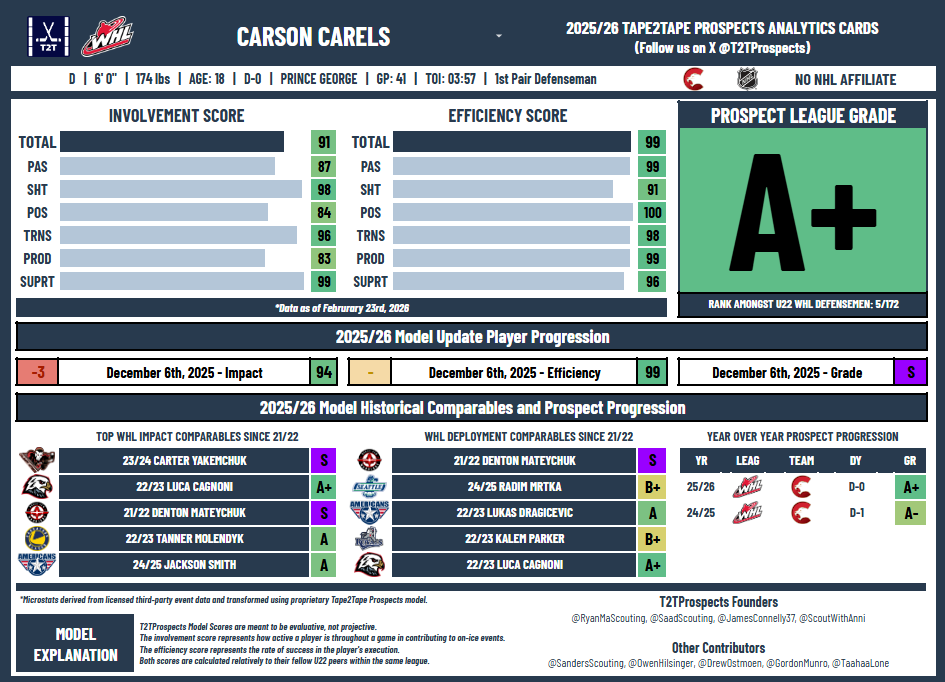
#15 - Carson Carels - Prince George Cougars - LD - WHL
Games Tracked:
04/11/26 vs Penticton (Playoffs)
03/13/26 vs Wenatchee
02/07/26 vs Kelowna
ELEVATOR PITCH
Carson Carels is a mobile, physical, left-shot defenseman with clear transition ability and some offensive activation upside, but questions about how his straightline offensive approach will translate, retrieval habits, and decision-making under pressure remain inconsistent. While the tools suggest legitimate top-four potential, his projection will depend on improving his on-ice awareness, simplifying puck management, tightening his overall execution in his own zone and whether his straigth line style of offense will translate.
Carson Carels projects as a mobile, physical, left-shot defenseman whose game shows real moments of effectiveness in transition and offensive activation, but whose defensive structure, puck management habits, and decision-making consistency still need refinement. There are the tools here that suggest Top 4 upside, but he’s going to have to learn to simplify his reads and tighten his execution under pressure.
Defensively, Carels is a mixed evaluation. On one hand, his mobility is good enough to handle rush defending at the WHL level. He can match speed through the neutral zone, maintain gaps, and use his skating to steer attackers toward the boards where he can lean on them and finish plays physically. When he’s set in structure, he has enough size and base strength to compete in board battles and wedge opponents off pucks effectively. There are plays where he also looks comfortable closing space and making life difficult on entries.
However, there are also clear concerns about structure and spatial awareness in his own zone. At times, he appears overly roamy and disconnected from defensive assignments, drifting out of position. That leads to moments where he looks a step behind plays developing around the net or in scramble situations. His retrieval habits were also not my favourite, he shows a really strong preference for backskating and delaying retrievals, sometimes to his own detriment. Rather than flipping his hips early and attacking loose pucks efficiently, he will just keep back skating, which can allow forecheckers to eiher get to the puck first or close in and pressure him into rushed decisions.
However, Carels is capable of making clean, direct passes when he is facing up ice. He can move the puck efficiently through layers of sticks, hit cross-ice outlets, and keep play moving north with reasonable pace. He also shows some willingness to activate offensively, jumping into plays as a trailer and getting pucks through to the net from the point and high slot. There is a clear intent to contribute offensively, and at this level, even with the wire crossing and mixed decision making, he is able to do so effectively.
The problem is consistency and scanning habits. There were multiple instances where he attempted to force plays up ice into pressure when safer, higher-percentage options were available, including a particularly poor read where he flipped a puck directly into a forechecker despite his defense partner being open behind the net. These types of decisions suggest his on ice awareness still need some development.
Offensively, Carels shows some encouraging traits. He has enough explosiveness to gain separation in straight lines, and there were sequences where he used his frame and acceleration to push into space, absorb contact, and drive toward the slot. He is not a particularly elusive defenseman, but he can generate offense through directness and strength rather than deception. I do have real questions on whether he’ll be able to do this in the AHL and NHL against bigger, faster and stronger players. Defenders that produce this way generally don’t translate that skillset super well at the next level. When he does make aggressive pinches or step up on loose pucks, he can extend possessions and create second-chance offensive zone time.
His puck distribution is generally clean when he is not under immediate pressure. He prefers simple, crisp passes and can move the puck efficiently in structured situations. However, when forced into lateral movement or improvisation, his execution drops noticeably, and he occasionally attempts riskier, low-percentage plays rather than defaulting to the simpler outlet.
Overall, Carels is a toolsy, mobile defenseman with legitimate transition ability and some offensive upside when he joins the rush or activates in-zone. The key concern is defensive structure and decision-making under pressure. If he can improve his scanning habits, and become more efficient on retrievals, there is a pathway to him becoming a minute munching two-way Top 4 Defenseman. Right now, the flashes of offensive tools and physicality are there in abundance but he needs to iron out the details, learn to flip his hips and find ways to create offense in a more translatable way.
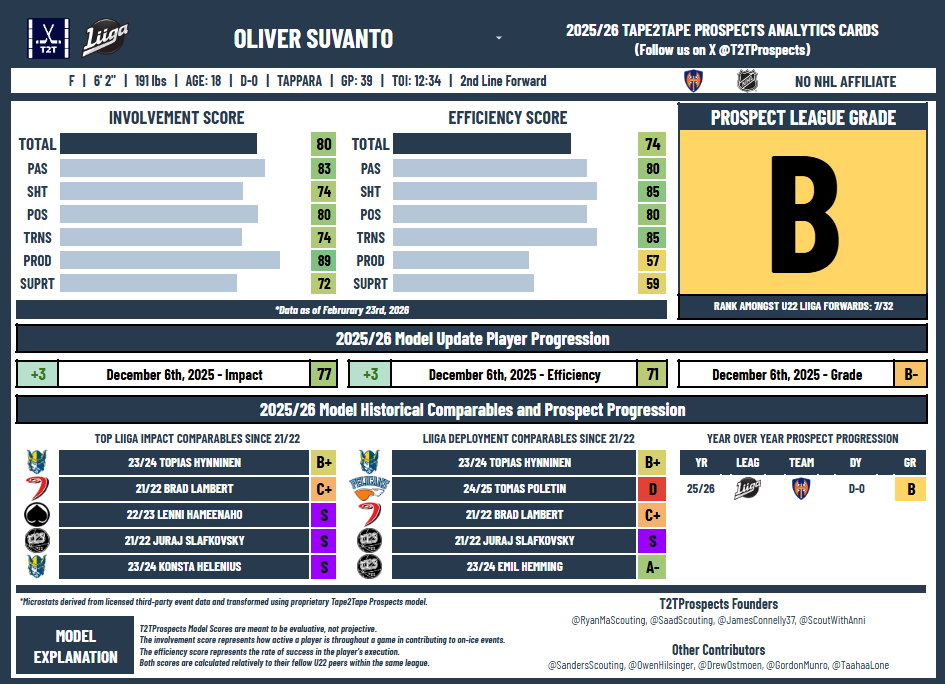
#16 - Oliver Suvanto - Tappara - C - Liiga
Games Tracked:
03/24/26 vs Porin Assat U20 (Playoffs)
02/27/26 vs KalPa
01/27/26 vs Mikkelin Jukurit
ELEVATOR PITCH
Oliver Suvanto is a high-motor, detail-oriented forward whose game translates through work rate, defensive reliability, and strong off-puck positioning, making him a coach-friendly complementary piece. While his habits and intelligence give him a solid floor as a potential middle-six centre, his limited offensive assertiveness and lack of consistent creation leave questions about whether he can evolve beyond a supporting role.
Oliver Suvanto projects as the type of player coaches are going to love because of how reliable, competitive, and detail-oriented his game is, but there are legitimate questions about how much offensive upside exists beyond a complementary role. He does a lot of little things well, consistently puts himself in the right spots, and plays with a motor that allows him to impact games without necessarily being the focal point of the offense.
The defining characteristic of Suvanto’s game is his work rate. He consistently stays involved in plays, hunts pucks effectively, and doesn’t give up on possessions. On the forecheck, he does a good job closing space, finishing his routes, and forcing defenders into uncomfortable situations along the boards. He isn’t overwhelming physically, but he’s competitive and persistent enough to wear opponents down over the course of a shift. That same mentality shows up in the cycle game, where he’s willing to do the dirty work required to keep possessions alive.
What stood out most was how often he found ways to arrive around loose pucks. Suvanto reads developing plays well and has a knack for jumping onto second-touch opportunities before defenders can react. Combined with his motor, it allows him to remain involved offensively even when he isn’t directly driving possession himself.
Off the puck, he may actually be at his best. Suvanto is a very intelligent mover who consistently identifies open ice and presents himself as an option in dangerous areas. He understands timing and spacing, finding ways to arrive in support rather than simply standing and waiting for the puck. There were several instances where he quietly slipped into high-danger areas and made himself available for teammates without drawing much attention beforehand. Those habits should continue to translate as he climbs levels.
With the puck, however, the limitations become more apparent. Suvanto has enough skill to make plays, but he isn’t someone who consistently creates offense through individual puck touches. The hands are functional, the passing is actually fairly solid, and he generally looks to move pucks toward the middle of the ice whenever possible. He showed a few flashes, including a nice play where he came out of the corner, split defenders, and attacked into the slot. Unfortunately, those moments were relatively infrequent compared to the amount of time he spent playing a supporting role.
The skating falls into a similar category. It’s smooth and efficient, but not particularly dynamic. He can find another gear when necessary and has enough mobility to keep up with play, but he isn’t going to generate consistent offense through pure speed or separation.
Defensively, Suvanto is one of the safer bets in the class. He backchecks hard, stays connected to the play, closes out effectively on puck carriers, and generally understands his responsibilities. He doesn’t cheat for offense, doesn’t blow the zone early, and consistently works within the structure of his team. Physically, he also showed he can hold his own against men and maintain possession through contact, which is encouraging for his projection.
The biggest concern is whether there’s enough offensive upside to justify a significant NHL role. The lack of production during the U20 playoffs raises some real questions, and I’d like to see him become more aggressive looking for his own scoring opportunities rather than constantly deferring. He simply doesn’t shoot enough for a player who gets himself into decent areas.
Overall, Suvanto looks like a high-motor, potential middle six complementary centre with strong off-puck intelligence and reliable two-way habits. The floor feels relatively safe because of the effort level, hockey sense, and defensive detail, but unless the offensive assertiveness takes a meaningful step forward, he projects more as a supporting piece than a true driver of offense.
#17 - Adam Novotny - Saginaw Spirit - F - OHL
Games Tracked:
03/31/26 vs North Bay (Playoffs)
03/01/26 vs Flint
02/05/26 vs Owen Sound
ELEVATOR PITCH
Adam Novotny is a physically imposing, net-front oriented forward whose forechecking pressure, puck protection ability, and offensive flashes around the crease give him legitimate NHL projection, but whose inconsistent engagement and uneven puck skill execution leave questions about how much true offensive impact he can drive. He looks like a strong complementary power forward at higher levels, with his ultimate ceiling tied to whether his consistency and puck creation can catch up to his physical toolkit.
Adam Novotny is a somewhat tricky player to rank because the raw tools, frame, and flashes of offensive intelligence are all there, yet the overall impact doesn’t always match what you’d expect from a player with his pedigree playing in the OHL. There are stretches where he looks like one of the best players on the ice, bullying defenders on the forecheck and making skilled plays in dangerous areas. There are others where he blends into the background more than you’d like, leaving you wondering whether there’s another level he simply hasn’t needed to access consistently.
Novotny’s game is built around his combination of size, strength, and puck-winning ability. When he’s engaged, he can be an absolute nightmare to handle on the forecheck. He gets in quickly, tracks pucks effectively, and uses both his frame and stick well to separate defenders from possession. Alongside linemates who also pressure aggressively, there were shifts where opposing defenders simply couldn’t establish clean breakouts because of the constant pressure he applied. He has the physical tools to overwhelm junior competition when he fully commits to that style.
Offensively, Novotny does some of his best work around the net. What stood out most was his patience in scoring areas. Rather than blindly jamming pucks into pads, he often takes an extra second to assess his options, using his hands and body control to maneuver pucks into better shooting positions. He has the confidence to handle pucks in tight spaces, sift pucks through defenders on goal, or extend plays behind the net when direct routes aren’t available. There’s a level of poise around the crease that allows him to generate offense without relying solely on shot volume.
As a passer, Novotny generally looks to attack dangerous areas. He consistently searches for slot passes and cross-ice opportunities, particularly off the rush where he can hit driving teammates with well-weighted feeds through pressure. However, while the intent is positive, the execution isn’t always particularly deceptive. He prefers playing a more patient style rather than being a quick-processing creator, often holding onto the puck looking for an opening rather than beating defenders with quick decisions.
The biggest question in his projection is how much offensive creation he will be able to drive at higher levels. While he flashes skill and creativity, the on-puck game still feels like a work in progress. He’ll attempt difficult plays through defenders in transition, cut inside at the blue line, or try to beat pressure with his hands, but the success rate is inconsistent. Under pressure, his puck skills can look average, and there were multiple instances where he attempted skill plays through defenders only to turn possession over. He tries things, which is encouraging, but he doesn’t consistently execute them.
Away from the puck, Novotny is generally solid defensively. He closes out on opponents well, gets low to take away shooting lanes, and understands where he needs to be in coverage. His skating is also good enough to support his overall game. He moves well for a player of his size and strength, though he isn’t the type of explosive skater who generates offense purely through pace or separation speed.
The one area where I’d like to see more consistency is his engagement level away from the puck, particularly on the backcheck. There were stretches where the effort level felt average relative to what he’s capable of bringing physically and competitively.
Overall, Novotny projects as a strong, intelligent power forward who can play a complementary offensive role while contributing through forechecking pressure, net-front play, and physical engagement. The tools are there for an NHL player, but whether he becomes a true impact piece in an NHL Top 6 or more of a supporting option will likely depend on how much offensive creation he can consistently generate against better competition.
#18 - Ethan Belchetz - Windsor Spitfires - LW - OHL
Games Tracked:
02/20/26 vs Kitchener
01/17/26 vs Brampton
12/11/25 vs Peterborough
ELEVATOR PITCH
Ethan Belchetz is a physically mature, detail-oriented winger whose value comes through support play, puck retrievals, and board work rather than true play-driving ability, with a toolkit built around size, strength, and small-area puck skill. While the frame, hands, and hockey sense make him a reliable complementary piece, his inconsistent pace and physical engagement limit his projection as more of a supporting middle-six winger unless he becomes more consistently assertive.
Ethan Belchetz is a physically mature winger whose value comes primarily through support play, puck retrievals, and complementary offensive habits rather than dynamic puck carrying or play creation. There are some projectable tools here (the frame, strength, forechecking intelligence, puck skills,and ability to play through contact) but I was left wanting more pace and overall involvement from a player with his physical profile.
The first thing that stands out is the build. Belchetz is solidly put together and has the size and strength to be difficult to handle along the boards when he chooses to engage physically. He protects pucks well on the wall, using his frame to shield possession and create time for teammates to support underneath. When he gets established in board battles, he can absorb contact, maintain possession, and bump pucks into advantageous areas to extend offensive-zone time.
His game is at its best when his feet are moving. Belchetz does a good job supporting breakouts by coming low into the defensive zone, presenting outlets, and helping move possession up ice. He consistently identifies good lanes both on the forecheck and defensively, showing an understanding of how to cut off puck carriers and steer play toward less dangerous areas. He isn’t an overwhelming forechecker physically, but his routes are intelligent and generally put him in positions to influence possession.
Offensively, he functions well as a support player. His hands are really quite good for a player of his size, particularly in small-area situations. He does a nice job picking up loose pucks along the boards, recovering possession from scrums, and making short plays around pressure. From below the goal line, he can distribute pucks into the slot and create secondary offensive opportunities. There are also moments where his combination of size and touch allows him to handle pucks through contact and maintain possession despite pressure arriving.
When he has open ice to attack, Belchetz can be effective. He skates well enough and is capable of building momentum through the neutral zone, using his length to push pucks around defenders and chase them down. In those downhill situations, he becomes much more difficult to contain. The problem is that he doesn’t consistently play with that pace. Too often after gaining the offensive blue line, he slows the play down rather than continuing to pressure defenders with his skating. There were numerous instances where he appeared to have an opportunity to attack space but instead allowed defenders to reset.
The physicality is also somewhat inconsistent. Given his frame, you’d like to see a player who regularly imposes himself on opponents, but that aspect of his game comes and goes. There are shifts where he’ll finish checks, pin players along the wall, and use his strength effectively. There are others where he arrives physically but fails to actually separate opponents from the puck. The body engagement is there, but the stick work and finishing detail often lag behind.
Defensively, there are some concerns. His effort level when backchecking is generally solid, and he can use his size and skating to recover effectively. However, outside of those situations, his defensive habits are less reliable. He has a tendency to trigger too aggressively toward puck carriers in the neutral zone or stop moving his feet altogether, relying on reaches and poke attempts instead of maintaining proper positioning. Better players routinely exploit those habits, stepping around his stick and creating separation.
Overall, Belchetz projects as a complementary winger whose best qualities emerge when he keeps the game simple, plays with pace, and leverages his frame. The intelligence, support habits, and physical tools are all present, but there is another level of impact available if he becomes more consistently engaged physically and learns to maintain pace through offensive possessions rather than slowing them down. Right now, he looks more like a useful supporting piece than a player who actively drives play himself.
#19 - Juho Piiparinen - Tappara - RD - Liiga
Games Tracked:
04/24/26 vs Latvia U18
03/21/26 vs Porin Assat U20 (Playoffs)
01/31/26 vs HIFK Helsinki
ELEVATOR PITCH
Juho Piiparinen is a highly reliable, pro-ready defensive prospect whose value comes from mobility, composure, and consistently clean puck management rather than high-end offensive creation. He projects as a safe, all-situations, second-pairing type of defender who can stabilize play through smart positioning, efficient retrievals, and dependable transition work, even if his offensive ceiling remains limited.
Juho Piiparinen projects as one of the safer defensive prospects in this class. He may not possess the high-end offensive creativity or dynamic puck skills that typically drive excitement, but he consistently does the little things well and already plays a mature, professional style that should translate effectively as he climbs levels. Between the skating, defensive reliability, puck-moving ability, and overall poise, there is a very clear NHL foundation here.
Piiparinen’s game starts with his mobility and defensive habits. He’s a smooth, efficient skater who maintains tight gaps, closes space effectively, and consistently positions himself well to kill plays before they become dangerous. His defensive game is built more around anticipation, stick detail, and body positioning than pure physicality, but he competes hard and doesn’t shy away from contact. He uses his reach effectively to break up plays, poke pucks free, and redirect possession toward teammates, and he consistently arrives in good defensive positions to disrupt opposing attacks.
One area that stood out repeatedly was his work on retrievals. Piiparinen handles pressure extremely well for a young defender. Rather than rushing plays or allowing forecheckers to dictate his decisions, he uses his body intelligently to seal opponents away from pucks and create clean retrieval opportunities. There were several sequences where he simply muscled attackers off of him, protected the puck, and allowed either himself or his partner to exit the zone under control. He plays with a calmness that prevents games from speeding up on him.
With the puck, Piiparinen is confident without being overly ambitious. He moves pucks crisply, makes quick decisions, and is comfortable carrying possession out of danger when lanes present themselves. His transition game is particularly effective because he recognizes when to skate pucks himself and when to distribute early. There is very little panic in his puck management, and his overall execution is remarkably clean.
While he is generally a simple player offensively, there are flashes of aggression that add another layer to his game. He isn’t afraid to activate into plays, and some of his most impressive moments came when pinching down the wall and firing difficult passes through traffic into dangerous areas. There were a few particularly nice cross-crease feeds generated from offensive-zone activations that showed more offensive awareness than his raw production might suggest. He also owns a hard point shot that can generate rebounds and traffic opportunities.
What makes Piiparinen appealing is how complete and projectable the overall package feels. He was one of Finland’s most reliable defenders at the U18s, consistently carrying pucks out, jumpstarting exits, defending aggressively, and playing with a level of composure that stood out among his peers. He doesn’t have many glaring weaknesses, even if he also lacks a truly elite offensive trait.
The ceiling may not be particularly flashy. He doesn’t project as a power-play quarterback or a defenseman who will drive offense through pure skill. However, there is considerable value in a defender who skates well, kills plays, retrieves pucks efficiently, moves possession cleanly, and can be trusted in virtually every situation. Piiparinen profiles as the type of second-pairing, Swiss-army-knife defenseman who can complement almost any partner and help stabilize a pairing through intelligence and consistency.
Among this class, there may be defenders with higher ceilings, but there are very few who possess a higher floor. The combination of movement skills, poise, defensive reliability, and simple effectiveness gives Piiparinen one of the safer NHL projections available.
#20 - Jack Hextall - Youngstown Phantoms - F - USHL
Games Tracked:
04/05/25 vs Chicago Steel
01/23/26 vs USNTDP U17
03/06/26 vs Madison Capitals
04/03/26 vs Cedar Rapids RoughRiders
ELEVATOR PITCH
Jack Hextall is a high-motor, forechecking-driven winger whose relentless effort, reach, and physical engagement make him a disruptive presence in all three zones, with enough puck skill flashes to suggest more offensive upside than a pure energy role. While his pace, anticipation, and competitiveness translate well to higher levels, his projection will hinge on improving decision-making and playmaking consistency to complement his otherwise effort-heavy, pressure-based game.
Jack Hextall was outstanding this year for Youngstown after his D-1 tape already had me a believer.
To start, Hextall has strong fundamental skating. It’s not a super explosive skating profile, but he moves well enough to keep pace with play and consistently arrives where he needs to be. What separates him is how engaged he is every shift. There were multiple sequences where he created offensive-zone possession almost entirely through sheer effort and anticipation.
On one early forecheck, he started net front before lunging into a passing lane and deflecting a defenseman’s breakout attempt. After a teammate recovered the puck and fed it back to him near the goal line, Hextall attempted a creative no-look backhand feed into the slot. The pass didn’t connect, but he immediately continued pressuring the defender into the corner, used his reach to poke the puck loose again, and helped recover possession for his team.
That sequence pretty much summarizes his game. Hextall is relentless. He pressures constantly, works hard on the backcheck, and consistently disrupts plays through effort, stick detail, and anticipation. He uses his lanky reach exceptionally well both on the forecheck and defensively, where he was able to break up potential slot chances and force opponents into uncomfortable decisions.
The physicality and puck protection are major strengths as well. Hextall consistently wins board battles, protects pucks effectively in the cycle, and works hard to establish positioning around the net front. He doesn’t shy away from contact and often uses his frame surprisingly well to extend possessions and wear down defenders. That willingness to attack inside has become a bigger part of his game recently. One of the most encouraging developments has been his increased assertiveness with the puck. Rather than simply facilitating possession and deferring to teammates, he’s doing a better job attacking dangerous areas himself and looking for opportunities between the dots.
There’s also nice flashes of puck skills here, settling difficult aerial passes cleanly through the neutral zone, net drives, slick no-look drop pass, some nice creativity like slipping a loose puck through an opponent’s skates before driving toward the slot. He has an array of toe drags and some decent east to west movement that suggests maybe there’s more than just your typical motor first energy guy.
I still have some questions about the playmaking. There are moments where he’ll make an excellent pass, like a feed off a turnover to an activating defenseman, but he also has a tendency to force difficult plays that don’t need to be attempted. He often comes low to support his defensemen and then tries these ambitious cross-ice stretch passes that get intercepted or miss their target entirely. The vision is there, but the execution and risk management still need refinement.
Overall, Hextall has one of the more intriguing toolkits in this age group. The motor is relentless, the forechecking impact is legitimate, the physicality is NHL-style, and the flashes of skill continue to become more frequent. The increased confidence with the puck and willingness to attack the slot area have elevated his offensive impact without sacrificing the effort-based identity that makes him effective. If he can continue refining the playmaking and improve the consistency of his offensive decisions, there’s a very interesting middle-six projection here built around pace, pressure, and competitiveness.
#21 - William Hakansson - Lulea HF - LD - SHL
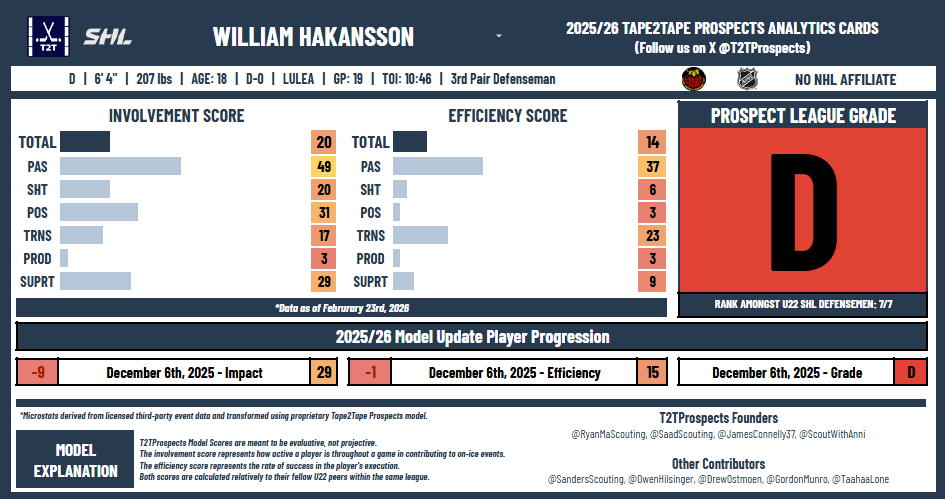
Games Tracked:
04/16/26 vs Slovakia U20
03/11/26 vs IK Oskarshamn (Playoffs)
01/26/26 vs Kalmar HC
ELEVATOR PITCH
William Hakansson is a mobile, rangy two-way defenseman whose skating, reach, and aggressive neutral-zone defending give him a clear translatable skillset, but whose puck management under pressure and occasional overcommitment limit his current reliability. If he can improve his composure on retrievals and refine when to step up versus when to back off, he projects as a potential useful, minute munching Top 4 defenseman.
William Hakansson profiles as a mobile, rangy left-shot defenseman whose skating and aggressiveness in the neutral zone give him a clear NHL projection, but whose puck security under pressure and decision-making consistency still need refinement before he can be trusted in higher-leverage minutes.
The skating is the most projectable part of his game. Hakansson moves well for a defenseman, with strong range both laterally and in straight-line recoveries. He shows the ability to close gaps quickly and get on top of opposing rushes, and he’s confident stepping up in the neutral zone to challenge puck carriers early. That aggressive posture is a defining feature of his defensive identity; he trusts his mobility to recover, and at times that confidence pays off with controlled entries denied before they develop. However, that same aggressiveness can occasionally pull him out of structure when he overcommits to the puck carrier, opening seams behind him when opponents are able to beat the first layer of pressure he brings.
Defensively, he plays with an active stick and good reach, which allows him to disrupt entries and contain players along the perimeter. He is not passive in his play, there’s a clear willingness to engage physically along the boards and finish plays through contact. When he’s properly timed, he can be effective pinning players or forcing puck retrievals into uncomfortable areas. That said, he does lose some physical battles along the wall, particularly when he arrives slightly off-angle or when he gets pinned before establishing leverage.
One of the recurring issues in his game is puck management under forechecking pressure. There were multiple instances where Hakansson skated himself into trouble by holding onto pucks too long without an escape route, ultimately retreating into lower-danger areas like the corner without making a clean play up the boards. When pressured in the neutral zone, he can become uncomfortable handling pucks in traffic and will default quickly to simple outlets rather than attempting to play through pressure. That limitation reduces his effectiveness as a transition driver.
That said, when he does get time and space, his puck movement is efficient. He plays quick up the boards, moves the puck crisply, and can execute simple breakout passes effectively. There are also flashes of more advanced offensive reads, particularly after controlled entries where he has delivered a few clean cross-ice passes from his off side on the forehand. Those moments suggest there is some secondary puck-moving ability if he can improve his composure under pressure.
Offensively, Hakansson is not particularly flashy, but he does show some willingness to engage and be active in the offensive zone. He will occasionally hold the puck rather than immediately defaulting to low-percentage shots, and he has a hard wrist shot that can get through traffic. His offensive activation is situational rather than constant. He will jump into plays at times, but it is not a consistent feature of his game.
There were also a few overzealous defensive reads where he shaded too aggressively toward the strong side, leaving weak-side space exposed, but these feel more like timing and experience issues rather than fundamental processing flaws. Overall, outside of a few moments where he was pulled out of structure or lost physical positioning, he largely held his own in SHL minutes without looking overwhelmed.
In summary, Hakansson projects as a mobile, aggressive two-way defender with clear translatable skating and defensive range. His path forward will depend on improving puck security under pressure, refining his decision-making when exiting the zone, and learning when to temper his aggressiveness in the neutral zone to maintain defesnive structure.
#22 – Jonas Lagerberg Hoen – Leksands IF U20 – RW – U20 Nationell
Games Tracked:
09/20/25 vs AIK U20
09/28/25 vs Skelletfea U20
09/27/25 vs Lulea U20
ELEVATOR PITCH
Jonas Lagerberg Hoen is a powerful, high-motor winger who combines explosive skating, strong puck protection, relentless puck pursuit, and a dangerous shot to consistently create offense off the rush while also showing encouraging defensive habits and competitiveness. Although his playmaking, off-puck offensive reads, and occasional tendency to cheat for transition offense still need refinement, his blend of size, speed, skill, work ethic, and physical edge gives him intriguing upside reminiscent of a young Valeri Nichushkin.
I think if this kid had a fully healthy season, there’d be way more shouts for him to go in the first round from public sites. I’ve seen a healthy amount of Lagerberg Hoen love of late. Notably, my friend and co-founder at T2TProspects, David Saad (@SaadScouting), has the Leksands forward ranked in his Top 40 as well and James (@JamesConnelly37) and I pushed hard for him for the Dobber Prospects Final Rankings.
JLH (yes, I’m too lazy to type out his full name) is so so fun as a player. At 6’2”, he flies on the screen with powerful strides and really makes some nice plays off the rush with the puck, tucking it through defenders’ triangles, attacking inside, using his legs to shield the puck as he cuts to the net. He’ll go on end-to-end rushes with the puck, with each rush posing a potential threat for him to lower the shoulder and beat you wide to the net. He showcased that REALLY nicely on both of his goals against Lulea U20, where he used his straight-up pace to beat the defender wide on one goal, and won a race to a puck on the second.
There’s some real grit and grind to his game as well, a play I remember against AIK U20 where he dove into the crease and bowled a defender over in an attempt to get to a loose puck.
In the offensive zone, I was really impressed with his ability to protect the puck along the halfwall, absorbing pressure and making the right play. He’s relentless on the puck, even when upended or forced off balance, he uses his reach to cycle the puck down low or get it back to his defenseman to keep the play alive.
The effort level extends to 50/50 plays as well. JLH uses his reach and skating super well to get to loose pucks, forcing defensemen to rim the puck behind the net, where his teammates can rally to win it back.
Defensively, lots of head scanning while defending the weak side instead of watching the puck, which is REALLY encouraging. He also shoots out of a cannon to close out on perimeter shooters, overwhelming them with his long reach and forcing turnovers or a punt into a 50/50 puck battle.
Very good shot as well, that he places with great accuracy and has some nice whip and power behind it. He had two absolute rockets against Skelleftea U20 in the same period on his offside that beat the goalie clean.
He can at times look to blow the zone, and there was a turnover against AIK U20 where his teammate sauced a risky and bad lead pass to him, but he shot out wide to try and start the break instead of recognizing that the pass could be picked off and that he should come back towards the puck instead. As a result, he got caught when the forechecking forward picked the pass off and went the other way.
I think the playmaking is certainly still a work in progress; some improved touch and quicker decision-making would unlock another level to his game on the puck, which is already great as a self-creator and possession sustainer. I’d also like to see more hard drives to the net off the rush without the puck, which I think would add another dimension to his game.
Amazing raw tools, a high work ethic, with a nasty shot and some edge to go with it… even with the injury, and fully acknowledging that I’m doing a lot of projection with regards to his skillet translating at a pro level… I think there are shades of a Valeri Nichushkin-esque player here.
#23 - Casey Mutryn - USNTDP - F - USHL
Games Tracked:
03/28/25 vs Des Moines Buccaneers
02/22/26 vs Lindenwood
04/22/26 vs Czechia U18
ELEVATOR PITCH
Casey Mutryn is a high-energy, physically engaged right-shot centre whose game is driven by relentless pace, heavy forechecking, and a constant willingness to throw his body around, creating a disruptive presence in all three zones. While his skill flashes, puck protection, and off-puck awareness hint at more than a pure energy role, his overly frantic execution and inconsistent puck management suggest a projection as a reliable, physical middle-six forward unless he can learn to harness that energy into more consistent impact and decision making.
Casey Mutryn is just a really funny player. From his first shift, the vibe I got from the right-shot centre was pure, unadulterated, frenetic energy. Unless he was defending in-zone or lurking around the slot looking for a scoring chance, the guy was just go, go, go.
Mutryn flies around the ice hunting pucks, attacking defenders, and putting constant pressure on opponents. The difference between him and a lot of other high-motor forwards is that when he arrives, he arrives with bad intentions. He hits hard and isn’t shy about throwing his body around whenever an opportunity presents itself. He actively seeks contact, tries to build momentum off it, and brings an edge that coaches are going to love.
The passing remains somewhat hit-or-miss, but the vision is there. There are moments where he’ll fire beautiful cross-ice breakout passes onto a teammate’s tape in stride, but much like the rest of his game, everything is played at full throttle. Sometimes those passes come in a little too hot, leading to bobbled receptions or missed connections. Still, I came away appreciating that he wants to keep play moving quickly and push possession north whenever possible.
What stood out more in recent viewings was how much skill exists underneath the physicality. Mutryn’s hands are legitimately good. He showed flashes of creativity in the offensive zone, made several smart puck touches under pressure, and used his skill to create scoring opportunities rather than simply relying on straight-line speed and force. His puck protection ability also impressed me more than expected. He does a very good job using his frame to shield pucks and maintain possession, and there were several sequences where he manipulated defenders effectively before making the next play.
His off-puck game may actually be one of the strongest parts of his profile. Mutryn reads developing plays well, takes intelligent routes through the offensive zone, and consistently finds ways to make himself available in dangerous areas. For a player with his size and physicality, he has a surprisingly mature understanding of spacing. He also showed more willingness and effectiveness around the net front than I initially gave him credit for, battling for positioning, creating traffic, and making himself a legitimate option in scoring areas.
There are still areas that need refinement. The puck skill doesn’t always keep pace with the speed at which he wants to play, and there are moments where the execution simply falls apart because everything is happening at 100 miles per hour. His discipline can also become an issue when frustration creeps into his game, and he’ll need to learn how to better channel that physical edge.
That said, there are a lot of projectable traits here. Mutryn skates exceptionally well for his size, plays with relentless pace, embraces physicality, contributes defensively, and has more offensive skill than he initially gets credit for. Whether he ultimately tops out as a high-end checking forward or develops into a complementary top-six power winger, he feels like one of the safer projection bets in this class.
#24 - Ryan Lin - Vancouver Giants - RD - WHL
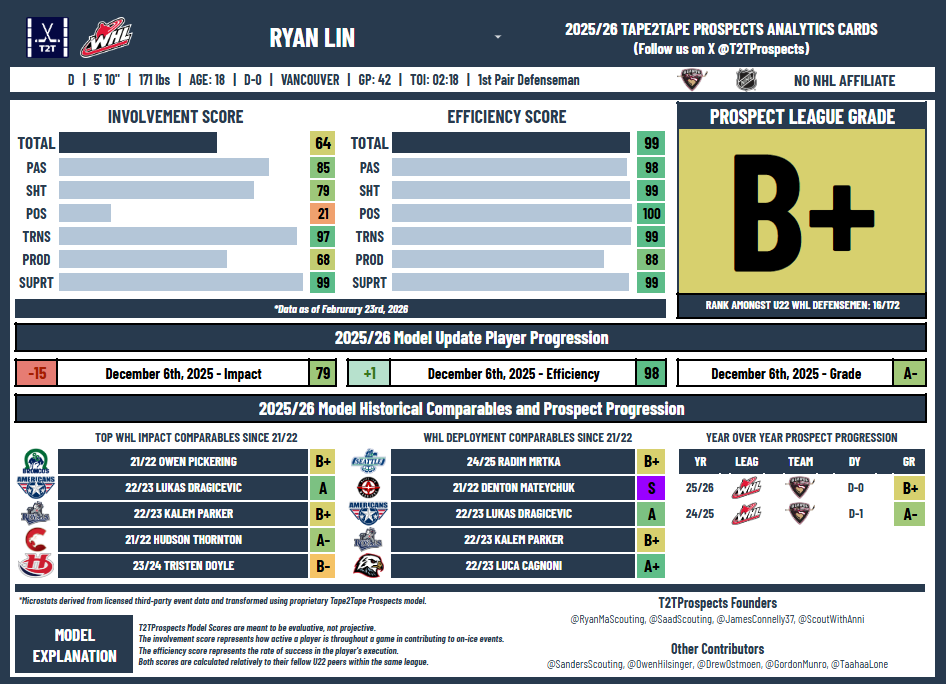
Games Tracked:
04/25/26 vs Norway U18
03/07/26 vs Kamloops
01/11/26 vs Wenatchee
ELEVATOR PITCH
Lin is a smart, modern transitional defenseman whose game is built around quick processing, efficient puck movement, clean zone exits, and intelligent offensive support, allowing him to consistently drive play despite lacking high-end skating explosiveness. While his backwards mobility, recovery defending, physical consistency, and willingness to sustain defensive engagements remain areas for improvement, his strong hockey sense, puck-moving ability, and projectable habits give him a solid long-term outlook, particularly in a strong development environment like Denver.
Lin is a player I’ve steadily grown to appreciate more throughout the season because while I don’t think there’s one singular dynamic tool that immediately jumps off the page, there’s a lot of quiet projectable translatable habits in his game that make me pretty optimistic about the long-term outlook. Add in the fact that he’s headed to University of Denver, which I think is a fantastic developmental environment and the fact he’s got a great first name, and I think this is a guy whose best hockey is ahead of him.
The biggest strength in Lin’s game for me is just how smooth and efficient he is moving pucks. He’s not an explosive skater and I wouldn’t call the top-end speed particularly high-end, but he’s a very fluid operator who processes the game quickly and consistently looks to stretch defenses with fast decisions. A lot of his offensive value comes from his awareness and mapping ability rather than pure physical tools. He does a really nice job identifying pressure early, using little delays and changes of angle on breakouts before moving pucks into open space. One thing I consistently liked was that he’s almost always trying to advance the play north rather than resetting or regrouping back to his partner. Sometimes that aggressiveness can lead to some overambitious stretch pass attempts through the neutral zone that get picked off, but overall I appreciated the mentality and confidence to try to move play forward quickly.
Lin is also very clean exiting the defensive zone. He doesn’t hold onto the puck for extended periods because he doesn’t really have the separation gear to skate away from pressure consistently, but he understands that about himself and compensates well by making quick, efficient decisions. A lot of his break outs would involve maybe three or four quick strides to change the angle before immediately moving the puck up ice. He rarely forces himself into prolonged puck battles unnecessarily and generally avoids making major mistakes under pressure.
Offensively, I thought there were some really encouraging flashes of skill and play extension ability. Lin jumps up really well to hold pucks in at the offensive blueline and showed some genuinely nice lateral movement and edgework walking the line. There was a sequence against Kamloops in particular where he made multiple nifty little adjustments at the point to maintain possession under pressure that really stood out to me. When he’s operating across the top of the offensive zone with time and space, there’s definitely some creativity and deception there. He also activates intelligently in transition and consistently looks for opportunities to activate into space backdoor or support rush attacks late as the trailing option.
One of my favorite sequences from him this year was actually an end-to-end rush where he recognized everyone on the ice had basically come to a standstill while he still had momentum. He used a series of head fakes and changes of angle to just skate right through multiple layers of defense and generate a dangerous scoring chance. That play kind of encapsulated his offensive game for me because he’s not winning with pure explosiveness, but rather timing, awareness and intelligence.
Defensively, I thought Lin was solid, though definitely not without flaws. His gap control is generally pretty good because he relies heavily on positioning and stick placement to steer attackers wide and take away options early. He’s not an overly aggressive defender though and rarely steps up hard to fully attack puck carriers. Sometimes that passive approach works fine because his reads are strong, but against more explosive attackers I thought there were moments where his lack of footspeed and aggressive footwork got exposed a bit.
His backwards skating in particular still needs work. There were multiple sequences where he’d get caught reaching or poking at pucks without fully keeping his feet moving, allowing quicker attackers to blow by him outside. I also wanted to see better recovery urgency at times when plays broke down offensively. When Lin jumps deep into the attack or turns pucks over trying to force exits, the effort level getting back defensively to clear net-front danger wasn’t always where I wanted it to be.
Physically, he’s not a punishing player, but I also didn’t think he was soft. Along the boards on 50/50 pucks he will initiate contact to create enough separation for himself to make a play and there’s a little bit of bite in his game situationally. He’s probably never going to dominate below the goal line defensively and I thought the net-front defending was… not always very effective, but I did at least appreciate that he stayed involved in battles and didn’t get completely bullied around without at least trying to push back.
One thing I noticed consistently in his defensive-zone play was that he’d often make the first disruption or first chop defensively, but the secondary effort afterward could disappear a bit too quickly. I’d like to see him become more consistent defensively and be more dogged in his approach after the initial read.
All in all, Lin feels like a really modern transitional defenseman prospect whose value comes from processing, puck movement and efficiency rather than overwhelming physical tools. There are definitely areas that still need refinement, particularly his recovery defending, physical consistency and backwards mobility, but the combination of intelligence, clean puck movement and offensive support habits make him a player I’m fairly bullish on long term, especially heading into such a strong developmental situation at Denver.
#25 - Gleb Pugachyov - Chaika Nizhny Novgorod - RW - MHL
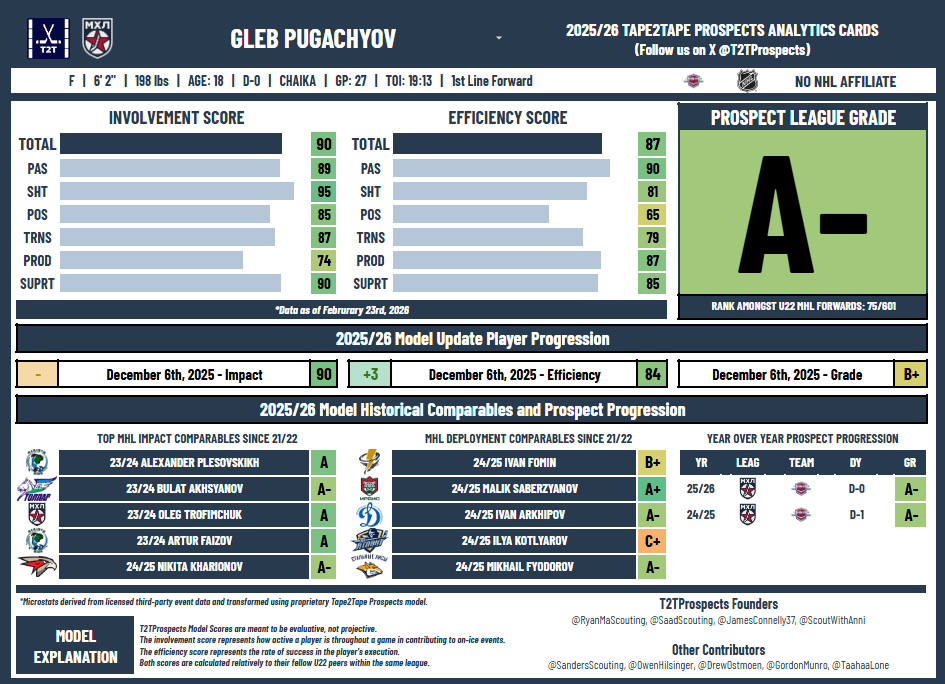
Games Tracked:
04/29/26 vs HC Loko Yaroslavl (Playoffs)
03/18/26 vs HC Irbis
02/25/26 vs Bars Kazan
ELEVATOR PITCH
Gleb Pugachyov is a powerful, high-motor winger whose size, skating, and physical engagement give him a strong foundational NHL toolkit built around pace and forechecking pressure. While he can impact games through straight-line rushes, net-front presence, and flashes of shot and passing skill, his inconsistent (at times borderline irresponsible) puck management and rushed decision-making under pressure limit his ability to consistently drive offense and will ultimately determine whether he settles into a reliable energy role or develops into something more.
Gleb Pugachyov is an intriguing power-winger profile because the physical tools, skating, and workrate all point toward a very high floor, but the decision-making and puck management habits still hold him back from being a consistently reliable driver of offense. The skillset is clearly there for a heavy, north-south winger who can impact games through pace, pressure, and straight-line attacks, but the execution is still inconsistent shift-to-shift.
The most noticeable trait is his combination of size, speed, and explosiveness. Pugachyov is a big mobile winger who can really get on top of defenders quickly, especially in forechecking situations where he commits early and finishes the play with physicality. He is consistently involved belowthe circles, and his willingness to engage physically stands out. When he arrives on contact, he does so with intent, finishing checks and making himself a factor in puck battles rather than just observing them. That physical engagement also translates to the net-front, where he shows comfort establishing body position and trying to create chaos around the crease.
Skating is a real separator in his game. For a player of his frame, he has strong straight-line speed and noticeable explosiveness out of his first few steps. He can close space quickly in transition, recover defensively when needed, and drive through open lanes with pace. He also shows decent agility in tighter areas than you’d expect for his size. There are moments where he fumbles pucks slightly under pressure, but he compensates with quick directional changes and enough lower-body control to regain balance and continue plays.
Offensively, there are legitimate flashes of skill. His shot is hard and releases quickly, particularly off the rush, and he isn’t afraid to use it when space opens up. The accuracy still needs refinement, but the mechanics and willingness to shoot are both encouraging. He also shows good puck comfort for a big winger, showcasing an ability to handle pucks cleanly in motion and make plays under moderate pressure. There are sequences where he demonstrates real passing touch, including a strong off-flank backhand cross-ice feed in transition and moments where he identifies slot opportunities well to create scoring chances for teammates.
The main concern in his game is decision-making and puck management under pressure. Too often, Pugachyov tries to extend plays beyond what is available to him or fails to scan early enough before receiving pucks, leading to turnovers or broken possession. He can bite off more than he can chew in traffic, and when his reads are late, he becomes vulnerable to puck losses despite his size and strength. Improving pre-scanning habits and simplifying his game under pressure would immediately raise his effectiveness.
Despite those issues, there is a lot to like in the overall toolkit. The combination of size, speed, physicality, and flashes of puck skill creates a profile that projects well in a bottom-six or energy line role with potential for more if the decision-making tightens. The workrate is consistent, the motor is strong, and the skating gives him a clear entry point into games even when his puck play isn’t sharp.
Ultimately, Pugachyov is a high-floor, toolsy winger who can impact games through pace, forechecking, and physical presence, but his offensive ceiling will depend entirely on whether he can clean up his puck decisions and become more efficient with his reads under pressure.
#26 - Ilia Morozov - Miami University (OH) - C - NCAA
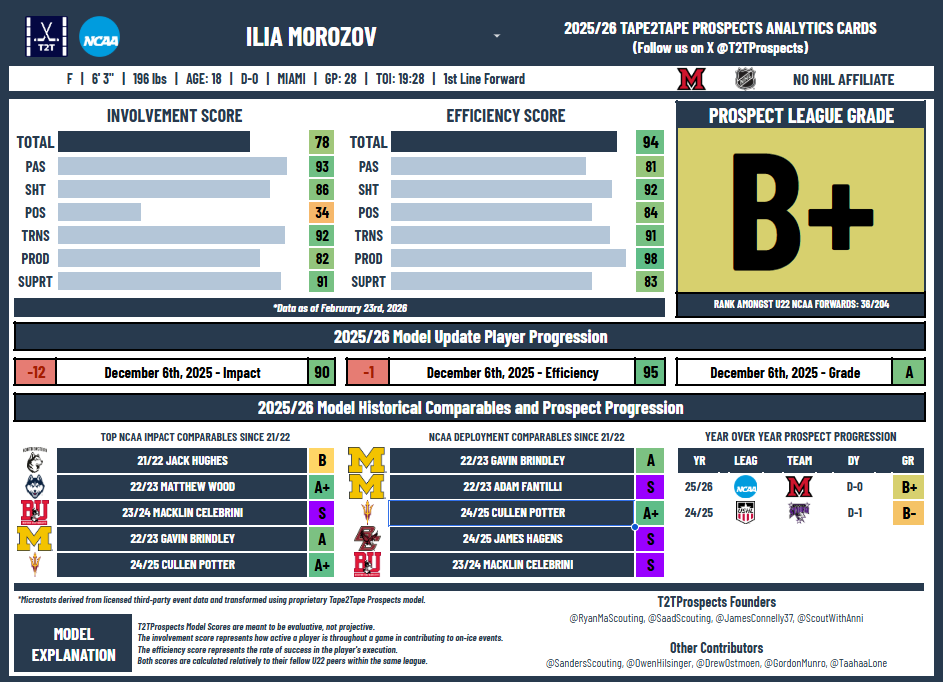
Games Tracked:
04/15/25 v Waterloo Black Hawks
12/19/25 vs Ferris State University
03/07/26 vs Denver University
ELEVATOR PITCH
Ilia Morozov is a big, defensively mature center whose game is built around structure, physicality, and puck-winning ability rather than dynamic offensive creation. The 6’3” freshman consistently impacted games through his low-zone support, board work, stick detail, and ability to maintain defensive positioning, making him a player coaches will trust in difficult matchups.
Ilia Morozov was truly impressive as a freshman in college this season, even if his game hadn’t changed much from his USHL tape in Tri-City. The big Russian center isn’t going to wow you with flashy puck skills or end-to-end rushes, but his impact on the game was felt almost every shift through his defensive habits, physicality, and ability to win possession.
The defining trait of Morozov’s game remains his defensive intelligence. At 6’3”, he combines a long reach with strong positional awareness, making him a difficult player to play through. He constantly supports low in the defensive zone, provides outlets for his defensemen, and understands how to sort coverage around the net front. Whether it was tying up sticks in the slot, identifying threats through layers of traffic, or staying above his man in transition, he consistently looked like a natural center. Scramble situations and broken plays rarely seemed to catch him out of position, and he did an excellent job maintaining defensive structure even when the rest of the team looked chaotic.
Along the boards, Morozov was excellent. He approaches puck battles knowing exactly how big and strong he is, and he plays accordingly. Stick lifts, body positioning, sealing opponents off the puck, finishing through contact along the wal. His reach allows him to disrupt plays before they fully develop, and he routinely poked pucks out of danger or extended possessions simply by getting a stick into the right lane. There was a maturity to his defensive game that stood out throughout the viewing.
The skating remains an interesting part of his projection. Morozov generates good power through long, efficient strides and covers more ice than people might expect once he gets moving. He isn’t particularly agile and lacks a true separation gear, which showed up on a potential shorthanded two-on-one where he couldn’t quite pull away from a pursuing backchecker. That said, I don’t think the skating has prevented him from being an effective player at the college level. His routes are generally smart, he arrives in the right areas on time, and his physical tools help compensate for the lack of top-end explosiveness. He’s impactful because he understands where he needs to be, not because he’s overwhelming opponents with speed.
Offensively, the picture is a little murkier. Morozov isn’t the most confident offensive player, but when he did get touches around the net, he showed flashes of soft hands and was able to create a quality scoring chance in tight. He also owns a legitimately heavy shot when he’s able to get it off cleanly.
The bigger concern is what happens when the puck stays on his stick for extended periods. Morozov often looks far more comfortable making quick support plays, cycling the puck, or moving it immediately to a teammate than he does trying to create offense himself. There were several instances where his head dropped while handling the puck, and his solution to pressure was often to try stickhandling through traffic rather than identifying an outlet. Those sequences usually ended with turnovers. The vision and playmaking feel fairly limited at this stage, and there are times where he almost appears reluctant to demand possession offensively.
There were also some small details that stood out as areas of improvement. He occasionally failed to present his stick as a target, including one costly sequence where a pass through the slot slipped right through him and quickly transitioned the other way. For a player who does so many little things correctly defensively, I’d like to see that same assertiveness in offensive support situations.
Overall, Morozov projects as the type of center coaches tend to trust. He’s big, responsible, physically engaged, wins puck battles, and understands defensive structure at a high level. The offensive upside remains limited due to the puck skill and playmaking concerns, but the combination of size, defensive instincts, and possession-driving habits gives him a very clear pathway toward carving out a potential 3rd line role at the NHL level.
#27 - Adam Valentini - Michigan - F - NCAA
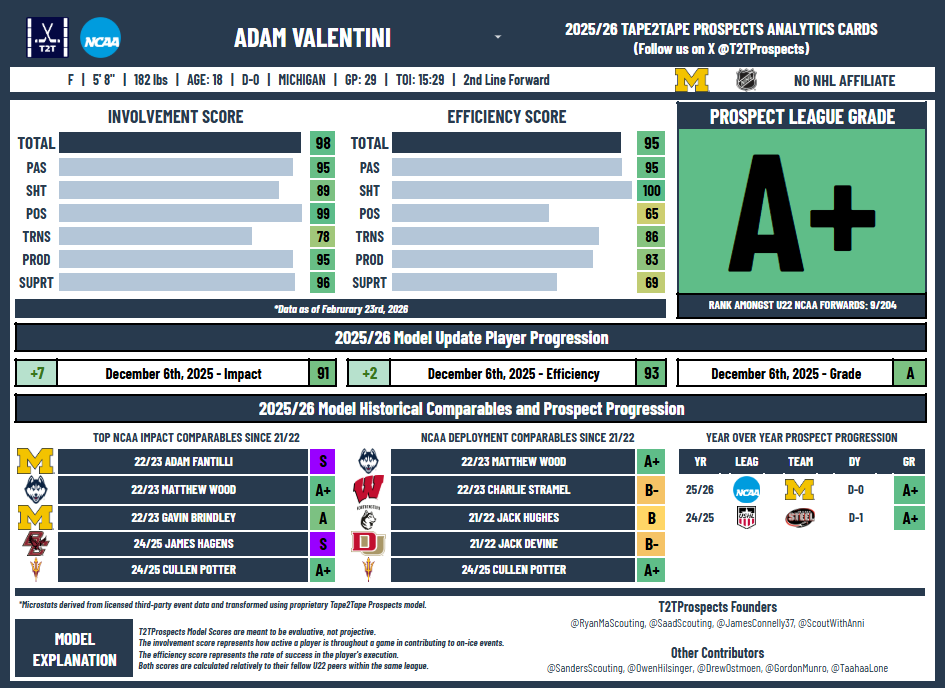
Games Tracked:
04/27/26 vs Finland U18
03/29/26 vs Minnesota Duluth
02/21/26 vs Wisconsin
ELEVATOR PITCH
Adam Valentini projects as an effective middle-six complementary forward thanks to his relentless work ethic, strong forechecking, intelligent defensive play, net-front competitiveness, and underrated shooting ability, all of which helped him successfully transition to the NCAA. While he still needs to improve his puck management under pressure, passing consistency, physical strength, and ability to attack defenders one-on-one, many of those weaknesses appear coachable, making him an appealing package, whose consensus public ranking undervalues his overall impact.
Adam Valentini’s consolidated ranking as of 5/4/2026 was 40th and I just think that it’s still too low for a player who’s been a quality impact player in the NCAA this year for Michigan and balled out for Canada at the U18s.
Valentini is far from a perfect player, but he does so many things right when you’re looking for a potential middle six complimentary piece that I just don’t think the hang ups are significant enough to drag his stock down, especially when I think a lot of it is teachable and fixable.
Valentini’s a really hard working player who’s just super active all over the ice. He’s always in and around the puck on the forecheck, ties up sticks well in the defensive zone in front of the net and routinely comes down low as a winger to support his defensemen, He’s just got a very nice, active stick that he uses to get into passing and shooting lanes to break up passes. Valentini’s play on the forecheck and defensively is mainly stick dominated rather than taking the body, but he will have shifts in games where he’s an absolute demon on the forecheck. He’ll close off angles and just relentlessly stick lift and out leverage defenders to win the puck back. Just great hustle from Valentini who makes up for a lack of natural explosiveness in his stride by just working harder than everyone else. He’ll beat out opponents to loose pucks on retrievals in the offensive zone and uses his body to gain leverage and seal opponents away from the puck.
I wouldn’t call Valentini dynamic, but there’s certainly a slippery element to his game along the boards. He does a great job spinning off of attempted hits along the boards, and then making quick plays to his teammates to keep the play alive. When he can get his feet moving, there’s also some nice agility and short area movement skills where he can dance his way into the high slot to get shots off. I also think he’s also an absolute nuisance off the puck. He’s just relentlessly willing to eat contact in the net front, battling much bigger and stronger players to take away the goalie’s line of vision. The shot from Valentini is also an asset, he’s got a real hard shot that he can rip off the rush and through traffic to beat the goalie and I think that this blend of skillsets makes for a really appealing off-puck complimentary piece in a middle six role.
I do think I’d like to see him make much quicker decisions with the puck in his own end though for breakouts. Valentini likes having the puck on his stick where he can cruise through the neutral zone, gain the entry and pass it out to his teammate along the halfwall before driving low, but there are times where he tried to hold the puck in his own end along the wall and got his stick lifted because he’d invited too much pressure before making his decision. The cross ice passing is also a bit inconsistent, and his energy at times to get out into the play causes him to over skate pucks but I think those are all things that are very fixable.
I also would like to see him challenge guys off the rush more, I think there’s more to work with in that aspect of the game but he seems content to just let a shot fly from distance whenever defenders close the gap on him. He’s adapted to the college game better than I anticipated, but I do think that he’ll need to be stronger on his skates especially if he wants to play that shifty cycle player role along the boards plus net front nuisance. Stronger contact balance will do wonders for him, and I do think going to college early was good for him to get a jump start on that end of his physical development.
All in all, Valentini is far from a perfect player, but the work ethic, the ability to create and keep plays alive in tight spaces and his shooting make for a really compelling package. Valentini took the NCAA challenge instead of sticking it out with Kitchener this year to much fanfare, but ultimately, I think he did make the right decision (even if it hurts to say that as a Rangers fan).
#28 - Alexander Command - Orebro HK U20 - C - U20 Nationell
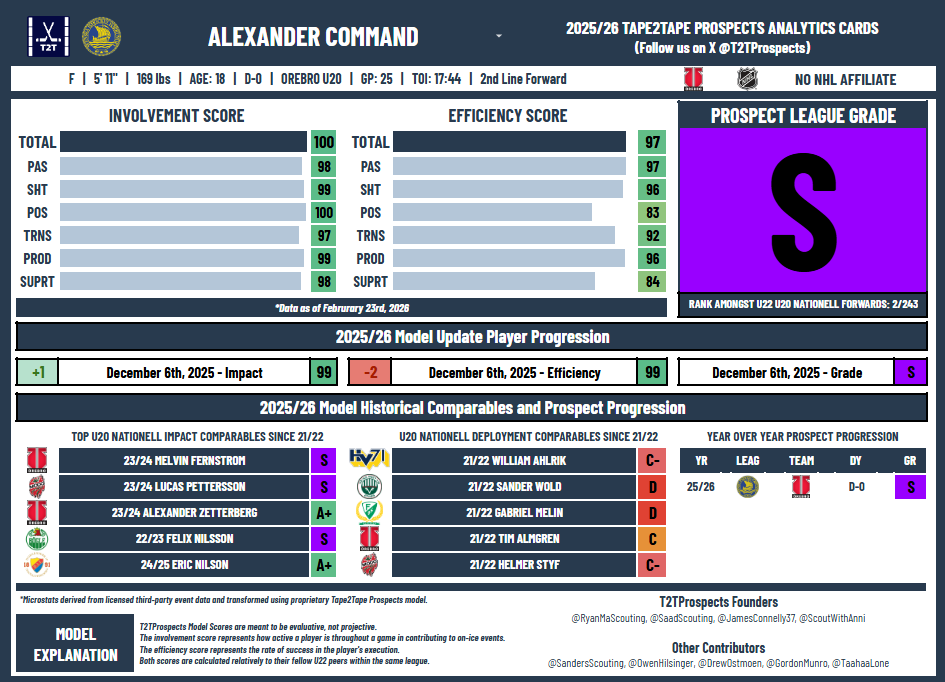
Games Tracked:
04/25/26 vs USA U18
03/28/26 vs Rogle BK U20 (Playoffs)
02/19/26 vs Frolunda HC
ELEVATOR PITCH
Alexander Command is a high-effort, physically engaged centre whose value comes from defensive structure, puck battles, and net-front work rather than offensive creation. While he brings strong habits, a good motor, some decent connective play and consistent willingness to play through contact, his limited puck skill, stiff skating, and slow decision-making under pressure suggests he may top out as a complimentary piece on a line at higher levels.
Alexander Command projects as a dependable, workmanlike centre who brings value through effort, structure, and physical engagement more than through high-end offensive creation. There are clear details in his game that translate to higher levels, namely his motor, defensive stick, and willingness to engage in battles, but his overall ceiling will depend on whether he can add pace and decisiveness with the puck, because right now his game is very much built on simplicity and effort.
Defensively, Command is at his best when he’s playing direct and engaged. He uses his stick well, stays involved in lanes, and shows consistent willingness to track back and support his defensemen. There’s a clear competitiveness to his game away from the puck, and he does a good job finishing checks and making life uncomfortable for opponents in tight areas. His lower-body strength is noticeable in board battles, where he can lean on players, fish pucks loose, and extend possessions through effort more than finesse. When he’s locked in physically, he can be a difficult player to play against in puck battles and net-front scrums.
He also shows strong habits around the net front. Command is willing to get inside positioning, battle for loose pucks, and work through contact to create second-chance opportunities. That willingness to go to the hard areas is one of the more projectable aspects of his game. There are shifts where he clearly sets a tone physically, including sequences where he stepped in aggressively after a teammate was targeted and just laid out two guys in response. That edge and willingness to engage is a real positive in his profile.
With the puck, Command is more limited. He is a simple, connective passer who generally looks to move the puck quickly to more skilled teammates rather than trying to extend plays himself. When he keeps things straightforward, he can be effective in transition support and cycle play, especially when he’s working low-to-high or feeding pucks into space for linemates to attack. He does get to the net front and will try to create presence in those areas, but he is not a particularly creative finisher or playmaker in tight.
The main concern offensively is decision speed and puck handling under pressure. There are too many instances where he takes an extra beat on the puck while trying to protect it, only to get it poked away as back pressure closes. His puck skills are serviceabl, he can handle and move pucks, but he does not have the evasiveness or creativity to consistently beat pressure in small areas. When he enters advantageous positions, his default tendency is to either fire the puck toward the net or push a simple pass into the slot rather than try to sidestep defenders.
That lack of dynamic skill is compounded by some skating limitations. While he has decent straight-line speed and works hard in pursuit, his hips look somewhat stiff, which can limit fluidity in transitions and quick directional changes. There are also moments where he appears to overcarry pucks or holds the puck for too long, leading to turnovers or lost possession when pressure arrives.
Overall, Command profiles as a detail-oriented, physically engaged centre who can contribute in a supporting role through effort, defensive reliability, and net-front work.
#29 – Simas Ignatavicius – C/F - Genève-Servette HC – NL
Games Tracked:
10/12/25 vs Lausanne
01/03/26 vs SC Bern
03/06/26 vs Biel-Bienne
ELEVATOR PITCH
Simas Ignatavicius is a mature, low-risk forward whose game is built around connectivity, forechecking pressure, net-front offense, and responsible puck management, making him an intriguing pro-style prospect already earning meaningful minutes in Switzerland’s top men’s league. While his skating mechanics, lateral agility, puck patience, and ability to consistently attack the middle of the ice limit his offensive ceiling, his translatable habits and versatile two-way approach give him a realistic path toward becoming a reliable bottom-six NHL contributor.
There’s no T2TProspects card for Simas Ignatavicius, unfortunately. You’ll have to blame the source data, which was incomplete for the player, but even without the visual, there’s a pretty underrated player.
Simas is playing tons of hockey in Switzerland’s best men’s league for Geneve-Servette, and watching him, you can see why he’s on the team at such a young age. There’s not a ton of fancy puck touches from Simas, but that’s not his game. Lots of his zone entries lead to dump-ins, and he’s not a super prominent component of the buildup of play through the neutral zone.
However, Simas is a true connector of play. When he gets the puck in the neutral zone, he prefers to defer to a teammate with cross ice passing and then driving hard north to open up passing lanes. The consistency with which he lands these plays is hit or miss, but the intention is laudable. When he does gain entries, he’s looking to maintain possession rather than driving the center of the ice. This mindset is both a pro and a con. On the pro side, he’s playing a structured, coachable, risk-averse approach, and on the other hand, his success rate of trying to attack the inside with the puck is very limited.
It’s not a finished product with Simas, who’s energetic and constantly poking and reaching and trying to cut off passing angles on the forecheck, but the lateral agility is suspect, which I expect comes from a more choppy skating style.
The goal scoring from Simas at the NL level has come a lot from driving the net front, tipping pucks in, and also some long-distance snapshots through traffic. It’s nothing fancy, but there are some nice deft stick handling under pressure that looks really nice when he doesn’t get it poked off his stick.
Simas’ offence shines the most when he’s one-on-one off the rush with some time and space. His two nicest goals of the year all came on his strong side, where he’d streak in off the wing, receive a pass in motion and beat the goalie clean.
I don’t think the ceiling is super high-end with this player, but he’s got a pretty translatable playstyle where, if you put some work into fine-tuning the skating mechanics and get him to show a bit more patience with the puck on his stick, you could one day find yourself with a pretty serviceable bottom six Swiss-Army knife.
#30 - Wiggo Sorensson - Boro/Vetlanda HC - C/W - Sweden Divison 4
Games Tracked:
03/12/26 vs Backen HC
02/25/26 vs IF Malmo Redhawks U20
02/06/26 vs USA U18
ELEVATOR PITCH
Wiggo Sorensson is a high-energy, explosive skater whose game is driven by pace, forechecking pressure, and the ability to consistently disrupt plays and create offense through individual rushes and quick zone entries, even in a lower-level pro environment. While his vision, puck distribution, and decision-making in the offensive zone still need refinement, his dynamic skating, confidence under pressure, and ability to tilt the ice in one-on-one situations make him an intriguing, toolsy prospect with clear developmental upside.
I wanted to dislike Wiggo Sorensson just off the principle that David (@SaadScouting) was imploring me to suffer 4th Division Swedish Hockey just to watch him. Clearly, there are some Sorensson fans with Scouching having him in his 1st Round and Tony Ferrari having him in his Top 45 earlier in the year as well. Unfortunately, Sorensson is just too fun and sick as a player for me to try and pretend to hate.
Sorensson’s development path playing in a lower-end men’s pro league is an interesting one, but he was clearly one of the best players on the ice regardless of which league he was playing in. Sorensson’s game hinges firstly on his outstanding skating. He’s quick, explosive, and he does a great job of understanding passing lanes to cut down space and angles on the forecheck. Tons of tipped pucks, or him just accelerating full speed into the end boards to take away a D-to-D pass.
Sorensson uses his skating to be a really fun, crafty and slippery player on the puck as well. He gets low in his skating stance, and he’s comfortable making plays through pressure, sifting passes through sticks with his back to the offensive blueline. He’s just very comfortable holding onto the puck through high-pressure areas because he’s confident his skating will allow him to maneuver himself out of any sticky situations. In his Division 4 game, I watched him literally hold the puck and take it for a lap in the offensive zone, as defenders tried to keep up with him before he went for a wrap-around attempt. The effortless stride and ability to accelerate and decelerate mean that he’s a very shifty player, willing to attack defenders inside and back out with some space and opportunity.
Sorensson’s game has held up admirably in a pro league (albeit not a great one), and there’s some feistiness. He drives down low and gets under guys trying to hold him or obstruct him, and drives through that contact. Just very good at getting himself going from a standstill.
The vision is still developing as a player; there are a few nice ideas as a passer on breakouts where he’ll look to bomb stretch passes down the ice, but I would like him to utilize his teammates more in the offensive zone and work off of each other in the cycle game. Right now, Sorensson is a player I feel gets a bad case of tunnel vision with the puck when he gets in the offensive zone. Tons and tons of immediate shots on the net with that wrister, usually from low danger areas that he’ll snap low and wide of the net. I think those habits and learning to defer from a scoring chance to find a teammate will be something that he has to add to his skillset as he develops.
All in all, Sorensson is a dynamic skater who’s a handful already for defenders to cover in one-on-one situations. There are flashes of creative, higher-end playmaking ideas and a high-energy profile that takes away passing lanes in a flash. It’ll be REALLY interesting to see where his development journey takes him, but there’s a really fun player here, and more people should get on the Sorensson train heading into the draft.
#31 - Niklas Aaram-Olsen - Orebro HK U20 - RW/LW - U20 Nationell
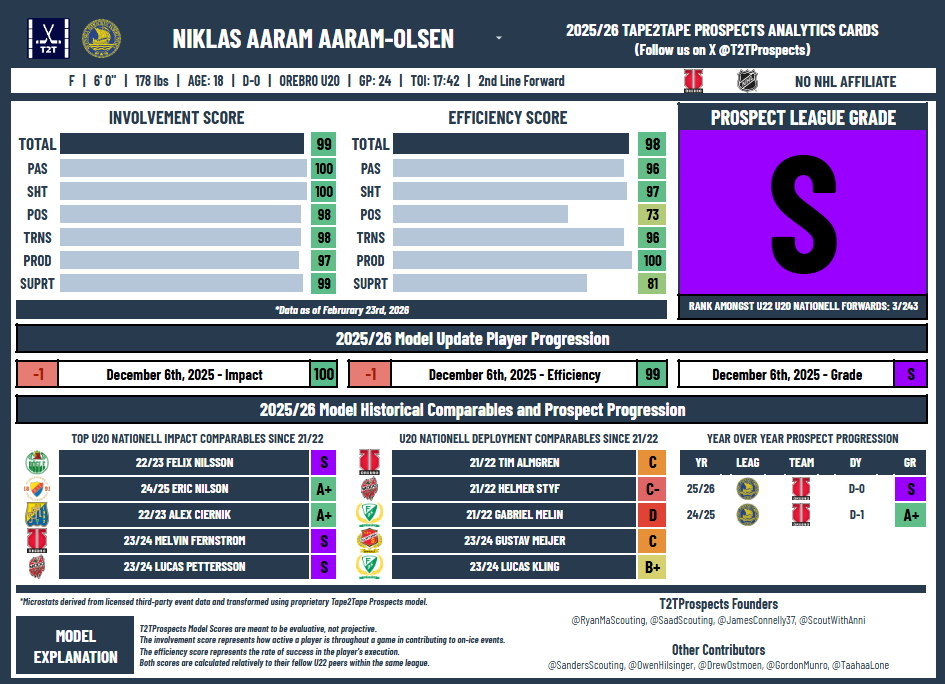
Games Tracked:
04/25/26 vs Canada U18
04/04/26 vs Frolunda HC U20 (Playoffs)
03/14/26 vs Linkoping HC
ELEVATOR PITCH
Niklas Aaram-Olsen is a strong-skating, defensively aware winger whose ability to close space, disrupt plays with his stick, and support transition gives him a solid floor. However, his conservative puck decisions, reluctance to consistently attack through contact, and inconsistent physical engagement limit his offensive impact and leave his projection dependent on whether he can play with more assertiveness and directness.
Niklas Aaram-Olsen is an interesting evaluation because the skating, length, and defensive stick give him a real foundation to work with, but the overall physical engagement and directness in his game still lag behind what you’d want from a winger with his mobility and frame. There are clear tools here that translate to modern pace-driven hockey, but the consistency of assertiveness (especially through contact and in attacking dangerous ice) needs toimprove.
The skating is the standout trait. Aaram-Olsen has good speed, and more importantly, he can generate separation through timing and first-step explosiveness. He uses that well in the neutral zone, particularly when he lowers his stance and reads plays early to jump lanes. There were multiple sequences where he effectively stole possession by getting under puck carriers and cutting off exits with good anticipation rather than pure physical pressure. That ability to close space quickly is a real asset and gives him value in transition and defensivelyn.
Off the puck, he also shows encouraging instincts in how he supports plays through the neutral zone and across the offensive blue line. He has a habit of presenting himself as an option in motion rather than standing still, and when he does time his routes correctly, he can arrive into space with speed and create clean entries. There are flashes of offensive awareness where he finds soft areas and becomes available as a trailer or weak-side option, particularly when crossing the line with pace.
With the puck, Aaram-Olsen is capable but somewhat conservative in his decision-making. He tends to default toward safer, more lateral or back-pass options, especially under pressure. On faceoffs or quick transitions, he often leans toward drop passes or cycling to the point rather than attacking space directly, even when lanes are available. That tendency limits his offensive impact because he does have the skating ability to threaten defenders more aggressively. These are moments where you want him to ATTACK gaps rather than reset possession.
He does flash some skill in tight areas. There were sequences where he attempted to maneuver through defensive triangles or work the puck across the blue line under pressure, and he showed enough hands to survive those moments, even if he didn’t always fully win them. He’s also comfortable operating in the middle of the ice at times, including a nice backhand feed into the slot to a trailing teammate, which hints at some secondary playmaking vision when he commits to it.
Defensively, Aaram-Olsen’s profile is stronger. He uses his reach effectively, and his stick detail is generally reliable. He’s active in passing lanes and does a good job angling puck carriers into less dangerous areas. In the neutral zone especially, his ability to get low, extend his stick, and time poke checks makes him disruptive. He reads plays fairly well and can catch opponents off guard when he anticipates movement rather than reacting late.
The concern comes with his physical engagement level. Despite having a frame that should allow him to be more impactful in these situations, he is too easily knocked off pucks in board battles and 50/50 situations. He often struggles to initiate contact effectively and can end up on the losing side of collisions when trying to play physically. There’s a tendency to avoid sustained battles or rely on stick work alone, which works in open ice but becomes less effective along the walls or net front.
Overall, Aaram-Olsen is a pace-and-skill winger with strong defensive anticipation and skating ability, but his projection hinges on whether he can add more physical assertiveness, attack gaps more directly offensively, and become more willing to play through contact rather than around it.
#32- Tommy Bleyl - Moncton Wildcats - RD - QMJHL
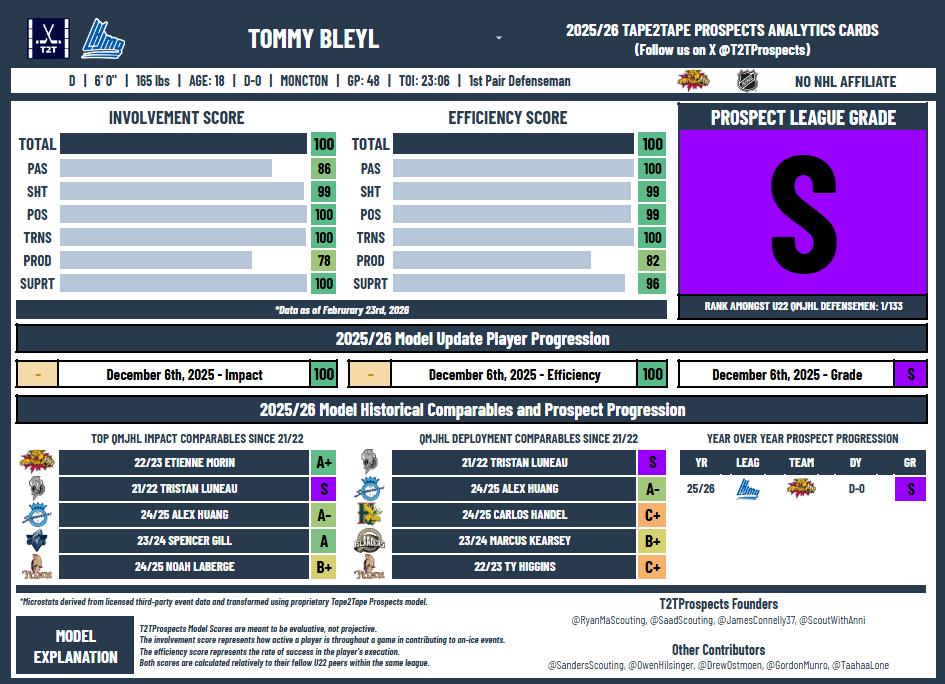
Games Tracked:
05/15/26 vs Chicoutimi (Playoffs)
04/27/26 vs Blainville-Boisbriand
03/27/26 vs Saint John
ELEVATOR PITCH
Tommy Bleyl is a mobile, right-shot puck-moving defenseman whose skating and quick decision-making allow him to drive transition effectively and move the puck with pace, particularly through clean outlet passes and simple offensive-zone distribution. However, inconsistent defensive engagement (especially in the slot and net front) along with struggles making the hard, physical plays at his size makes him a player that will need further refinement of his details before he makes the jump to pro hockey.
Tommy Bleyl projects as a mobile, puck-moving right shot defenseman who can help drive transition and contribute offensively, but his defensive engagement and consistency without the puck remain clear limiting factors in his current projection. There are moments where his game looks clean and efficient, and others where lapses in urgency and detail make him far less reliable than his tools would suggest.
Offensively, Bleyl is at his best when he’s playing north-south and keeping the puck moving with pace. He’s a smooth skater in straight lines and shows a clear intent to push play up ice quickly, often looking for long breakout passes to jumpstart transition. When he has time, his touch on those longer outlet attempts is solid… he can hit teammates in stride and efficiently move pucks through the neutral zone without overhandling. There’s a simplicity to his puck movement that works in his favor when he commits to it.
In the offensive zone, Bleyl is a quick decision-maker as a passer and shows flashes of patience when reading developing plays. He doesn’t always rush his reads, and there are sequences where he holds just long enough to open a shooting lane or slide a puck into the slot for a better look. That said, he remains very much a straight-line player offensively. When he receives pucks with speed, he can gain a step on defenders in open ice, but he lacks that extra gear or lateral shiftiness to consistently beat pressure one-on-one or extend plays through contact. If forced to double back or work through traffic, he struggles to maintain puck control and can get pushed outside.
Defensively, Bleyl is a mixed evaluation. On the perimeter, he actually defends reasonably well. His stick is active, and he does a decent job mirroring attackers, poking at pucks, and disrupting rhythm when he’s engaged. There are even moments where he shows a bit of burst and effort to close gaps and stay involved in plays along the boards.
However, he needs a more active and urgent stick in the slot, where too often shooters are allowed clean looks without enough pressure. Net front defending in particular remains a concern. On broken plays, his recognition and urgency to find and tie up opponents is inconsistent, and he can lose track of assignments when chaos develops around the crease.
There are also questions about his defensive motor over the course of shifts. While he can show effort in spurts, particularly when defending wide or chasing puck carriers, he does not consistently bring that same level of urgency in the most critical areas of the ice. That inconsistency shows up in coverage lapses and delayed reactions when the play shifts quickly toward the net front.
He does show some useful agility in his own zone, particularly when evading pressure on retrievals. Tight turns and quick directional changes allow him to escape forecheckers at times and reset possession, but those flashes are not always supported by consistent decision-making under pressure.
Overall, Bleyl is a transitional, puck-moving defender who can help move the puck efficiently and contribute in spurts offensively, but his defensive detail, net front defending, and ability to handle physical pressure will ultimately determine whether he can hold a higher-level role. Right now, the tools are there, but the engagement level and defensive reliability lag behind.
ROUND 2 (RNK #33 - #64)
#33 - Beckett Hamilton – RHC – Red Deer Rebels – WHL
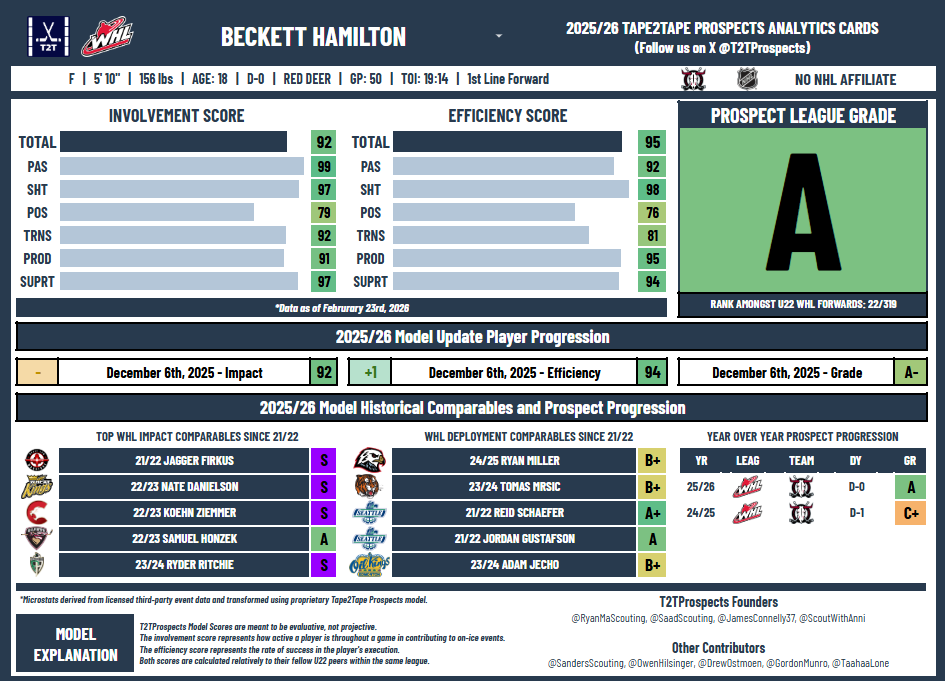
Games Watched:
10/29/25 vs Calgary
12/12/25 vs Calgary
07/01/26 vs Brandon
ELEVATOR PITCH
Beckett Hamilton is a high-motor, pace-driving center who consistently impacts the game through relentless skating, forechecking pressure, and strong transitional play, with enough skill and puck movement ability to be a focal point on Red Deer’s power play. While he still needs to add strength and improve his puck protection in battles along the boards, his speed, work ethic, and projectable two-way engine make him a highly intriguing and fairly safe developmental forward in the 2026 draft class.
In the @T2TProspects Group Chat, Drew (@DrewOstmoen) asked David (@SaadScouting) who his sleeper forward of the 2026 NHL Draft was. David’s response? Red Deer’s Beckett Hamilton.
When asked to describe the right-handed center’s game, this is what David had to say.
“Super high energy and works through pressure super well. Plenty of skill, but really needs to add muscle.”
I already had Hamilton on my list of players to watch (another @T2TProspects model favourite), but I moved him up the priority list after David’s glowing endorsement.
The first thing that you notice about Hamilton is that he’s an absolute motor monster. There were very few unnoticeable shifts from the Rebels’ center. He’s always buzzing in and around the puck, effortlessly quick and smothers defensemen on retrievals with his speed.
When he gets open ice to build his speed into, he’ll knife through the neutral zone and create a chance for himself off the rush. He’s also played more of a quarterbacking role on the powerplay for Red Deer, which is not super common, but he’s a quick decision maker who is comfortable with the blue line behind him.
As David mentioned, he does need to build up his strength. He can get bodied off the puck easily, and the puck protection along the boards isn’t a strength. I did notice, though, that at times, he does a good job at times of counteracting that weakness by using his quickness to get into a good position to absorb the contact and out-leverage his opponents.
There’s a super pacey player here in Hamilton, whose speed translates in all three zones, who will forecheck and backcheck from red line to red line, and has some nifty passing and great ideas with the puck. Hamilton really is the absolute engine of his line. Tons of puck touches, tons of zone entries, and a really fun player to watch.
There are some low percentage perimeter shots at times, but with time and space on the powerplay he can absolutely rip it as well. All in all, I’ve been impressed with what I’ve seen from Hamilton and certainly one of the more projectable players at this stage of the draft for me.
#34 - Adam Goljer - HK Dukla Trencin - RD - SVK
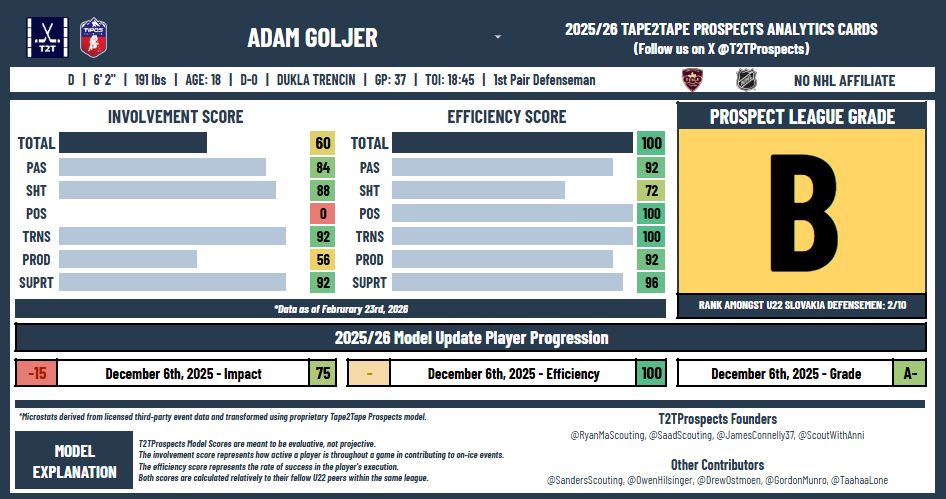
Games Tracked:
04/23/26 vs Norway U18
04/22/26 vs Canada U18
04/02/26 vs HK Skalica
ELEVATOR PITCH
Adam Goljer is a reliable, defense-first right-shot defenseman with strong stick positioning, good gap control, and a projectable defensive floor built on structure, puck disruption, and simple, effective breakout decisions. While his limited mobility, stiff hips, and lack of physical edge may cap his ceiling, his poise with the puck, willingness to activate offensively, and overall reliability give him legitimate upside as a potential NHL #4/5 defender and a solid top-50 prospect in the class.
Adam Goljer is a reliable, predictable defenseman but there are some high end moments that really intrigue me and I think there’s a player here. Slovakia’s captain at the U18s is not the most fleet of foot in terms of his agility, and his hips are not as fluid as some other defense first guys I’ve watched, but his powerful strides allow him to get moving forward and eat up ice when he needs to. There’s a very nice defensive floor with Goljer who’s generally super reliable in his own end even when matched up against men or powerhouse teams like Team Canada.
He does a great job of using his stick to take away passing lanes and protect the middle of the ice. Just does a very good job of funneling guys away from the slot. I do think that he needs to keep his feet moving defensively, there are some plays where he’s leaning his upper body forward, trying to lean and rub guys out along the boards when defending the rush. That’s not always going to work especially if the opponent drives through the contact and it means there are some times where he gets beat around the outside. However, that stick comes into play and even though it isn’t always pretty, he does a good job knocking pucks away to clear the danger.
What I will say is, Goljer’s defensive game is predicated on his stick and positioning. He’ll get some criticism from other scouts due to the lack of edge or physicality in his game at his size, and while I do think it is something I’d like to see him improve on, I do think his style of defending will be effective and projectable. Sure Goljer can’t erase chances and rushes like some guys I’ll have much lower on the board can, but he does a great job tying up opponents along the boards to allow for reinforcements to arrive. On zone exits, he’s making quick plays north, using the boards to his advantage and just doing lots of pre-scanning so he’s not just passing it to nobody.
What I find really intriguing about Goljer is there’s some willingness to jump up into the play and hold the puck. He’s very eager to jump up the ice during broken plays where he can see if he hunt a shot for himself in the high slot, and all over the ice I think Goljer makes good decisions with the puck, even if they’re not the most dynamic. He’s very comfortable and poised with the puck in the offensive zone, looking to either tee up a shot, cycle it down low, or pass it to his forward along the half wall. He’s not a player that’s uncomfortable with the puck like a lot of the other bigger players though, he’s willing to hold the puck, slow it down and scan for an opening before snapping the puck to his teammate.
Goljer is a bit more shot oriented which does result in some block shots. It certainly would be nice to see more... ambitious passing ideas from him, but the poise in handling the puck under pressure and having the discipline to make good decisions with the puck is still impressive to me.
All in all, Goljer’s a defensive prospect that I think has a really compelling overall package. He’s big, mobile, with smart decision making and a willingness to do more than just get rid of the puck when it’s on his stick in the offensive zone. Even with the lack of physicality and play killing ability and stiffer hips, I think there’s a real good shot of a #4/5 defenseman on an NHL team someday which isn’t bad especially given his frame and handedness.
#35 – Morgan Anderberg – Vaxjo Lakers HC – LW/C – SHL
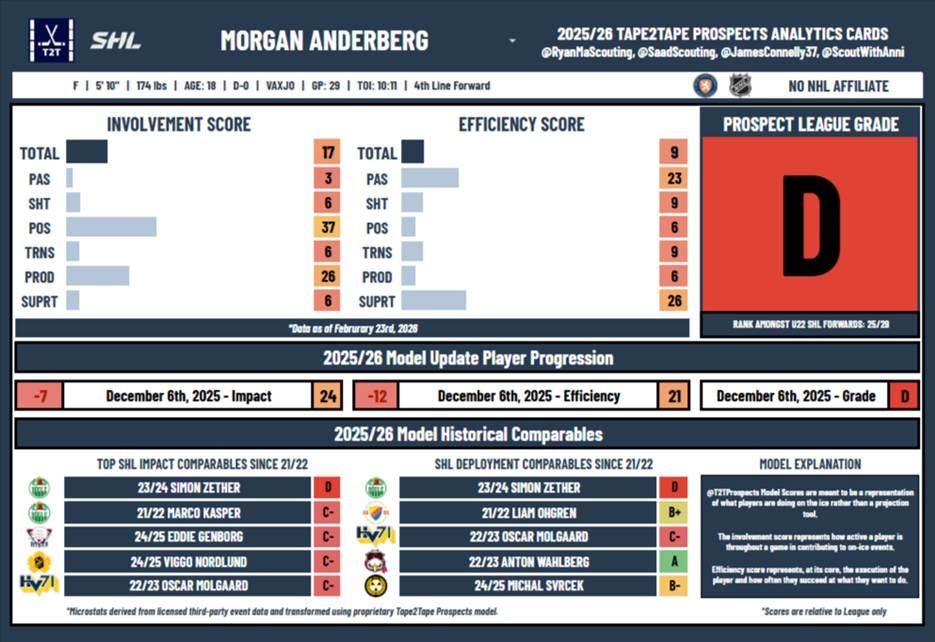
Games Tracked:
12/20/25 vs Timra IK
02/07/26 vs Rogle BK
02/21/26 vs Malmo Redhawks
ELEVATOR PITCH
Anderberg is a high-motor, competitive forward with strong skating, relentless forechecking habits, and a well-rounded two-way game that has allowed him to earn SHL minutes despite limited offensive deployment. While he lacks high-end creativity and has not consistently driven offense at this level, his pace, work ethic, defensive detail, and pro habits make him a projectable depth forward with intriguing upside if his skill game continues to develop.
Anderberg is the least heralded of the SHL draft eligibles this season, and while he hasn’t played a feature role in the SHL, there’s a player here that’s deserving of some flowers.
The score on our @T2TProspects model doesn’t look great, but a reminder that context matters. Our model scores are based only on U22 players in the same league. So while a D grade looks quite terrible, he’s being compared to the best the SHL has to offer. Anton Frondell, Victor Eklund, and a host of other top 64 draft picks, as well as future lottery picks in Stenberg and Bjorck.
The quality of the league matters, and Anderberg’s historical comparisons of guys like Kasper, Genborg and Fisker-Molgaard highlight just how tough the level of competition is in Sweden’s top league.
Anderberg’s been really fun to watch, even in his super-limited minutes. He’s just a really competitive, hardworking player with some really high-end skating. Those skill sets have made him a line-up staple for Vaxjo this season.
The goals he’s scored this year have been pretty lucky; both were rush attacks on his off wing where he was trying to center it to a teammate, but somehow the puck would take a bounce enroute and squeeze its way in. With that said, however, there is something to the adage “you create your own luck”, and Anderberg embodies it in the mature approach he has to the game.
Anderberg flies through the neutral zone with and without the puck, pushing play north and pressuring opponents with his pace. The SHL is noticeably a tick higher in pace than the U20 level, and Anderberg doesn’t just stick with everyone; he’s well above average.
Great forechecking routes, and he’ll get onto defenders retrieving the puck in a hurry, pinning them to the boards, and hassling them with an active stick. He has a well-rounded two-way game as well, using his skating to backcheck effectively and also battling extremely hard in the slot to tie up sticks and clear the traffic for his goaltender.
I also love how solid his stick is. In the defensive zone, when they need a clear, whether it’s on his backhand or forehand, he can get the right weight to get it out of the zone.
Overall, just a player with an insane motor and high work ethic that’s already excelling in a limited role in one of the top men’s leagues in the world. The pro habits, effort level and the work along the boards make me bullish on this player, who’s always fighting for real estate in the net front and has shown some flashes off the rush and in tight. Not enough of a creative skillset at this point in his development to drive real offence at this level, but there’s a player.
#36 - Maddox Dagenais - Quebec Remparts - C - QMJHL
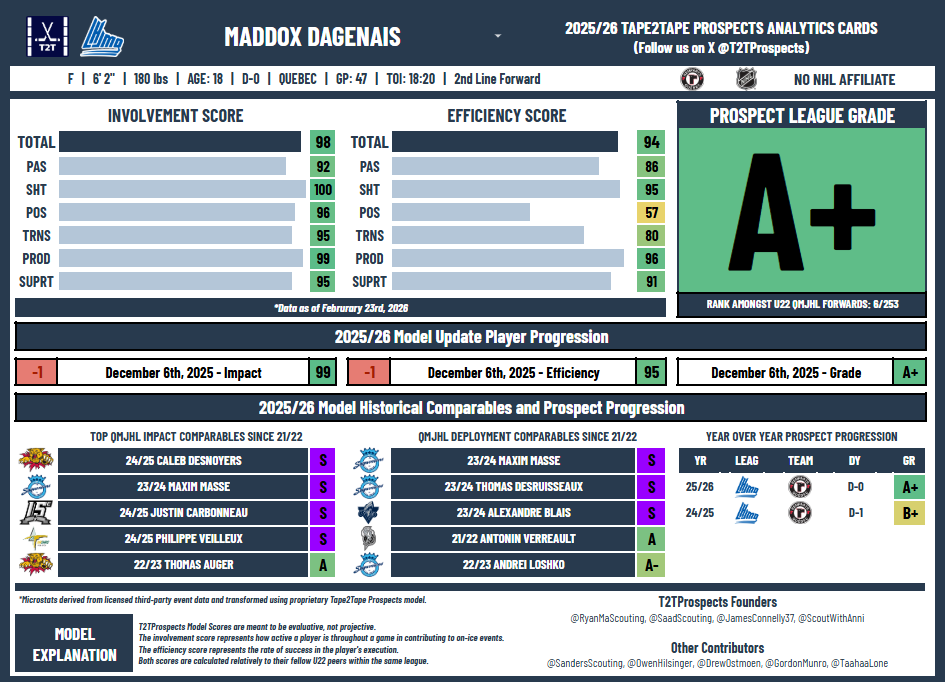
Games Tracked:
04/25/26 vs Norway U18
04/06/26 vs Charlottettown (Playoffs)
03/07/26 vs Shawinigan
ELEVATOR PITCH
Dagenais is a high-upside but highly inconsistent project pick. The offensive toolkit is good enough to be considered high-end, with strong skating, legitimate puck skill, high-end passing flashes, and a quick-release. Unfortunately, he’s undermined by inconsistent engagement and pace, and subpar play processing away from the puck. While his defensive consistency, contact balance/puck protection, and decision making speed still need significant development, his rare combination of size, skill, and offensive creativity makes him a worthwhile investment.
Dagenais is one of the more fascinating projection bets in this class for me because there are moments where the combination of skill, skating tools and offensive flashes genuinely look top-20 caliber, and then other stretches where the pace, engagement and processing completely disappear from the game. In the end though, I still lean pretty heavily toward the upside here.
The biggest thing that keeps pulling me back in with Dagenais is the raw toolkit. I actually think the skating and mobility are really good, particularly for a player with his frame and offensive style. He’s got nice tight turns, can change direction quickly and has enough straight-line mobility to beat defenders wide when he attacks with confidence. Once he gets going through the neutral zone and across the offensive blueline, there are some legitimately exciting flashes of on-puck skill and creativity. He handles the puck well at higher speeds, can attack laterally and has enough touch to work his way through traffic on occasion.
The passing ability is probably the standout offensive tool for me though. Dagenais can make some really impressive passes and showed flashes of genuinely impressive vision throughout the year. One sequence that really stood out was his bullet cross-ice feed through traffic to Jacobson for Canada at the U18s. He’s actually got very good touch on his pass even if he is a bit “see pass, make pass” rather than creative manipulator. Even on simpler exits, there were little details I liked, like soft chip plays up the boards to relieve pressure and maintain possession support rather than blindly throwing pucks away.
He also has a pretty dangerous shot when he chooses to use it. The release is quick and snappy, doesn’t require much setup space and comes off the blade with good velocity. Combined with the skill package, there’s definitely enough offensive talent here to bet on in terms of upside if things come together.
What I appreciated too was that Dagenais does show flashes of competitiveness and edge. He’ll work hard to crash the net front, dig for loose pucks and engage physically when he’s emotionally invested in a sequence. There was a really nice forechecking play where he came from behind the play, stripped the puck cleanly and immediately turned it into a scoring chance. Defensively, I also thought his stick detail in the neutral zone were solid. He uses his reach well to take away passing lanes and disrupt transitions before they fully develop.
The frustrating part though is just how inconsistent all of it can be. For a player with his physical tools and offensive talent, I wanted way more sustained engagement away from the puck. Too often when Dagenais wasn’t directly involved in the play offensively, he’d just kind of drift or stand around near the bluelines in transition rather than actively trying to find soft ice or become available for his teammate. The physicality similarly comes and goes. There are shifts where he’ll engage hard around the crease and along the walls, followed by long stretches afterward where the urgency and bite completely disappear.
Physically, I also think he still has a long way to go developmentally. His balance and leverage right now are honestly pretty rough and he can get knocked off pucks or disrupted through contact more easily than you’d like. Even when he tries to engage physically himself, he’s not always successful because the lower-body strength just isn’t there yet. That’s a big reason why I think his long-term projection is still heavily tied to physical development because there’s a lot of skill underneath that frame that could really be unlocked once he gets stronger and more stable through contact.
I also thought the offensive processing pace still looked like a work in progress. Dagenais can become a bit of a low-tempo attacker when he has time and space, almost slowing himself down too much rather than attacking advantages immediately. I’d really like to see him speed up his decisions and recognize opportunities earlier because there are definitely sequences where he leaves offense on the table by holding onto pucks a split second too long.
Still, for all the frustrations, I just think the upside swings here are really interesting. Big centers who skate well, show legitimate passing skill, own a quality shot and have shown flashes of being able to attack defenders one-on-one are hard to find. The intelligence, consistency and physical maturity are definitely still works in progress, but I think there’s enough raw offensive talent and enough flashes of competitiveness edge to bet on here.
#37 – Samu Alalauri – RD – Pelicans U20 – U20 SM-sarja
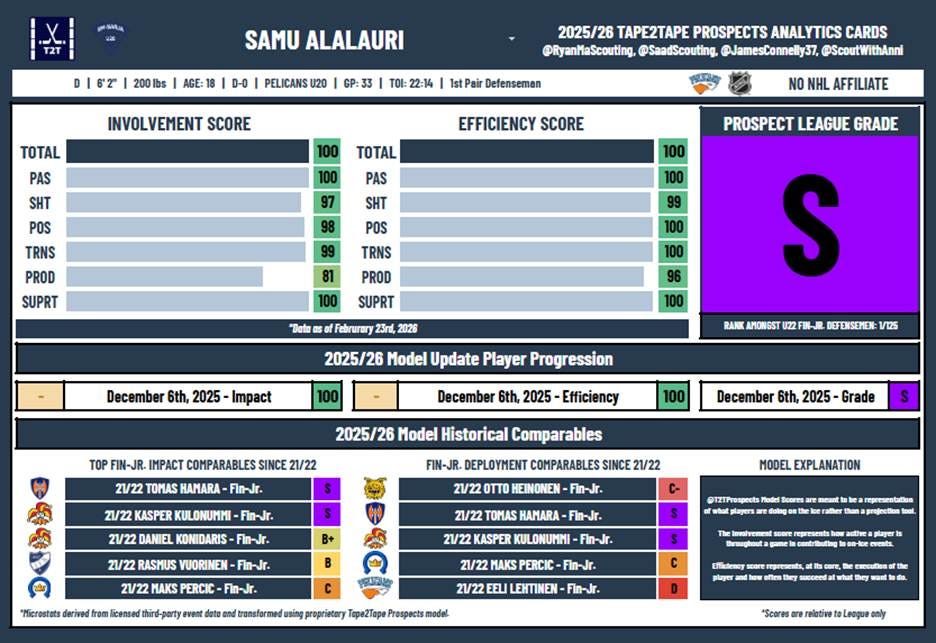
Games Tracked:
02/21/26 vs Porin Assat U20
02/19/26 vs Kalpa Kuopio U20
11/21/25 vs HIFK Helsinki U20
ELEVATOR PITCH
Samu Alalauri is a rangy, physical defenseman whose game is built around strong puck retrievals, smart use of size in board battles, and efficient north-south puck movement, giving him a very solid defensive floor and strong controlled exit metrics. While his offensive upside is limited and his stick work and zone entry defense can be inconsistent against higher pace attackers, his physical presence, skating, reach, and reliability in transition make him a high-floor, defensively reliable projection as a shutdown-oriented defender.
Samu Alalauri is one of the more compelling big, tall, rangy athletes on defence in this year’s draft after you get past the creme of the crop in the first round.
He’s big and strong, and he’s extremely efficient at meeting opponents along the boards for 50/50 pucks. Alalauri will smash his shoulder into the fray with some violence and wall off the opposing forward from the puck with his frame. If Alalauri can avoid getting his stick tied up, it often leads to really clean retrievals.
I think that’s the shining point for Alalauri; he’s big, but he’s very smart in picking his spots to leverage his size to maximize how efficiently he can get the puck going the other way. He’s not someone who’s constantly cross-checking guys in the net front, or hounding opponents with pushes and board plays. When he decides he has a chance at the puck, he enters with violence to gain complete control over it.
There was a play against Assat that really impressed me. He blew up the opposing forward along the end wall, walling him away from the puck, took it out from behind the net the other way and then sent a beautiful diagonal cross-ice pass to spring his winger for a partial break. It’s really encouraging to see these kinds of plays from Alalauri at this stage because it’s an extremely valuable skill, especially for big defensemen who won’t be the most dynamic on the puck offensively.
His impressive understanding of how to use his size and skating to retrieve pucks and push play north out of his zone is a key reason why Alalauri’s controlled exit rate and puck battle win rate are both 96th percentile in the Finnish Junior League this season. On top of that, for a bigger player, he’s poised on the puck. Short-area bumps up the board to his forwards, reversals to his defensive partner, and skating away from pressure to open up passing lanes for exits, Alalauri has shown me that he’s not a one-trick pony and is comfortable making plays under duress.
Alalauri’s rush defence is mostly very good; he’s rangy and uses his long reach to take away space and make life difficult for his opponents. He relies on that reach a lot, tapping at sticks, poking at pucks and pestering the opposing player. My main criticism of the player in that aspect is that the stick can feel a bit weak and spammy in its application. He’s not really forceful with his sweeps with his stick, and it means that he doesn’t consistently dislodge pucks that way to turn them over.
Alalauri is also a positionally aggressive defender when defending zone entries; he doesn’t offer a ton of cushion, instead crowding at the blueline and banking on the opposing player not having the speed to beat him. It generally works for him, as even when opposing players do get a step, his skating and reach are usually enough to allow him to keep up. However, sometimes, it burns him, like the OT game-winning goal he allowed against Assat, when the opposing forward sliced between him and his teammate for a breakaway goal.
I think the ceiling is ultimately capped with the player who isn’t going to offer you a whole lot once you cross the offensive blueline (although I did see some nicely timed activations that he was ultimately left unrewarded for), but lots of NHL teams are going to value him as a DFD who can factor in positively on zone exits.
I’m extremely curious to see how Alalauri’s game will translate at a higher level or in a higher-paced league (it’s a shame we’ve yet to see him get a call up to the pro level), and I do worry that facing more intense forechecks on a smaller ice surface might impact how effective his game is, but there’s a physical, high floor projection.
#38 - Marcus Nordmark - Djurgardens IF U20 - LW - U20 Nationell
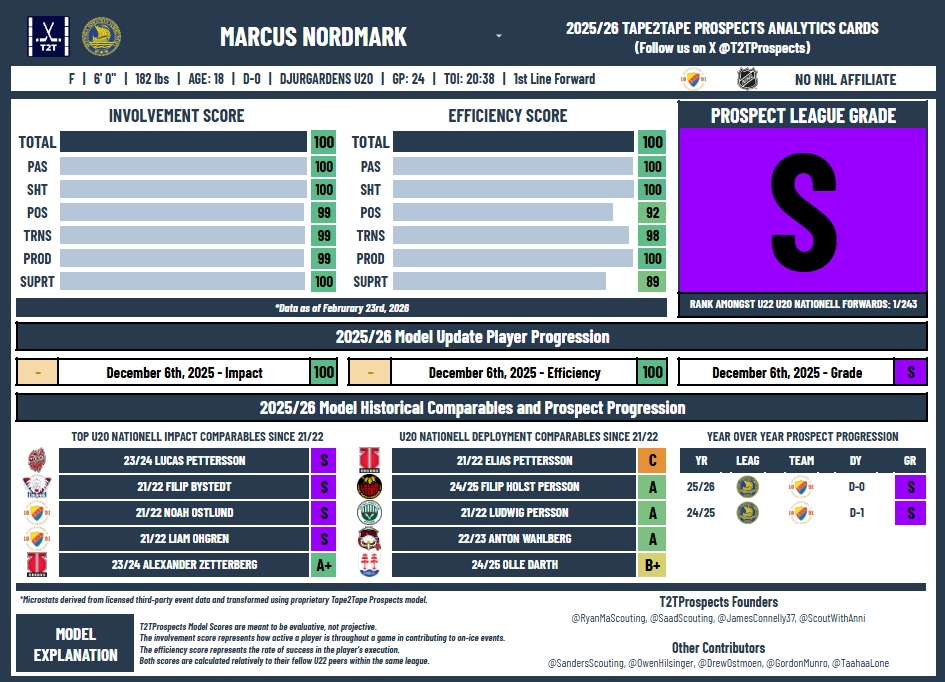
Games Tracked:
04/25/26 vs USA U18
03/14/26 vs Skelleftea AIK
02/27/26 vs Brynas IF U20
ELEVATOR PITCH
Marcus Nordmark is a highly skilled offensive talent whose puck handling, creativity, and playmaking flashes suggest the upside of a legitimate play-driving forward, but his game is held back by inconsistent engagement and a lack of urgency away from the puck. While the tools to create offense are clearly present, his passive defensive habits, perimeter tendencies, struggles in physical battles and unwillingness to kick it into 2nd gear leave him as someone who should’ve been far more impactful this season.
Marcus Nordmark is one of the more frustrating evaluations in this class because the skill level is obvious, but the consistency of his engagement leaves a lot to be desired. There are flashes throughout his shifts where he looks like a legitimate offensive creator capable of driving play through skill, vision, and puck handling. The problem is those moments often feel isolated between long stretches where he simply isn’t impacting the game enough.
Offensively, Nordmark has some genuinely intriguing tools. His hands are quick, he settles difficult pucks cleanly, and he shows creativity both as a passer and puck carrier. There were multiple sequences where he displayed the ability to manipulate defenders, extend possessions, and create passing lanes that most players wouldn’t even identify. I particularly liked some of the one-handed shovel passes he executed along the walls while under pressure, as well as his willingness to attempt more difficult plays through traffic. When he’s engaged, he can operate as a dual-threat offensive player who creates for both himself and his teammates.
His puck skill also allows him to make plays after entries. One sequence stood out where he worked the puck along the boards, circled through the neutral zone after being forced wide, re-entered the zone, handled pressure from multiple defenders, and eventually created a scoring chance with a pass into the slot. Those flashes of confidence with the puck are what make him such an intriguing projection.
Nordmark also possesses decent straight-line speed and can generate separation when attacking open ice. He showed a nice burst on several occasions, including one play where he recognized space off the puck, split the defense, and received a stretch pass in stride. However, I’d like to see him utilize that speed more frequently. For a player with his skating ability, he rarely attacks the net off the puck and often settles for playing around the perimeter rather than forcing defenders to react to him.
The biggest concern in his game is the lack of urgency. Defensively, there were simply too many shifts where he appeared disengaged. In his own zone, he often defaulted to circling around the play, waving his stick in the general vicinity of opponents rather than actively moving his feet and closing space. His defensive habits can become extremely passive, and he frequently looked more interested in leaking out for transition opportunities than helping complete defensive possessions. He has a tendency to blow the zone early and wait for offense to develop rather than contributing to the work required to regain possession.
Even when engaged physically, the results were inconsistent. Against stronger competition, particularly at the SHL level, he struggled badly in battles. He was regularly pushed off pucks, knocked off balance, and overpowered along the walls. There were several instances where he appeared to initiate contact only to end up losing position almost immediately.
Ultimately, Nordmark’s projection will come down to whether he can consistently access the tools that make him interesting. The puck skill, creativity, vision, and flashes of offensive play-driving ability are all present. The issue is that he too often plays below his talent level. There’s a noticeable lack of pace and urgency to large portions of his game, and until he shows a greater willingness to engage physically, move his feet defensively, and consistently attack with intent, he’ll remain more of a collection of intriguing flashes than a fully realized prospect.
#39 - Nikita Klepov - Saginaw Spirit - F - OHL
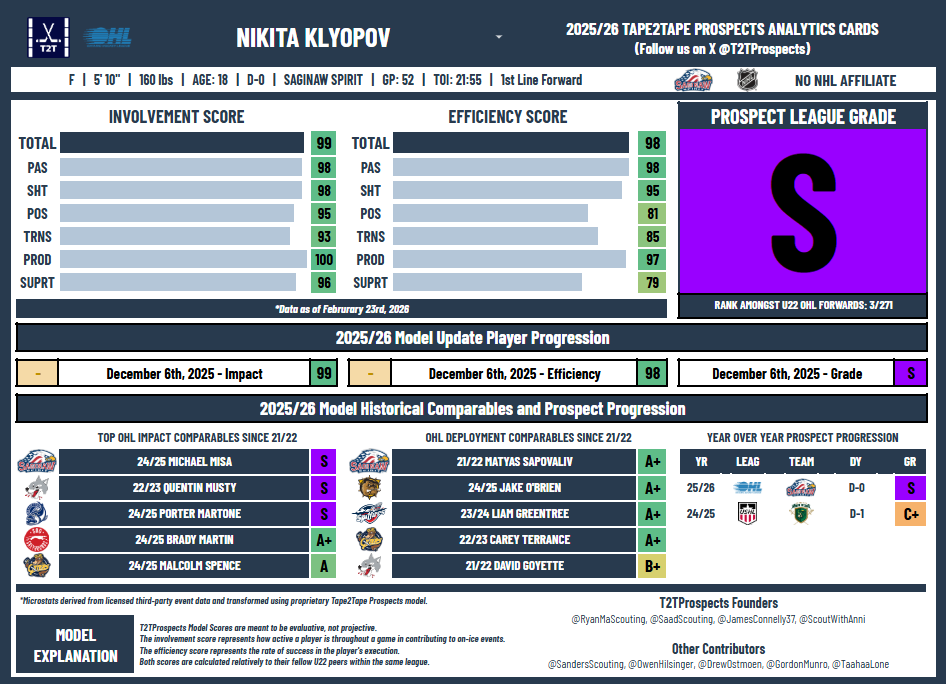
Games Tracked:
04/02/26 vs Kitchener (Playoffs)
02/22/26 vs Guelph
01/22/26 vs Peterborough
ELEVATOR PITCH
Klepov is a highly skilled, slippery transitional forward whose game is driven by elite agility, deception, and puck manipulation, allowing him to consistently evade pressure and create offensive advantages in space. However, his tendency to overhandle the puck, inconsistent processing speed, physical limitations against pressure, and inconsistent off-puck engagement introduce a wide range of potential results, making him a high-risk, high-reward projection bet despite his clear flashes of dynamic offensive creation.
Klepov is one of the more entertaining players in this class for me because there’s just a ton of movement, deception and pace manipulation in his game that makes him really difficult to handle. He’s not necessarily a burner in terms of pure north-south speed, but he’s a very slippery, agile player who consistently finds ways to slither out of pressure and create advantages with his edges and handling ability.
What really stood out in my viewings was how comfortable Klepov looked operating through layers of defensive pressure when defenders were primarily attacking his stick rather than his body. In transition especially, he was really effective using east-west movement and changes of pace to pull defenders toward him before slipping pucks into space for teammates driving behind coverage. One sequence that really stuck with me was him getting triple teamed after crossing the offensive blueline and somehow still maintained possession for long enough to extend the play. At the same time though, that sequence kind of summarized both the positives and negatives of his game because while the skill to evade pressure was impressive, I also found myself wanting him to make quicker decisions more consistently instead of overhandling pucks.
Klepov loves to stop up after entries and manipulate defenders rather than simply attacking downhill immediately. When it works, it can be really dangerous because he has a strong enough stick and enough deception to freeze defenders and open passing lanes into the slot. He showed some really nice awareness, identifying neutral zone coverage breakdowns as well, hitting teammates with stretch passes into space when defenders lost track of assignments. Once he gets defenders leaning or reaching with their sticks in open ice, his lateral movement becomes really difficult to contain and he can create some really slick passing sequences against the grain.
At the same time, there were definitely moments where his processing confused me. There were rush sequences where the obvious play was available immediately, yet he’d inexplicably slow things down and completely kill any advantage his team had. He’d be on a 3-on-3 rush where he would inexplicably delay at the line, forcing his teammate to essentially glide along the blueline trying to stay onside before floating the puck toward where his teammate had previously been, effectively handing the puck back to the other team.
Another thing I noticed was that when Klepov got pushed onto the back foot offensively, particularly with the blueline behind him in-zone, he became far less willing to lean into his evasiveness and creativity. Instead of using his slipperiness to extend plays laterally, he’d often default to low-percentage shots on goal instead.
There’s no doubt Klepov is skilled and slippery but he can be real wasteful too with his decision making.
Physically, there are some pretty clear limitations right now as well. Klepov really struggles when defenders choose to play through his body instead of his stick. Along the boards especially, he lost a ton of pucks whenever defenders closed him out physically and didn’t afford him the space to slip away. To his credit, he does at least try to initiate contact first sometimes to create separation for himself when going after a 50/50 puck, but he’s just not strong enough yet for it to consistently work.
Off puck, I also thought the engagement level ran a bit hot and cold. His forechecking impact was pretty average, and there just wasn’t enough consistent urgency for me. Too often it felt like a bit of a lift-and-coast approach where he’d arrive late with his stick after the puck had already moved. Defensively, there were at least some positive moments. He showed decent activeness closing out toward perimeter players, had a few nice neutral zone effort sequences and contributed reasonably well as a shot blocker but the consistency level is still just very inconsistent.
All in all, Klepov is still a really fun projection bet because players with this kind of agility, and offensive creativity are hard to find. The physical limitations, inconsistent engagement and occasionally baffling decision making create some real risk in the profile, but the offensive tools and transitional playmaking flashes are dynamic enough to make an investment in this range.
#40 - Alan Shaikhlislamov - Tolpar Ufa - RW/LW -MHL
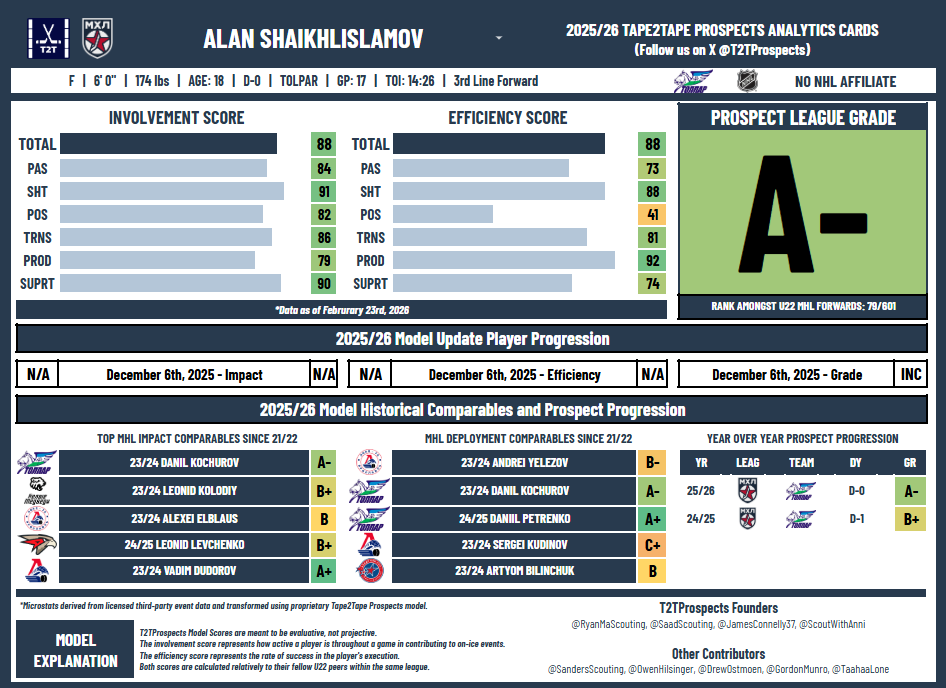
Games Tracked:
04/07/26 vs Avto Yekaterinburg (Playoffs)
03/19/26 vs HC Belye Medvedi
02/13/26 vs HC Kuznetskie Medvedi
ELEVATOR PITCH
Alan Shaikhlislamov is a high-motor, defensively engaged winger whose game is driven by an explosive first step, relentless puck pressure, and strong forechecking habits that make him effective in all three zones despite limited offensive polish. While his puck skills, on-puck zone entry creativity, and ability to consistently threaten the middle of the ice still need development, his work ethic, defensive impact, flashes as a playmaker, and projectable motor give him strong bottom-six NHL projection with room for growth given his late birthday.
I REALLY like Alan Shaikhlislamov.
Sure he’s spent the season in the MHL, and that league is always a little bit hit or miss but man I think this may be my favourite Russian League player so far this draft cycle. I don’t know how high the ceiling is for Shaikhlislamov who’s not this super slippery, dynamic offensive player with the puck, but I can see the makings of a pretty good bottom six player here.
Shaikhlislamov is an absolute hound on the ice in the best way. Just really encouraging effort levels for a winger, even in his own end. He explodes out from his spot defensively to chase down rims from his defensemen to support breakouts and even when he’s beat to the puck he does a great job of applying puck pressure on the pinching defenseman to try and turn the puck over. He’ll finish his hits all over the ice and he’ll make sure to add an extra shove after he closes out on a shooter or puck carrier if they let go of the puck before he gets there.
This relentless, disruptive nature extends in the offensive zone as well and on the backcheck. Just all over the back of opposing puck carriers trying to win pucks back and he does a wonderful job reading defenders on the forecheck, cutting off passing angles with his stick and forcing the opposing team to force pucks up the boards where his teammates can pinch and kill clean breakouts. At the crux of all of this from Shaikhlislamov is a really explosive first step that allows him to build speed in a hurry and close distance on opponents quickly.
There’s also a really smart passer here in Shaikhlislamov, who sees passing lanes really well and showed flashes of really high end touch, being able to feather passes through traffic to his teammates in the slot. (He had a great pass against Avto Yekaterinburg in the playoffs where he got the puck in the high slot and just softly lifted it through four defenders to get it to his teammate in front of the net.
In the offensive zone, Shaikhlislamov’s game revolves around hard work along the boards. He’s constantly engaged in the cycle game, picking pucks out of corners and scrums and looking to get it into the slot area with his passing. He also does a great job with off puck routes, finding soft ice in order to receive the puck with space to move into and trying to get into the net front.
I do think the puck skills are going to be an area of improvement though, Shaikhlislamov reverts to a lot of dump ins when approaching the offensive blue line, and I think especially in the MHL where the quality of defense isn’t always the best, there is a lot of opportunity for him to showcase and develop a willingness and ability to attack guys to create for himself. The skating and first step is there, but there seems to be an lack of on puck creativity in terms of using his hands and skating to create advantages for his team with the puck. As a result he also doesn’t threaten the middle of the ice enough and settles for too many low danger perimeter shots.
All in all, I think there’s a super translatable skillset here with Shaikhlislamov and as one of the youngest players in the draft class with a September 2008 birthday I think there’s tons and tons of time and opportunity to develop more confidence with the puck. He’s not as far along in his refinement and skill as a guy like Fyodorov but I really do think the physical tools, size and age are going to be really intriguing to develop and why I’ll actually have him just ahead of Fyodorov in my final rankings. I’ve got a good feeling about this one…
#41 - Victor Plante - F - USNTDP - USHL
Games Tracked:
03/29/25 vs Cedar Rapids Roughriders
04/24/26 vs Denmark U18
ELEVATOR PITCH
Victor Plante is a high-motor, intelligent two-way forward whose game translates through pace, defensive reliability, and strong slot-to-slot habits rather than high-end offensive creation. While his skating, compete level, and details give him a strong pro-style foundation and a relatively high floor, his limited dynamic offensive skill likely caps him as a dependable energy 3rd liner rather than a complimentary top six player.
Victor Plante is the type of player who wins coaches and fans over in a hurry. His game isn’t particularly flashy and I don’t think he’ll ever be mistaken for a high-end offensive creator, but he does so many little things well that it’s easy to envision him carving out a role as he climbs levels. He’s a smart, responsible player who doesn’t cheat the game, competes hard in all three zones, and consistently finds ways to impact shifts without needing the puck on his stick for extended periods of time.
For me, Plante is what I like to call a slot-to-slot player. He backchecks all the way into the defensive slot, works hard to break up plays, and then drives the offensive slot with the same level of commitment. A lot of his offensive impact comes from getting to the right areas at the right time. There’s an honesty to his game that’s easy to appreciate… he works for his offense instead of waiting for it to come to him.
The skating is a big reason why his game works. He gets up and down the ice well, closes quickly on opponents, and consistently arrives on pucks with purpose. Despite lacking ideal size, he plays like he’s a few inches taller. He uses his compact frame effectively, has surprising shoulder strength, and does a good job leveraging his reach to shield pucks and battlem through contact. He was constantly involved in my viewings, hounding pucks on the forecheck, disrupting plays through the neutral zone, and helping extend possessions through sheer competitiveness.
His defensive habits are particularly appealing. Plante doesn’t just wave his stick around in the general direction of puck carriers—he genuinely closes out on players and commits to taking away time and space. Whether it’s stepping into passing lanes, getting into shooting lanes, or supporting underneath in board battles, he consistently shows good details away from the puck. He wins possession back in a variety of ways, whether that’s through direct pressure, deflections, support routes, or simply outworking opponents in contested areas.
With the puck, Plante is primarily a connector. He moves pucks efficiently through the neutral zone, helps transition play north, and generally makes smart decisions. His small-area passing is quite good, particularly when feeding teammates in motion, and there are moments where his patience stands out. He’ll occasionally slow the game down in his own end and hit a well-timed stretch pass that immediately creates transition opportunities.
I do think there’s a little more skill here than he’s often given credit for. There were flashes that elevated his projection beyond a simple energy-line role. Splitting defenders using his hands, a few net drives resulting in a shot on goal…. they aren’t plays he makes every shift, but they show there’s some offensive capability underneath the work ethic.
That said, I still have questions about the ultimate offensive ceiling. Most of his offensive-zone passing remains fairly perimeter-oriented, and he doesn’t consistently create dangerous opportunities through deception or individual skill. The hockey sense is there, the details are there, and the compete level is there, but I’m less convinced there’s enough dynamic offensive talent to project him into a major scoring role.
Overall, I like Plante quite a bit. Strong skating, intelligent two-way habits, relentless work ethic, and enough flashes of skill to keep defenders honest make for a very projectable player. The size won’t do him any favors, but he plays with enough grit, pace, and determination that I wouldn’t bet against him finding a way to become a pro. The offensive upside may be somewhat capped, but the floor feels relatively high because of how reliably he impacts the game in all three zones.
#42 - Daxon Rudolph - Prince Albert Raiders - RD - WHL
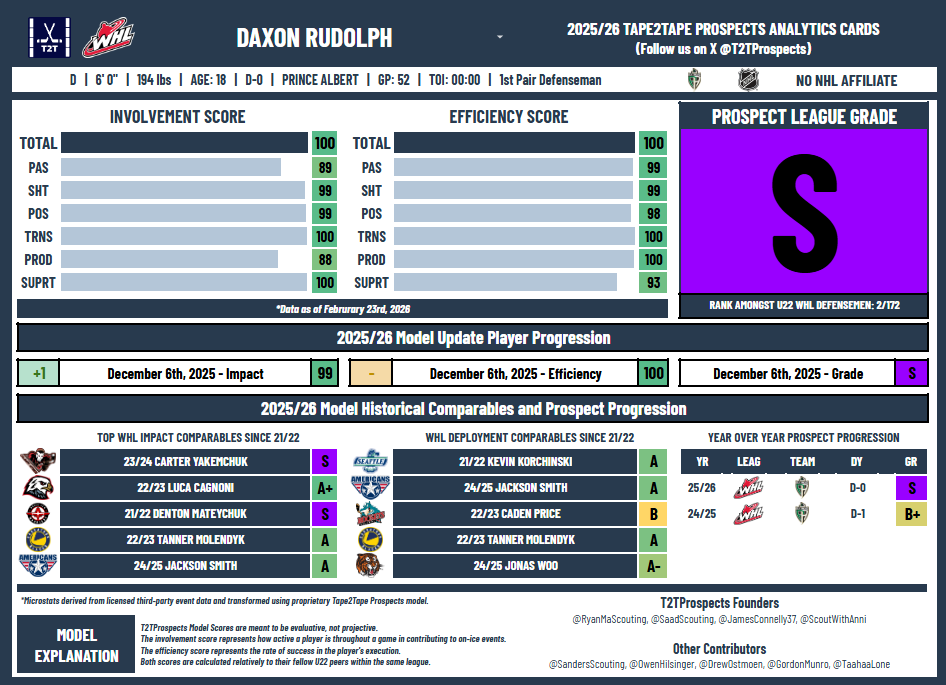
Games Tracked:
04/29/26 vs Medicine Hat (Playoffs)
03/27/26 vs Red Deer (Playoffs)
02/16/26 vs Moose Jaw
ELEVATOR PITCH
Daxon Rudolph is a mobile defender whose skating, active stick, and flashes of transition play give him legitimate NHL tools, but his game currently lacks the processing speed, pace and decisiveness needed to consistently leverage them against pressure. While he can transport pucks, disrupt plays, and activate offensively when given time and space, inconsistent awareness and scanning habits, hesitant puck management, and defensive lapses leave him far more of a project than I believe has been circulated.
I know I am going to get SIGNIFICANT backlash on this ranking for Daxon Rudolph, and I get it. I’m probably one of the few guys who will have him this low, but he’s generally been one of the most frustrating players I’ve watched this year especially given how great I thought he was in his D-1, and it genuinely feels like his play has gone in the wrong direction.
There are stretches where Rudolph looks like a modern puck-moving defender capable of driving transitions, activating offensively, and disrupting plays with an active stick. There are other stretches where his awareness and decision-making leave him chasing the game.
Rudolph’s skating forms the basis of his projection. He’s a smooth, fluid mover who can comfortably carry the puck through the neutral zone, join the rush as a second wave option, and maneuver around lighter layers of pressure. Offensively, I particularly liked his movement away from the puck. He consistently found opportunities to activate into open space around the slot, making himself available as a passing option and creating additional layers for his team’s attack. When he has time and space to operate, there are flashes of soft skill that allow him to work through coverage and generate chances off the rush.
Defensively, Rudolph’s stick is one of his better assets. He does a nice job mirroring attackers, extending into passing lanes, and attacking the hands to break up plays before they develop. His ability to knock pucks loose and disrupt possession stands out, and there were numerous instances where he killed plays early through anticipation and stick positioning. He also showed some willingness to engage physically around the crease, tying up sticks and attempting to limit second-chance opportunities.
The issue is that many of those positive traits become less effective when the game speeds up. Rudolph can look hesitant with the puck, particularly during retrievals and zone exits. I’d like to see significantly more pre-scanning before touching pucks. Too often his head remains down through retrievals, only looking up once pressure has already arrived. That forces rushed decisions, abandoned passing options, and unnecessary turnovers. There were multiple sequences where he attempted to skate through pressure without recognizing the closing defender, resulting in dangerous puck losses in his own zone.
His passing ability also remains inconsistent. While there are moments of quality puck distribution, I’d like to see him play with more pace and conviction on his breakout attempts. Rather than manipulating forecheckers or using his skating to escape pressure before making a play, he can become reactive and make situations harder than they need to be. In the offensive zone, he generally defaults to safer options such as cycling pucks low or dumping them into space when confronted by pressure.
Defensively, Rudolph can become spatially disconnected during scramble situations. There were instances where he drifted toward empty ice while immediate threats developed around the net front. Added strength will be important as well. His aggressive stick often gets him into good defensive positions, but stronger forwards can power through his engagements and continue driving toward the crease.
Ultimately, Rudolph’s appeal lies in the combination of mobility, defensive disruption, and occasional flashes of offensive skill. When his motor is engaged, he can kill plays, transport pucks, and contribute positively in transition. The challenge is improving his awareness, processing speed, and ability to execute under pressure. He currently needs a bit of space to access his best tools, and without more explosiveness, contact balance, or puck protection, that limitation becomes more apparent against higher-end competition.
#43 – Vertti Svensk – LD – SaiPa – Liiga/U20 SM-sarja
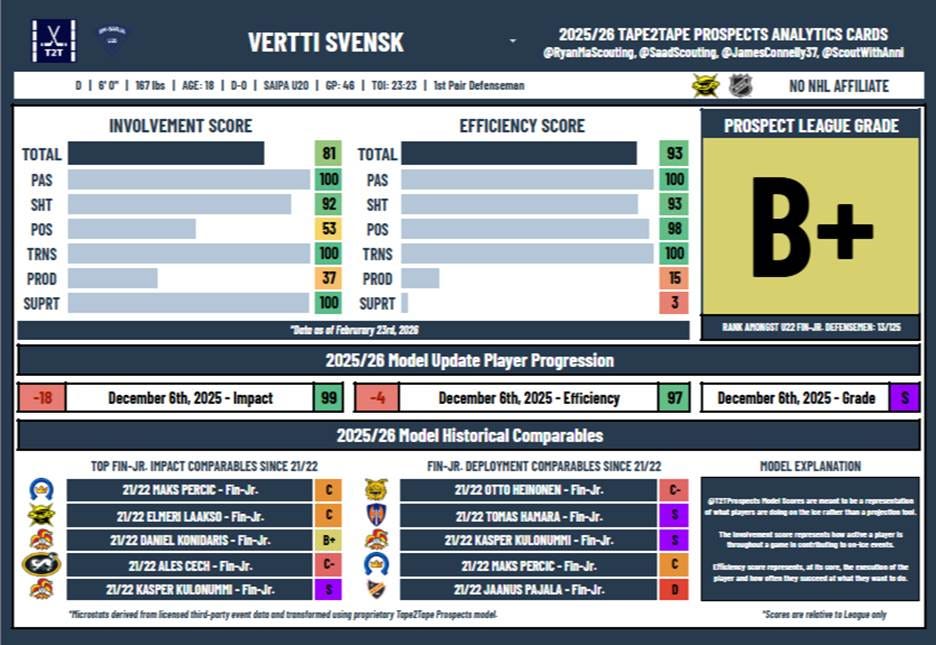
Games Tracked:
12/04/25 vs KooKoo U20
01/09/26 vs Roki U20
01/14/26 vs Oulum Karpat
01/16/26 vs Mikkelin Jukurit
ELEVATOR PITCH
Svensk is a highly mobile, skate-first defenseman whose elite mobility drives strong defensive range, rush denial, and puck retrieval efficiency, while also enabling him to contribute as a capable puck mover and occasional transition threat offensively. However, his defensive structure, gap discipline, and consistency in coverage remain a work in progress, and while he has the skill to create offense in flashes, his long-term value will hinge on refining his decision-making and becoming more positionally disciplined under structure.
I didn’t expect to watch Svensk play on the wing in my first Liiga game against Karpat, but funny enough, I didn’t hate it. The top-notch skating clearly translated, and he played a refreshingly aggressive forechecking game in his limited ice time.
Svensk, as my friend Charles (@SandersScouting) at T2TProspects would call him, is a fun, “skatey” boy, and well, Svensk can skate, that’s for sure. It allows him to efficiently mirror opponents when defending rushes, to stop and start on a dime, and it also allows him to get to puck retrievals while avoiding pressure from incoming forecheckers. The mobility lets him be really aggressive in closing space along the perimeter, and it means there are some really nice splash plays when defending rushes where he can just kill plays with his stick.
Offensively, while he’s not nearly as audacious and involved on the puck as Soderberg is in transition, Svensk is a really talented player with the puck as well. He’s capable of playing stretch passes between the lines, backhanding passes softly off the boards under pressure to teammates, and he’s even willing to take pucks for a ride between the blue lines and into the offensive zone while trying to deke through defenders.
Svensk plays a really balanced game in the offensive zone (like a lot of Fins), and he won’t push or force the issue in the offensive zone unless he sees an opportunity, but there’s a lot of skill here.
His goal against RoKi U20 was a thing of beauty where he deftly stick handled past a defender closing out on him, took the puck to the hashmarks and rifled it through the goalie. Another play against KooKoo U20, when they had KooKoo hemmed into the offensive zone, he got the puck off a rebound, delayed, faked the shot, toe-dragged it past the sprawling defender, and wristed it towards the net.
It’s a really fun player with some sick tools that I think could really benefit from being challenged next year in a men’s league or North America. The in-zone defending can get chaotic at times; Svensk can lack the eye discipline you would like from a defenseman, and his smooth skating can lead him to roam more than coaches may be comfortable with. There were a few mental lapses covering the backdoor that he’ll need to tighten up, and he had a few scrambly moments trying to organize and pass off coverage, but he’s a willing participant in board battles, and he’ll often go in shoulder and hip first to try and wedge opponents off the puck.
I’m a big fan of Svensk, and while I wonder how he would play in his own end when forced to be more structurally disciplined, I think there’s too much skill and confidence to drop him much further in my rankings.
#44 - Ludvig Soderberg - LD - Sodertalje SK U20 - U20 Nationell
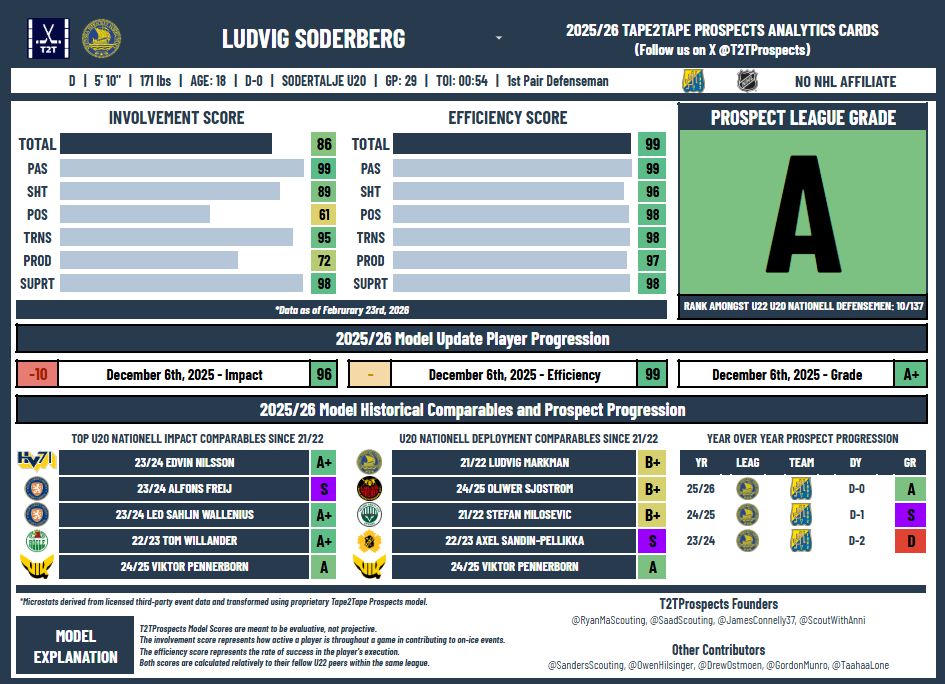
Games Tracked:
11/14/25 vs Orebro HK U20
11/30/25 vs Vaxjo Lakers HC U20
12/17/25 vs Kalmar HC
12/19/25 vs Modo Hockey
ELEVATOR PITCH
Soderberg is a highly mobile, intelligent puck-moving defenseman whose game is driven by elite skating, strong transitional ability, and confident playmaking that consistently generates controlled entries and drives play in the offensive direction. While his cup of coffee in the SHL highlighted both his responsible risk management and his need for added physical maturity to handle stronger competition, his overall processing, movement skills, and transition impact make him an exciting development bet whose effectiveness will depend on continued growth in strength and off-puck defensive consistency.
Soderberg got a cup of coffee in the SHL, and it’s clear to see why in both ways.
On one hand, the strengths were there, super fluid skater, high intelligence and confidence with the puck while also having a very responsible risk vs reward style to his game. Especially against men in the SHL, he was much more willing to make the quick play up the boards and retreat on 50/50 pucks near the blue line, which was the main concern of mine from his U20 tape.
On the other hand, his frame is clearly just not ready for a full-time SHL role. Got blown up a few times on breakouts/retrievals that led to turnovers (in all fairness to him, one was mostly his teammates’ fault for saucing him a suicide pass right into pressure).
All in all, though, Soderberg is a REALLY fun player, and I’m not surprised that Scouching had him ranked 36th back in December. I’m not that high on him myself, but I expect that I’m really not far behind.
Just a really natural mover with the puck, who drives a TON of play the right way for Sodertalje. If anything, I feel that his transition score per our model at T2TProspects is somehow too low. Soderberg is a transition monster at the U20 level, using his exceptional skating to carry the puck through the blue lines and generate controlled entries.
He’s a super-aggressive player who relies on that skating to allow him to recover from any missteps. At the U20 level, you see way more aggressive pinches from him, over pursuits along the boards, but while the stickwork could use some work in his own end, I can appreciate the activeness and motor.
Soderberg doesn’t have the hardest shot, and it can almost look floaty at times, but he’s shooting mostly for tips, and it’s super effective at getting through traffic. There are certainly things for him to improve on in his own end, but the movement skills, passing acumen, and intelligence make him one of the most exciting hidden gems in the Scandinavian Region.
We’ll need to see how his off-puck game matures in its consistency, even if it’s working for him at the U20 Level, but I think this is someone who will really benefit from a bigger challenge in the HockeyAllsvenskan or SHL in his D+1.
#45 – Jaxon Cover – London Knights – LW – OHL
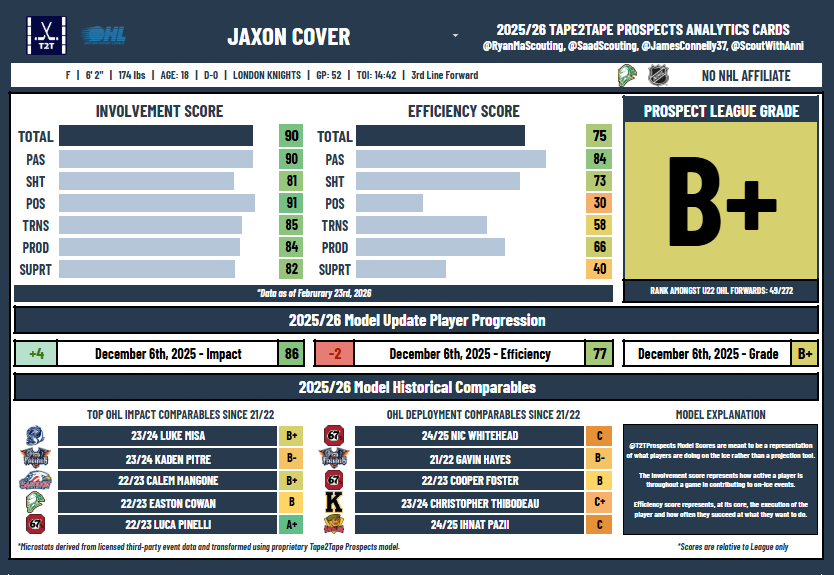
Games Tracked:
02/27/26 vs Windsor
01/10/26 vs Erie
11/28/25 vs Saginaw
ELEVATOR PITCH
Jaxon Cover is a high-upside, rapidly developing forward whose offensive game is driven by strong net-front instincts, creative puck distribution in tight areas, and a dangerous catch-and-release shot when operating in rhythm around the offensive zone. While his skating mechanics, off-puck structure, and consistency in forechecking and transition engagement remain raw and inconsistent, his rapid development curve, intelligence in scoring areas, and flashes of high-end offensive creativity means there’s a ton of upside to unlock if his toolset continues to mature.
Jaxon Cover didn’t really start playing ice hockey until he was around 13 years old, which is important to note when you watch him play.
Cover is far from a finished product; there are moments of brilliance and high-intelligence-based connective play. He has a nose for the net, an adeptness of picking out pucks from between skates and sticks in the slot, and flashes of physicality. If you watch the good flashes of Jaxon Cover, it’s not a surprise that he’s generated the hype he has.
I don’t think I’ve seen enough of those flashes from Cover to grade him in my first round, and if I am ONLY taking into account what I’ve seen on tape in these three games, I’m not sure I’d have him in my Top 64... but again, I take you back to the first sentence. He’s come a really far way in not a ton of time.
Let’s first talk about the good with Cover. The shot can be a weapon. When it comes to catch and release shots or pouncing on loose pucks in the slot, the shot comes off his stick with life and accuracy, going bar down like his goal against Windsor. He’s got a bit of a slingshot mechanic, though, and it sometimes means that when he’s facing pressure, he doesn’t get the full load up, and the shot can come off his stick really weak. Essentially, Cover at this stage is not yet a self-creating goal-scoring threat, but his nose for the net means he can still find ways to get on the score sheet.
The best of Cover’s game ultimately comes when he or London are moving forward with the puck. The skating becomes more purposeful when the puck lands on his stick in high-danger areas, and he’s extremely intelligent and sharp with his decision-making under those circumstances. Sometimes it’ll be really quick, short area passes to teammates to set up quality scoring chances. Sometimes he’ll hold the puck, delay, attack the middle, draw attention from the defence, stickhandle through a stick or two and then sauce a pass back against the grain to a diving teammate. He’s an extremely dangerous player in the final stages of play in the offensive zone before a scoring chance. He wants to get the puck to his teammates in the slot, and when he’s in rhythm and moving in one direction, he can execute that goal amongst the best in the OHL.
On the downside, the skating and structure without the puck are clunky. Cover has good intentions, and I don’t think this comes down to a lack of competitiveness, but he’s not someone who I feel makes enough hard plays on the forecheck. I’m not sure if it’s his roller skating background, but Cover floats into his spots on the forecheck, taking wide, looping turns. I haven’t seen him make explosive force plays along the boards to cut a breakout off. A lot of the turnovers he forces are also often the result of his teammates funnelling defensemen into him. He comes off unengaged at times without the puck because of this skating style, but I do think the motor is there; he will have spurts of plays on the backcheck where he’ll absolutely hound opponents with stick lifts.
The motor is also not an issue when the play gets into a board battle; he’s a willing participant, trying to use his stick and body to move players away to poke pucks to teammates. It’s hit and miss, though, at this stage, as Cover is still learning how to leverage his size and strength to consistently win puck battles.
Cover offers an extremely fascinating dilemma for NHL front offices. Offensively, his creativity and ideas on the puck are high-end and show an innate understanding of making tight-area plays under pressure, but he takes wide turns and struggles to change directions quickly with the puck. That weakness carries over off the puck, where the rest of his game remains raw and very much a work in progress. His ranking relies a lot on the premise that his rapid improvement to this point continues, but I think there are enough tools and flashes here for him to be a Top 50 player in the class.
#46 - Viktor Fyodorov - Torpedo Nizhny Novgorod - C - KHL/VHL
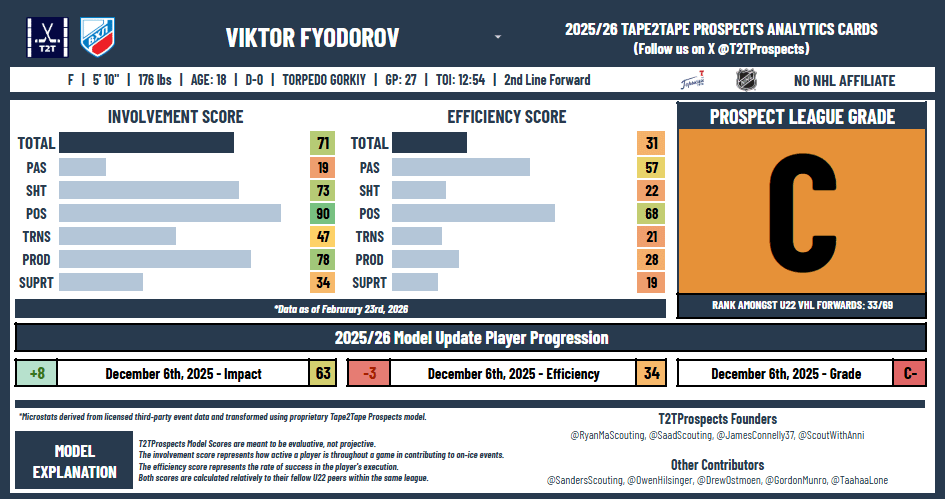
Games Tracked:
04/14/26 vs HC Omskye Yastreby (Playoffs)
03/04/26 vs HC Ladiya Togliatti
02/11/26 vs HK Norilsk
ELEVATOR PITCH
Viktor Fyodorov is a high-motor, two-way forward who impacts the game through relentless puck pressure, strong stick detail, physical engagement for his size, and intelligent short-area decision-making along the boards and in transition. While his puck handling at speed, passing accuracy, and tendency to settle for lower-danger perimeter shots still need refinement, his competitiveness, defensive disruption, and ability to sustain cycles give him a strong support-forward projection.
Viktor Fyodorov is 100% a top 3 Russian League player in the draft for me this year.
I’m always a big fan of players that showcase a ton of motor and willingness to engage in the play at all times and that is the crux of Fydorov’s game when it all boils down. Fydorov is super pesky on the backcheck, using an active stick to try and stick lift opponents and turn play the other way. He’s not the biggest player but he will absolutely line guys up and step into them when they’re not expecting to be hit with timely step ups in the offensive zone.
Along the boards, there’s a bit of an edge, even if he can’t get to the puck carrier before the puck is gone, he’ll throw an extra shove at the end. He’s got good effort level in the neutral zone and on the forecheck to just close down angles on opponents and cutting down space for them to operate. He uses this motor to get in on pucks after dump ins or retrievals after shots, and he’s just got a really strong stick that he leverages in all phases of the game, whether it’s using to take away the puck, or maintain possession of it through contact.
Fyodorov’s skating is good enough at his size (and he does look a bit bigger than his EP listed height of 5’11”), and he’s a smart off puck mover in transition, getting into pockets of space and pushing north to give his teammates outlet options. With the puck, there’s some nice plays and ideas. He’s smart and poised under pressure, using good pre-scanning habits to make quick plays like backhanding it off the wall to his teammate with his back to the offensive blueline to gain the zone.
Fyodorov just has very good understanding of leverage, using it to maintain puck possession and sealing opponents off when meeting along the boards for a loose puck. When he can’t field passes clean, he’s got the coordination to kick it to his stick with relative ease while getting hounded. He tries to make quick plays in the cycle game along the boards to keep plays alive and that applies to his game in the neutral zone as well, often using quick passes to get play oriented the right way.
Fydorov is a very good small area player who thrives on being in the thick of the play and contributing positively along the boards, but the passing accuracy and hit rate is definitely a work in progress to this point. He does a great job working pucks into the right areas but his final conversion on passes into the real scoring areas of the ice to teammates often get blocked or disrupted.
I also think Fyodorov’s puck skills are good but the handling at high speeds can be a bit loose and he doesn’t always execute smoothly. Plenty of occasions where he’s mishandled pucks and has to kick them back to is skate while in motion and using some awkward, long, rangy stickhandles on dekes. Fydorov is a willing shooter, but due to his size and puck skills I do think he’s a little bit too content with settling for lower danger perimeter shots. He’s got a nice toe drag and release but it does tend to get blocked a good amount.
All in all, Fydorov is a hard working player who makes and executes quick short area plays around the ice well with his decision making. There’s a slippery aspect to his game along the walls, and there are all the tools here for him to be a very good support player on a line.
#47 – Adam Andersson – C – Leksands IF U20 – U20 Nationell
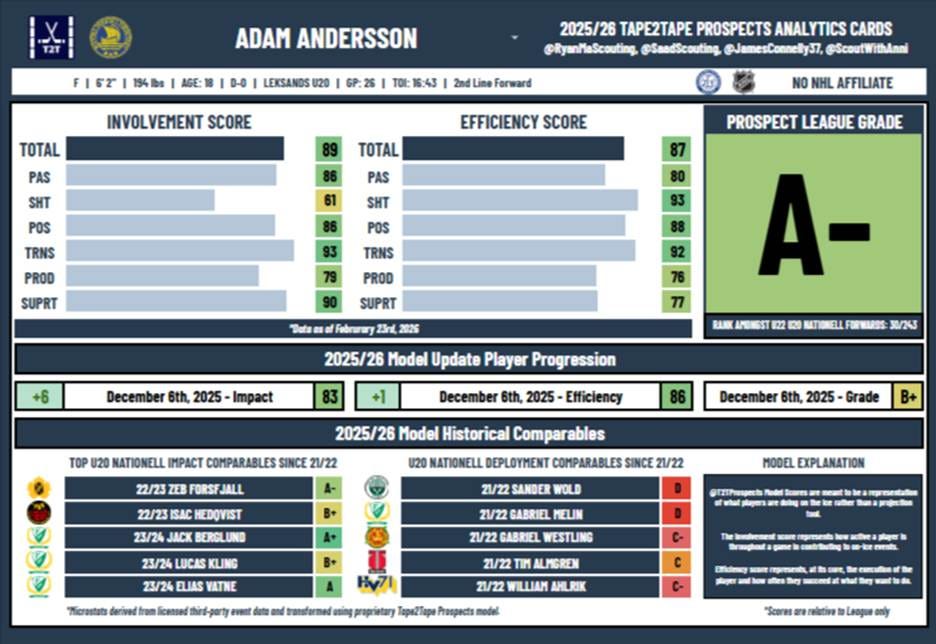
Games Tracked:
10/18/25 vs Brynas U20
11/28/25 vs Timra U20
02/21/26 vs Skelleftea U20
02/26/26 vs Mora IK U20
ELEVATOR PITCH
Adam Andersson is a big, defensively responsible 6’4” center whose value comes from strong positioning, reliable slot protection defensively, effective stick work, and a disciplined two-way game that projects well in a defensive and support role. While his skating, physical dominance, and self-created offensive impact are more limited, his size, defensive reliability, and finishing skillset give him a very viable bottom-six NHL projection if his mobility and puck protection can develop further.
Adam Andersson scores in three ways.
1) A power move from behind the net, on his forehand, where he sweeps the wrap-around attempt to the far side.
2) A one-timer on his offside.
3) A laser beam snapshot from a distance.
It’s a simple approach, and while it hasn’t yielded him many goals, at 6’4”, there are some tantalizing traits here.
There’s a lot of vanilla to Andersson’s game for the most part. Great centerman habits where he’s constantly protecting the slot in the defensive zone, dropping down to the goal line to support his defensemen when they get board-played. He’s consistently in the right spots on the forecheck, even if he’s not necessarily winning tons of pucks and that forces quick decisions from the opposing defensemen, which can lead to mistakes.
The one thing I can appreciate about Andersson as well is his commitment to closing out perimeter shooting threats. He takes away the shooting lane, gets square to the shooter, and uses his stick to force a pass down the boards, where he can funnel the play into coverage. It also leads to tons of deflected passes in passing lanes and makes him a reliable penalty killer and defensive zone player.
Andersson isn’t a great skater, to be completely honest. He’s got long, slow strides, and he’s super upright in his skating stance, which leads to somewhat awkward-looking mechanics. I wouldn’t call him super explosive either, but with time and space, he can really make some nice plays.
His assist against Modo Hockey was a thing of beauty, gathering the puck from his own end, evading the first forechecker with a cut to the inside, before taking the defenseman wide, and using his long reach to hook a pass into the slot for his teammate to tap in.
With that being said, at his size, Andersson is not super physically imposing. He will have some plays where he can squeeze an opponent off the puck with his size, and clear it, but there are often times (especially when he’s at a standstill covering the slot or net front) that smaller players can out-leverage him.
Andersson has some nice puck protection skills, but I find that with the puck on his stick, he likes to stick handle away from pressure and into open space, which is often away from the net. I’ve yet to see many moves where he drives the net with purpose to get off his own shot in tight; he seems to love dropping the puck back, or pulling up for an attempted slot pass instead. Without the puck, he’ll drive the slot area and park up in front of the net, but overall, he just does not have enough self-creation towards the center of the ice.
In summary, there’s definitely a player here in Andersson. You can do much worse than a big, defensively responsible center who works hard around the ice and has a really effective stick. The concerns will lie in the skating and the inconsistent contact balance and puck protection skills that may hamper his NHL projectability. There are some comparisons to be made with fellow Leksands product Tinus Luc Koblar,, who’s been having a breakout D+1 while showing out for Norway at the World Championships.
#48 - Ben Macbeath - LD - Calgary Hitmen - WHL
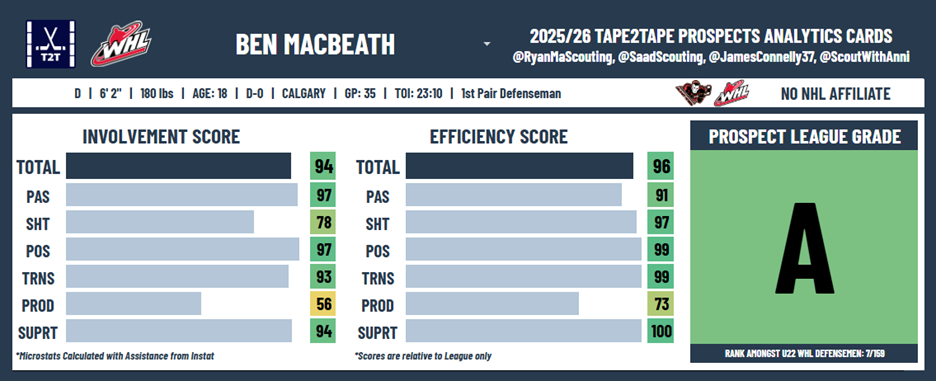
Games Tracked:
11/05/25 vs Moose Jaw
12/06/25 vs Lethbridge
12/30/25 vs Vancouver
ELEVATOR PITCH
Macbeath is a smooth-skating 6’2” left-shot defenseman who wins his minutes by combining strong rush defense, an active and intelligent stick, and calm, efficient puck movement as a reliable distributor from the back end. While his lack of top-end explosiveness and physical edge may limit his ceiling, his poise under pressure, anticipation, and steady passing ability project well as a secondary puck-moving defenseman at the NHL level.
Macbeath is someone who I think certainly deserves to be in the conversation for one of the Top 50 prospects in the 2026 NHL Draft.
The 6’2” LHD has logged huge minutes this year for Calgary, and I’ve been a huge fan of his style of play. A really smooth skater with fluid hips, MacBeath has a super active stick that he uses to disrupt opponents trying to attack him off the rush.
Because of this, he’s great at defending at the point of attack, stepping up at the blueline with great accuracy, while also having the maneuverability to back out of it if he thinks he’s about to overcommit. As the secondary defender, he does a great job anticipating passes as opponents cross the blue line and uses it as his opportunity to jump up and break up the play.
I’ve also really liked Macbeath’s play on the puck this year. Just a really poised player that has some real confidence on the puck. He’s not afraid to take the puck on a ride in his own end and through the bluelines when he has space, but that’s not even his calling card.
Macbeath is a true distributor of the puck. When I think of high-volume players, I think of super-fast players that zoom across the ice, but Macbeath influences the game in a much more subtle way. His passes are quick and arrive with some pace, springing his teammates with open ice to skate into.
I don’t think he’s super dynamic by any means, and he doesn’t play a super physical brand of hockey at 6’2”, but there’s an intelligent player here that I think has more than enough skill sets for an NHL team to work with. The biggest concern for me is the lack of explosiveness; it doesn’t look like he has that next gear when he builds up speed, and it was pretty apparent in a few foot races for a loose puck.
All in all, there’s a really good player here that could turn out to be a great secondary puck-moving defenseman on an NHL team with some above-average rush defending capabilities.
#49 - Brek Liske - RD - Everett Silvertips - WHL
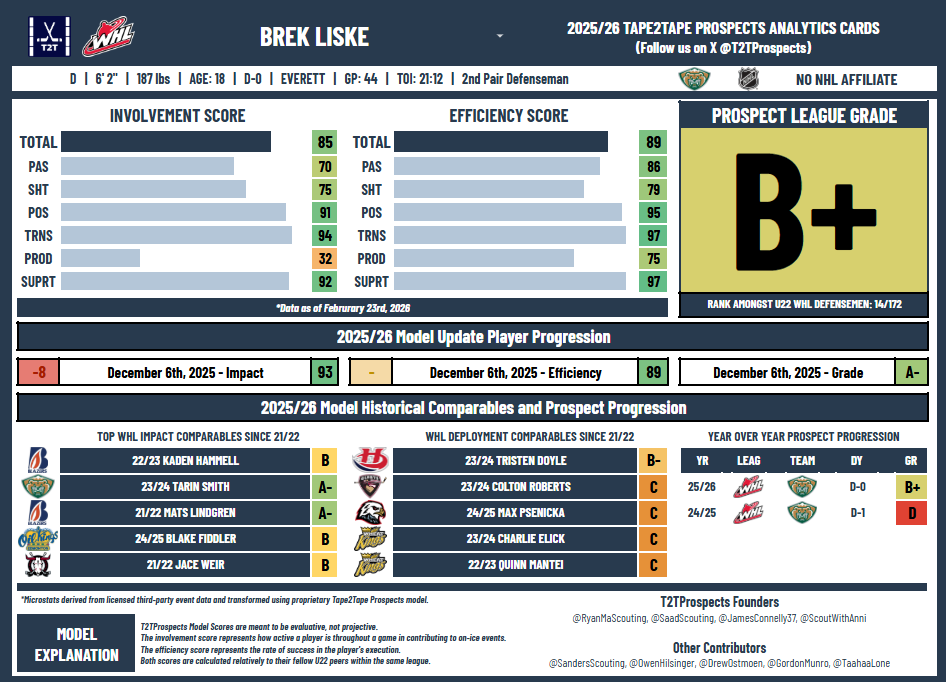
Games Tracked:
10/04/25 vs Victoria
11/26/25 vs Regina
01/03/26 vs Wenatchee
ELEVATOR PITCH
Liske is a strong, mobile 6’2” right-shot defenseman who stands out with his mobility, sturdy frame, and sneaky offensive shot that generates rebounds and secondary chances, giving him intriguing value as a transition-supporting blue-liner. While he isn’t a dominant play driver or highly dynamic passer yet and could use more physical assertiveness along the boards, his discipline, puck-moving efficiency, and ability to his shot off make him an intriguing upside bet whose overall impact may grow with a larger role.
One of my co-founders at T2TProspects, David Saad (@SaadScouting), has had a huge crush on the Everett Silvertips’ RD since October, and it’s easy to see why.
Liske is the opposite of Macbeath… but in a good way.
While both are officially listed at 6’2”, Liske looks the part more than Macbeath. He’s big and sturdy, and very evidently a much better natural athlete. The skating is top-notch, and he can really get going through the neutral zone when you give him a head of speed.
One thing I’ve really appreciated about Liske is his shot. He’s got a really sneaky wrister that he actively looks for, that fits through traffic and almost always generates quality chances off the rebound for his teammates. That’s where the size and skating make Liske a super intriguing product because there are flashes in the offensive zone where he’ll hold the puck around the perimeter looking for an opportunity to let a wrister go.
I’ve heard some people characterize Liske as a bit risky in play style, and at least in my viewings, that’s not something that flared up too much. He’s got a good stick that he uses effectively to hassle opponents along the wall, and for the most part, I like how disciplined he’s been in his “pinch” vs “stay” decision-making.
Even when he gets put into bad spots (like getting handcuffed with a bad pass into his feet at the offensive blueline from a teammate), he doesn’t panic and has the presence of mind to shunt the puck into a less dangerous area of the ice so he and his teammates can recover.
I wouldn’t say he’s the most dynamic passer, and Everett doesn’t rely on him nearly as much to be a dominant player in transition, but he’s accurate on his breakout passes when he’s asked to. I also think he does a great job of blending his ability to skate for entries and exits, subsequently opening up the passing game for himself.
You’d want Liske to be a bit more physically dominant along the wall, given his frame, but he’s still competitive in puck battles, and he’s had to play on his offside at times in the season. All in all, the size, skating, and shot make Liske an intriguing option, but I’m left wondering how he would perform as a driver of play if he had to play a bigger role.
#50 - Evan Jardine - F - Youngstown Phantoms - USHL
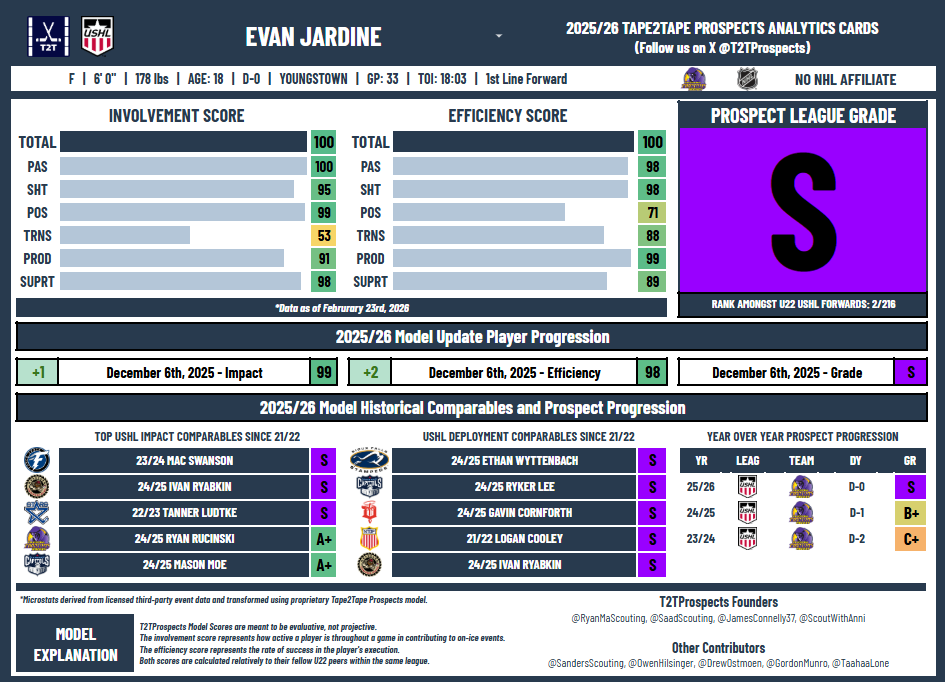
Games Tracked:
05/09/25 vs Muskegon
01/23/26 vs USNTDP U17
03/06/26 vs Madison Capitals
ELEVATOR PITCH
Evan Jardine is a cerebral, pass-first forward whose elite pre-scan habits, vision, and efficient processing allow him to consistently identify and execute high-end passing plays in tight and under pressure, making him one of the draft’s more underrated playmaking threats. While his shot is serviceable and his stick skills are strong, concerns around physical engagement, board battle consistency, and effectiveness on the forecheck temper his projection. Ultimately, his hockey IQ and distribution ability still make him a compelling driver of offense with real NHL upside as a complementary playmaking winger.
I’m a fan of Evan Jardine who just oozes a calm, cerebral presence on the puck and is for my money, one of the best passing forwards in the draft this year that not enough people are talking about.
Jardine is constantly pre-scanning before he receives a pass or picks up a puck, and this habit of his makes him really good at diagnosing and navigating pressure. He can sense and feel the pressure, where it’s coming from, and with good awareness of where his teammates are, he can make quick, subtle and efficient movements to get his body where it needs to be, and the puck where it needs to go. That’s the hallmark of Jardine’s passing, it’s always purposeful. He’s so smart; he gets to loose pucks quickly, and because he always knows what he wants to do with the puck before he gets it, he can make quick decisions with the puck to get it to his teammates in space.
It’s truly impressive. Because the core of his passing comes from his vision and hockey sense, rather than his hands and skating, it appears understated on screen. However, Jardine demonstrates an undeniable ability to find passing lanes.
No look tips under pressure along the boards to get his teammate the puck with space, constantly making cross-seam passes that force the defence to scramble and recover, slipping passes through skates and sticks to teammates in the slot, backhand saucers in his own zone to clear the first layer of the forecheck and get his defensemen into open ice, etc. He makes it look so easy, but Youngstown consistently created dangerous scoring chances when he was on the ice. While he definitely leans passer over the shooter, I did like what I saw from his shot when he showcased it. It’s a snappy, quick release that he can fit through traffic, and while he won’t be winning any Rocket Richards with that shot, I think it’s a sneaky good one.
I really love how effective and efficient his stick work is, too. He has a quick and accurate stick lift that lets him pick out pucks in the periphery of board battles, and his hand-eye coordination is deft, allowing him to tip and corral bouncing and airborne pucks. Unfortunately, I would like to see him be harder to play against. On the puck, he protects it well before making passes, but I find a really concerning lack of engagement on forechecks and in board battles. While his stick lift is effective, it’s not infallible, and it seemed he was particularly susceptible to contact.
Overall, I’m enthusiastic about Jardine’s combination of hockey IQ, passing ability, and his efficient play style. My reservations lie with his ability to engage more physically in the other areas of his game away from the puck.
#51 – Ryder Cali - F – North Bay Battalion – OHL
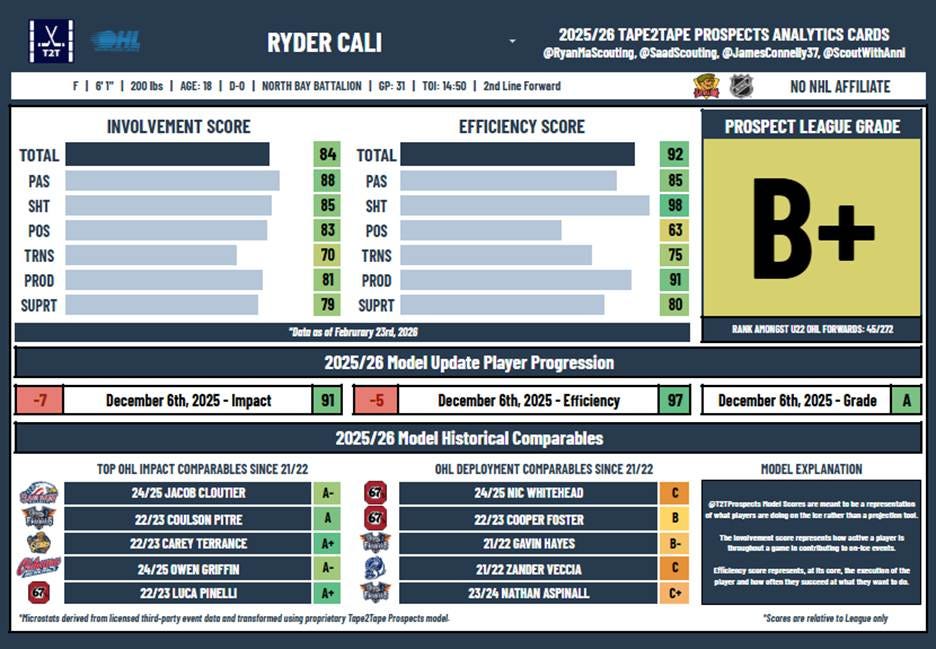
Games Tracked:
03/05/26 vs Oshawa
02/01/26 vs Niagara
10/18/25 vs Barrie
ELEVATOR PITCH
Ryder Cali is a high-floor, coachable forward whose game is built around strong straight-line speed, simple north-south attacking, net-front opportunism, and reliable support habits that make him effective in structured systems despite limited offensive creativity. While his puck skill under pressure, board battle effectiveness, and forechecking impact remain below average and may cap his ceiling, his speed, work ethic, and translatable style still project him as a potential depth NHL forward with upside as a complementary energy piece.
Ryder Cali is an OHL coach’s dream, but is also the kind of player that will go underappreciated wherever he goes.
Cali doesn’t have the elite tools that you’d be looking for as an NHL team but the translatable way in which Cali plays will very likely make him a Top 64 pick in the draft this year, and is someone I could easily see the Team Canada selection committee of old bringing to a World Junior Championship as that random surprise depth piece.
Cali’s a good skater who doesn’t have great acceleration or burst, but builds up speed REALLY well. This makes him dangerous when he receives a drop pass, and gets the opportunity to build up his speed through the neutral zone to attack defenders who are near a stand still. A few nice stick handles in tight, and Cali can blow by less agile or unsuspecting defenders and attack the net.
Cali also has some nice off-puck movement; he doesn’t generate a ton of clean slot chances off of it, but he’s really opportunistic around the crease area, looking for rebounds to punch in. When he does get an open look in the slot, he’s got a nice snapshot as well that he can use to pick corners for goals.
That’s Cali’s game in a nutshell: Use your speed to get entries, and when you can’t, dump it in. Support your linemates as the F3, recover pucks, get them to the blue line, and then drive the net front hard and look for loose pucks. It’s not sexy, and Cali’s draft stock will be held back in some ways because of that.
In summary, he’s not a player who can hang onto the puck in the offensive zone against a set defensive structure and create an advantage for his team with the puck. There aren’t tons of high end skill in his package outside of those few flashes off the rush. Cali has a great complementary style to his game, but the lack of creation on the puck and lack of hard skills without the puck make his projection less clear-cut. He’s not a super effective forechecker, ranking just 36th percentile in the OHL for takeaways and 61st percentile in puck battles this season. He’s not a high-volume playmaker that can consistently hit passes into the middle of the ice from the perimeter as a passer, and he’s a player that I’ve seen struggle to handle pucks in the offensive zone under pressure.
The question for NHL teams will be, “what is his projection?” The speed and net front scoring won’t be enough to carry him into an NHL role. Can he learn to win battles along the boards more consistently? Can he keep pucks alive in the offensive zone and hang in there physically to get a cycle going? There’s a lot to like here, and Cali will have every opportunity to show that growth next season with Providence College.
#52 - Brooks Rogowski - Oshawa Generals - C - OHL
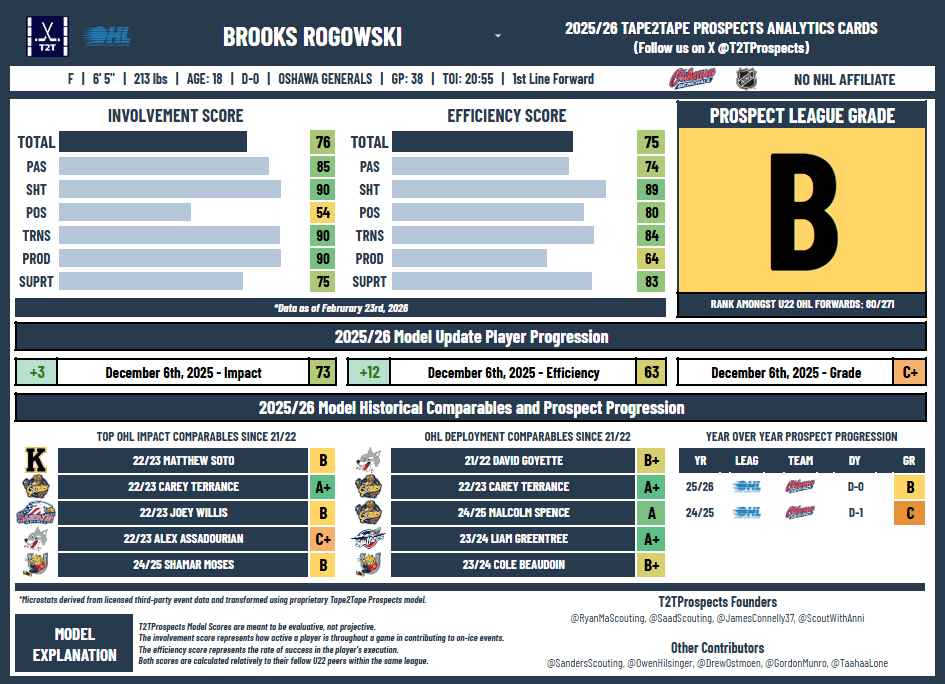
Games Tracked:
04/25/26 vs Sweden U18
03/15/26 vs Barrie
02/08/26 vs Sudbury
ELEVATOR PITCH
Rogowski is a projectable, size-and-mobility-based centre whose value comes from decent skating, responsible defensive positioning, and above-average passing instincts for a bigger forward, giving him appeal as a complementary, two-way support player. However, his limited puck skill, inconsistent physical engagement, underwhelming puck protection, and slightly slow execution of his ideas limit his offensive upside, leaving him best projected as a complementary center rather than a true driver of offense.
Rogowski is a player I found myself going back and forth on quite a bit this year because there are elements of his game that I think are genuinely projectable at higher levels, particularly the skating, passing instincts and defensive habits for a bigger center, but there are also some pretty clear limitations offensively that leave me questioning how much upside there really is here. All in all though, I still came away liking enough of the translatable traits to keep him around the 50s range on my board.
For a bigger forward, the skating is honestly pretty solid. Rogowski moves well north-south, can build speed through the neutral zone and showed the ability to be the first player in on dump-ins and loose pucks. I wouldn’t necessarily call him explosive or overly dynamic with his feet, but the mobility is definitely good enough for his size and gives him a decent floor as a support player. Defensively, I also thought he showed a pretty mature understanding of where he needed to be positionally. He’d regularly come down low into the defensive zone to support his defensemen, swept loose pucks out toward his wingers and helped relieve pressure with quick simple plays.
What I found most interesting about Rogowski though was that despite being a bigger center, he’s actually a very pass-first player offensively. A lot of bigger forwards at this level default toward straightforward north-south power plays or shot volume, but Rogowski consistently looked for slot-oriented passing options instead. When he had time and space with the puck, there were some legitimately really nice cross-ice feeds and interior passes. Off the rush, especially, he flashed some good vision finding trailing teammates or slipping pucks into the middle of the ice instead of forcing perimeter shots. I actually think he probably needs to shoot more because there were sequences where he passed up reasonable shooting opportunities, trying to force the extra play.
The ideas, willingness, and skillset are there but the hockey intelligence and quick decision making as a passer does lag at times. There was a 2-on-1 sequence that kind of summarized his offensive game for me where he identified the correct passing option, but executed it just a split second too late and slightly behind his teammate, ultimately killing the chance. The processing and ideas are often fine with Rogowski, but the execution and pace of the decision making falls just short.
At the same time though, I don’t think Rogowski is really a driver of offense right now. A lot of his transition offense comes more as an off-puck presence rather than someone actively transporting or creating through layers of coverage by himself. His puck skills are average and he doesn’t really create much separation handling the puck through pressure. Along the boards especially, he usually defaults toward quick chips, rims or simple wall plays rather than trying to extend possession and attack inside himself.
Physically, I also expected a little bit more from a player with his frame. Rogowski isn’t really all that physical despite the size and I actually thought he struggled with contact more than I anticipated. Defenders were able to get underneath him easily, push him off his spots and disrupt his balance. His puck protection when forced to hold the puck for extended stretches was also pretty underwhelming because he could get undercut pretty easily. I think adding more lower-body strength and stability will be really important for him moving forward.
Defensively, there’s enough engagement here that I wouldn’t call him passive by any means, especially compared to some of the other bigger centers in this range. He showed decent effort coming back into the zone and I liked some of the details in his positioning. In the neutral zone particularly, he used his reach and timing pretty effectively to disrupt passing lanes and break up plays before they fully developed. However, I don’t think his defensive game can be considered a strength. He doesn’t consistently win races to loose pucks in his own end the same why he does offensively, doesn’t really separate players physically and often relies more on poke checks and his reach than actually taking pucks away outright. The backcheck effort level could also run a little hot and cold at times.
On the forecheck, Rogowski similarly leaned heavily on his reach rather than consistently driving through opponents physically. There were moments where he closed well and disrupted plays, but I wanted a little more pace, urgency and physical assertiveness considering the size profile.
All in all, Rogowski feels like a decently projectable complementary center who brings decent skating, good enough defensive tools and some legitimate passing instincts for a bigger player. I don’t think there’s a ton of offensive creation upside here because the puck skills and physical play both lag behind a bit, but the combination of size, mobility and connective playmaking ability still makes him an interesting player in this range of the draft for me.
#53 – Beckham Edwards – Sarnia – F – OHL
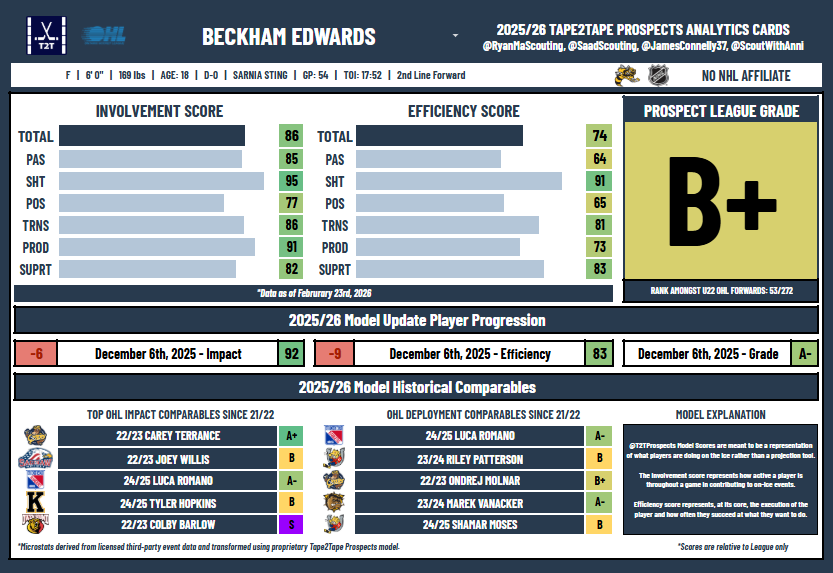
Games Tracked:
03/20/26 vs Kitchener
02/27/26 vs Barrie
02/06/26 vs Oshawa
ELEVATOR PITCH
Beckham Edwards is a defensively aware forward whose value comes primarily from his anticipation, lane disruption, and straight-line skating that enables transition opportunities and a heavy shot-focused offensive approach. However, his limited on-puck creativity, inconsistency with his off-puck routes, and reluctance to attack defenders with possession, significantly caps his offensive ceiling, making him a project pick that is valued for his defensive-zone work and shot volume until the on-puck creation improves.
After watching Edwards and Di Iorio back to back, Beckham Edwards is certainly the easier watch on the eyes. He’s just a much better skater who has above-average straight-line speed, and even though he’s very hunched over in his stance, the skating is one area of his projection that will be easier to envision at the pro level compared to his Captain and Sarnia teammate.
Edwards’ hallmark to his game is his defensive intelligence and work rate in his own end. Very good anticipation defensively to get into passing lanes, but in conjunction with his foot speed, it means that he can pick off passes at the bluelines and charge forward for rush opportunities where he can then beat goalies clean with his shot. He’s got good feet on the perimeter, opting for shorter strides that will allow him to change direction and mirror opponents. He’ll explode forward with his stick and close gaps, before boardplaying the opponent.
Edwards is another player who leans toward being a shooter rather than a passer. He likes bringing the puck across the blueline, and rather than trying to drive the net or create a high-danger chance with his skating or hands, he’ll wrist a long-distance shot on goal, swim the defender and try to beat him to the rebound. Edwards in the offensive zone is also a pretty vanilla product, lots of quick, decisive passing on the perimeter that don’t really threaten the middle of the ice. Off the puck, he’ll usually be going to the net front to bang in rebounds or camping in the mid to high slot looking for shot opportunities. If there’s one thing about Edwards is that he will spam shots at any angle. If he’s within medium range of the net, his instinct is to shoot it, not really scanning to see if there’s a passing option.
I don’t really love Edwards’ off-puck routes in his own end. He tends to bring traffic towards his defensemen after a retrieval, and that just adds a ton more congestion and pressure for his teammates to navigate, and he doesn’t make himself an outlet option, often forcing them to punt the puck up the ice to one of the wingers. In the neutral zone as well, tons of times where he’ll overlap into his teammates’ lane, causing congestion and confusion.
I think there’s a lot more to exercise here with Edwards in terms of his natural tools, but I find his overall involvement in the game lacking. I won’t speculate if it’s to do with a lack of confidence in his hands, but Edwards never tries to attack defenders with the puck, even on odd-man rushes or partial breaks. The motor is inconsistent on the forecheck; even though he has the size and speed, he lacks the timing and industriousness as the F3 to break up plays and force offensive or neutral zone turnovers.
All in all, the raw tools are there for Edwards, which means that there is a projection for him at the pro level. However, the hockey intelligence when his team has the puck is far from ideal, and I’m not certain that it can be easily fixed. NHL teams that see him as a potential defensive zone workhorse and value his heavy “shots on net” programming could take him higher, but that’s ultimately why he’s just outside the Top 50 on my board.
#54 – Yaroslav Fedoseyev – Belye Medvedi Chelyabinsk – RD – MHL/VHL
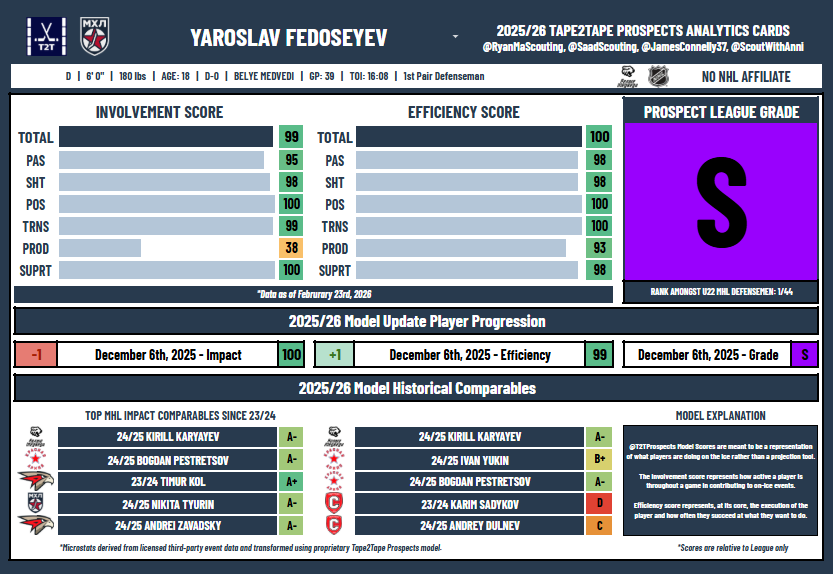
Games Tracked:
10/03/25 vs Mamonty Yugry
01/29/26 vs HC Metallurg Novokuznetsk
02/26/26 vs AKM Tula Region
02/28/26 vs Ryazan-VDV
ELEVATOR PITCH
Fedoseyev is a smooth-skating, fluid and mobile defenseman with strong rush defense, proactive stick work, and some flashes of real high-quality breakout passing that makes him intriguing as a puck mover. However, his inconsistent pace of play, lapses in structured defensive coverage, and a lack of urgency and pace with the puck limit his projection, leaving him as a really fun and really chaotic developmental bet.
Fedoseyev is pretty unique. I certainly like him more than a lot of the defensemen I’ve done this season, but I’m not sure I see enough of a package where I could carve out exactly what I envision him doing at the NHL level someday.
Funny enough, I’ve actually been far more enthused with Fedoseyev’s VHL tape than at the MHL level. Perhaps it’s me adjusting my expectations based on the context of him playing against men compared to his U21 peers, but I think the pace and intensity of his game is just a smidge heightened at the VHL level.
Fedoseyev is a smooth skater with fluid hips and great four-directional movement. You pair that with a proactive stick and a great understanding of gap discipline, and you see a player who is really adept at defending the rush and in space. Lots of great plays where he’ll wall off a winger streaking in, and kill the play before they can even get to the circles.
There’s also some slick passing plays under pressure, and he has some really nice stretch passes from his own end. That’s where the player profile becomes a bit muddy. On paper, a smooth skater who can make nice breakout passes suggests he’s a strong puck-moving defenseman.
This is mostly true, but the pace is worrisome, especially in the MHL, where he truly looks like he plays at his own pace, which works but can almost come off as low-motor. There’s a lack of urgency with the puck, and I wonder if that’s a byproduct of him not feeling the challenge at that level, or if it’s simply the speed at which he’s comfortable playing the game.
The pace concerns lessen a bit at the VHL level, where I think the level of competition forces him to make decisions with the puck and on 50/50 plays quicker. However, I have noticed him struggling to defend in structure. Handing off coverage, tracking his man, there are some lapses when defending in the zone.
There was a play on the penalty kill at the VHL level where he just looked lost the entire time. The shift ended after a scoring chance in the slot was saved when he failed to fill the spot vacated by his defence partner.
To his credit, Fedoseyev has a nice snapshot he should use more often. With time and a bit of space, he can wire it in for goals (it’s actually how the majority of his goals have come this season).
The question ultimately lies in what role he could fill one day in the NHL? The pace won’t make him a huge needle-mover in transition, and while the rush defence is high-end, the in-zone defending is truly a work in progress. Could he become a defensively sheltered, puck-moving third pair, 2nd power-play unit guy? Maybe, and that’s what an NHL team will be hoping for when they draft him, but there’s just so much fun stuff to his game that I think you just have to bet on the talent.
#55 – Thomas Vandenberg – Ottawa 67’s – C – OHL
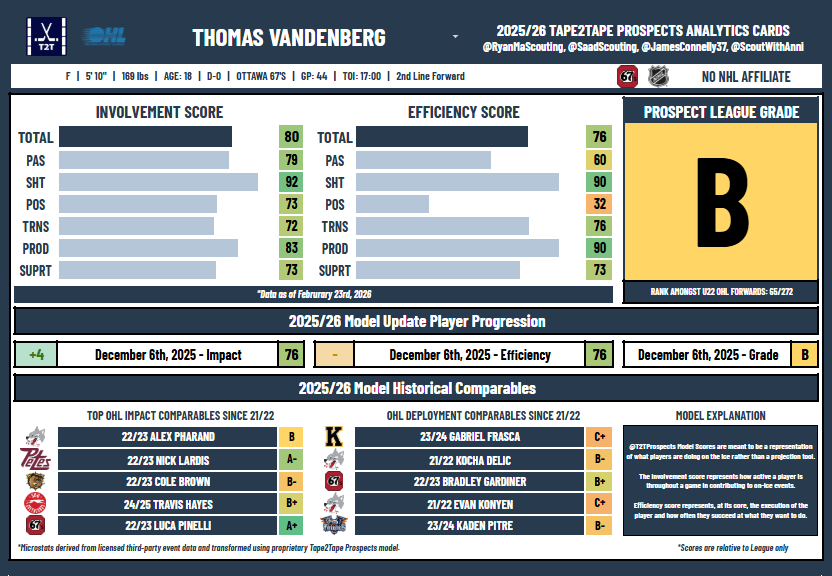
Games Tracked:
03/01/26 vs Sarnia
01/18/26 vs Peterborough
11/28/25 vs Oshawa
ELEVATOR PITCH
Thomas Vandenberg is a smart, defensively responsible, off-puck-driven center whose value comes from strong awareness as the F3, effective support play, physical engagement in board battles, and reliable net-front/off-cycle scoring contributions. However, his limited explosiveness, weak transition creation, and underdeveloped passing when it comes to getting pucks into the high-danger areas of the ice restrict his ability to drive play with the puck, projecting him primarily as a bottom-six, matchup forward who benefits from a longer development runway due to his late birthday.
Thomas Vandenberg has become a bit of a favourite here at T2T Prospects with both David (@SaadScouting) and Owen (@OwenHilsinger) swearing by the left-handed centremen’s NHL projectability.
In many respects, I see what Owen and David see in the player. Vandenberg’s not a huge guy, but he’s stout and physical and not particularly afraid to mix it up with bigger players than himself. He took a bit of a late crosscheck early in my first viewing of the day against Sarnia, and played the rest of the game like he had a real bee in his bonnet.
Vandenberg is a smart player who understands his role on the forecheck as the F3, never overcommitting, and always staying above the play, where he does a lot of unheralded work. He works hard in support of his wingers, joining puck battles, sealing off the boards, and picking his spots to jump in and cut off plays. That’s what Vandenberg’s game is all about to this stage: picking his moments off the puck to be as impactful as possible.
In the offensive zone, he works well with his teammates. The best offensive shifts for Vandenberg are those in which he and his line establish possession in the offensive zone and then begin cycling the puck, working it around in the corners, supporting each other in puck battles and rotating into the slot. Those sequences have led to pretty much all the goals Vandenberg has scored this year, whether it’s receiving a pass off the half wall from a teammate, deflecting a point shot, or banging in a rebound. From a macro point of view, Vandenberg’s offensive impacts at this stage are almost strictly off-puck.
Vandenberg’s defensive zone play and work rate are fine. I wouldn’t call him high motor, but he’s supremely efficient at sealing off players, getting leverage in board battles and chopping pucks off sticks. He’s not like a Quinn McKenzie who will buzz all around the ice, but he’s always in good spots defensively, and when he chooses to get into puck battles, he’s very effective at breaking up the play even if he can’t win the puck back.
It’s a hardworking, projectable style of play, but Vandenberg really doesn’t have the confidence or the skating at this stage to effectively impact the game with the puck on his stick. Not enough plays to the middle of the ice for me, whether it’s attacking for himself or getting pucks to his teammates in the slot.
It’s a limited passing toolset at this point for Vanderberg, and the results bear that out as well in the T2T Prospects model. Just 12th percentile in passes that lead to shots on goal, and just 32nd percentile in high danger passing. There were some nice moments in the corners where he could get the puck to the center of the ice, but in my three games, it just looked like his teammates were never on the same page. Right now, Vandenberg’s intelligence allows him to find space off the puck for his own scoring chances, but he hasn’t yet figured out the calculus to consistently get the puck to his teammates in similar spots when they’re expecting it.
I also think there can be far more pace and impact in transition to Vandenberg’s game. The skating at his size, I think, is really holding Vandenberg back at this stage in realizing his potential. He’s just not the best natural athlete, and it means he can’t turn and burn in the neutral zone and consistently drive plays into the zone on his own. There aren’t a ton of controlled entries that he creates, and I have seen a few times off the puck where he gets crossed up with a teammate in the buildup of play in the neutral zone.
With all things considered, Vandenberg is good. He’s a smart player who’s doing a ton to maximize the traits he does have, while masking his weaknesses. I think improved pace and explosiveness in his skating are the main things holding Vandenberg back from having a truly elite impact on the ice and both are certainly fixable. I think there’s a good chance of a “bottom of the line-up” projection here at the NHL level for Vandenberg, and with a September 2008 birthday, he’s got a TON of runway left.
#56 – Jean-Cristoph Lemieux – C/RW – Sudbury Wolves – OHL
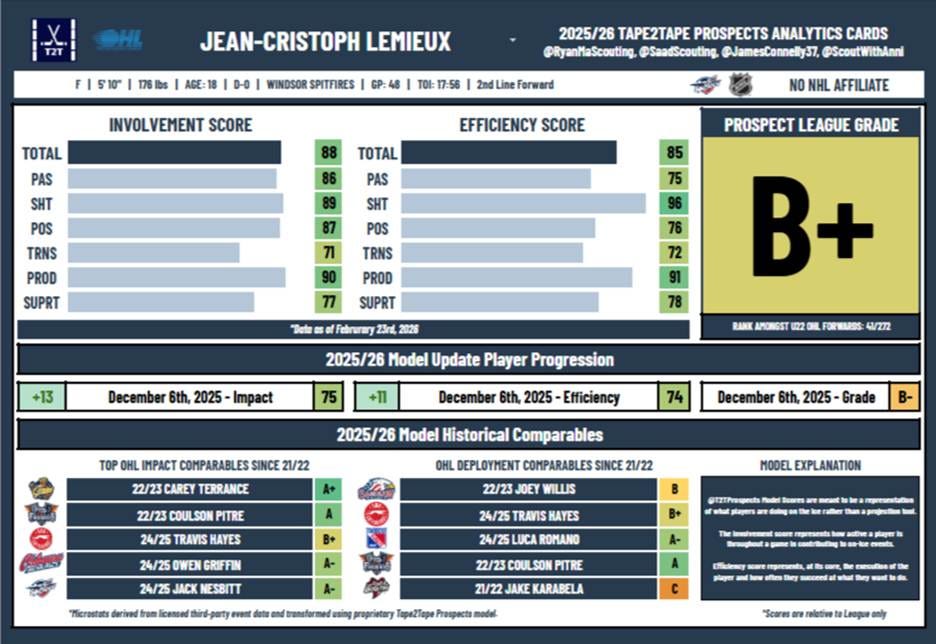
Games Tracked:
10/05/25 vs Owen Sound
01/07/26 vs Soo
02/01/26 vs Ottawa
ELEVATOR PITCH
JCL is a versatile, net-driven two-way forward whose game is built around strong off-puck intelligence, timely route-running in transition, and a hard-working, physically engaged style that makes him effective in bottom-six and support roles. While his motor consistency, forechecking intensity, and puck skills are still works in progress, his translatable habits, defensive awareness, and ability to generate offense through smart positioning and net-front play makes him a solid bet for a bottom six role in the NHL someday.
JCL matched his production of 18 points through 33 games with Windsor in just 15 games for Sudbury. The 6’0” left-handed forward has taken full advantage of his new role in Sudbury, and his draft stock has risen steadily under this new opportunity and deployment.
At his best, Lemieux profiles well as a spark plug, bottom of the line-up player. A diligent player away from the puck, I don’t necessarily see the same violence on the forecheck as I did when he played a secondary role for Windsor. However, he’s still a pesky player who intelligently cuts off opponents’ breakout attempts with anticipation along the half walls.
JCL isn’t the biggest player, but he has some very solid contact balance; he can take as good as he gives, and that makes him hard to erase from puck battles. I’d like to see a more active stick; his best work on the forecheck involves making body-on-body contact and pinning players or pucks along the boards with his skates rather than great stickwork to pick pucks away.
The skating is above average for Lemieux, and while it’s not elite, his off-puck movement and intelligence, especially in transition, mean he doesn’t need blazing speed to generate rush chances. Almost like a center forward in soccer, Lemieux times his runs incredibly well, cutting across the face of defenders at the blueline to receive aerial pucks or feeds from his teammates. Once he gets that bit of separation from the defenseman, that’s when Lemieux’s still-developing skill package comes into play.
Lemieux’s hands won’t wow you, but he’s got strong fundamentals, with a net-oriented style of play and some flashes that give you enough optimism that there’s something to work with. While most of his chances lead to him trying to take it to the net, Lemieux will at times experiment, a fake inside, then a windmill to the outside, before saucing a backhand pass across the crease.
I do think that JCL’s defensive intelligence is there; he comes down low to support his defenseman as a center, gets to the boards when he’s playing on Chovan’s wing, and has good scanning habits in his own end as a weakside defender. He also has some moments on the backcheck, when he’s close to the puck carrier, where he’ll really dig in with his stick lifts to try to turn the puck over the other way.
However, I do think the motor has waned as he’s stepped into a more demanding role with Sudbury. The forechecking has not been as consistent (his game against the Ottawa 67’s was one of the least intense games I’ve seen from him this season), and his backchecking has also been relatively hit or miss.
His role has clearly evolved on his new team, and while he now features on PP1 and sees far more offensive zone time, he’ll need to find the right balance on a night-to-night basis to sustain a more consistent effort. I have no doubt the motor and “dawg” he’s shown throughout the season are still there, but, like Easton Cowan had to figure out with the London Knights in his D+1, the balancing act between driving offence and playing that high-motor supporting game is still something that needs to be worked out.
I think there’s certainly enough to warrant a Top 2 Round selection here. The off-puck intelligence, motor, and net-driven play make for a strong floor, and while the on-puck skills are not dazzling, there are flashes, and he drives offence in a very translatable way. I do not doubt that he’ll have plenty of opportunities in Sudbury over the next few seasons to continue to hone his craft as an offensive player.
#57 – Landon Amrhein – Calgary Hitmen – F – WHL
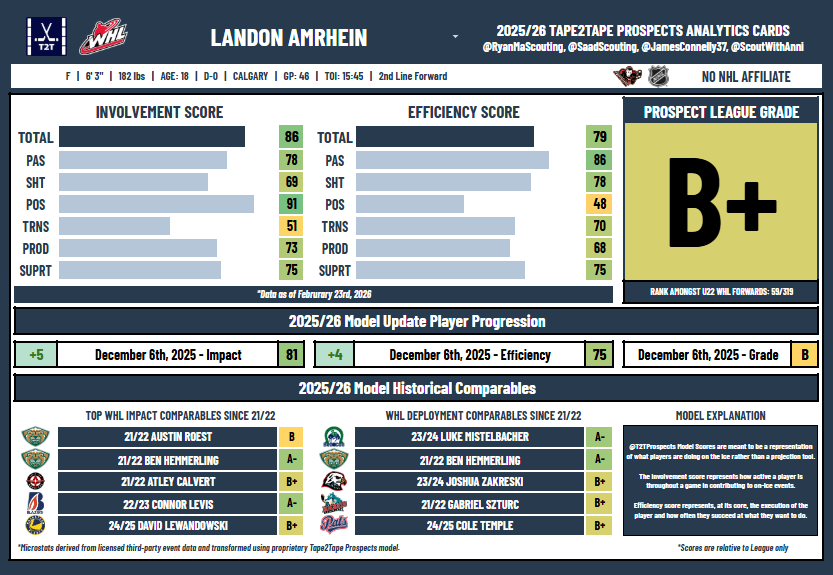
Games Tracked:
03/04/26 vs Swift Current
02/14/26 vs Edmonton
12/06/25 vs Lethbridge
ELEVATOR PITCH
Amrhein is a 6’4” WHL winger with strong passing instincts and a valuable role as a transition connector, often operating off the right wall to create controlled entries and feed dangerous interior passes, but he isn’t a consistent puck carrier or shooter. His projection hinges on whether his average skating, inconsistent stop and start ability, and underdeveloped physical game can evolve enough to let his passing touch and flashes of skill translate into a more complete offensive threat at higher levels.
Landon Amrhein has some real potential and is another intriguing developmental power forward to take after the first round this year.
Amrhein is a big boy, but if you’re looking for a crash-and-bang physical power forward, you’re out of luck. Amrhein on the puck is a far more finesse-based passing big. Along the boards in his own end, he’ll shield the puck with his frame and make nice bump passes to his faster teammates (usually Molgachyov or Wilkie) to carry through the neutral zone on exits. Amrhein grades out well in the T2T Prospects model as a transition threat, but it’s nothing dynamic, as he plays what I like to call the “John Tavares” role on entries. He’ll park himself on the right wing and receive passes from his teammates before entering the zone.
This is where the playmaking chops really highlight themselves though. He rarely opts for the power move on that wing, instead constantly looking to pass the puck through sticks to the center lane of the ice. Even with defenders trying to take that pass away with their stick, he’s remarkably adept at getting it to his teammates in stride, which led to a ton of scoring chances for his line off the rush. WHL teams have tried to adapt to this by aggressively attacking the center lane forward instead, and forcing quick decisions from that player, but I’m still left impressed with the touch Amrhein shows on his passing from the boards. There were some nice moments behind the goal line as well, where Amrhein will flip passes through traffic into the slot area for scoring chances.
Amrhein also showcases a diligent attitude in his support game. He’s got a long and rangy reach, which he uses as his primary weapon defensively. It’s a gift and a curse. There are times on the forecheck where Amrhein’s reach surprises defenders, and he’s able to poke it off their stick. Other times, he can really cut down time and space in a hurry and force defensemen into bad or rushed decisions.
Unfortunately, an issue I have noticed with Amrhein is that while his skating is actually average, and he can actually beat much smaller players down ice for loose pucks when he gets going with a head of steam, his ability to stop and start is below average. As a result, he does become guilty of not moving his feet on the backcheck and can get caught flatfooted in the defensive zone. When that happens, he starts spamming the reaches with his stick. He gets away with it most of the time, but at the NHL level, that won’t fly. He got penalized for that exact scenario with a holding call on the back check against Swift Current.
I’d like to see more of a dual-threat skillset from Amrhein, whose shooting involvement is pretty weak (47th percentile in SOG and 30th percentile in shots off the rush amongst WHL forwards), but there’s an untapped skillset here on the puck. Amrhein’s skating is not dynamic enough to be used to create time and space against a set defence, but on broken plays where he finds himself with both, the 6’4” winger shows off some almost Tage Thompson-esque plays with the puck.
Long, rangy stickhandles through traffic, a nice deke through an opponent’s triangle at a standstill to keep the puck from getting broken out of the zone... There are some intriguing tools here. While Amrhein hasn’t been able to meld his passing touch, strength/contact balance, and hands all together into a cohesive package, all of these elements flash separately (just never together), and you’re left wondering what this player could look like in a few years as he grows into his frame and learns how to use all the tools in his toolbelt.
The on-puck impact needs a good amount of development, and while the skating is not something I expect to be able to really improve much, it’s good enough to hang at the pro level. I think, like a lot of the players in this 2nd Round range, but especially with him, NHL teams will need to take a long-term approach with Amrhein, who’s already an effective supporting WHL player, but needs a lot of moulding and opportunity to develop into a true on-puck threat.
#58 - JP Hurlbert - Kamloops Blazers - F - WHL
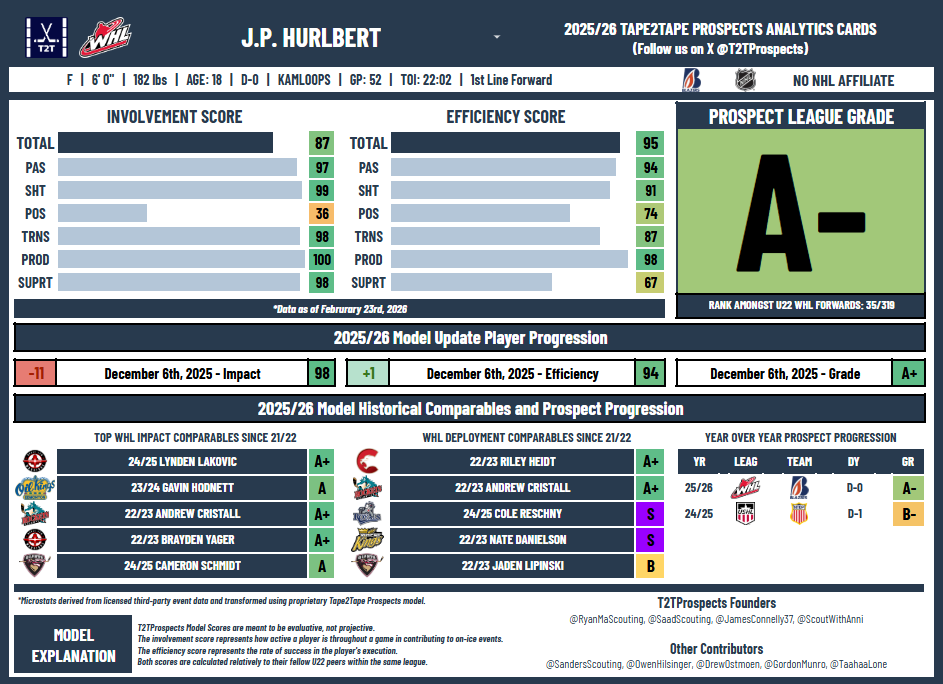
Games Tracked:
04/01/26 vs Kelowna (Playoffs)
03/07/26 vs Vancouver
01/31/26 vs Prince George
ELEVATOR PITCH
Hurlbert projects as a secondary-scoring winger whose value comes from off-puck instincts, shot volume, and timing into open ice rather than dynamic puck transport or rush creation. While he shows flashes of physicality, simplistic inside cuts on zone entries, and a quick-release, his limited skating, inability to navigate pressure with the puck, inconsistent pace and defensive intensity, his penchant for low danger perimeter shooting caps his ability to drive play. It makes him more of a complementary, depth off-puck scorer than a true driver of offense.
I want to like Hurlbert like so many people do, because there are real flashes of legitimately projectable offensive habits and some intriguing physicality, but the pace of his game and lack of consistent impact away from the puck just leave me unconvinced. At the end of the day, though, I still think there’s enough offensive instinct and off-puck scoring ability here to justify keeping him around the late-50s range on my board.
The first thing that stands out with Hurlbert is that he does bring a decent amount of physical engagement when the game calls for it. He works pretty hard as a forechecker, isn’t afraid to finish checks and has a bit of a nasty streak in his game that can make him annoying to play against. There were multiple sequences where he’d upend defenders or finish through hands along the wall to disrupt possessions. The problem though is that despite all the contact, he doesn’t actually recover pucks all that often afterward. A lot of the physicality ends up feeling a bit performative. This aspect of his game kind of summarizes his profile for me: there’s decent activity, but not always a ton of actual impact behind it.
Skating is definitely one of the bigger concerns in the profile. Hurlbert really lacks explosiveness and I don’t think there’s much of a separating gear he can get to at all. He can’t really beat defenders wide off the rush and there isn’t much pace to his puck carrying. In fact, one of the more noticeable issues in his game was just the lack of urgency with the puck in general. A lot of his offensive sequences developed at a slower pace and allowed defenders to stay structured against him rather than forcing them into difficult recovery situations.
Because of that, Hurlbert really relies on manipulation and timing offensively rather than pure skill or speed. As a self-creator, he’s honestly pretty much a cut-inside-from-the-wing-and-shoot type of player. He loves delaying after crossing the offensive blueline on his forehand before trying to cut toward the middle for a shot attempt. There were also some nice flashes where he’d try to skill pucks through defenders’ skates at the line to generate controlled entries or use his quick-release to get shot opportunities off the rush. When he successfully pulled those plays off, it actually created some dangerous looks because one nice thing about Hurlbert is he’s not afraid to shoot and he can get his shot off quick.
The issue is that once defenses get set, I don’t think Hurlbert really has the skating or handling ability to consistently work his way into the middle of the ice. Too often he’d drift back toward the blueline under pressure and just let shots fly from distance rather than continuing to attack downhill. Weirdly enough, I almost liked him more offensively when he was forced onto his backhand because it prevented him from immediately settling into those perimeter shot habits. It forced him to keep his feet moving and continue attacking space instead of defaulting to low percentage attempts.
Off puck though, I actually thought there were some pretty nice offensive habits here. Hurlbert has a crafty understanding of spacing and consistently found ways to sneak into open ice for scoring chances. He showed smooth little adjustments around coverage to get available for tap-ins or to establish positioning advantages at the offensive blueline before attacking space. In a weird way, his off-puck movement almost compensates for some of the skating limitations because he understands how to arrive early into space rather than needing to separate explosively afterward.
He also clearly has some offensive structure tendencies that his team leaned on regularly. One sequence that kept showing up was him rotating high into soft space where he could receive a quick pass from the right defenseman and immediately fire one-timers. Along the walls offensively, when pressure arrived quickly, he generally made pretty simple, efficient plays by shunting pucks down the boards and extending cycles rather than trying to overhandle the puck.
Defensively though, I thought the overall impact was pretty underwhelming. Positionally, he usually looked like he was tracking the play properly, but he rarely forced opponents into difficult decisions or disrupted possessions consistently. There just wasn’t much pace, pressure or real effort in his defensive game. He’d arrive into lanes and occupy space, but often never truly closed plays out aggressively.
All in all, Hurlbert feels like a player with a niche skillset and not a ton of margin for error to make the pros. His game is built around off-puck offensive instincts, some shooting ability and a bit of physical edge. The skating limitations, the pace and off-puck habit concerns scare me, and I don’t think there’s a ton of upside as a true driver of offense. Still, the combination of smart off-puck movement, flashes of skill manipulation on entries and some projectable scoring habits will be enough for me to keep him in my Top 64.
#59 - Liam Ruck - Medicine Hat Tigers - F - WHL
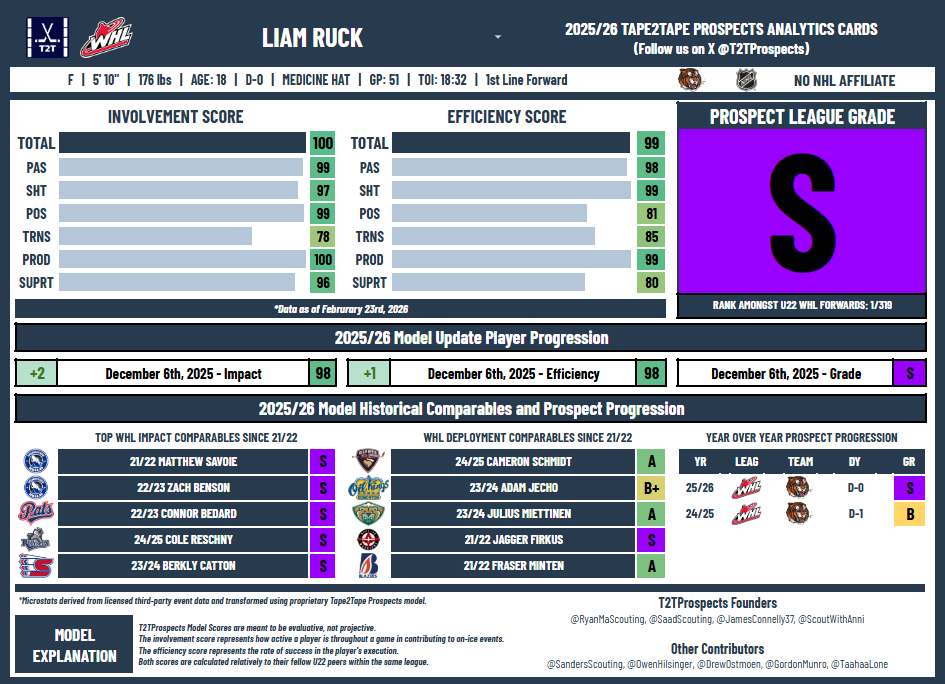
Games Tracked:
04/25/26 vs Prince Albert (Playoffs)
03/27/26 vs Regina (Playoffs)
02/24/26 vs Edmonton
ELEVATOR PITCH
Liam Ruck projects as a complementary scoring winger whose value comes from elite shot quality, strong off-puck awareness, and consistent ability to find soft ice for rebounds and broken plays, rather than truly meaningful puck-carrying or chance creation through possession. While his release and off-puck timing make him a legitimate scoring threat, his limited self-creation, inconsistent defensive urgency, and passive forechecking effort cap his upside and makes him more of a complementary depth scorer with sheltered deployment than a true offensive dynamo.
Ruck is another player I find that public consensus has much higher than I do, and to some extent I get it. There are parts of his offensive game that I think are genuinely projectable, particularly the shot, off-puck movement and ability to find soft ice, but the lack of creation ability and inconsistent engagement level away from the puck left me with some pretty significant reservations.
The first thing that stands out with Ruck is just how smart he is finding dangerous areas of the ice offensively. He’s not really a player who creates much in tight coverage or drives offense through possession, but he consistently puts himself in positions where plays can come to him. In transition especially, he does a really good job finding little pockets through the neutral zone where teammates can spring him with stretch passes for partial break opportunities. He understands spacing well and has a natural feel for drifting into soft ice before defenders can fully pick him up.
That same awareness carries over into the offensive zone too. I thought Ruck showed very nice off-puck movement, consistently driving the middle lane in transition and getting himself around the net at the right times for rebounds, loose pucks and broken play opportunities. This allows him to be the kind of player who can quietly disappear for stretches and then suddenly pop up in a dangerous scoring area with the puck. Ruck feasted around the crease specifically, he worked hard to get to loose pucks near the net and had a good habit of arriving and getting to the crease to bang in second chance opportunities quickly.
The shot is probably the defining tool here though. Ruck has a really nice whippy release that absolutely jumps off his stick with a ton of accuracy and power. He leans on it heavily offensively and for good reason because he can beat goaltenders cleanly without needing much time at all. The puck comes off his blade extremely quickly and he does a good job getting into shooting posture before defenders can fully close him out. A lot of his offensive value at higher levels is probably going to hinge on that shot continuing to translate because I don’t think he projects as a primary creator offensively.
As a passer, there were some decent flashes, particularly off the half wall where he could feed pucks into the high slot or quickly distribute into dangerous areas after recovering loose pucks. Along the boards offensively, I also liked some of the little details in his game. There were plenty of nifty little stick plays to extend possession, whether it was quick shunts into space for teammates, subtle touches down the wall or little redirections to keep cycles alive.
The issue for me is that once Ruck actually has to fully corral the puck, absorb pressure and create something under sustained defensive pressure, the offensive impact drops off pretty significantly. I honestly came away feeling like if he had to hold the puck for more than a few seconds in-zone at even strength, the play usually died shortly afterward. He’s just not much of a true self creator. He doesn’t manipulate defenders consistently, create separation through handling or extend possessions under heavy pressure. A lot of his offense is built around quick decisions, finishing plays and finding open space rather than actively driving controlled offensive sequences himself.
Physically, he actually handles contact reasonably okay. He doesn’t get knocked off pucks super easily and can survive contact well enough along the walls. But despite that, I still found him way too soft in terms of physical engagement. Defensively especially, there were way too many sequences where he’d kind of just get his stick into an area or hover near the puck without really digging in to win the puck back. The forechecking impact was similarly underwhelming. He didn’t show any real motor or effort to create pressure and often finished hits after the puck had already moved rather than actively arriving in time to disrupt the play itself.
The defensive effort level off puck frustrated me quite a bit at times too because there were loose puck races and recoveries where he physically could have gotten there first if he really pushed, but instead settled for softer stick pressure or looping routes. I don’t think the motor is necessarily bad every shift, he has his moments, but there just wasn’t enough urgency in that area of his game for me.
All in all, Ruck feels like his road to the NHL will be one of a complementary scoring winger whose value comes from shot quality, off-puck intelligence and finding soft ice rather than dynamic creation ability. It’s no shock that his numbers absolutely skyrocketed when Andrew Basha came back from injury. It was clear to anyone watching that Basha was the engine of that line, not the twins.
Overall, the lack of physical urgency, forechecking pressure and offensive self-creation definitely cap the upside for me, but the scoring tools and offensive instincts are still good enough that I’m comfortable keeping him in the Top 64 on my board.
#60 - Joe Erickson - Blake School - C - USHS/USHL
Games Tracked:
04/03/26 vs USNTDP U18
03/22/26 vs Green Bay
03/14/26 vs Muskegon
ELEVATOR PITCH
Erickson is a 6’4” raw forward whose draft appeal is driven by elite skating, unreal fluidity for his size, strong reach-based defensive disruption, and emerging playmaking instincts in transition and zone entries. While his motor and involvement are encouraging and he flashes real passing touch and puck protection ability in tight, his game is still undermined by inconsistent defensive structure, spacing issues, and limited self-creation, making him a developmental project pick that’s pedicated mostly on upside.
Joe Erickson is pretty raw, his USHS schedule with Blake was not the most difficult and his USHL sample size is small, but from what I’ve seen from the 6’4” forward in the USHL in my three viewings there’s enough for me to give a pretty bullish final ranking on the player.
Erickson doesn’t bring the hulking 6’6” frame of Letourneau and West before him, but my god is the skating and hip fluidity ridiculous at his size. Erickson gets in and out of his breaks like butter, and can absolute glide all over the ice. What’s most encouraging from my viewings is that Erickson keeps his feet moving and is consistently trying to be involved in the play away from the puck, a motor that you don’t often or always see from these bigger players. Great use of his reach and stick length to close out on perimeter players and get into shooting lanes defensively. He’s always poking and prodding at the puck on both ends to try to create second chances for his team to win the puck back.
The offense is primarily playmaking heavy in his limited role in the USHL for Chicago. Nice little delays or curl backs when entering the offensive zone, holding off defenders with his size and reach before looking to make passes into the center of the ice for his teammates. Great use of his reach in transition as well to create the angle to make some nice cross ice passes. There’s some flashes of him having good hands and wanting to attack pressure head on with elusiveness rather than raw power, but I think he’s not quite used to the level of competition at the USHL and has had a bit of trouble making those final executions of plays through contact. However, like his goal scoring chance against Green Bay, he shows the ability to maneuver and re-orient his body with the puck in a phone box, receiving it in the slot with his back to goal before being able to smoothly turn, shield the puck and then try a few dekes in tight on the goalie.
Erickson is clearly a pretty raw product overall though who doesn’t quite understand defensive positioning and overall on-ice spacing. There are just too many plays at the USHL level where he’s really just trying to chase the puck or get in and around the puck when it’s not necessarily a good thing.
Defensively, he can get caught latching on the puck carrier, and even though a teammate is already defending that player, he will try to step in and get a poke in. It’s good intention from Erickson, but what he really does is set a pick on his own teammate, and scrambles the defensive structure a bit.
He’s also a bit chase and reach heavy defensively, and that makes him particularly susceptible to sharp changes in direction from the opponent. His goal is to ride the player into the boards, or to spam his long reach to knock the puck off their stick but like the old basketball adage, sometimes when you reach, the opponent will teach. Offensively again, he’s guilty sometimes of drifting too close to his teammates who have the puck, or double covering a player on the forecheck, just adding extra congestion for his teammates and breaking the structure of the system.
All in all, I REALLY like Erickson, enough to the point where even with the super limited sample size, the warts from a positioning and spacing perspective and the current lack of self creation at the USHL level, I STILL think he’s someone I’d be comfortabel making a bet on with a Top 64 pick. It’s certainly a raw package and he’s got a lot to work on, but the mobility, the smoothness in which he can play, the great ideas he has with the puck as a playmaker, and the relentless energy he has for a player of his size are tools NHL teams will value at his size.
#61 - Simon Katolicky - Tappara U20 - LW - U20 SM-sarja
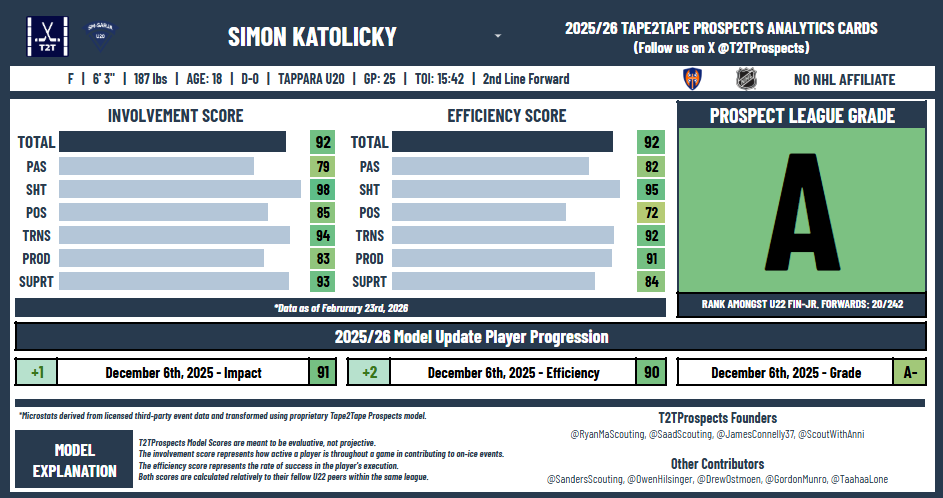
Games Tracked:
04/22/26 vs USA U18
03/21/26 vs Porin Assat U20 (Playoffs)
02/28/26 vs Ilves U20
ELEVATOR PITCH
Katolicky is a 6’4” explosive-skating winger whose value is almost entirely tied to his physical tools and motor, showing flashes of effective forechecking, slot-area shot generation, and transition pace, but without consistent physical engagement or clear offensive structure. His projection hinges on whether he can translate his skating and frame into more dominant, purposeful play without the puck and as a carrier, as his current decision-making and puck execution remain raw and inconsistent.
Simon Katolicky is the age old question on whether you draft a player based on what he’s shown you today, or what you think he could show you 5 years from now.
The positive traits of Katolicky are obvious, he’s HUGE at 6’4”, 198 lbs and I do think that he’s a genuinely good skater at his size. He’s got great explosiveness to close distances and that makes him a guy I think could be a great forechecker as he figures out exactly what kind of player he wants to be. I do think though, that at his size, Katolicky struggles with figuring out how he can best impact the game.
There’s a good effort level for Katolicky on the forecheck, and he motors all over the ice in that phase of the game, but I do think that there are times where he reminds me a little bit of those stretch fours in the NBA back before Steph Curry made three point shooting popular. What I mean by that is, for a player of his size, with his natural explosiveness, I really did anticipate more physical play from him on the forecheck. He closes distance so well to pressure opponents trying to break the puck out, but he always eases up and tries to make a stick-on-stick play when he could just use his size and strength and move them off the puck. There are moments where he recognizes this, and will put his shoulder into a guy along the boards and strip the puck away, but I want to see those moments far more often than I have. This is not to say I’m not a fan of his active use of sticks though, because I am. He really does try and get into passing lanes and hassle puck carriers, but I just think that he could use his size to a far more dominant effect.
Defensively, I’m left wanting more. Not a ton of engagement in his own end, was guilty a few times of blowing the zone to chase offense. I just need him to use that same motor on the forecheck and apply it more consistently to getting out on shooters and supporting his defensemen on breakouts. There are spurts of effort on the backcheck, and there are splash plays that make me think there could be a very good player in his own end someday. He has moments where he’ll track down low and just out-muscles guys to win the puck and get possession going the other way.
Katolicky also seems to want to play a more complimentary, off-puck finesse game, but I’d really like to see a ton more engagement and creation from him as a puck carrier. I just think that even with the skating and frame, Katolicky just doesn’t really have a plan when he gets the puck. His understanding of how to use his tools to create an advantage for himself is lacking and it means his offensive contributions are a bit all over the place.
He’s very slot focused as both a shooter and passer and whenever he sees a shooting lane, he doesn’t usually let the opportunity go by without jumping on it. He also does a good job getting to the danger areas on the ice off-puck so that he maximize his scoring chances. The passing is very much slot oriented as well but it feel like it’s mainly him flinging the puck into the slot hoping someone will be there to be on the receiving end.
All in all, Katolicky’s entire draft stock is based on his tools and size. When he keeps his feet moving and engages physically there are real flashes of a guy you could see on a bottom six energy line, but he remains a very raw player who lacks the awareness and execution to maximize his skillset at this stage. Like Erickson, certainly a project pick, but a really intriguing one, and he ends up in my Top 64.
#62 – Jonah Sivertson – F – Everett Silvertips – WHL
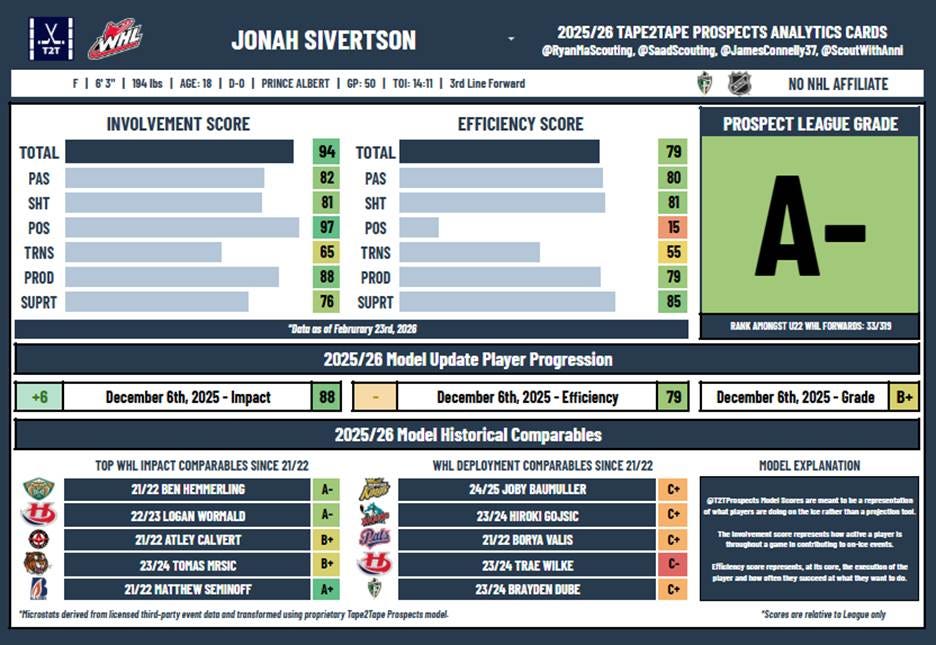
Games Tracked:
02/27/26 vs Penticton Vees
02/14/26 vs Saskatoon
11/28/25 vs Brandon
ELEVATOR PITCH
Sivertson is a 6’3” forward with strong puck skills, impressive hands in tight, and a quick, accurate high-slot wrist shot that allows him to create offense through smart off-puck positioning rather than pure rush creation. However, his below-average skating limits his effectiveness on the forecheck and backcheck and raises concerns about how his patience-driven, skill-based offense will translate against faster, more structured pro competition.
I’m a little conflicted with regards to Jonah Sivertson.
I think that there’s potential here in the player, and there is definitely a lot to like, but I’m not sure if I can get past the skating projection at the next level.
Let’s start with the good first. Sivertson isn’t just a big player on the ice (although at 6’3” he is a big boy), he’s also a smart off-puck mover with some really nice puck skills at his size. Really nice ability to settle bouncing pucks and handle them through sticks and pressure to release his teammates into space with cross ice passes or short area bump passes.
That’s what’s most impressive about the player for me after watching him. A lot of bigger players really struggle with the puck in their feet or in tight, and it’s easy for smaller players to get under them, gain leverage and steal it away. It’s not as easy with Sivertson, who’s got deft hands that he’s comfortable using to navigate and hold on to pucks through pressure in the offensive zone and in tight on the goalie.
The puck protection and puck skills show up as a creator too and while Sivertson hasn’t figured out how to attack the middle of the ice through traffic consistently yet, his off-puck movement opens up pockets of time and space in the high slot where he’s then able to exploit scrambling defenders with shot fakes, and backhand-to-forehand dekes, working his way to the net for high danger opportunities.
Instead of using his size to drive pucks to the center like a traditional power forward would, when Sivertson can create towards the center of the ice through traffic, he relies primarily on patience and his hands, outwaiting defenders, and letting them go full snow angel to try to cut off passing lanes before deftly dragging the puck past them and into the slot.
While it’s not an area of his game that’s super prominent yet, Sivertson also shows flashes of a power game. Skating down the right side, putting a defender on his back hip, and just ripping wrist shots on net, he’s had a few goals this season that showcase he’s got some thunder behind his skill package.
Sivertson clearly favours getting the puck onto his forehand where he can let his shot go, and it’s not a bad idea. He’s got an absolute bullet of a wrist shot that he scores with very good consistency in the high slot area. Whether it’s from some nice off-puck movement to find open ice, or jumping on loose pucks, it doesn’t need to be a perfect look for Sivertson, whose shot from that area is lightning quick and accurate.
With all that being said, Sivertson’s skating is going to be a big concern for NHL clubs. He just doesn’t move around very well on the ice, and it’s glaring on the forecheck and backcheck. It’s hard for Sivertson to be an effective forechecker, as he doesn’t have the foot speed to get to his spots on time. Defensively on the back check, he tries hard, but oftentimes, rushes that appear to be three-on-three end up becoming odd-man rushes when he’s the third man back.
I also wonder how well the on-puck game will translate against faster pros, where his patient delays and off-puck movement may not buy as much time and space for him as it does right now.
It’s a very intriguing package for a late riser in the season, who’s producing despite a lack of power play ice time, and I do like him more than some of last year’s big boys like Oilers draft pick David Lewandowski who suffered similar skating issues but offered far less upside on the puck.
#63 - Logan Stuart - USNTDP- C - USHL
Games Tracked:
03/21/26 vs Waterloo
02/21/26 vs Lindenwood University
01/28/26 vs Youngstown
ELEVATOR PITCH
Logan Stuart is a great straight-line skater and high-energy 200-foot player who has evolved from a pure support role into someone showing more confidence carrying the puck and attacking off the rush. While his offensive toolkit is still limited in terms of passing and finishing, recent improvements in puck carrying, strength, and decision-making suggest real developmental upside if he can become a more consistent self-creator.
Man… I think I really like Logan Stuart which to be fair is not new if you’ve read my write ups on guys like Leon Kolarik and Ryan Brown.
When I watched his D-1 tape at the start of the year for the NTDP, I wasn’t overly impressed. My notes and general assessment of him at the time was as followed:
Logan Stuart is a fine player. If there’s one thing you can’t question about Stuart, it’s that he tries hard. He’s buzzing around the ice a lot, and he’s great at skating in straight lines. On 3 or 4 occasions in this game, he was able to beat everyone else on the ice to a loose puck. That’s good. What’s not so good is that after he gets the puck, he almost immediately gets pinned to the boards and can’t win the ensuing puck battle, ultimately turning the puck over. There’s nothing wrong with a player of Stuart’s ilk; all pro teams need players like him who skate hard, fill their rush lanes correctly, kill penalties, and are positionally sound.
Some of this is still true today, Stuart is indeed an EXCEPTIONAL skater and can absolutely fly through the neutral zone and uses that to his full extent as a 200-foot player. While his late January game against Youngstown appeared to be more of the same as what I saw in his D-1, I really do feel he’s turned a page heading into the last 2 months of the season and is really playing his best hockey of late. There’s still a tenacity to his game where he flies in full speed on the forecheck to hassle opposing players, and while his size is still a limiting factor and he can bounce off hits, there are also plays where he can tip pucks away and get into the path of clearance attempts. I think he could take better routes to make life easier for himself but he gets there in a flurry, and has really improved his strength along the boards to handle physicality and win his far share of puck battles.
What’s really impressed me is Stuart has taken more control of the puck. No longer just a tertiary support player on a line who just tries to fill lanes, there’s real signs that Brad Stuart’s son could be more of an on-puck driver of play. He uses his speed to burn past defenders around the outside, using soft dumps off the wall to himself, or pushing the puck up ice to skate into. There’s a little more shiftiness to his game where there are moments he will stop and start, and is willing to drive the puck across the blueline down the center of the ice, hang onto it while battling through traffic before rimming it his teammates along the boards. There’s also some nice flashes of edgework in the neutral zone where Stuart will twist left and right to avoid pressure.
It’s not a perfect skillset and while extremely high pace, I wouldn’t say that Stuart is a great passer or scorer at this stage in his development. I do think that there are some real signs of growth here from Stuart, and if he can take this recent stretch and elevate it even further to become a more dangerous self-creator in the final third there could be a really great player here.
#64 - Lincoln Kuehne - Arizona State - RD - NCAA
Games Tracked:
02/21/26 vs Nebraska-Omaha
02/14/26 vs Western Michigan
12/13/25 vs Minnesota Duluth
ELEVATOR PITCH
Lincoln Kuehne is a steady, mobile 6’2” defenseman who defended well despite a difficult Arizona State surrounding cast, using smooth skating, good gaps, and a reliable first pass to stay effective without taking unnecessary risks. While his game is fairly vanilla offensively and he needs more strength and physicality in battles, his mobility, poise, and defensive reliability give him a solid chance of developing into a complementary, projectable NHL defenseman.
Lincoln Kuehne doesn’t do anything particularly spectacular, and he is one of the older players in the class as a 2007 birthday but I think there’s good chance he gets into NHL games one day.
Before I get into Kuehne’s tape, let me preface this all by saying that Arizona State was a tire fire this year. Finishing the season with just a 14-21-1 record... it was a year to forget for the Sun Devils. Despite that, I thought in my viewings that Kuehne looked the part of a poised, mature player who plays within his means and avoids the big mistakes.
Kuehne had really fluid mobility at 6’2”, and he used that range and mobility to defend his blue line well. He wasn’t necessarily a play killer but had really fluid hips and ability to mirror puck carriers and had good gaps while defending the rush. He’d aggressively surf out, sometimes even above his defensive blueline to attack puck carriers and force them to hold up the puck, delay or dump it in. He did a great job getting the puck moving when he had some time and space, and when he was facing a tough forecheck, he really played a very simple game that didn’t require him to make too many decisions or get too creative with the puck. Just some quick chip outs or dump ins to fight again another day.
I was enthused to see that Kuehne, when he felt he had the time and space, did show some nice understanding of putting his teammates in positions to succeed. On breakouts he would sometimes hold and delay to draw in pressure before passing it his defense partner, buying them more time and space to move the puck. Other times, he would aggressively trigger across the ice to break up a pass, then seal off the opposing player to allow his defense partner to collect the puck with room.
In his own end, he was able to make nice clean first passes, and despite spending a lot of time defending in his own end this year, I thought he treaded water in a tough environment. He battled hard in the net front area, and used a good stick to break up plays and clear loose pucks that were in and around the crease. I do think he struggled this year to win puck battles outright, and a lot of that comes down to him growing into his frame and becoming stronger as a player. However, I do think he’s already doing a great job of taking contact and being able to stay in the battle and not give the opponent an easy play to maintain possession.
Offensively, Kuehne’s quite vanilla, but he does pick his moments. A quick, decisive passer in the offensive zone Kuehne doesn’t really threaten the middle of the ice with his play, but he does show good activeness, skating through arms and sticks when pinching down in the offensive zone to keep plays alive.
Add that to a whippy, quick shot that he can use to get through traffic and I think there’s a ton to work with here for a potential complimentary, mobile, projectable defense-first NHL defenseman, especially if he continues to improve and hone his craft, as well as grow into his frame and develop more of an edge to his game. All in all, Ryabykin’s far more chaotic profile could net a higher potential, but I’m a huge fan of Kuehne’s mobility and projectability given he’s playing in a really tough situation at ASU.
ROUND 3 (RNK #65 - #96)
#65 - Casper Juustovaara Karlsson - Lulea HF - C/LW - SHL
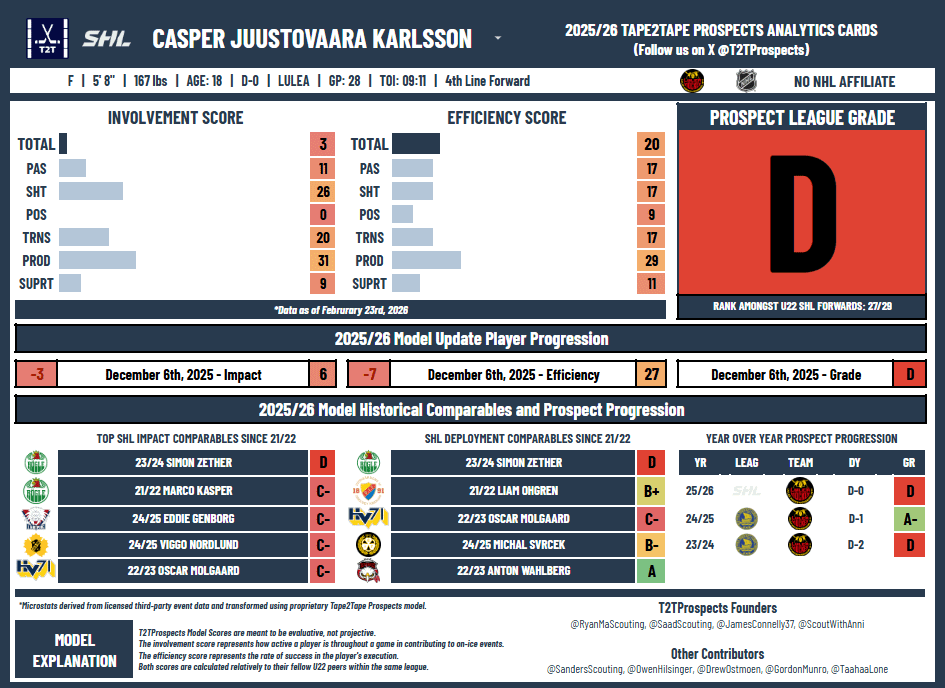
Games Tracked:
03/22/26 vs Brynas IF U20 (Playoffs)
02/21/26 vs Brynas IF
01/15/2026 vs Orebro
ELEVATOR PITCH
Casper Juustovaara Karlsson is a high-motor, aggressive 5’9” forward who showed he can elevate his game even in the SHL, using relentless forechecking, physical engagement, and strong defensive pressure to disrupt opponents and drive play through effort. Offensively, he brings straight-line rush ability and some puck-carrying skill, but inconsistent puck handling and limited access to the slot cap his creation upside, making him more of a fun potential depth forward.
Casper Juustovaara Karlsson spent a good chunk of his season in the SHL this year, and when the 5’9” forward returned to the U20 Nationell to end the season, he did a very good job reminding his fellow U20 country men that there is indeed a difference between playing against boys and men.
Don’t look at CJK and assume he’s some sort of soft skilled, perimeter player. There’s a really high energy, high motor player with plenty of snarl to his game. In Lulea U20’s playoff game, he was absolutely bullying guys. He was relentless defensively against the puck carrier, all over their backs on the backcheck and against the walls, using an effective and aggressive stick to work them over. Did a great job of mirroring when defending out on the perimeter and man he was just upending guys along the boards as both a defending player and on the forecheck.
He’s a very smooth mover when he’s moving forward, comfortable attacking the middle of the ice off the rush and using his legs to protect the puck as he weaves through traffic, poking and prodding for potential openings to explode into. He’s a high effort pursuit player who rallies to pucks after shots so he can attack the puck retriever on the other team and force high pressure, quick decisions instead of allowing the opposing team to recollect themselves. He tries to read the defenders when he does this, looking to take away the hard rim along the boards when he flies in. Sometimes it works and he’s able to overwhelm the defender when they realize their escape valve’s been bottled up, but sometimes it also means he ends up abandoning the center lane that he was initially occuping which gives the opposing team a clean exit.
CJK’s ability to pick up pucks cleanly through traffic is inconsistent, and his puck protection at the SHL level was particularly a point of emphasis that should be highlighted for his development going forward. He’s far more disciplined defensively in the men’s league (at the U20 Nationell level he was more willing to fly the zone to see if he could get a deep feed), but the puck skills were not a strength as he did bobble the puck quite often. CJK’s game is predominantly based on attacking in straight lines down the center of the ice off the rush before guiding and drifting his way out to the perimeter. He has a difficult time consistently finding a way to access the slot area as a puck carrier.
CJK did have a few nice plays from the boards on breakouts where he was able to make quick plays under pressure to get the puck into the center of the ice for his teammates to skate into for clean exits. Even at the SHL level, CJK was a pest, showcasing a high end work ethic on the forecheck, and doing a good job applying pressure and then getting to the net front for tips after winning the puck back. Even though he had real difficulties winning any of the physical exchanges at his size, there’s a real edge to CJK’s game and good enough movement skills that I think he’s almost certainly worth a Top 75 investment from an NHL Team.
#66 – Pierce Mbuyi – F – Owen Sound - OHL
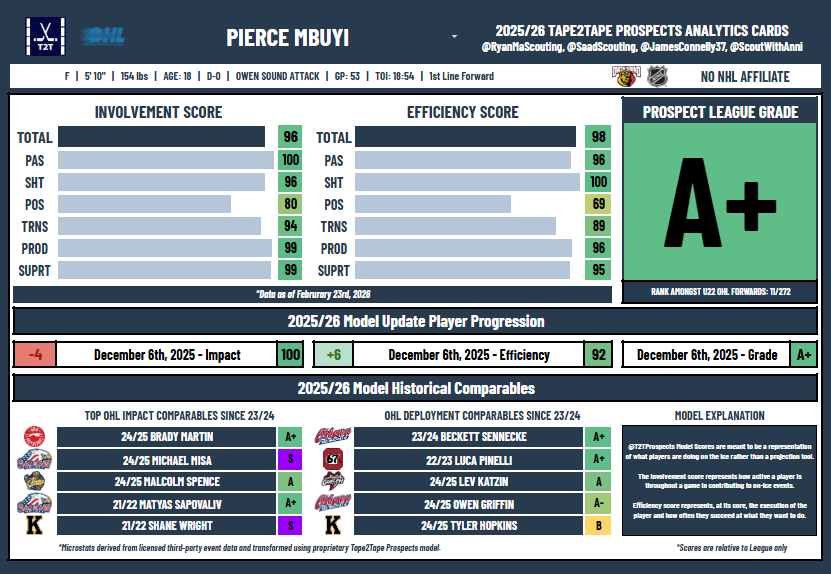
Games Tracked:
10/17/25 vs Guelph
12/11/25 vs Barrie
02/21/26 vs Brampton
ELEVATOR PITCH
Pierce Mbuyi is a high-activity OHL forward with a dangerous power-play one-timer, quick release in tight, and strong puck involvement through constant movement and retrieval work. However, his inconsistent passing and severe issues with puck protection and contact balance raise major translation concerns, making him a prospect whose NHL projection hinges heavily on physical development.
The first time I watched Pierce Mbuyi, I thought this kid could’ve been a fringe first-round talent. Which, admittedly, is where I had him at one point. Unfortunately, I don’t think he’ll be a guy who goes in that range anymore, but I remain a fan of the player.
The reasons I liked Mbuyi off the jump are still very much there. A NASTY one timer that he weaponizes on the power play to become one of the top power play producers in the OHL, while also being able to get it off in the offensive zone at even strength.
There’s also some nifty hands in tight from Mbuyi, who can curl and release pucks through sticks to get them off in traffic, getting quick shots in tight while attacking the defender’s triangle… there’s a reason he’s been so productive this season.
He’s also a puck magnet, which can inflate his passing micro stats in his T2TProspects model card. Tons of puck retrievals and puck touches for Owen Sound, which is a byproduct of just constantly buzzing around and being around the puck. Mbuyi is certainly constantly involved in the play, whether it’s joining board battles as the third man in or tracking down loose pucks and dragging pucks across the offensive blue line.
Unfortunately, the finishing touch with the puck has been hit-and-miss. The passing accuracy has been inconsistent; while Mbuyi loves using his eyes to try to manipulate passing lanes open, sometimes he forgets to check if the passing lane is ACTUALLY open. As a result, he’ll end up passing it right into the defender’s stick in passing lanes.
The biggest issue, however, is easily the contact balance and puck protection. I try not to say this, but in Mbuyi’s case, it is nearly non-existent. He’s easily worked off the puck along the boards, and offensive zone time can die on his stick at times, simply because he is unable to ward off physical defenders.
It’s a fun player who is constantly trying to leave his mark every time he’s on the ice, but I fear that at his size, the puck protection and contact balance are going to severely hamper how many NHL teams are going to be willing to take him with a high pick.
I still think he’s worth a Top 75 pick, but I could easily see him falling into the late rounds or even undrafted if NHL teams are unconvinced his game will translate to the pro level. You hope that his energy will make him a useful player if he can get some lower-body training in.
#67 - Tomas Chrenko - HK Nitra - C - SVK
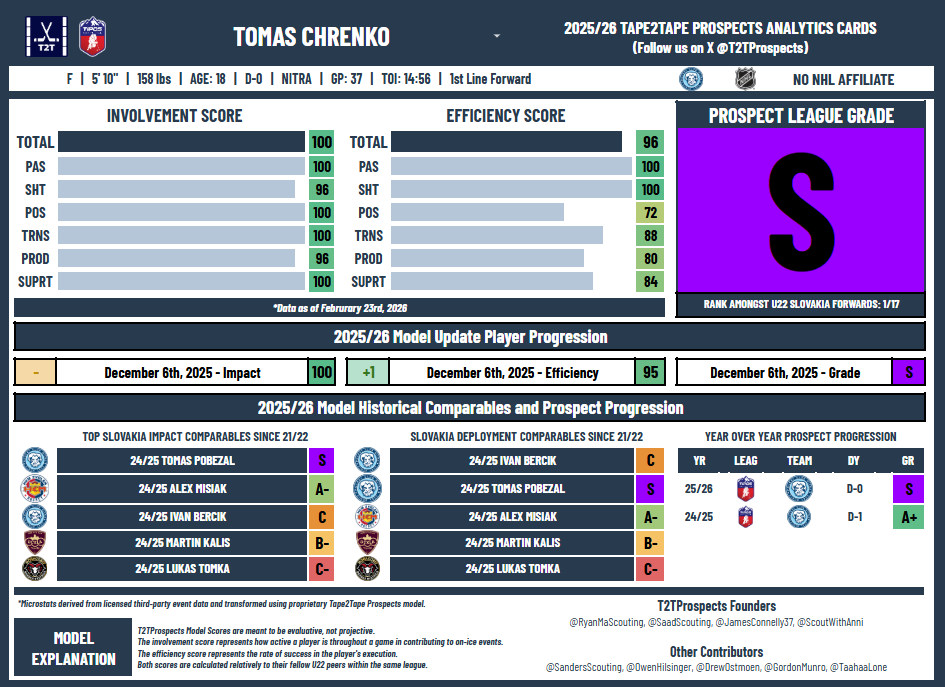
Games Tracked:
04/19/26 vs HC Slovan Bratislava (Playoffs)
04/04/26 vs HK Poprad (Playoffs)
03/08/26 vs HC ‘05 Banska Bystrica
ELEVATOR PITCH
Chrenko is a smaller, smooth-skating forward whose best traits are his off-puck movement, shot volume, and ability to consistently find dangerous scoring areas, which he showcased especially well at the WJC. While he lacks strength and consistent ability to attack the middle or win battles against men, his intelligence, craftiness, and pace-based game still give him a potential bottom-six projection worthy of a Top 75 selection.
Chrenko was one of my favourite players at the WJC this year and I thought he shined more (albeit due to deployment and opportunity) than most of his fellow members of his 2026 NHL Draft Class. That tournament is going to be doing a lot of heavy lifting because the 3 games I watched for this report were not... super inspiring.
Chrenko is a smaller forward, but he’s a great skater when he gets his feet moving. He can really fly all over the ice with a smooth stride and I think that’s helpful for a smaller player. His WJC was honestly very nice, some good perimeter passing to shift the defense and he was an absolute menace all tournament with his off puck movement. Finding space in the slot, back door, Chrenko was finding opportunities from super high danger areas, letting it rip every chance he got and converting it at a pretty good clip. Even his game winning goal tonight came from a broken play where he found himself in an opportune spot to shoot it while the defense was disorganized, scrambled, and looking the wrong way.
As a smaller player he’s not super adept at attacking the middle of the ice with the puck, but he’s very willing to try. He’ll take his speed through the neutral zone, attacking the blueline trying to back defenders up before using some stride dekes where he pushes the puck forward into open ice, slightly to his right in order to get it into space to skate into.
In Slovakia, we get a far more vanilla version of Chrenko, but a version that does give me confidence there’s enough structure and maturity to his game for him to develop into a potential bottom six piece someday. Chrenko is in and around the play without the puck, using his stick to poke and prod and try to fish pucks out but he really lacks the physicality and strength to win these battles right now.
With the puck, against men, he keeps it simple with lots of dump ins at the line and perimeter passes. He’s also way more comfortable shooting it from distance, but I would like to see him utilize his hands and feet to weaponize and execute some of his nice passing ideas that he showcased at the WJC. He had one nice play in the semi’s where he found an opening in the neutral zone, attacked the defender, slipped the puck through their triangle and blowing past them, before drifting back out with patience and centering a pass to his teammate driving the center lane. While I wouldn’t call Chrenko dynamic, there are moments of him being a crafty, slippery player and as he continues to build his strength and his comfort level with the puck against men, those moments will occur more and more often.
All in all, Chrenko is a smart player that thrives with his off puck movement and shot volume, while pairing it with some craftiness on the puck as a perimeter playmaker. The pace would use some improvement, and I think he has a lot of strength and conditioning (really just strength) to do, but I’m very comfortable spending a Top 75 pick on him. He’s right in that group of smaller, feisty players that I like in the 3rd round.
#68 - Yelisei Ryabykin - MHK Dynamo Moskva - LD - MHL
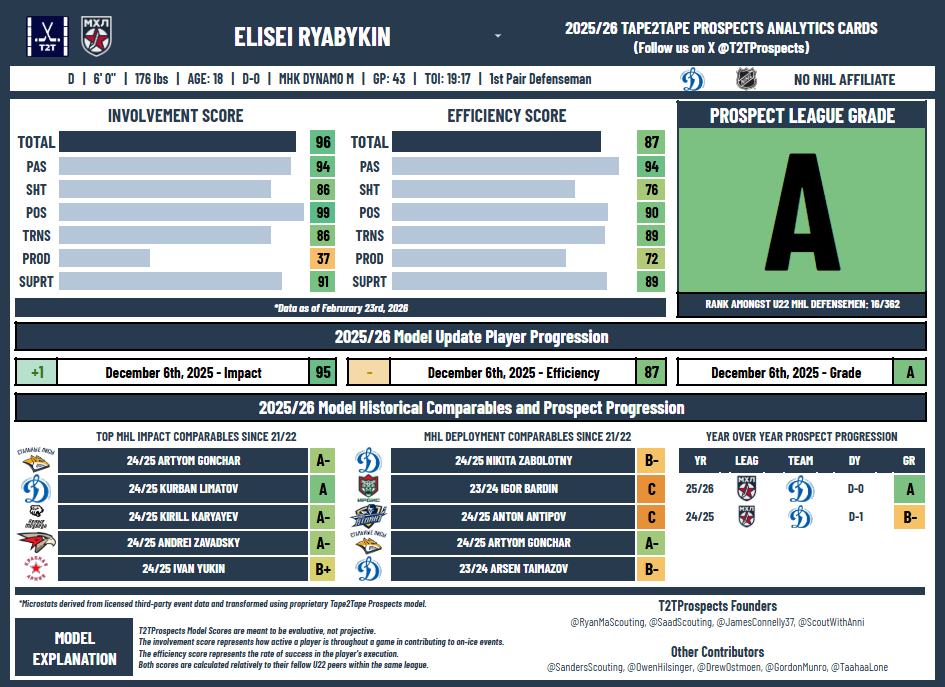
Games Tracked:
03/22/26 vs AKM Tula
01/12/26 vs SKA 1946 Saint Petersburg
12/14/25 vs MHC Spartak Moskva
ELEVATOR PITCH
Ryabykin is a highly active, offensively engaged MHL-coded defenseman who consistently joins the play, activates off the blue line, and shows real ambition as a puck carrier and passer with creative ideas in transition and the offensive zone. However, his heavy skating stride, inconsistent defensive positioning, and lack of refinement in puck touches and decision-making make him a pure project pick who will need significant structure and development.
Ryabykin is a pretty fun player but he’s very evidently a junior hockey player who will need to clean up a lot of the stuff he does on the ice and refine his craft.
Ryabykin’s mobility reminds me a bit of Di Iorio (I know, defenseman vs forward), but both players are actually decently good at moving around on the ice but their strides just feel very heavy and not super nimble. In other terms, the feet look heavy but man Ryabykin doesn’t let the aesthetics keep him from being involved in the play all over the ice in the MHL.
Ryabykin’s got a really good activeness, activating along the boards frequently to get to far side dump ins to maintain offensive zone possession. He’s even got some power forward-esque flashes (as a defenseman!!!) with the puck where he’s looking to carry the puck into the offensive zone and get passes into the slot instead of just getting rubbed out along the boards like some other defensemen we’ve watched in the past. There’s a real commitment by Ryabykin to get shots on goal, he’s comfortable walking the line towards the middle of the ice to let one go, but he’s not a one trick pony, he’s also more than happy to hold the puck as he maneuvers around the perimeter in the offensive zone, using his frame to protect the puck as he goes.
The touch on his passes could use some improvement; they come off his stick a bit heavy at times and it makes his passes difficult to consistently corral for his teammates, but there are some really good ideas from Ryabykin. He loves jumping up into the play where he can be a potential option on zone entries in the neutral zone, attempting passes to the center lane, and he shows good poise and intelligence in the build up of play by drawing pressure to himself with the puck before tucking them past the pressure and to his teammates on breakouts. He’s also got ambitious ideas as a passer in the offensive zone with cross seam passes and also looking to fit pucks cross ice through traffic in the neutral zone. The final execution has been hit and miss (the aforementioned final touch) but he’s been a very fun watch.
This eagerness to get involved is a bit too much at times, he ends up really high up the ice on breakouts that leaves his team susceptible to counter attacks and I’m not sure how his game would work in North America when more structure is expected and required. Defensively he’s also too reachy for my liking, he overextends himself on plays and I’m not a huge fan of how he’s been able to defend in space... just not too sure how that will work against stronger, faster and more agile opponents.
His hips are stiff and he’s not proactive enough defensively when there’s extended time spent in his own end. He just needs to keep his feet moving when he’s defending in space and in his own end otherwise he’ll keep find himself getting caught chasing air when defending rushes. He’s definitely a player that I think does his best defending when he’s aggressive, when he’s on the backfoot the play is super all over the place and he struggles to kill plays with physicality.
All in all, there’s a very fun player in Ryabykin who has all the creative ideas you want in a defenseman who can eventually contribute actively in the offensive zone. He doesn’t come without his warts, but I do think that these are fixable problems with some improvement to his edgework and explosiveness. Not a Top 64 player for me, but there’s an interesting project here in the third round for a team to sink their teeth into.
#69 – Leon Kolarik – Peterborough – F – OHL
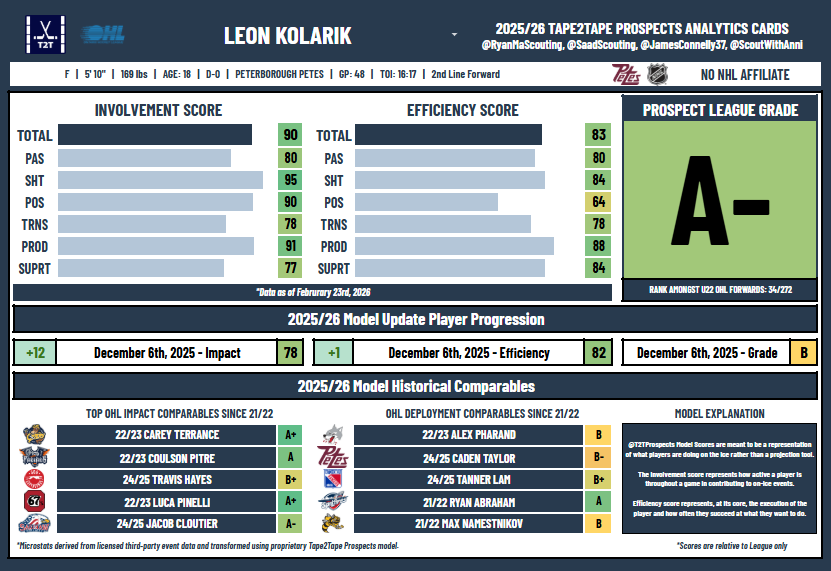
Games Tracked:
03/20/26 vs Kingston
03/06/26 vs Niagara
02/07/26 vs Sudbury
ELEVATOR PITCH
Leon Kolarik is a high-energy, elite forechecking winger who drives play through relentless puck pressure, strong stick work, and outstanding puck-winning ability alongside Adam Novotny. However, his limited on-puck confidence, inconsistent passing under pressure, and lack of true play-driving ability make him more of a depth projection who relies heavily on off-puck work and effort rather than true offensive creation.
Gosh, Leon Kolarik was a big riser in the T2T Prospects Model from December to March, and if my viewings are any indication of his larger body of work the last three months, then that score increase from a B to A- is extremely accurate and deserved.
Watching Kolarik and Novotny together on the forecheck is like watching a work of art. Dump and chases, where they’ll just go in hard along the boards, lifting sticks, poking at pucks. They both excel at just being a general nuisance to the opposing defenders and absolutely ruining their night by picking their pockets before looking to find a centring pass. With Novotny, it’s almost expected. He’s big, strong, explosive and used to playing against men. However, watching Kolarik on the forecheck at his slight 5’11” frame is genuinely impressive. Really strong and active stick, and a great understanding of leverage that allows him to win puck battles easily. He’s like a dog on a bone, relentlessly staying with the defender who’s trying to find an escape. It should come as no surprise that he’s in the 99th percentile in the OHL this season in puck battles. Against Kingston alone, he had 4 plays where he stole a puck below the goal line and centred a pass into the slot for a scoring chance.
Kolarik just has a great feel and chemistry with Novotny. When he’s the F2, he always gets to the right spots to support Novotny when the power forward gets on his horse on the forecheck to receive the puck from the board battle, and then has the awareness to bump it to Lutz in dangerous scoring areas. Along the boards and in the corners, he’s not the strongest and can get moved off the puck, but that strong stick still allows him to win his fair share of those exchanges. There are also a few rare flashes of him showcasing some change of direction ability to shake defenders in the corners to buy himself space.
Offensively, most of Kolarik’s goals will come from him charging the net front for tips, banging in rebounds or hunting space on the weakside for one-timers. He clearly thrives primarily from the chaos he and his line can create from the forecheck, and so his contributions on the puck in the offensive zone against a set defence aren’t super noticeable. Kolarik is also a good defensive winger, is always super aware and knows when to drop down to cover the slot and break up passes when the play goes into the corners. I’d like to see him get to the wings and play a more prominent role on exits, but therein lies the big issue with Kolarik at this stage of his development.
He’s not super puck-dominant as a player and doesn’t factor consistently in transition for Peterborough, preferring to get the puck off his stick quickly so that he can get on his horse and get on the forecheck if there’s a dump-in. I feel that Kolarik’s confidence with the puck isn’t really there, and that leads to him really pushing the rush button on playmaking decisions. There are a lot of passes off the rush that just aren’t super accurate, like passing behind teammates driving the center lane. It’s unfortunate because there are actually some really nice ideas with the player, like trying to feather an entry pass against the grain or trying to zip a pass across the ice laterally to the open wing. He’s rushing these passes, and a lot of them don’t have the right weight or timing, and they’ll bounce off his teammate’s sticks or skates, whereas if he had just trusted himself and held the puck for that second longer, there could’ve been a really nice play.
All in all, I’m a big fan of Kolarik, who has the work rate and puck-winning skills you want to see in an undersized player who hopes to project into a potential bottom-six role. The passing skillset and a lack of any true signs of plus traits with the puck on his stick likely mean that, at his size, he’s someone that NHL teams likely won’t take a flyer on until later, but there’s a guy worthy of a third-round investment here for me.
#70 – Ryan Brown – London Knights – LW – OHL
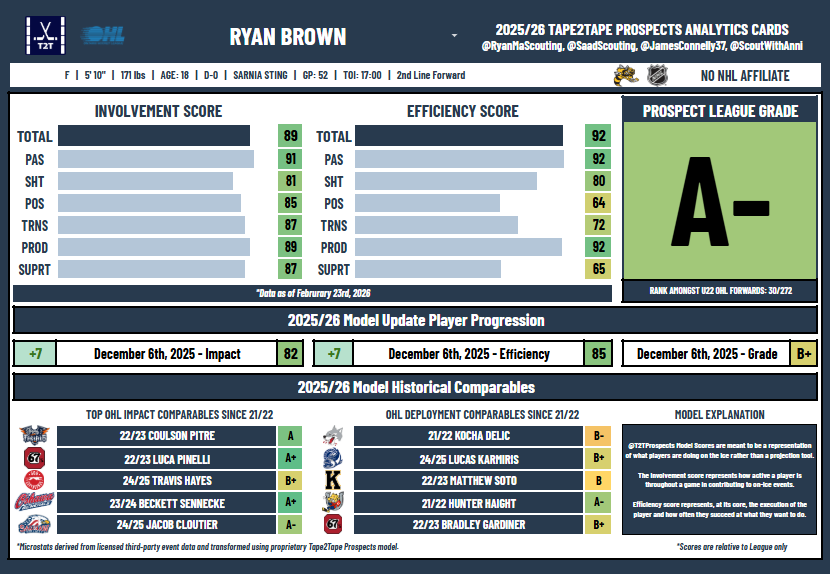
Games Tracked:
03/06/26 vs Erie
01/25/25 vs Peterborough
12/28/25 vs Sarnia
ELEVATOR PITCH
Brown is a hardworking, physical, and highly intelligent winger whose value comes from competitive effort, strong puck protection, and advanced scanning habits that allow him to make creative, anticipatory passes in transition and the offensive zone. However, below-average skating agility and average skill at his size, limit his ability to create independently or attack the middle consistently, making him a projectable but non-dynamic depth option.
Brown is a super energetic and hardworking player who’s not afraid of contact and almost relishes it. Brown is just a really smart player, and I think it helps him in a bevy of situations and makes me confident that there’s a player here, even with the hang-ups some people will have about him.
Let’s start with the concerns. Brown, I think, is just a fine skater. He builds up speed decently well in straight lines, but his stride isn’t the easiest on the eyes. He looks like he’s trying really hard every time he gets on his horse, and his stop-and-start ability is below average. That’s a bit concerning for a player at his size at just 5’11”, and given he’s one of the older players in the class, it means there’s little optimism that he’s going to grow and have a bigger frame to get to. The below-average agility, coupled with just average hands and skill, means that he’s not the most dynamic on the puck, and he’ll struggle to attack the center of the ice on his own.
Despite these real concerns that will hamper Brown’s projection at the next level, there’s just so much to love in my viewings that I find myself a fan of the profile anyway. First of all, on a side note, I’m always a fan of a player who will finish his checks and rough it up after the whistle or in scrums, and Brown’s shown an appetite for both facets.
What’s more relevant is the puck protection and contact balance. Brown will sometimes have to throw his entire weight into a board battle, and when he telegraphs this intention, he can get side-stepped and look like he’s chasing air, but he’s feisty and gives as good as he gets, and he handles contact really well against the wall in the cycle game. A really low center of gravity means he’s hard to shake off the puck, and he’ll skate through shoves and sticks before cycling the puck down low. Against Sarnia, he came in on the forecheck, the defender saw him coming, tried to reverse hit him, but Brown ate the hit, stick lifted the much bigger defender, stole the puck and then centred it for a scoring chance. Against Peterborough, he showed great awareness and timing by jumping in to cut off a Petes forward trying to skate the puck out with Nurmi all over his backside. He picked the puck off, shielded the puck through contact and drove the net for a backhand chance.
Outside of his toughness and competitiveness, I also think Brown is a really intelligent player, and it shows in his play both on the puck as a passer and off the puck. Brown constantly has his head up, scanning the ice with and without the puck, and it allows him to make some really creative passes in transition and the offensive zone. Lots and lots of cross seam passes in the final third, but also, he does a great job of passing into space with anticipation. He had a beautiful pass from his own end against the Petes where he received the puck and did a no-look, between-the-legs tip pass up the boards to a streaking teammate who got a scoring chance off the rush. He realizes he’s not the most agile player and that he can’t skate or stickhandle his way out of tight spaces, so he pre-scans, anticipates where the open passing lanes WILL be, and then hits lead passes with great regularity for his teammates to skate into with open ice.
All in all, I think there are real concerns about Brown’s skill set and tools for his size, but his competitive nature, contact balance, and intelligence make him a player worth betting on in the Top 75 of the draft for me. I expect him to play a huge role in the future for London, who’s done a great job developing and churning out NHL talent, and I wouldn’t be surprised if Brown was one of those feel-good stories when we look back in a few years.
#71 - Jakub Vanecek - Tri-City Americans - LD - WHL
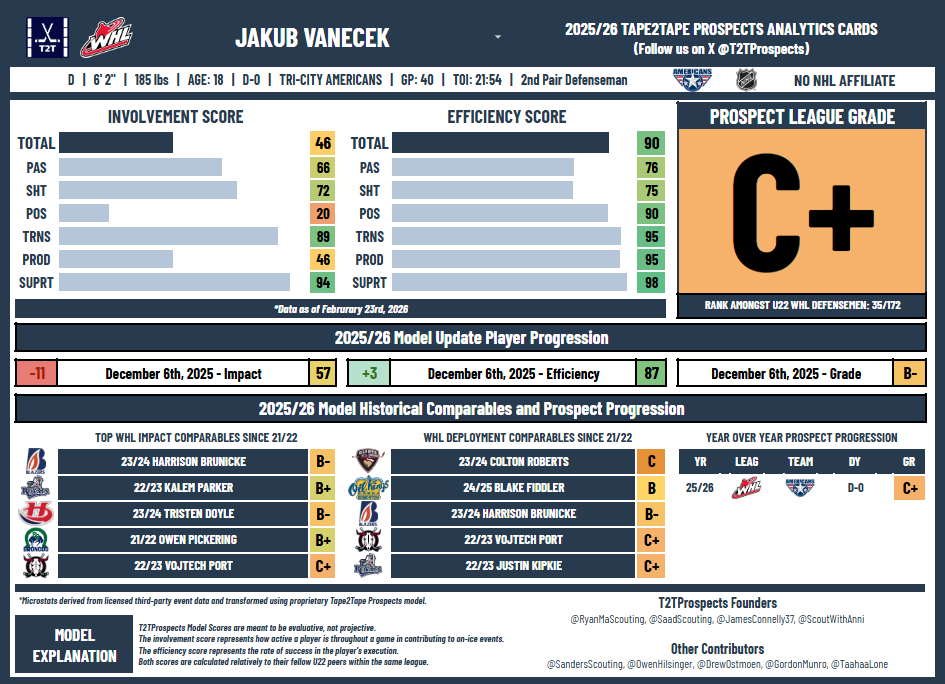
Games Tracked:
04/23/26 vs Sweden U18
03/07/26 vs Seattle
02/06/26 vs Penticton
ELEVATOR PITCH
Vanecek is a mobile, defense-first blueliner whose strongest traits are smooth skating, controlled gap play, and mature defensive reads that allow him to defend the rush effectively and move pucks safely in transition. While he offers occasional offensive flashes, his game is best suited to a simple, low-risk approach, with limited high-end offensive projection but a solid long-term option as a reliable, mobile defensive defenseman.
Vanecek is the type of defenseman I tend to find myself liking more than consensus because while there may not be a ton of flashy production or ultra-high-end offensive creation, there’s a really solid foundation of mobility, defensive habits and transitional play here that feels projectable long term. He’s definitely still somewhat of a project and I don’t think the ceiling is massive offensively, but the combination of size, skating and defensive instincts really is pretty enticing.
The first thing that jumps out watching Vanecek is just how mobile he is for his frame. He’s a really smooth skater who moves well laterally, closes space effectively and generally looks comfortable operating in transition on both sides of the puck. There’s a fluidity to the way he moves that makes him pretty effective defending rushes because he rarely looks panicked or overextended trying to recover. One sequence that stood out early in my viewings was him aggressively jumping up into the play, beating a forward closing out on him and slipping a saucer pass into the middle to extend the attack. Those flashes aren’t necessarily constant, but they show there’s at least some offensive instinct and confidence underneath the more defense-first approach.
Defensively, I thought Vanecek showed a pretty mature understanding of spacing and timing. He does a really nice job closing space under control without overcommitting himself and consistently uses his stick effectively to disrupt plays and knock pucks loose. In transition coverage especially, I liked how aggressive he could be as the weak-side defender coming across the ice to cut plays off early when the opportunity presented itself. There’s a decent amount of assertiveness in his defensive reads despite him not necessarily being an overly physical or punishing defender.
Physically, I actually think there’s a little bit more edge here than people might initially expect too. He’s not a huge open-ice hitter or anything like that, but he’ll engage physically along the walls and use his frame well enough to compete for positioning. Combined with the mobility, that gives him a pretty nice defensive toolkit to work with moving forward.
Where I think Vanecek is strongest though is probably in the simplicity and efficiency of his puck movement. He’s not really trying to force difficult east-west plays or ambitious stretch passes through traffic often. Most of his exits are straightforward reversals, quick ups along the wall or simple strong-side breakout plays. Normally I’d maybe want a bit more offensive ambition from a defender in this range, but honestly I thought it fit his game well because he generally stayed within himself and avoided forcing unnecessary mistakes.
That said, there are still flashes of more advanced puck movement ability here. One thing I noticed multiple times was his ability to make clean breakout passes from a standstill while facing pressure on his strong side. Calm, poised with good mobility and understanding of space… there’s the fundamentals for a really good player here.
The biggest issue for me offensively is that when Vanecek does try to push the pace with the puck himself, the execution can get rushed a little bit. There were sequences where he’d carry the puck forward with good pace and intent, but then hurry the final pass instead of fully settling the play down before distributing. I think some of that just comes from him still learning how to process offensively at higher speeds but the tools themselves are promising and the hope is he can have more leeway to develop that side of the game when his surrounding situation isn’t the disaster that Tri-City was this year.
Overall, I came away viewing Vanecek as a pretty solid defense-first projection bet with enough mobility and offensive flashes to potentially grow into more over time. I don’t think he’s the kind of player who’s going to quarterback a powerplay or consistently create offense through high-end skill manipulation, but there’s value in defenders who skate this well, defend rushes intelligently and move pucks efficiently without putting themselves in bad spots. He’s probably best right now when he keeps things simple and lets his skating, positioning and defensive detail drive his game, but there’s enough raw offensive ability underneath that to make me interested in the long-term development path.
#72 – Landon Hafele – Green Bay Gamblers – F – USHL
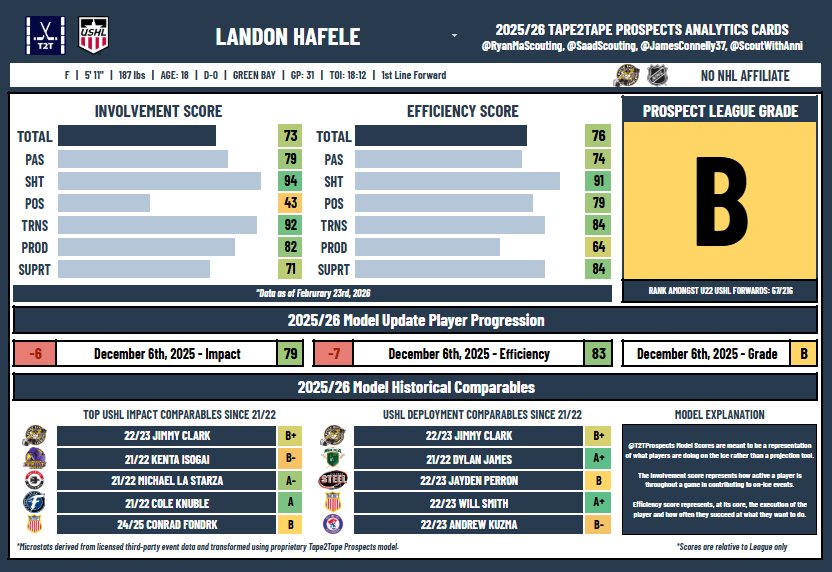
Games Tracked:
03/01/26 vs Madison
02/13/26 vs Lincoln
09/19/25 vs Sioux Falls
ELEVATOR PITCH
Hafele projects as an older, high-motor depth winger who drives value through effort, straight-line speed, and strong board play rather than offensive creation. While he consistently wins battles, supports entries, and generates chances off retrievals and loose pucks, his limited on-puck creativity and lack of dynamic offense caps his upside to more of a fourth-line or energy role at the pro level.
Landon Hafele is an older prospect among draft-eligible players, with a September 18th, 2007 birthday (he’s almost a full year older than Ryder Cali), and that may explain why his pro habits are really good (for the most part).
There’s a really good 4th line wing projection for Hafele, who’s one of the more high-motor, competitive players in the USHL this year. He’s a good skater, and he uses that skillset tirelessly, getting into puck battles all over the ice. The T2T Prospects Model had him 94th percentile in the USHL this season in puck battles, 93rd percentile in hits, and 80th percentile in shot blocking. This is a player who works hard along the boards, squares up to take away shooting lanes, and I think defends really well out on the perimeter, using an active stick to pester and poke away at the puck.
I’ve really liked Hafele’s support play in the offensive zone this season. He’s very perimeter-centric, cycling the puck to teammates and just keeping it simple. I think he does most of his best work below the dots, where he can charge into puck battles with an aggressive stick and generate takeaways behind the goal line.
With the puck, there aren’t a ton of things to write home about. Sometimes he’ll try to stick handle around opponents at a standstill to get a pass off under pressure along the half wall, and most of the time the defender will take the body, and the puck will squirt away.
At the offensive blueline, he’s more comfortable with time and space on his strong side to wire shots from above the dots. It’s a heavy shot, and I think it’s one he can find success with, but it doesn’t look like he got any goals from that spot this season. He doesn’t seem very comfortable making plays straddling the blueline, however, and in his game against Madison, I found out why. Hafele got caught on his offside, tried to stickhandle back to the center lane, got his pocket picked, and despite an admirable effort on the backcheck, the opponent was able to shrug off the stick checks from behind and score on the breakaway.
It’s puzzling because he’s got really fluid skating in all four directions, and so I would like to see him use that skating a lot more with the puck in transition or as a creator in the offensive zone. Instead, he plays a passenger role in transition, and to be fair, he is always in the right spots along the wall to assist with zone entries. He can stop and start very well, which makes him an ideal player in that position, as he can receive the puck at a standstill and get going before the defenders can seal him off.
The straight line speed is nothing to sneeze at, though and despite his inability (or unwillingness) to use it as a play driver, Hafele does a great job creating opportunities off the rush by simply outskating opponents to retrieve aerial passes or loose pucks. He’s 72nd percentile in the USHL this year at rush chance shots and 79th in off-puck shots, which highlights his offensive game pretty well. It’s all about getting out for partial breaks and driving the net for rebounds and loose pucks.
All things considered, there’s a Calle Jarnkrok-esque player here in Hafele. A winger who can play a bit of center if needed, and who’s fast in straight lines, which can make him an effective stretch-man for partial breaks. A player who plays with energy along the boards, gets into puck battles (even if they don’t always lead to takeaways), but drives pretty much 0 offense towards the middle of the ice with the puck as both passer and shooter.
As a super old D-0 prospect, his runway is a lot shorter, and the ceiling is not super high-end. I think there’s a player for the top 3 rounds here, but I’d rather take the younger, more exciting options if I were drafting for an NHL team.
#73 - Lars Steiner - Rouyn-Noranda Huskies - RW - QMJHL
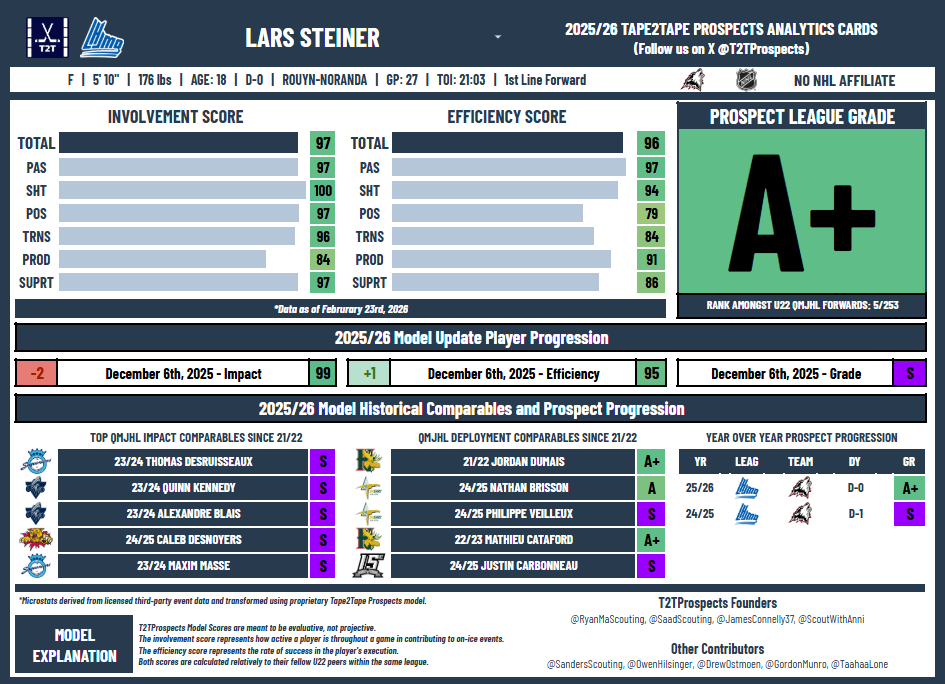
Games Tracked:
04/29/26 vs Chicoutimi (Playoffs)
03/20/26 vs Val-d’Or
02/07/26 vs Victoriaville
ELEVATOR PITCH
Steiner is a tough evaluation because his effectiveness swings heavily with his engagement level, flashing as a disruptive, physical, forechecking winger when dialed in but disappearing for long stretches when he coasts or cheats for offense. The underlying tools for a player his size are there. A stout frame, good contact balance, puck protection, and occasional flashes of edge, suggests there’s a potential depth energy player, but the inconsistency in motor and defensive involvement makes his projection less clear cut.
Steiner is probably one of the stranger evaluations for me in this class because early in the year he genuinely looked like the exact type of annoying, high-energy bottom-six winger NHL teams love having in playoff environments, and then by the end of the season you’re left wondering where it all went.
The biggest question I kept coming back to while watching Steiner was honestly just: where did the motor go?
Earlier in the year and in some previous viewings, there were legitimate flashes of a real buzz saw type of player. When Steiner is physically engaged and actually hunting pucks aggressively on the forecheck, he’s extremely effective despite not being the biggest player. He’s short and stocky, has really solid contact balance and can work defenders over surprisingly well below the dots. There were multiple sequences where he’d cross-check defenders, get underneath their hands with stick lifts, finish through bodies and even just outright stand players up through the neutral zone to disrupt transitions. For a smaller winger, there’s actually a decent amount of edge and nastiness in his game when he decides to access it.
The frustrating part though is that the consistency of that engagement just completely vanished for long stretches this season. Too often Steiner looked very nonchalant away from the puck. There were stretches of him cheating for offense by blowing the zone early, coasting through defensive sequences or simply failing to get involved enough in his own end. On the forecheck especially, there were way too many shifts where he’d circle around rather than fully attacking defenders and forcing rushed decisions. That’s what makes the projection so difficult because I actually think the underlying tools to play an effective energy role are there… he just didn’t consistently choose to play that way this year.
Offensively, Steiner’s game also drifted a little too perimeter-oriented for my liking. A lot of his puck movement consisted of safe perimeter passing and he didn’t consistently attack defenders head-on with enough force. He tries to create separation with stop-start movement and changes of direction, but honestly the mechanics can look a little awkward at times and don’t always create the advantages he’s looking for. Because he’s a smaller player without great reach, he can also get stripped easily when he tries to overhandle through traffic or stickhandle directly into coverage.
That said, there are definitely still some offensive habits I liked. Steiner finds soft ice well and despite the smaller stature, he actually projects as a surprisingly effective net-front presence because of how sturdy he is on his skates. He protects pucks really well coming out of the corners, doesn’t get knocked off his spots easily and can establish body positioning around the crease effectively. There’s an unorthodox quality to it because he’s not big in the traditional sense, but his stout frame and balance let him survive contact well enough to become a legitimate screen and rebound presence offensively.
I also think the flashes of puck protection ability are genuinely projectable. When he’s fully engaged physically, he can shield pucks effectively along the walls and extend possessions better than most players his size. Combined with the willingness to occasionally play with real edge, it’s easy to see why there’s still intrigue here even after a disappointing year.
Defensively though, I definitely wanted more involvement. Steiner just wasn’t consistently engaged enough tracking back, pressuring underneath the puck or supporting retrievals in his own zone. Again, that’s what makes me lean toward blaming at least part of this on environment because the physicality and earlier body of work suggest he’s capable of being much more disruptive than what he showed consistently this year.
All in all, Steiner remains a top-75 player for me largely because I’m still betting on the idea that the off-puck work rate and overall engagement level rebound once he gets out of the QMJHL environment and into a more structured development system. The combination of contact balance, stoutness, puck protection and occasional genuine physical edge still gives me hope there’s a versatile, high-energy bottom-six winger in here somewhere.
#74 - Noel Pakarinen - Kiekko-Espoo U20 - LW - U20 SM-sarja
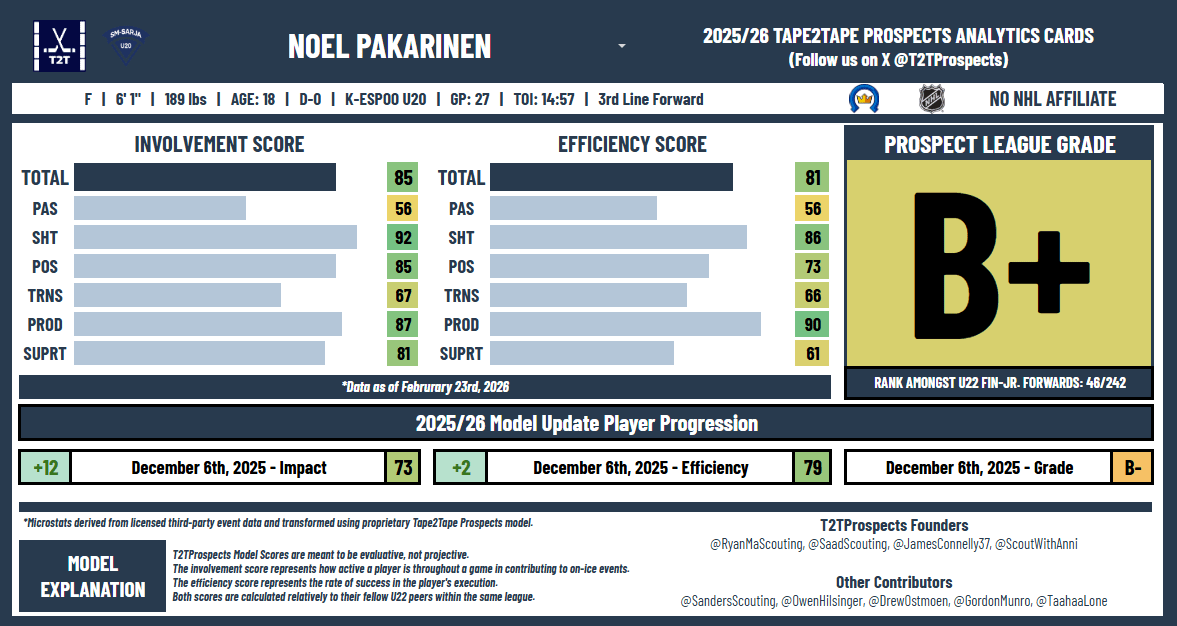
Games Tracked:
04/02/26 vs Tappara Tampere U20
03/17/26 vs JYP Jyvaskyla U20
01/21/26 vs Hameenlinnan Pallokerho (Liiga)
ELEVATOR PITCH
Pakarinen projects as an uber physical, support-style winger whose value comes from his size, straight-line skating, and a noticeable edge rather than puck-driving offense. While he can contribute as a perimeter passer and shooting option, his limited forechecking impact (besides the relentless physicality), inconsistent puck-winning intensity, and lack of interior offensive creation point to a likely depth projection.
Noel Pakarinen is a throwback player in a modern league. The 6’2” winger has been the most impressive Finnish U20 league skater I’ve watched so far this season.
Pakarinen’s game is all about reading the play in front of him and playing a support role on his line while bringing a nasty edge that fades in and out of the grey area of the rule book which NHL teams will LOVE. Pakarinen is big, with a pro frame, and he’s not afraid to use it against his U20 compatriots. He finishes his hits when he’s got his opponent lined up, he’s not afraid to take punishment in the net front (as long as he gets to give a healthy amount back), and in the corner, he loves his reverse hits. Against Tappara alone, he had 2 reverse hits, one of which ended up being his last shift of the game after his hit snapped the opponent’s head back and left him on the ice.
With the puck, Pakarinen’s game is two-faceted. If the defender is giving space, he’s not afraid to step into that space and snap shots on goal from distance. Otherwise, his game is pretty perimeter-centric, lots of short area passes along the boards to his teammates to keep cycle plays alive and little quick bump-ups in transition. He’s not someone who can take the puck through the neutral zone and beat guys outside.
On the forecheck, he has a good stick that can get into passing lanes, but I’d like him to show more of a second wind of effort on trying to win back pucks after his team turns it over in the offensive zone. I also find that for a player whose physicality is his calling card, he doesn’t really play the role of pest in board battles. Lots of staring and waiting for the puck to come loose. No shoved or attempts to dislodge the puck.
His passing rarely ever threatens the inside, and all of his goals are very much off-puck with net drives or pouncing on slot shot opportunities from nice set-ups from teammates. At this stage, Pakarinen is very much a complementary forward who capitalizes on his scoring chances but doesn’t really challenge defenders with his skillset, and his ability to win back pucks and apply pressure on the forecheck is not nearly as good as I’ve seen suggested.
All in all, Pakarinen is a nice projectable bottom-six player who I think will have lots of fans in NHL front offices because of the edge that he brings to his game. He’s likely in that range of prospects alongside Vandenberg, Lemieux and Hafele, but I think despite the size and physicality advantages, I don’t think the industriousness and/or intelligence as a forechecker are as consistent as those names.
#75 - Malcom Gastrin - MoDo Hockey U20 - F - U20 Nationell
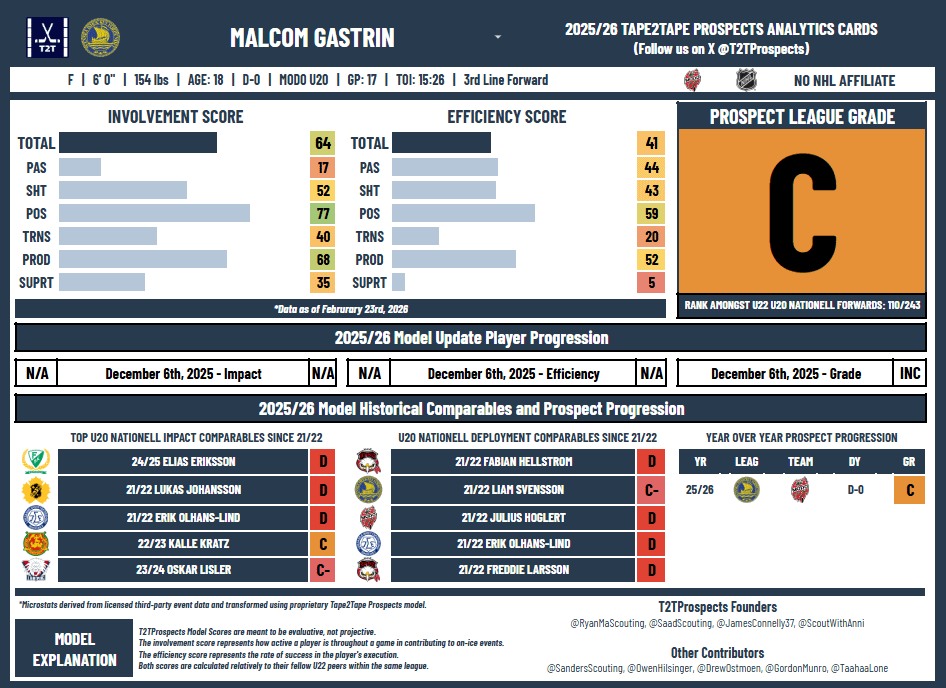
Games Tracked:
03/16/26 vs Djurgardens IF U20 (Playoffs)
03/01/26 vs BIK Karlskoga
01/18/26 vs Skelleftea AIK U20
ELEVATOR PITCH
Gastrin is a high-detail, straight-line two-way forward whose game translates best in structure rather than as a play driver. While he shows strong defensive awareness, good neutral-zone decision-making, and useful support habits, his struggles with balance, puck protection, and playing through contact limit his ability to create offensively or sustain plays. Overall, he profiles as a young, developmental depth forward whose projection hinges on improving his skating mechanics and strength to become more reliable under pressure.
Malcom Gastrin’s a tough evaluation for me.
On one hand, I do like the details in the defensive zone. Gastrin works hard to takeaway passing lanes into the slot and is willing to tie up sticks. He’s got a pro-sized frame that he will need to bulk up and grow into. He’s got very good patience and poise when the play breaks down in the neutral zone, he’s able to hold onto the puck, and shows a willingness to reload the play and make quick plays due to his awareness of where everyone is on the ice. It could be a simple cross ice pass back to his defenseman if no options present themselves, or maybe he’ll quickly turn and rifle a pass up the near boards to his teammate who has a bit of an opening at the blue line.
On exits, he’s smart and engaged, willing to come and tuck in from the far boards to provide another outlet option for his teammate. There are also some flashes of some nice slot-oriented passing ideas from behind the net and the half wall, but Gastrin really does struggle to keep his balance and stay on his feet through contact along the boards. It keeps him from staying alive in the play, losing battles along the boards, and not being able to be a follow up threat to his slot passes. He’s ultimately a very simple player with the puck, and there’s not really any dynamic notes to his game. He relies on skating into space, struggles to protect the puck at times and doesn’t really have many tricks in his bag to counteract physical or tight defensive coverage. Lots of pucks that he just struggles to settle and corral.
Some of it comes down to I think the mechanical components to his skating stride that could use some work. He really looks like he has to put everything into it in order to get moving from a stand still, and he doesn’t get enough bend in my opinion in his stride. This skating style also hampers him along the boards where he doesn’t really showcase good use of leverage in order to win board battles and maintain balance. Regardless, he works hard to not give up on plays off of turnovers and works hard to catch up and keep up with the puck carrier to try and force a turnover.
Gastrin is also quite reachy defensively, and I’d certainly like to see him keep his feet moving more often in his own end instead of relying on his strength and length to poke pucks away. His Allsvenskan tape was much of the same as U20 Nationell tape, which in same ways is impressive because translating your game from the U20 Nationell to the HockeyAllsvenskan and not showing a huge drop off is impressive for a player who was maybe a month away from being eligible for the 2027 NHL Draft.
Ultimately, Gastrin is a straight line player with good effort level, has very good details in his own end and the neutral zone but is by every definition of the word, a developmental project. Some improvements or optimizations will need to be made to his skating stride as well as his ability to play through contact. Ultimately, Gastrin is a smart player and while he has a ton of growth left when it comes to being a more self sufficient creator with the puck, I think this is a very developable package (especially given how young he is for this class).
#76 - Yegor Shilov - Victoriaville Togers - C - QMJHL
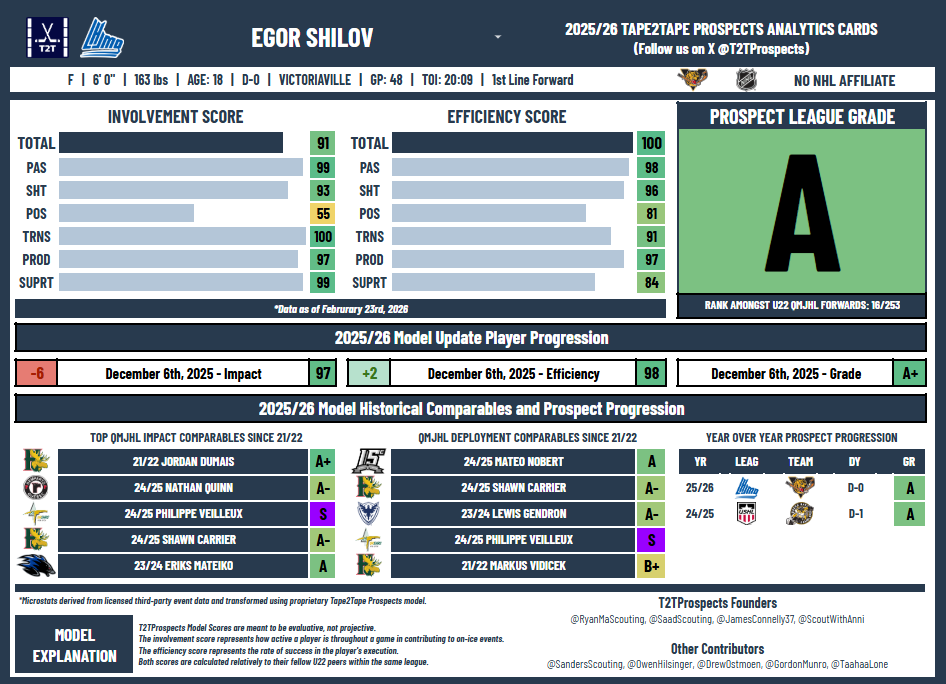
Games Tracked:
03/28/26 vs Blainville-Boisbriand (Playoffs)
03/01/26 vs Newfoundland
02/06/26 vs Sherbrooke
ELEVATOR PITCH
Shilov is a highly skilled but volatile offensive center whose elite puck manipulation, edgework, and passing touch make him a constant creative threat with the puck. However, major concerns about his competitiveness, defensive engagement, and physical play significantly limit his translatability, making him a boom-or-bust prospect whose value hinges almost entirely on whether his off-puck intensity ever catches up to his offensive talent.
Shilov is one of the ultimate boom-or-bust players in this class for me because the skillset is just so polarizing. There are some genuinely beautiful soft-skill flashes and puck manipulation sequences here that make you understand why people get intrigued, but at the same time, I have serious questions about how much of this game actually translates once the pace, structure and physical demands ramp up. The puck skill is outstanding but the projection is just a tough one.
Purely from a visual standpoint, Shilov is a really fun player to watch with the puck. He’s incredibly smooth and poised in possession and has this patient, almost casual style where he constantly manipulates tempo and waits for defenders to open themselves up. He’s very willing to work east-west with his edges, using little delays and sidesteps to buy extra time and weave through coverage rather than just forcing plays. There’s a ton of comfort handling pressure here and he can brush off stick checks really effectively with subtle puck positioning and edgework adjustments.
When he has time and space to operate, you can absolutely see the offensive talent. Shilov has really nice passing touch and consistently looks to thread pucks through layers rather than settling for perimeter passes. There were multiple sequences where he slipped difficult passes through defenders to spring teammates into dangerous ice, and his hand-eye coordination along the walls was impressive, too. He did a really nice job picking bouncing pucks out of the air or corralling awkward touches cleanly before immediately transitioning into possession plays. The puck skill level is just undeniably good.
The issue is that so much of the game outside of those offensive touches feels incredibly soft.
Physically, competitively and defensively, there are just massive concerns here right now. The hustle level was honestly pretty rough in a lot of viewings and there were way too many sequences where he’d simply coast through plays away from the puck. Along the walls especially, almost everything defensively felt like soft pokes, light stick taps or passive fly-bys. He’d get himself into the right general positioning at times defensively and even come down low occasionally to support his defensemen, but once he arrived there, he often didn’t actually do anything impactful afterward.
That’s kind of the recurring theme with Shilov. He understands spacing and can physically arrive into the correct areas, but there’s just not enough urgency, physical competitiveness or defensive bite once he gets there. He doesn’t win many puck battles, doesn’t pressure particularly hard and generally avoids engaging physically whenever possible. For a player whose offensive game already leans heavily on being finesse-oriented, that creates a pretty concerning overall projection.
What makes him especially difficult to evaluate is that his offensive style works extremely well in the QMJHL environment specifically. The league’s looser defensive coverage and generally lower off-puck work rates allow him to play this slower, patient, east-west possession game where he can create and exploit gaps through deception and edgework. He’s almost perfectly built stylistically for junior hockey because defenders will often attack him with their sticks first instead of fully closing through his body, which gives him room to manipulate coverage and extend plays.
But there were definitely moments where you could also see the limitations of that approach. There were sequences where Shilov almost looked overconfident with the puck, trying to skate directly into bodies or hold onto possession too long before getting completely bottled up and stood up through traffic. Against defenders who chose to close physically and take away his time aggressively, the offensive effectiveness dropped off pretty quickly.
Still, for all the flaws, I just can’t fully quit the skill package here. The edgework, puck control, patience and passing touch are legitimately intriguing and there’s enough offensive manipulation ability to imagine him becoming a nifty secondary creator if things work out. The problem is that almost everything about the off-puck game needs to improve significantly for that projection to actually become realistic.
All in all, Shilov is a super flawed but very entertaining prospect whose ranking is almost entirely driven by soft skill upside rather than projectable habits right now. I don’t think the current version of this player is especially translatable to higher levels because the competitiveness, defensive engagement and physical play are all major concerns. But the comfort level with the puck under pressure is real, the passing skill is real and the offensive creativity is certainly real. If he ever starts consistently applying himself away from the puck, there’s definitely talent here worth betting on, which is why I still keep him inside my top 90 despite all the concerns.
#77 - Noah Kosick - Seattle Thunderbirds - C - WHL
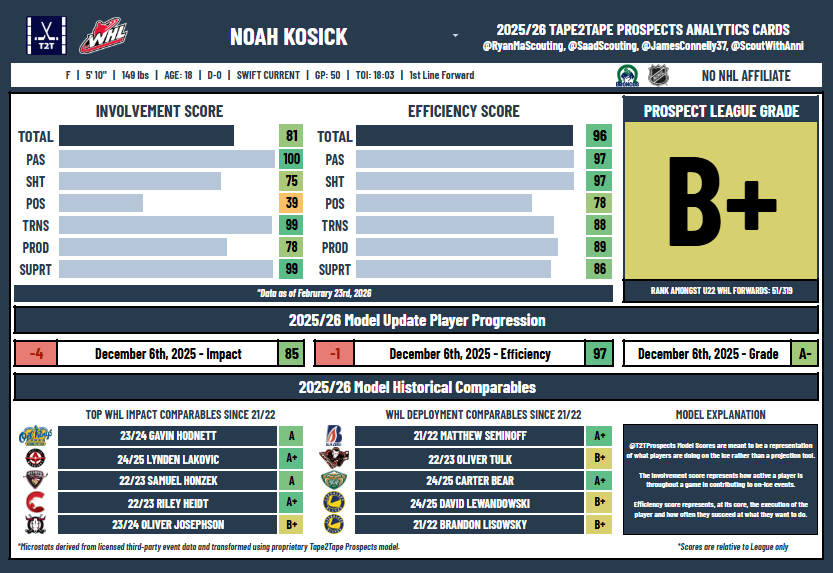
Games Tracked:
03/22/26 vs Spokane
02/27/26 vs Vancouver
02/07/26 vs Portland
ELEVATOR PITCH
Kosick is an elite, high volume, and extremely cerebral playmaker whose passing metrics and puck distribution ability stand out as some of the best in the WHL, especially in transition and off the rush. However, his perimeter-heavy offensive style, lack of puck protection and physical engagement, and passive defensive presence limit his ability to drive play consistently, making him a high-upside question mark as an undersized forward who needs more pace and competitiveness to make it at the pro level.
Kosick’s game will go underappreciated because his skillset is very much cerebral rather than frenetic on-screen involvement and pace, but he does feel, in a lot of ways, like the quintessential undersized CHL forward.
Kosick’s calling card in this current stage of his development is his playmaking, and the T2T Model microstats to support it are ridiculous.
100th percentile in passes leading to shots on goal
98th percentile in accurate passes
96th percentile in accurate pass percentage
99th percentile in puck receptions
This is a player who gets the puck a lot when he’s on the ice for Swift Current and now Seattle, and constantly threatens the defence with his playmaking. To be fair, there is a good amount of vanilla perimeter passing from Kosick, who, when in the offensive zone, likes to move the puck around with his defensemen to try to move the shape of the defence. This will artificially boost his passing accuracy, given the volume in which he touches the puck, but there are also some really special moments, too.
Kosick has an incredible touch with the puck off the rush, finding teammates with perfectly weighted passes through layers of sticks and defensive coverage and into the slot. He’s also a very smart player in transition, using a myriad of ways to get pucks to his teammates in motion, whether it’s nice little bump passes under pressure or cross-ice feeds to an open wing. I also like how, despite having lots of perimeter passes in the offensive zone, Kosick is very cerebral, and when an opening presents itself, he’s willing to hold the puck and use his shot fake to then open up cross-seam passing lanes.
I’d like to see Kosick utilize his shot more often, but he is, at this stage, a very, very perimeter-centric player who rarely attacks the super high danger areas of the ice. It ultimately comes down to a softer skillset and not really having the puck protection skills to reliably get into those areas of the ice with the puck.
This softer playstyle also dings Kosick a bit for me in his off-puck game. He rotates between the F2 and F3 role depending on whether he’s at center or has been kicked to the wing, but he’s not really hard on pucks and is almost a non-factor in puck battles. Defensively, I’d also like to see a lot more intensity from Kosick, who’s generally in the right spots but doesn’t employ a super active stick and has a more passive approach when defending on the perimeter.
There are also some pace concerns for Kosick, who I think avoids contact when carrying the puck, and it’s severely holding back his potential as a play driver. I think we could see a lot more out of him in terms of carrying the puck between the bluelines, challenging defensive coverage that has multiple guys back, and being a dominant engine for his team in terms of transitioning play from the defensive end to the offensive end. While his ability to pick out needle threading passes with a numbers advantage is eye-popping, I find that against a set defence, he’s more comfortable with a dump and chase.
All in all, there’s a player whose playmaking is some of the best in the WHL game this year, but the rest of his game has a lot of room left to develop before we see a potential pro package. I’m willing to take a bet on him, but the energy and physical play really need to take a jump in his D+1.
#78 - Zach Lansard - RW - Regina Pats - WHL
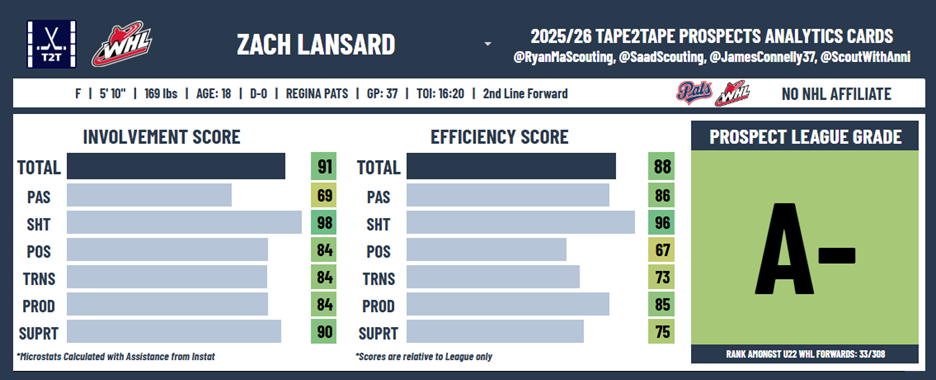
Games Tracked:
12/17/25 vs Prince Albert
12/31/25 vs Moose Jaw
01/14/26 vs Swift Current
ELEVATOR PITCH
Lansard is a confident, pace-driven transition winger who consistently pushes play north with the puck and shows flashes of real creativity, especially through occasional high-end passing off the rush. While his skating and scanning habits support a solid three-zone game and he competes on the forecheck with an active stick, his limited puck protection under pressure and tendency to default to low-percentage shots when pressured prevent him from fully translating his tools into a consistently impactful player offensively.
I’m a fan of Zach Lansard.
Very confident player on the puck, who’s not afraid to attack and drive play north as soon as he receives it. Just a really pacey player, and while the skating can look a bit too upright, he can really move.
He’s not a super high-volume transition passer that will threaten the slot constantly, but there’s some really nice touch on some of his long-distance passes. I keep going back to a saucer pass he laid out beautifully off the rush from the offensive blueline against the Wheat Kings that went tape to tape to his teammate who was driving the net.
His contact balance isn’t the best, but it doesn’t keep him from initiating contact when going into a corner for loose pucks. He’ll get into board battles, and he’s got a really active stick that will hound opponents even if the success rate isn’t always stellar.
He doesn’t close out defensively to the perimeter super well, but he does well to get his stick into passing lanes. He also has good scanning habits, where he’s very cognizant of opponents trying to sneak in on the weak side. There were a few times, either on a backcheck or defending in his zone, where he would out-leverage the opponent, stick lift them and erase them from the play.
When Lansard is motivated, he can be a really effective forechecker, using his speed to pressure defenders and force mistakes. On the puck, there’s some twitchiness to his game, where he’ll stop on a dime after an entry, and look for options before cycling the puck down low.
Something I would like to see more of from Lansard is his puck protection and his ability to handle pressure in the offensive zone. There are lots of stop-and-starts from Lansard along the boards, which is how he predominantly tries to shake defenders. The issue arises when he gets forced away from the half walls and towards the top of the zone and along the blueline. When he feels pressure here, there seems to be a lack of faith in his own contact balance and puck protection, and his instinct is to try to wrist a shot through traffic.
It works out well most of the time, but on occasions where the shot attempt is blocked, it leaves him and his linemates susceptible to counterattacks. Despite these concerns, Lansard is a fun player who brings a pacey style of play, some flair to his game on entries, and some pretty solid three-zone play.
#79 – Cole Zurawski – Owen Sound – RW – OHL
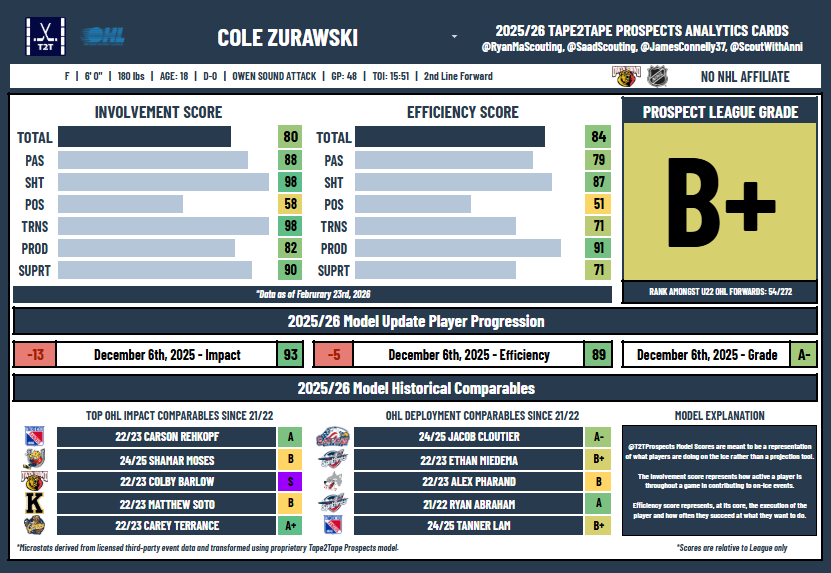
Games Tracked:
03/14/26 vs Guelph
02/21/26 vs Brampton
01/03/26 vs Peterborough
ELEVATOR PITCH
Zurawski is a very fun, rush-oriented, shot-driven winger who thrives in open ice, using strong skating and a quick, accurate release to generate most of his offensive value rather than working through structured offensive-zone creation. While he flashes moments of playmaking and can be effective on the forecheck when engaged, his defensive inconsistency, limited puck protection, and stagnating development throughout the season keep him from expanding beyond his relatively one-dimensional skillset.
Zurawski’s underlying numbers have fallen off since December per the T2T Prospects model, and despite being a player I had really high hopes for early in the season, the play of late has been reflective of the model score. Zurawski hasn’t been noticeably worse in any meaningful way, but the issue is that he’s stagnated and hasn’t shown the growth I was hoping for since I had him as an honourable mention in the Dobber midterm rankings.
The good news is that Zurawski is still a fun, pacey player, and I’m always a fan of those guys and willing to give them chances. Zurawski’s game leans much more shot-heavy than it does passing, and I don’t necessarily hate that approach. He’s got a nice whippy shot that is deceptively quick and accurate, allowing him to convert on his scoring opportunities efficiently. Add that to him being a really smooth skater who gets up to top speed really well, then it should come as no surprise that Zurawski is one of the more rush-oriented players in the OHL this season. He loves getting the puck off the rush where he can fly down the wing on an odd-man rush, get it between the circles, and snipe a shot through a goalie’s 6 or 7 hole for a goal. That shows up in the T2T Model too, as he’s 95th percentile in the OHL this season in rush chance shots on goal. That, in a nutshell, is Zurawski’s game: hunt rush opportunities and use your speed out in open ice as frequently as possible. If you can’t beat the guy wide, either dump it in and let your teammates chase it down or try to chip it off the boards to yourself.
This isn’t to say that Zurawski doesn’t or can’t pass. He’s just not really looking to do that most of the time in the offensive zone. When a pass is obviously available, like it was early in his game against Guelph on a 2-on-1, he showed nice touch on his pass, saucering it perfectly to his teammate driving the far post. There are also some nice moments from Zurawski on the forecheck. When he’s motivated, he flies into the offensive zone to track down loose pucks. He also has some really nice moments in board battles where he really showcases an understanding of leverage to win back pucks. His assist against Guelph came off a really nice forechecking play where he outleveraged the defender behind the net, stole the puck and centred it to his teammate for a goal.
Unfortunately, a lot of the weaknesses I saw early in the season are still very much prevalent. Zurawski could be an extremely effective three-zone player if he committed to it, but sometimes he’s so fixated on getting out as an option on the rush that it comes at the expense of his play in his own end. Too many plays where he’s looking to blow the zone before his team has even gotten full possession of the puck back, and he’s just not super engaged in his own end. He doesn’t consistently help his defensemen out when they’re under pressure by chasing down their rims to his wing, and there’s just a generally lackadaisical approach to his off-puck defending.
I also haven’t been a fan of his motor when it comes to consistency. When he’s in board battles, he’ll work hard to take the puck away, but struggles with taking contact and maintaining possession to keep cycle plays alive. I’ve also noticed he’s really slow to join board battles to support his teammates as the second guy in. It’s reduced him to a bit of a one-trick pony at times offensively in the offensive zone, where he’s mainly just a guy who will sift shots in from the perimeter for his offence. Taking into account just average hands that don’t string tons of moves together and dekes that go really wide and far away from his body, I think he’s still a developmental pick in the third round at this stage, much like Lansard.
#80 - Nikita Shcherbakov - Tolpar Ufa - LD - MHL/VHL
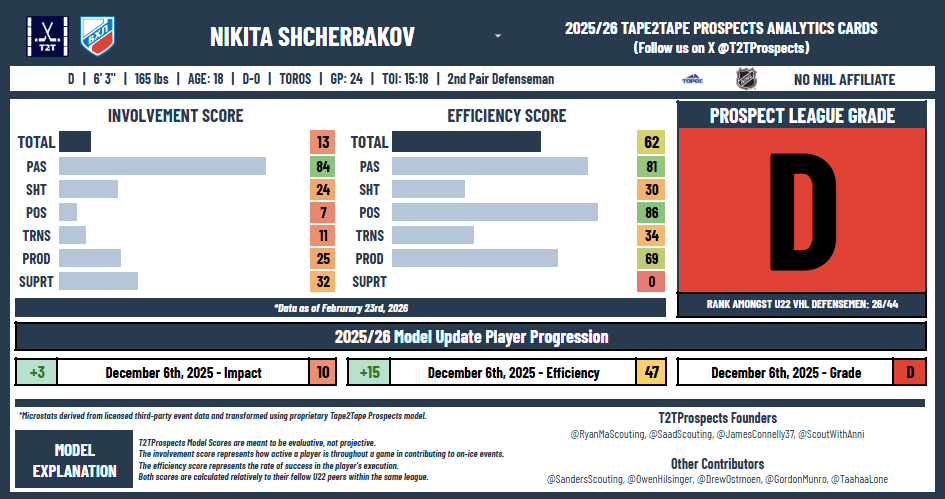
Games Tracked:
03/14/26 vs Gornyak-UGMK
02/07/26 vs CSK VVS Samara
01/05/26 vs MHK Molot Perm
ELEVATOR PITCH
Shcherbakov is a big, mobile, physically assertive Russian defenseman whose game is built around reach, strength, and shutdown ability, with flashes of offensive confidence. While his defensive tools and occasional offensive activation suggest there’s more to give from this player, his inconsistent puck management and unreliable breakouts make him a project pick who could either develop into a modern two-way defenseman or plateau as a steady but limited KHL-level player.
Nikita Shcherbakov is an interesting one.
My first viewings of Shcherbakov weren’t all that interesting. Just your typical big, mobile Russian defenseman who chips pucks up the boards and don’t try to do too much. Then I watched his game against Gornyak-UGMK and I’m beginning to think there’s a guy here worth taking in my first three rounds.
Let’s start with the given for a lot of these massive defensemen, Shcherbakov isn’t some shrinking violet. He’s big, is a bit of an asshole in the best kind of way, is physically strong and will just hold guys along the boards and just halt the flow of play while his teammates dig in to get the puck out.
On breakouts, Shcherbakov is mostly very vanilla. There are some nice quick passes up ice, but a lot of it is just him trying to shove it up the near side boards to his winger who’s facing tons of backside pressure. He ends up handcuffing them far too frequently and the play gets stuck in the zone. There are some times (very rarely) where Shcherbakov tries to get a bit cute with it and use some turns to buy space behind the goal line to look for a better pass but it’s definitely a work in progress and not a tool he feels comfortable with too many forecheckers in the vicinity.
The mobility is good though, he’s handled VHL minutes very well, and he’s got some decent turns in tight. While he only really showcased it in the one game I watched and the other two were very uninspiring, that 3/14/2026 game was really FUN. There was some real confidence that game from Shcherbakov to handle the puck in the offensive zone. twisting and turning to create space. He’s still learning to convert those delays and on-puck moments into real goal scoring chances for his team, one play he forced a d-to-d pass when he ran out of ice and it got deflected, but he also had a nice one where he drew two guys to him, got it down low and his team almost scored.
Scherbakov also showed in that final game that with some space he was willing to walk the line, look for a shooting lane and use a wrist shot or set up a slapshot on net. Good power on that shot, and I think it could be a weapon for him as he rounds out his game and figures out what he can and can’t do. There was just a comfort I didn’t expect to see from him in the offensive zone, showing off some nice keeps and decent lateral movement while handling the puck with his back to the blueline and using his reach to move the puck away from pressure to step inside. On broken plays in the offensive zone, Shcherbakov shows a willingness to use his skating to get into open space and use his frame to protect the puck and drive it towards the slot. There’s a good rangy defensive player that uses his length primarily to knock pucks away and in his super fun game, he did get into some trouble with his little turns with the puck, having to rely on his reach and skating to recover.
It’s raw and chaotic and he hasn’t figure out how to use those flashes of flair and puck protection in the offensive zone in his own end to break pucks out where he’s honestly a bit of a mess. He needs to showcase these high end traits far more often, the story of his season has been more boring and pedestrian, but that game really opened my eyes to what he could be if he’s given some more license to create. He’s a really fun project, but if the consistency and hockey intelligence don’t come together to supplement his freakish natural tools you could be sitting on a guy who just ends up being a career KHLer.
#81 - Ryan Roobroeck - Niagara Ice Dogs - LW/C - OHL
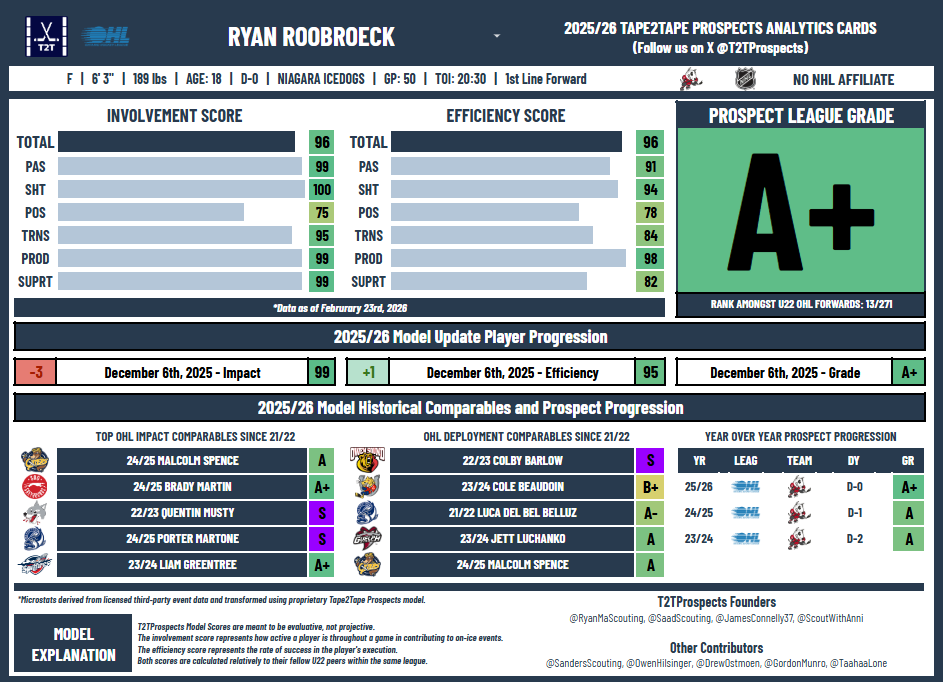
Games Tracked:
02/06/26 vs London
01/24/26 vs Owen Sound
12/13/25 vs Barrie
ELEVATOR PITCH
Roobroeck’s season was a step backward from early first-round expectations, as his lack of urgency, physical engagement, and consistent intensity limited the impact of his size and frame. While his shot remains a legitimate strength and he flashes some offensive awareness in space and around the net, his passive playstyle, limited interior drive, and inconsistent execution on skill moves with the puck makes him purely a mid round bet on traits rather than his true body of work.
Coming into the year, Roobroeck was actually a player I had sitting inside my first round. Big players with legitimate shooting talent, decent enough mobility and flashes of offensive skill were always going to intrigue me. Unfortunately, I thought this season, Roobroeck was pretty disappointing overall before it was ultimately cut short due to a lower-body injury to end the year.
The biggest issue for me with Roobroeck this year was just the lack of urgency and physical engagement in his game relative to the tools he possesses. Positionally, I thought he was fine defensively. He stayed in structure, took away lanes reasonably well and understood where he needed to be in coverage, but the mindset was way too passive for a player with his frame and physical tools. He’s not an aggressive defender who closes quickly or arrives with force into exchanges. Even when he would step into guys along the boards, it often felt more like a soft lean-in than an actual hit.
That lack of consistent pace and intensity carried over into a lot of other areas of his game as well. As the F1 on dump-ins and forechecks, I thought there were too many sequences where he simply didn’t pressure hard enough or arrive with enough intent to disrupt plays. Around his own crease, I also wanted a lot more engagement physically. Roobroeck would often try to use his backside or body positioning to nudge attackers away from rebounds rather than actively tying up sticks or clearing second chance opportunities.
Offensively, though, there are still tools here that make him interesting. Roobroeck has a legitimately very good shot, and probably the biggest reason I still have him relatively high despite the disappointing year. He generates impressive power without needing much time or space and can beat goaltenders cleanly from range when he gets the puck into shooting posture. A lot of his offensive touches came as more of an off-puck attacker on entries, crossing the offensive blueline along the wall and receiving passes into space rather than creating entries himself, but he still found ways to generate offense by floating into soft ice and getting himself around rebounds and loose pucks near the crease.
Roobroeck also showed some nice passing ideas throughout the season, whether it was slipping pucks into the slot from behind the net or attempting quick touch passes off the rush on entries. The execution was pretty hit or miss, but I did like some of the creativity and offensive awareness he flashed. In transition, when he had time and space in his own end, there were also some really nice moments where he’d use delays and one-handed puck protection while shielding the puck from pressure to buy himself more time before moving it up ice. My issue though is that while he’s been touted as skilled, his puck skills in tight areas aren’t great and he struggles to turn efficiently in small spaces with the puck. He relies heavily on his frame to protect possession, but despite his size, I didn’t think he consistently found or attacked inside lanes, often floating back out when he gets an inside track instead of working through contact to get it to the net.
All in all, Roobroeck still has enough raw tools for me to remain somewhat optimistic. Unfortunately, the lack of pace, physical engagement and intensity in his game really hurt his projection this season. There’s still a path here if he can become harder to play against, and becomes more direct and more assertive consistently, but after viewing him as a potential first-round talent early on, I couldn’t justify him any higher than here… and even that felt a bit generous.
#82 - Mans Gudmundsson - Farjestad BK U20 - RD - U20 Nationell
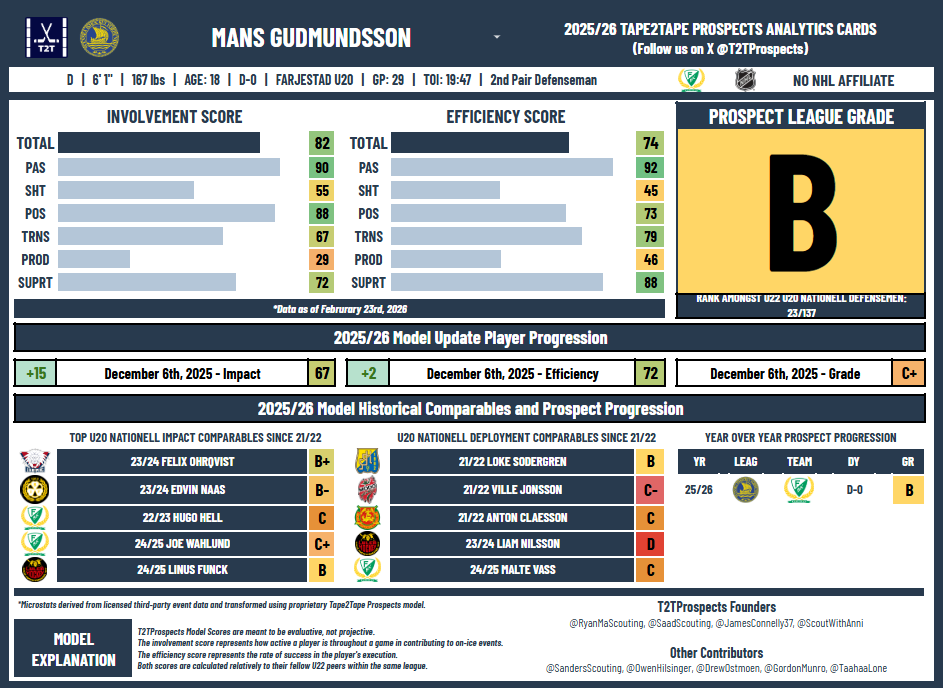
Games Tracked:
04/25/26 vs USA U18
03/26/26 vs Frolunda HC U20 (Playoffs)
02/11/26 vs VIK Vasteras HK U20
ELEVATOR PITCH
Gudmundsson projects as a reliable, defense-first blueliner whose NHL value will come from strong rush defending, physical engagement, and disciplined gap control rather than high-end athleticism or on-puck dominance. While he lacks elite skating or dynamic offensive tools, his intelligence, activeness in the offensive zone, quick decision-making, and aggressive pinching with a solid shot give him enough complementary upside to profile as a depth NHL defenseman if his development continues.
Mans Gudmundsson doesn’t have the highest upside, but I think there’s a decent bet for an NHLer here someday.
Although Sweden got their lunch money stolen in my viewing of them against the US at the U18s, I do think that taking in Gudmundsson’s full body of work, that with a few tweaks, an NHL team will be very happy with him someday. Gudmundsson’s road to the NHL, in my opinion, will primarily be predicated on how good of a physical, shutdown defender he can be, and outside of a few quirks that need working on, I think he plays this role well, especially when he was playing the more reserved safety net for Malte Gustafsson.
He played with real edge and physicality, clearing the crease and slamming guys into boards. It was a nice sign to see because in the U20 Nationell, Gudmundson’s game doesn’t lead with physicality.
He’s a very good rush defender for the most part, the back skating and edgework can be a bit wonky, but when he’s balanced and in control, he does a superb job reading gaps and walling off players trying to get fancy with him. His best defending is done when he’s able to flip his hips and mirror opponents, angling them off into the boards as he uses a really effective stick to hassle and take away passing lanes.
I wasn’t a huge fan of Gudmundson’s consistency when defending 2-on-1s against the US... to be fair to him, it’s not an ideal spot to be in, and his defense partners in Elofsson and Gustafsson did leave him out to dry a few times with over-eager pinches, but I’d like him to do a better job taking away the passing lane. He was playing it a bit too passively the first time, went full TJ Brodie slide the 2nd time, but went down too early where the cross crease still got through.
He was very aggressive to close out to puck carriers and while the physical edge in those league games were lacking, and I’d like to see him actually kill the play and turn it the other way, I do think that the U20 Nationell version of Gudmundsson shows that overall, there’s a competent odd-man rush defender here. Certainly some details to iron out especially when he’s playing with other defensemen who are super eager to get up into the play like he is, but the tools and hockey sense are all there.
Gudmundson doesn’t have these outstanding puck skills or elite lateral movement, but I love how quick and decisive his pinches are. He’s aggressive and assertive, and he does a great job of jumping up to keep plays alive, and has some nice passing plays into the slot when he gets the puck in motion. He’s also got an absolute bullet of a wrist shot that he can get off quickly, and an absolute bomb of a slap shot. I’d like to see him use his shot more often and place it with a little bit more accuracy but I think it’s a sneaky good weapon that will help him contribute offensively, alongside with his engagement along the boards to keep plays alive.
In his own end, very quick decisive player with the puck. Quick passes to a forward dropping down low for them to turn and burn north, rims around the boards, stretch passes for tips, simple d-to-d passes, Gudmundsson does a very good job reading the play in front of him to find open passing lanes rather than relying on his size or natural athletic skills to be an efficient player on breakouts.
All in all, Gudmundsson is a defense-first defenseman with some nice activeness in the offensive zone who’s just baseline good at everything that he’s asked to do. He won’t be the most dynamic player in the world, and maybe he’s not the natural athlete that a guy like Schairer or Marthaler are from the US, but he’s smart, and reads his surroundings on the ice very well which makes me think there’s potential for him offensively as well. Those traits are infinitely more important to me and why I think he’s someone worth investing in the Top 96.
#83 - Landon Nycz - LD - University of Massachusetts - NCAA
Games Tracked:
04/06/25 vs Tri-City Storm
10/05/26 vs Northern Michigan University
ELEVATOR PITCH
Nycz is an intriguing offensive-leaning defenseman with excellent skating, edgework, and transitional puck-moving ability, showing real flashes of control and passing touch when given time and space. However, his inconsistent defensive reads, low engagement level, and struggles with situational awareness in his own zone significantly limit his current projection, making him a high-upside but unreliable defender who needs major improvements in compete and defensive consistency to reach his offensive potential.
Landon Nycz is a really exciting yet also frustrating talent. There are clear reasons to like the 6’2” left-shot defenseman, the biggest being his skating. He’s a remarkably fluid mover with excellent edgework and four-directional mobility. His stride is smooth and effortless, allowing him to close space quickly and transition pucks up ice with control. When given time and space, his stretch passing can be highly accurate. He’s capable of threading a pass off the boards or hitting a teammate in stride from his own end. Nycz also possesses soft hands and enough confidence to take the puck on little adventures even under forechecking pressure, showcasing both poise and skill.
Despite an offense-leaning profile, Nycz isn’t your typical Power Play QB. When I’ve seen him on the PP, he was positioned as a shot option on his off-side rather than as a quarterback at the top. His approach was heavy on shooting rather than distribution.
Defensively, however, Nycz has struggled with consistency. His reads were hit and miss, and he can be mentally a step behind when play breaks down. There are several moments throughout games where he freezes amid scrambles, unable to locate loose pucks around his feet. He isn’t particularly assertive in his own end; his engagement level defensively is low, and he looks too easy to play against. Just not enough of a compete level for me right now with his in-zone defending.
His rush defense mirrored the same inconsistency. He often starts sequences with solid gap control and a good initial stick, but has a habit of straightening up too early. Opponents exploit that by accelerating wide or cutting inside, catching him flat-footed and forcing him into recovery mode. These moments eroded much of the early defensive positioning advantage he’d gained. As the situation often is with these molds of players, high volume of transition involvement also means more turnovers and Nycz isn’t immune to this. He’s had his fair share of pizzas in the handful of games I’ve watched.
Overall, Nycz is an intriguing but frustrating player. The tools are clearly there: size, skating, transitional vision. He led all 17-year-old defensemen in USHL scoring last season, and his second game for UMass is a look into what kind of player he can be at his best. For now, his combination of skating and puck-moving remains the draw, but he’ll need to add more competitiveness, and reliability in his own end to fulfill his potential.
#84 - Mikey Berchild - USNTDP - F - USHL
Games Tracked:
04/04/25 vs Muskegon Lumberjacks
ELEVATOR PITCH
Mikey Berchild is a smart, detail-oriented forward whose strong defensive habits, puck support, and flashes of creativity with the puck make him an intriguing long-term prospect. While his edgework, offensive instincts, and competitiveness stand out, he'll need to add strength and find ways to create more space and increase his offensive involvement at higher levels to maximize his upside.
Mikey Berchild is a player whose game can be easy to overlook at first because so much of what he does well comes from details away from the puck. Whether deployed at center or on the wing, Berchild is positionally sound, consistently arrives in the right defensive spots, and does a good job scanning and shoulder-checking to stay connected to the play. He forechecks with purpose, supports his teammates well, and generally plays a mature, low-maintenance game that doesn’t result in many glaring mistakes.
What ultimately keeps drawing me back to Berchild, though, are the flashes of offensive creativity that appear throughout his shifts. When he has time and space, there’s real confidence to his puck carrying. He attacks the middle of the ice willingly, shows good patience through delays and cutbacks, and has the edgework to change directions in tight areas to extend possessions. There are sequences where he’ll weave through layers of coverage, manipulate defenders with subtle changes of pace, and create opportunities that aren’t immediately obvious.
The skating is solid overall. He’s not an explosive north-south burner, but his edgework and agility allow him to navigate traffic effectively and make plays while changing directions. He also has a good nose for the net, consistently finding opportunities to arrive around the crease as a scoring option rather than simply circling the perimeter.
One area that still needs development is his physical strength. Berchild competes hard in board battles and doesn’t shy away from contact, but he can get overwhelmed by stronger opponents and lose initial puck battles. To his credit, the work ethic is there. He regularly stays engaged after losing possession, using stick lifts, second efforts, and persistence to work his way back into plays and recover pucks.
Overall, Berchild blends strong habits, intelligent positioning, and subtle offensive skill into an intriguing package. He may not overwhelm you with high-end tools, and there are certainly concerns about how he is going to be able to consistently create space at higher levels and how to up his involvement in the play when he doesn’t have the puck offensively, but there’s a cerebral quality to his game, and the combination of competitiveness, puck skill flashes, and attention to detail which give him a solid toolkit to build upon.
#85 - Linus Loob Trygg - Farjestad BK U20 - C/LW - U20 Nationell
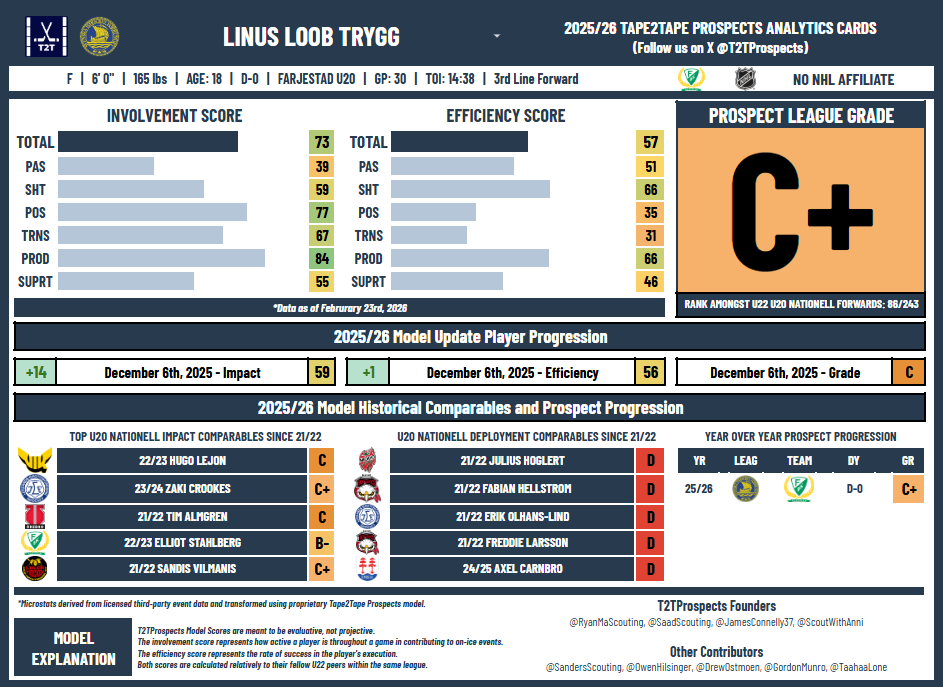
Games Tracked:
03/17/26 vs Sodertalje SK U20 (Playoffs)
02/11/26 vs VIK Vasteras HK U20
12/16/25 vs Orebro HK U20
ELEVATOR PITCH
Loob Trygg is a toolsy, pace-driven forward with explosive skating, creativity, a strong shot, and flashes of two-way intelligence, but his game lacks the consistency and physical engagement needed to fully capitalize on those strengths. He projects as an intriguing NHL depth prospect if he can become harder on pucks, improve his puck protection, and more consistently blend his skill, speed, and competitiveness into a cohesive package. That improvement will have to come quick though as one of the oldest players in the class.
Linus Loob Trygg’s a very fun, toolsy player but after three games I’m still left wanting more.
That’s not meant to be a slight to Loob Trygg at all, I’m a fan of the overall package he brings, but as an older player in the class who could’ve been a 2025 NHL Draft player if he was born a few weeks earlier, I think I was hoping the cohesion of all his individual skillsets would come together more consistently.
As I mentioned, the individual tools are all there for Loob Trygg, he’s an explosive and fluid skater that gets out of his breaks well, and plays with an edge, willing to upend opponents and slam them into the boards. He uses this speed to his advantage where he wants to attack downhill with speed and momentum on his side. It’s not always the cleanest and for every play he splits the defense, you can bet there’s another where he skates into traffic and loses the puck in a swarm of sticks and skates.
There’s good passing ideas as well from the half wall in transition, nice little creative bumps into the center of the ice to teammates, and he’s a player that really tries to drive play into the center of the ice, whether that’s slot passes or trying to stick handle his way in. The execution is not always quite there, deflected passes, plays where he’s not on the same page as his teammates, but the ideas are there, and he does have some neat no-look passes that he will sprinkle in. I also really appreciate him willing to come down the boards as a winger to support his defensemen in order to get pucks out instead of trying to fly the zone for a chance at a rush opportunity. All in all, Loob Trygg is a nice, connective player on his line who is willing to try and drive offense himself as well.
Loob Trygg’s also got a very nice shot and some good in-zone off-puck movement. He’s also got some nifty hands in tight that I think will serve him very well at the next level as soon as he figures out how to effectively protect the puck. I think for a player of his skating ability and size, he should be doing a much better job of handling contact and making plays through it. I also think that he needs to be harder on pucks, if Loob Trygg would show a more consistent motor, I think he’s someone that would fly up my board.
As Owen points out (@OwenHilsinger), he does have
“flashes of strong defensive instincts”
and as a lanky, rangy player, there’s potential for him to be a super disruptive defensive player who can force turnovers and create rush chances for himself. I’d also like to see him use his speed to drive the net when he’s off-puck far more. He’s just far too content to glide in line with his puck-carrying teammate instead of trying to stretch the defense and create traffic.
All in all, Loob Trygg is a fun, traitsy player who plays with pace and has genuinely been one of the best U20 Nationell playoff performers this season. I think there’s certainly a chance for him to become an NHL depth piece someday, but he needs to ramp up the consistency of his ability to take and give physicality with and without the puck. The tools are all there for Loob Trygg, but as an older birthday, he doesn’t have the luxury of time to figure out how to meld everything together.
#86 - Oscar Holmertz - Linkoping HC U20 - C - U20 Nationell
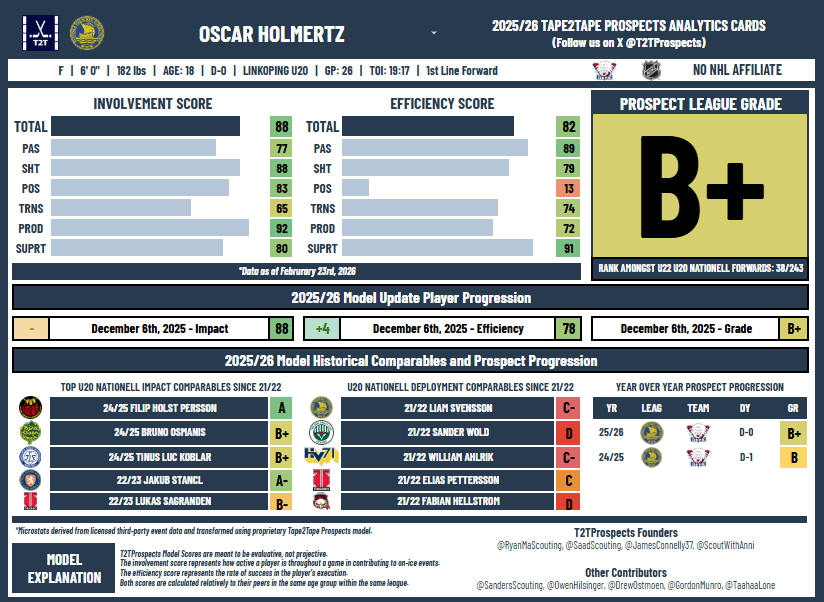
Games Tracked:
03/17/26 vs Orebro HK U20 (Playoffs)
02/15/26 vs Vaxjo Lakers HC U20
12/26/25 vs Farjestad BK (SHL)
ELEVATOR PITCH
Holmertz is one of the youngest players in the class and projects as a long-term upside bet, showing flashes of high-end playmaking creativity, offensive intelligence, and puck-pursuit ability that hint at a much more dynamic player once he physically matures. Right now, inconsistent engagement, poor puck security under pressure, and a lack of strength limit his effectiveness, but increased physical development and SHL experience could unlock a far more dangerous creator and puck-winning forward in the future.
Holmertz is an August 2008 birthday, and as one of the youngest players in the class, he’s certainly got some growing to do in his 6’0” frame, and I’m excited to see what kind of player he could be in a few years after an SHL season or two under his belt.
Holmertz has moments of being an exceptionally creative and skilled player as a playmaker. There were some nice cross-seam passing and using head and shot fakes to open passing lanes on the power play. He had an absolute bullet from his own half-wall against Orebro to his teammate at the opposite blueline, getting his teammate loose for a breakaway chance.
There are some really great sports of puck pursuit as well in the offensive end. Chasing his own dump and chases, winning races to a teammate’s rim down the boards, hunting down defenders from behind the net on breakouts, Holmertz has some nice moments of explosiveness that will allow him to introduce himself into plays you don’t expect. Unfortunately, as I mentioned before, he has a lot of growing to do physically. He’s just not strong enough to outleverage guys and win these battles unless he can get a clean stick lift.
He’s also just not consistently hard enough on 50/50 pucks and puck battles, and it makes life too easy for his opponents at times in the neutral zone. I’d really like to see him turn those flashes of rallying to the puck in the offensive zone and mirroring that in the other two-thirds of the ice. The backchecking effort is extremely hit and miss, and I have noticed a few times where he’d drag himself out of position in the defensive zone, looking to cheat for offence.
I find he also really struggles to corral pucks played to him at the offensive blue line or in the neutral zone. Lots of pucks that bounce off his stick and away from him, or him struggling to settle it before physical defensive coverage settles in around him, and possession is lost. He struggles to create time and space for himself with the puck, and it’s unfortunate because the plays he is capable of making with the puck as a playmaker are dangerous in the moments when he can get control of the puck.
Ultimately, my ranking for Holmertz is heavily contingent on projecting what I think he’s capable of. I think real dedication on his end in terms of getting stronger, coupled with getting playing reps in the SHL, will do wonders for his development. I believe that if Holmertz can really improve his strength and contact balance, it will make him more comfortable receiving passes and more capable both in terms of being an effective puck hunter and also as a creator. He’s nowhere near a final product, but there’s enough here to like.
#87 - Vilho Vanhatalo - Tappara U20 - RW/LW - U20 SM-Sarja
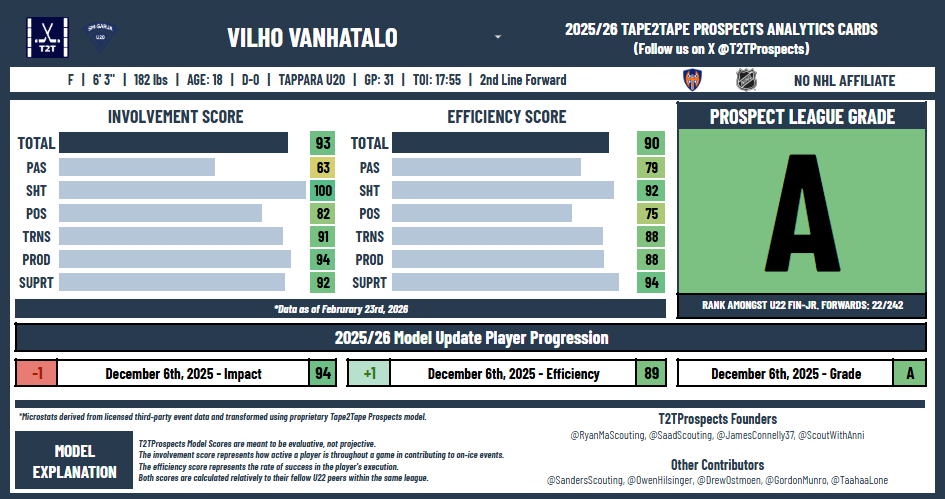
Games Tracked:
04/25/26 vs Slovakia U18
03/28/26 vs Kiekko-Espoo U20 (Playoffs)
12/27/25 vs KooKoo Hockey
ELEVATOR PITCH
Vanhatalo is a toolsy winger whose NHL appeal is built around a legitimately dangerous shot, good size, and enough skating ability to project as an off-puck scoring threat if the rest of his game develops. The frustration is that his puck skills, physical engagement, defensive effort, and ability to consistently leverage his tools lag behind, leaving him as a prospect whose success depends on whether he learns to play with greater purpose and competitiveness away from the puck.
Vilho Vanhatalo is a frustrating player to watch because I think there’s a lot to be excited about, and the good is really quite good, but I’m not sure the package is ever going to come together to a point where he can be a realistic NHL option.
Vanhatalo is a big, rangy player who prefers to play the game in straight lines with the puck. There’s generally decent speed and pace when he wants to use it, but the contact balance and skating stride are a bit awkward and despite this well above average speed, he doesn’t generate the power to go through guys, nor the explosiveness to get past them. It leaves Vanhatalo in this weird spot where he looks like he’s moving all over the ice on the forecheck and in the neutral zone... but he’s not really creating anything or pressuring anybody with that movement.
However, the shot is a WEAPON, and in a sport where goals, and more importantly, goal scoring, come at a premium, it’s easy to see why Vanhatalo still has plenty of fans, even if I’m not anywhere close to as bullish as some others may be. His shot comes off his stick like a rocket, he doesn’t need a huge wind up to get it off, and I think he gets into the high danger scoring areas enough off-puck that there could be a reliable bottom six goal scoring threat if everything else really comes together.
Vanhatalo clearly knows he has a great shot too, and much of his game is oriented around getting himself into spots where he can use it. Any chance he gets to take a shot, with a reasonable chance of getting on net, and you can bet that he’ll take it. Unfortunately, he doesn’t really have the skillset to be able to create space for himself with the puck to get a shot off as a self-creator and so he is very much an off-puck shot hunter for the most part.
Vanhatalo’s game on the puck is very hit or miss, there’s a real focus from him when he serves as a playmaker to get the puck towards the slot, but man for a guy his size he gets moved off of the puck and bodied around very easily and he can get quite loose and careless with his decision making at times in the neutral zone. It almost looks as if he’s just flipping the puck into open space... there’s good intention most of the time but the execution and accuracy is not so great.
My biggest pet peeve with Vanhatalo is he just isn’t a consistently engaged player defensively. Doesn’t use his speed to get back on the backcheck, doesn’t make an effort to close down shooting lanes, he’s not super physically engaged outside of the odd bump in the corner. It’s frustrating to see because he’s got a super rangy reach that could make him an absolute demon as a forechecker and defensive player given his speed if he would just commit to it defensively.
All in all, Vanhatalo is a shot oriented player (which is good cause he does have a great shot), and that will buy him a lot of good grace from some NHL front offices. The size and skating are sufficient, and there’s real potential for his play off the puck (that shows up in flashes)... he just needs to really show a willingness to work for it. He fits right into that range with guys like Loob Trygg and Holmertz.
#88 - Rudolf Berzkalns - Muskegon Lumberjacks - C - USHL
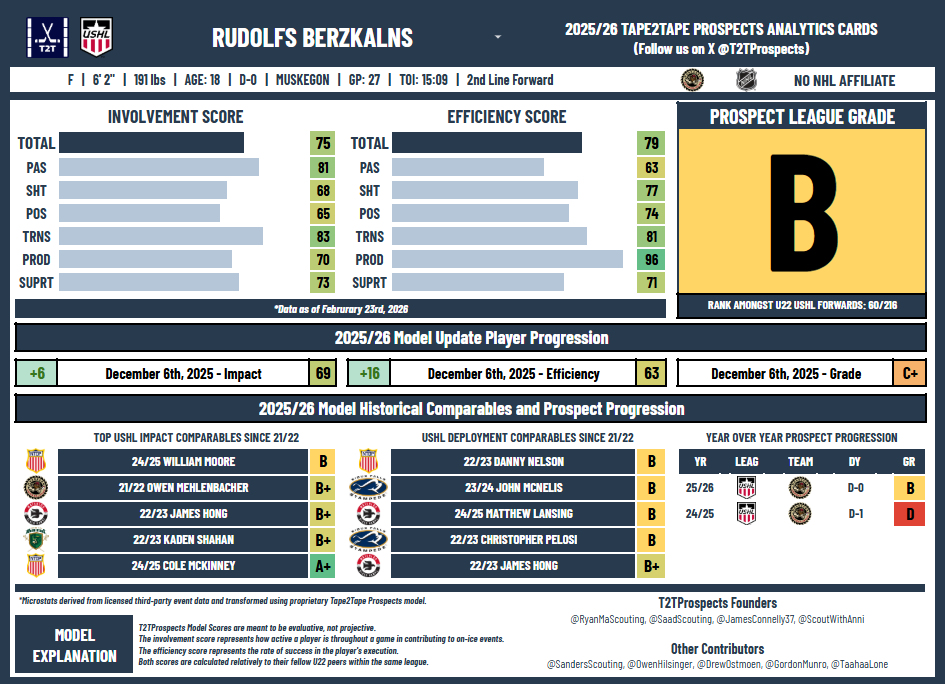
Games Tracked:
04/25/26 vs Dubuque Fighting Saints (Playoffs)
03/28/26 vs USNTDP U18
02/28/26 vs Omaha Lancers
ELEVATOR PITCH
Berzkalns is a physically mature, two-way center whose strengths lie in his puck protection, connective playmaking, defensive awareness, and ability to make smart plays under pressure, giving him a highly projectable package for a future depth role. While limited skating and a lack of dynamic self-creation likely cap his offensive ceiling, his passing touch, interior play, and translatable habits make him an intriguing mid-round bet if he can improve his pace and overall engagement level.
Berzkalns is one of the more intriguing mid-round center bets in this class for me because while I don’t think there’s a ton of dynamic upside offensively, there’s a lot of projectable translatable habits in his game that could allow him to carve out a role higher levels one day.
At his best, Berzkalns is a big, physically strong center who plays a very mature, controlled game with the puck. The skating is definitely a concern and I don’t think he’s ever going to be a player who beats opponents with pace or explosive east-west movement, but it’s passable enough for me considering the rest of the package. What stood out to me most in my viewings was just how comfortable he looked handling pressure and contact along the boards. He uses his size, reach and strength really effectively to protect pucks, buy himself an extra second and make short-area plays under pressure. Whether it was little bump backs to supporting teammates in the middle, slipping passes up the wall on exits or holding onto pucks long enough to open passing lanes, I thought there was some really nice connective playmaking ability here.
Berzkalns is also a very underrated passer in my view, especially when he rotates out towards the wing and starts facilitating from the half wall. He showed really good patience waiting for lanes to open up and could make some legitimately nice cross seam passes into the slot or weak side flank. I thought there was a pretty consistent understanding of slot-oriented passing and putting teammates into positions to attack quickly off receptions. At times, he could mishandle puck receptions himself and kill some sequences before they developed, but overall I thought there was more touch and offensive awareness here than his raw production might initially suggest.
Offensively, Berzkalns isn’t the most dynamic self-creating threat and I do think that limits his ceiling somewhat. He can work through traffic with his hands and strength to gain entries, and every once in a while he’ll split defenders cleanly and generate a rush chance for himself, but it’s fairly hit or miss overall. Against set defenses, he’s much more effective extending possession cycles and facilitating than he is creating separation on his own.
Defensively, I thought there was a lot to like here. Berzkalns consistently came down low into the slot to support his defensemen and used his stick well to get into passing and shooting lanes and I thought his defensive positioning was solid. However, I would still like to see more overall activity and engagement in his own end. There were too many sequences where he’d get a bit static standing around the slot instead of proactively closing space or arriving harder onto plays along the boards defensively. Given his frame and strength, I think there’s still another level of physical engagement he can tap into on a more consistent basis.
All in all, I don’t think Berzkalns has the dynamic tools to project as a major offensive player at higher levels, but there’s enough passing touch, defensive and interior play, and pro-projectable habits here for me to buy into him as a potential depth complimentary center down the line if the skating and overall pace continue to improve.
#89 - Pax Kleffner - Leksands IF U20 - C/W - U20 Nationell
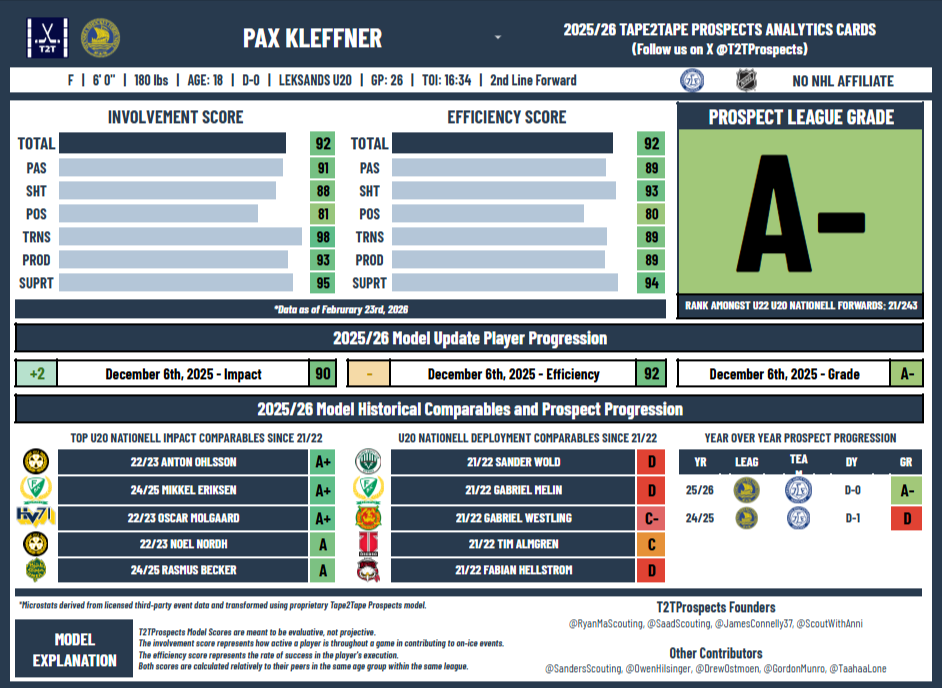
Games Tracked:
03/29/26 vs Mora IK U20 (Playoffs)
03/08/26 vs MODO Hockey J20
02/07/26 vs Timra (SHL)
ELEVATOR PITCH
Kleffner is a smart, defensively responsible forward whose combination of size, straight-line speed, forechecking intelligence, and underrated shooting ability gives him a strong projectionas a potential bottom-six NHL player. His limitations with puck handling under pressure, inconsistent motor, and lack of standout playmaking cap his upside, but his hockey sense, defensive habits, and off-puck offensive instincts make him an appealing mid-round development bet.
I like Pax Kleffner. I don’t think he has the brain and passing of his teammate Andersson, or the high-end explosive ability of JLH, but I do think that the Leksands product is worth a look here.
Max Isaakson has gotten a lot of love for his cerebral two-way play, and while I didn’t see that in my viewings of the player, I do see it with Kleffner, who I think has gone a bit overlooked. There are some good natural tools with Kleffner; he’s already a good pro size at 6’1”, and he’s got more than enough speed in straight lines. I think Kleffner’s calling cards at this stage in his development are his intelligence, speed and shot.
Kleffner’s a very tuned-in player who’s a really smart forechecker and knows how to use his size and speed to maximize takeaway opportunities. He had a great forechecking play against Mora IK, one-on-one, where he used his reach to poke the puck loose, kicked it to himself, shielded the defenseman on his backside before saucing a backhand pass through the crease to a teammate. He’s a player who doesn’t motor all over the ice trying to finish hits and lift sticks; he times his moments to pressure the forecheckers and gets them in tough spots.
Kleffner will support his teammates on the forecheck and along the boards, where he does a lot of good work. He’ll wall guys off in the offensive zone along the boards to maintain puck possession and then try to make soft, quick touch passes to his teammate while being held to keep plays alive. I think he could be stronger on loose pucks or plays in tight. The hands are a weakness at this stage; he can’t really effectively pick out pucks and move them through sticks unless he’s got a dominant position and some space. There were also too many moments where he’d overskate pucks trying to pick them up through a mass of sticks and skates.
Defensively, Kleffner is responsible, playing tons of PK time, and he does a great job collapsing into the slot and then getting back out to funnel play from the middle of the ice down the halfwalls. Would like to see more of a motor from Kleffner instead of relying on his positioning, and more aggressiveness and physicality when going after pucks, but I think he’s got a great understanding of taking away passing lanes.
Kleffner in the offensive zone mostly works the boards, charging through in straight lines, absorbing contact along the boards and trying to one-hand shovel it to his teammates in close support. There were a few moments with time and space after zone entries where he’ll cut back along the half wall and try to attack the middle of the ice, but the hands don’t survive under contact, where he’ll fumble pucks and turn them over.
Kleffner’s playmaking hasn’t stood out to me, but he drives the net front without the puck, knows when to sit down into space to get slot shots and also has a really underrated wrist shot that he generates a lot of power from and can beat goalies clean from distance.
All in all, I think the raw tools are there for Kleffner to be a bottom-six NHLer with the skating, intelligence, defensive awareness and shooting skillset. The puck skills and motor will need an uptick, but I do think there’s a guy worth taking a flyer on somewhere in this range.
#90 - Alexander Bilecki - LD - Kitchener Rangers - OHL
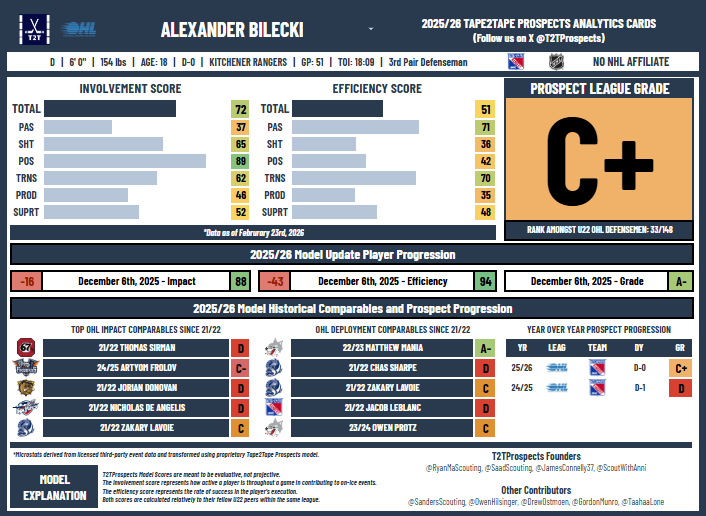
Games Tracked:
11/15/25 vs Guelph
12/13/25 vs Saginaw
01/10/26 vs Owen Sound
ELEVATOR PITCH
Bilecki is a cerebral, pass-first defenseman who stands out for the touch on his passes, strong spatial awareness, and ability to activate intelligently in the offensive zone to generate cross-seam plays and scoring chances. While his composure and passing vision are clear strengths, concerns around his stiff skating stride, pace of play, and inconsistent defensive engagement will determine whether his skillset translates against faster, more physical pro competition.
I thought I was going to be the big Bilecki guy this year as a Kitchener Rangers fan but after a red hot OHL Playoffs it looks like the hype train has passed me and I’m now one of the guys that are considered low on him.
The first thing that shows up on tape for Bilecki is the passing. He doesn’t always make super quick plays, and you sometimes would like him to pick up the pace a bit, but the passes are laid out with really amazing touch. They’re almost always perfectly weighted and easy to settle for his teammates, which makes transitioning from behind the net to the opponent’s blueline much easier.
He’s also a smart player who maximizes his contributions as a defenseman off the puck. He activates a ton down the wall and into the slot in the offensive zone, finding empty ice to try to exploit defensive coverage. He’s been able to generate a ton of scoring chances this way with slot shots and being a part of some really nice cross-seam passing plays.
He will sometimes make me a bit nervous in the defensive zone when he gets pressured or forechecked because he goes into corners and board battles at his own pace, but his first play on pucks is generally accurate and precise and find their way out of the zone or onto a teammate’s stick. He doesn’t look like he plays with a ton of urgency, but I think it may just be personal confidence in his ability to execute.
There are flashes of really underrated passing ability, a no-look pass cross-seam or a back pass to his defence partner while sandwiched between two forecheckers… he’s just a very cerebral defenseman with top-notch spatial awareness.
While he does a good enough job boxing out the net front, scouts will want to see more of a competitive edge along the boards in puck battles when his first attempt fails. However, the biggest drawback for me so far is that the skating looks too stiff and upright; he will need to improve that as he develops, because against more potent rush offences, he may get taken advantage of.
#91 - Giorgos Pantelas - Brandon Wheat Kings - RD - WHL
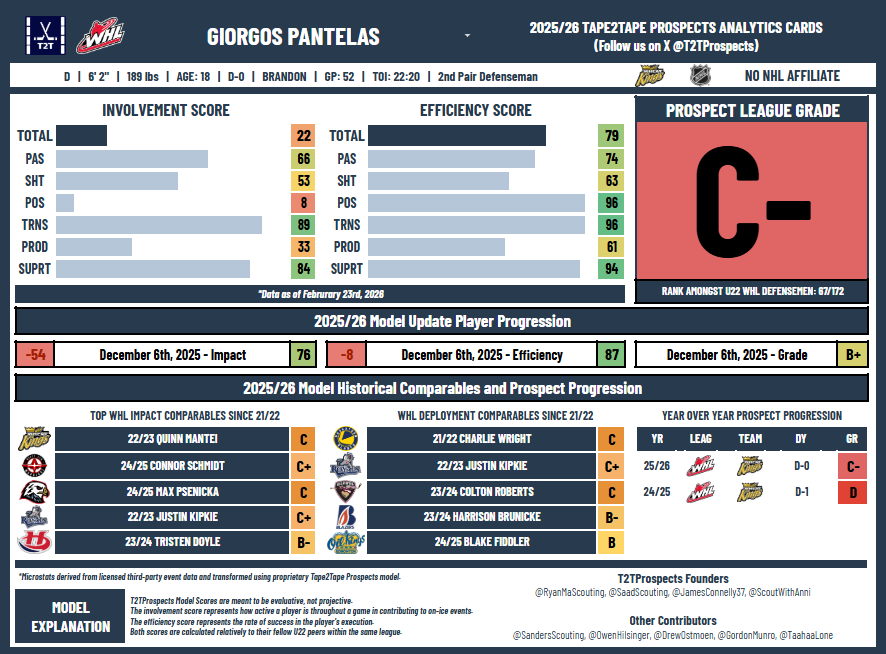
Games Tracked:
03/21/26 vs Regina
02/07/26 vs Prince Albert
01/27/26 vs Seattle
ELEVATOR PITCH
Pantelas is a pro-sized right-shot defenseman who excels at defending the rush with strong gap control, an active stick, and excellent situational reads, while also showing confidence as a puck mover who wants to jump-start transition and carry play. However, his limited mobility, inconsistent puck skills under pressure, and tendency to overextend offensively create real concerns about whether his aggressive, play-driving instincts will translate effectively against faster, more structured pro competition.
Pantelas is an intriguing RHD with pro-size who got some shouts early in the year as a potential 1st Round talent. I won’t go that far with my ranking, but I do think there are tons of positives with this player that are worth an investment from NHL teams.
Pantelas is a rush defense guru even with the physical limitations of his movement skills. His pivots are slow and he doesn’t flip his hips well to change direction but he really understands how to negate rush chances. He’s got amazing gap discipline, a great stick that he uses to poke pucks away, and just a great feel for when to attack puck carriers trying to gain the zone and when to back off.
The in-zone defending is mostly good, while there are a few too many plays where he gets caught standing around, and I’d love to see him bring a more physical edge in the net front area and along the boards, he does still have a good stick that he uses when chasing down opponents along the boards.
What makes Pantelas unique is that he plays as if he envisions himself as this skilled, puck carrying defenseman… and when he’s playing well, or facing teams with less explosive physicality on the forecheck, he really does look the part. Very willing to drive up the ice with the puck to jump start the breakout or to gain zone entries. He’s even got a few flashes as a puck carrier in the offensive zone where he will try to split defenders with the puck, trying to dangle his way into the slot. The success rate is very very low due to a lack of foot speed and actual puck skills, but I do have a bit of an appreciation for the confidence and brazen attempts rather than the typical vanilla, low event style that other players of his size bring.
Pantelas’s contributions in the offensive zone do primarily come down to a good volume of perimeter shots and vanilla perimeter passing. Despite his audaciousness in driving transition play, his mobility and feet are not strengths and keep him from being able to walk the line effectively and create from a standstill against a set defense.
What gets Pantelas into trouble is that with his overzealousness to be a motor for his team in transition, he can bite off far more than he can chew at times. There are bad, severely over-aggressive pinches in the offensive zone at times that lead to odd-man rushes the other way where his just average top end speed keeps him from being able to recover effectively.
In his own end, Pantelas relies on his ability to skate through pressure and use his tank-like frame to keep forecheckers at bay. When it works, he looks very good, but there’s a real tendency for Pantelas to be far too willing to hold the puck on breakouts. He get’s too cute with it, trying to shake left and right with limited space below the goal line, inviting more pressure than his skillset can handle and causing turnovers.
All in all, I think Pantelas’ mindset and willingness to be a driver of play from the back end is admirable, and his ability and understanding of defending and killing rush opportunities will mean NHL teams will be willing to take a chance on him. Unfortunately, I do think that the actual tools don’t fit the playstyle on the puck, and it’s not a skillset I see translating effectively at higher levels.
#92 - Ludvig Andersson - C/RW - Orebro HK U20 - U20 Nationell
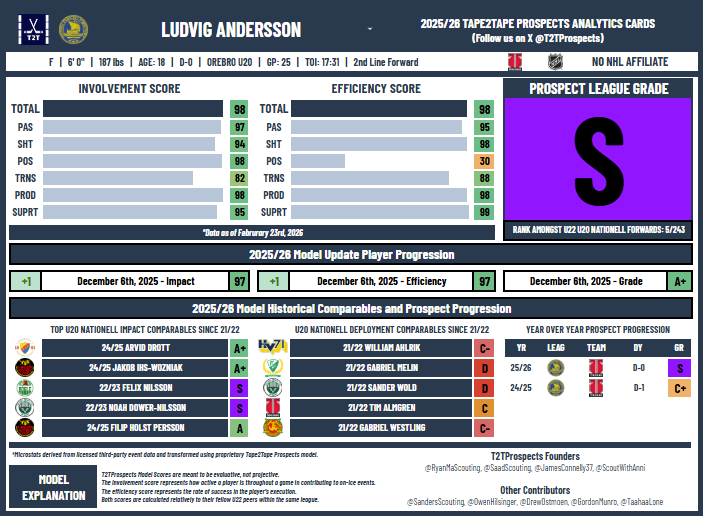
Games Tracked:
10/26/25 vs Frolunda HC U20
11/29/25 vs Rogle BK U20
02/15/26 vs VIK Vasteras HK U20
ELEVATOR PITCH
Andersson is a net-front oriented complementary forward who contributes through crease presence, opportunistic passing from below the goal line, and physical flashes rather than through driving play or creating off the rush. While his supporting instincts, effort in the high danger areas, and situational awareness give him a shot a the NHL, limited puck dominance, inconsistent skating efficiency, and occasional defensive lapses make him more of a specialized depth bet than a true play-driving forward.
I don’t see it completely with Andersson as a driver of play.
But perhaps it makes sense that his support game is his main strength per our T2T Model, and his production is possibly more of a byproduct of playing on a great Orebro roster with more than enough high-end talent for him to work with.
Andersson, at his core, is a net front player, and Orebro uses him as such in the offensive zone. Constantly just above the crease at even strength, at times parked to the side of the net along the goal line. Orebro experimented with him in the bumper on the power play but it was short-lived, and he’s back below the goal line.
There’s a nice complementary package here in Andersson, who has a nose for the net, and is a pretty nice passer from below the goal line. In the games I watched, he was good for three things:
1) A few nice nifty passes into the slot from the side of the net
2) Some chaotic moments in the net front as he goes for loose pucks in the crease
3) A big hit or two on the forecheck
There are some nice flashes of puck protection skills from Andersson, where he’ll use his frame to shield the puck and either drive the net or take it behind and look for a pass, but it’s not a prominent part of his game.
It’s clear the on-puck game is very much a work in progress, and he’s a player who can easily get lost on the ice sometimes when you watch him, since he’s very much a passenger in transition.
He does a good job getting to the boards on outlets, and he has good pre-scanning habits as a playmaker, which allows him to make these nice area passes off the boards under pressure to find his supporting teammates.
Andersson is a hard player to categorize because his game and skill sets don’t fit into any of the traditional schools of thought.
On one hand, he’s a hound for the net front where he scores pretty much all his goals, he’s a smart player who sees the ice well enough and has the skill to execute some nice passes, a decently active stick that takes away pucks in the neutral zone, and he’s not afraid to mix it up and lay some big hits to set the tone.
These characteristics would suggest he’s a workhorse type of player, who does all the little things to allow the creators alongside him to do what they do best
On the other hand, he’s a really upright skater who looks a bit awkward in his stride and doesn’t generate tons of explosiveness, so he’s not the most effective forechecker, the puck protection is not where you would want it along the walls in the offensive zone, and some defensive lapses defending the back door as a winger that make you wince. All in all, the physical tools and chemistry with his linemates means I think he’s worth a pick in this range.
#93 – Jakub Frolo – C/RW – Ilves U20 – U20 SM-sarja/Liiga
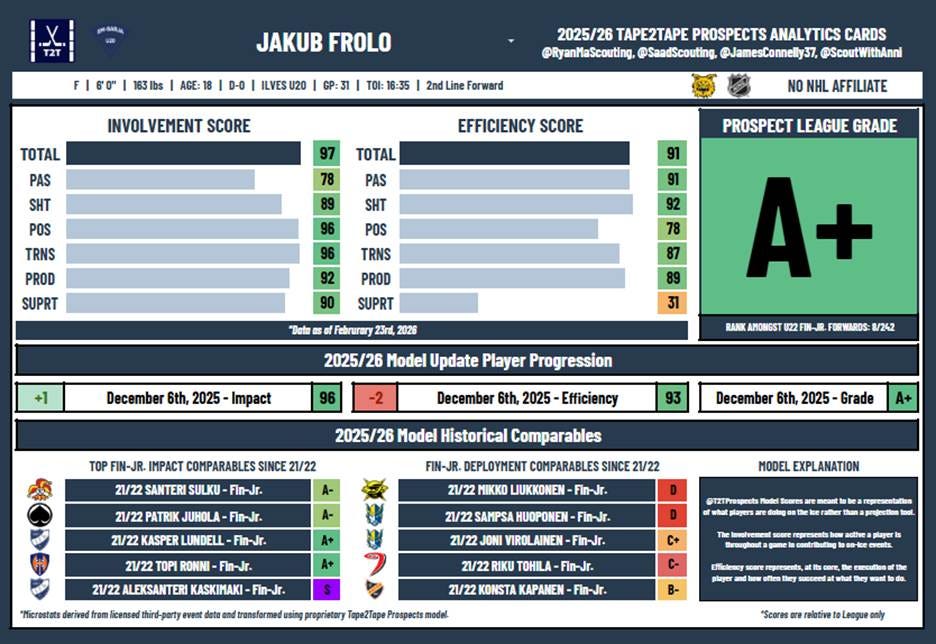
Games Tracked:
02/21/26 vs Kiekko-Espoo U20
01/17/26 vs HIFK Helsinki U20
12/02/25 vs Lulea Hockey
11/22/25 vs TPS Juniorit U20
ELEVATOR PITCH
Frolo is a big, straightforward depth forward whose game is built around off-puck effort, defensive details, and opportunistic finishing rather than play-driving, with his best traits showing up as a backchecking hound and net-front presence. While he impressed in limited pro minutes, his limited puck touches, inconsistent motor in junior, and lack of offensive creation point to a capped projection as a potential bottom-of-the-lineup NHL role player.
Jakub Frolo got into a Champions League game for Ilves this season against Lulea (an SHL side), and didn’t for a second look out of place. I imagine there’s few greater compliments I can give to the player than that. Of the four Jakub Frolo games I was able to get in, that performance (in which he played over 10 minutes as a teenager) was easily his best. It gives a nice forecast of what kind of role he could play at the next level as he continues to develop.
Frolo’s effort level and motor are noticeably heightened as the stakes get higher. Against Lulea, he was an absolute HOUND on the backcheck. Frolo’s a much better skater than what his U20 level tape suggests, and even in the high pace set in that Champions League game, he got to his spots (albeit a hair late) on the forecheck, and won some really nice puck battles on the backcheck. Even against men, he’d use his size and frame to push the opponent off balance, and tip the puck back towards the opposing net for his teammates to chase.
Frolo also blew the zone a lot less when he was playing at the pro level. As a U20 player for Ilves, even though he played predominantly at centre, there were times ALL THREE forwards blew the zone and left their defensemen out to dry. Conversely, at the men’s level, even as a winger, Frolo would patiently wait along the sideboards, sometimes even coming down below the goal line to help release the pressure on his defensemen.
Frolo’s play on the puck is a work in progress. Lots of dump and chases when he enters the zone, and while that’s expected in Liiga when you’re playing a depth energy role, you’d want to see a lot more from the player when he returns to the U20 level. While there are some nice flashes of him using his frame behind the net to change directions and shake coverage, I find he’s way more perimeter-centric with the puck than you would hope, really avoids attacking the center of the ice, and does the large majority of his work in the offensive zone off puck.
The shot is good for Frolo, who’s got a few one-time goals this season for Ilves U20 and finishes his chances at a good clip, but I find that he really doesn’t do much for me as a driver of play. Very low puck touches in the buildup of play, can struggle to corral and settle pucks passed to him when under pressure, and after watching his Champions League game, I was frankly a bit disappointed with the motor he showed hunting down loose pucks and forcing takeaways when he returned to U20.
Frolo at his best projects as a potential bottom of the line-up player, who can be tenacious on the back check, and show great intelligence and opportunism by jumping unsuspecting opponents to cut off outlet passes. He can be an effective off-puck scorer with a quick and heavy release that allows him to capitalize on scoring chances. He’s very much a straightforward product whose motor will ultimately decide whether the NHL sees a future for him.
Unfortunately, I fail to see him being a creator of offence at the next level, and a relatively capped ceiling. However, there’s some potential here for an NHL-quality package given his size and frame.
#94 - Chase Harrington - Spokane Chiefs - F - WHL
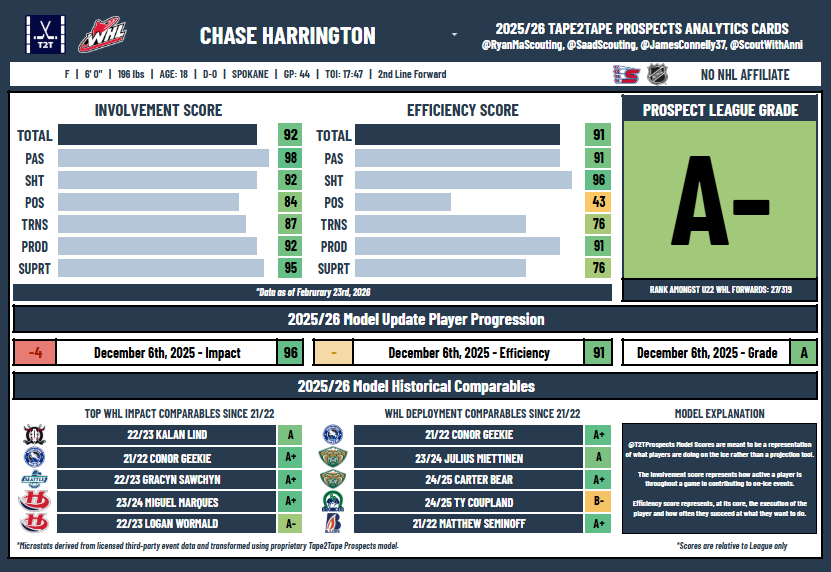
Games Tracked:
03/27/26 vs Prince George (Playoffs)
02/28/26 vs Tri-City
01/23/26 vs Penticton
ELEVATOR PITCH
Harrington is a support forward who thrives next to high-end play drivers, using a strong active stick, physical engagement, and a heavy shot (that he loves to use inside that left-circle) to generate offense in a secondary role. While his playoff intensity shows he can be impactful when engaged, limitations in skating, puck protection, and consistent offensive creation suggest a projection as a depth, energy-driven complementary forward is most likely.
Chase Harrington’s profile is clearly one of a support player, and when you stick him with talented play drivers like Berkly Catton or Mathis Preston from last year’s loaded Spokane team, Harrington can be a very impactful player.
Unfortunately for Spokane and Harrington, after a T2T Model S-Tier score in his D-1, his score this year has fallen to an A-. It hasn’t helped that Harrington’s biggest PR boon in these playoffs (which have looked much better than the regular season games I watched) has not been about his improved on-ice motor and tenaciousness, but rather his screaming at an injured Carson Carels in front of the bench.
That isn’t to take away from Harrington’s performance two games into the WHL playoffs. The playoff games for Harrington do show promise as a complementary player if he can keep up this work ethic even in regular season games. Against Prince George, he was physical from the jump, throwing hits and finishing his checks every chance he got.
Harrington has a great stick that’s really strong, and he can use it to lift an opponent’s stick and deftly steal the puck away. He gets a bit spammy with them, and at times, that gets him into a bit of trouble with hooking calls. He’s not super agile, and it does mean he has difficulty defending shiftier opponents who can stop and start and change directions on him, but that stick and reach does allow him to sometimes force turnovers at the defensive blueline and spring himself for partial breaks.
Unfortunately, Harrington isn’t the fastest skater either, so a lot of these partial breaks actually have defenders draped all over his back. His best contributions in transition are actually off-puck, where he drives the net hard to tap in backdoor goals or shove away at rebounds. Even with the slightly below-average skating, Harrington shows some confidence bringing the puck across the blueline. He generally keeps it pretty vanilla, usually handling it around the perimeter, but if he has space, he will try the occasional stop and start along the wall to try to shake a defender off balance.
Harrington’s offensive zone contributions are relatively limited. There are some nice attempts from either below the goal line or from the half wall where he’ll try to sift pucks into the slot, but often it doesn’t connect and exits back the other side, he’s competitive along the boards and gets into tons of puck battles all over the ice, but I think his stick is his best asset there and when he’s board played he’s usually unable to maintain possession of the puck.
What I have noticed as well with Harrington is that he LOVES shooting the puck every chance he gets in the offensive zone from that left circle. Whether it’s off the rush or set in the offensive zone, if he can get the puck and some space in that left dot, he WILL let it fly. Tons of his goals this season have been scored from there.
All in all, Harrington’s a fine player who doesn’t have outstanding hands or puck protection, but when he is motivated (like in big playoff games) he brings an edge and relentless effort to his game with a pro-level shot and just good enough skating to hang with the big boys.
#95 - Ossi Tukio - Ilves U20 - LD - U20 SM-sarja
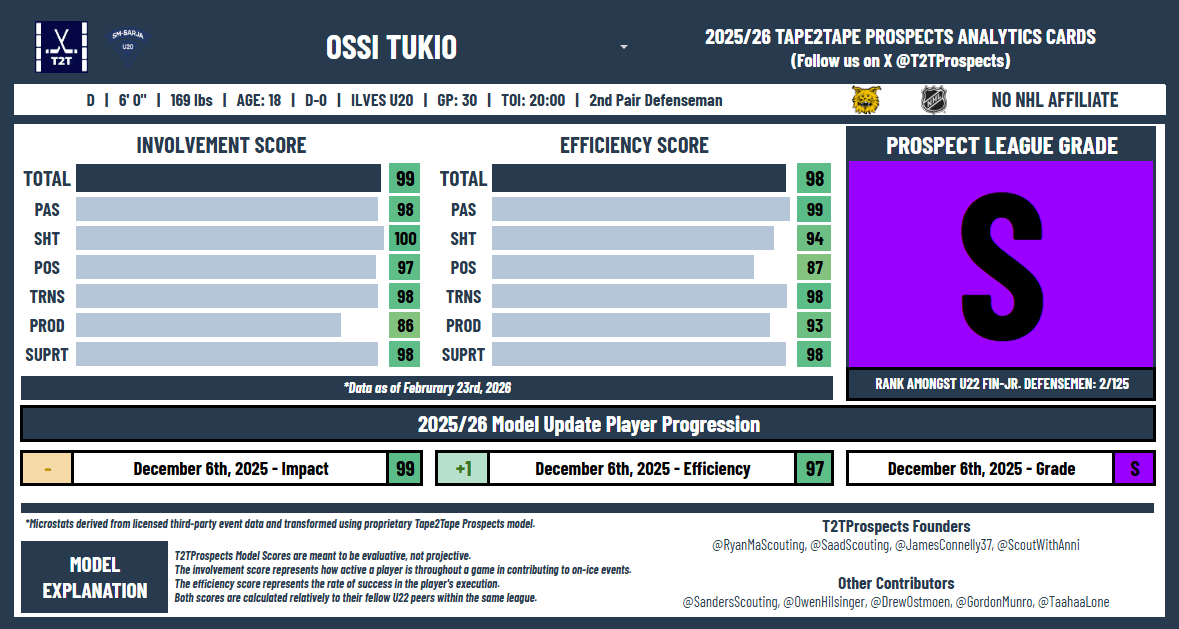
Games Tracked:
03/22/26 vs Karpat Oulu U20 (Playoffs)
01/16/26 vs Tappara Tampere U20
11/19/25 vs Fischtown Pinguins (Champions League)
ELEVATOR PITCH
Tukio is a pro-sized, fairly polished two-way Finnish defenseman who blends responsible defensive positioning, decent skating, and moments of controlled puck movement to project as a mid-round option. While he shows flashes of puck-moving ability and composure under pressure, his lack of physical assertiveness and only average athletic traits limit his ceiling to more of a safe, structured two-way depth defender at higher levels.
Ossi Tukio would’ve been a player I LOVED three or four years ago when I was really just getting started with scouting and junior hockey in general.
I still like his mould of player, and I think he’s a player who’s got a decent baseline of skills and drives good enough results on the ice to be considered in those mid rounds. I probably just won’t push for him to go in the Top 64 as I did in previous years with guys like Niemela and Vaisanen.
Tukio is probably the most intriguing and refined version of the European prospects I’ve watched in terms of blending his moments of flair and creativity with responsible play, and he’ll end up ranking the highest amongst them to this point. Tukio isn’t the most exciting profile overall, he’s a good size at 6’2”, and skates well enough to maintain a good gap on rush defense while also being able to get back for retrievals. He’s not overly physical defensively at his size, and I would like to see him be way more effective defending on the perimeter, given his reach advantage. Still, he’s positionally sound with good scanning habits, and I think he’s a good enough defensive player at this stage to think that as he grows into his frame, that edge NHL teams will want him to develop can come around.
Tukio’s got some decent skills, and he’s shown an appetite to create breakouts from his own zone by skating through the first wave of pressure when he gets the opportunity to get moving first. There are good short area passes and decision-making by Tukio, who will flip passes up the boards to clear the zone or use his defence partner for a quick give-and-go when he receives the puck under duress. His game is pretty north-oriented, and it’s just a very clean experience where some of my recent viewings with guys like Tideman and Bratt have proven to be... more chaotic.
In the offensive zone, Tukio’s got some nice shifty skating at the offensive blueline to side step pressuring defenders, and using some nice tight turns along the halfwall when he activates to cut back and maintain possession. He mixes a good balance of using his skating and hands to create advantages in the offensive zone, but not to the extent where he will get burned with a mistake or turnover.
All in all, Tukio’s a responsible, pro-sized defenseman who shows a few flashes throughout the game that suggest there could be a two-way puck-moving defenseman. His playstyle has the Finnish defenseman pipeline written all over it, but there will need to be more of a consistent, physical effort in his own end for him to fulfill his NHL aspirations. Not an extraordinary athlete either, who may find these little spurts on the puck right now at the U20 SM-sarja level won’t translate against a higher pace environment. I think he’s still a player worth taking a look at in this range.
#96 - Axel Brongel-Larsson - Frolunda HC U20 - LD - U20 Nationell
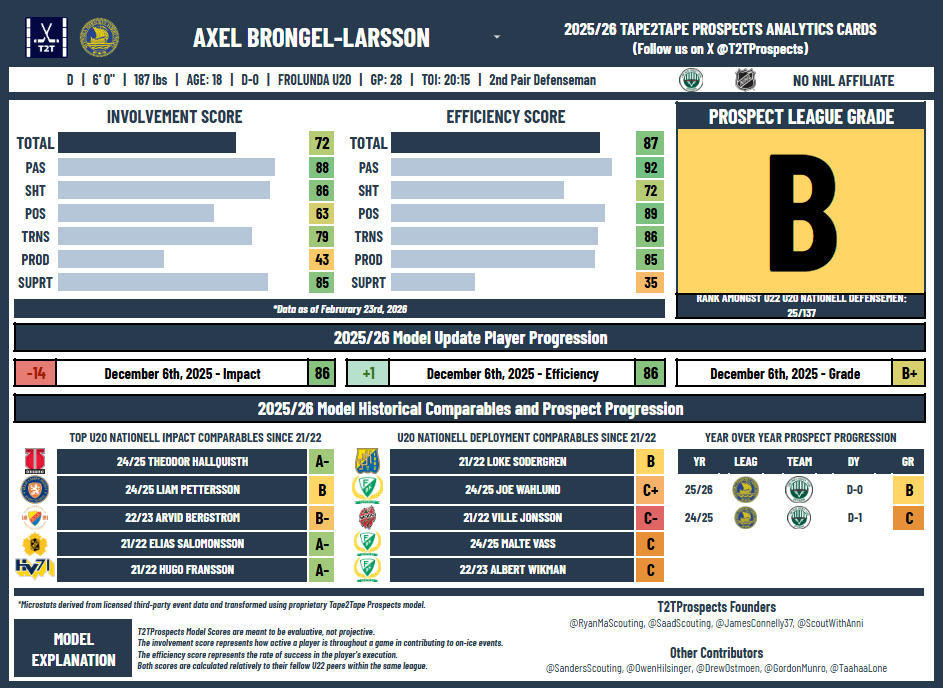
Games Tracked:
04/18/26 vs Djurgardens IF U20 (Playoffs)
03/06/26 vs Rogle BK U20
01/18/26 vs Sodertalje SK U20
ELEVATOR PITCH
Brongel-Larsson projects as a defensively reliable, physical, and competitive depth defenseman whose main value comes from aggressive rush defending, net-front defending, and disciplined positioning rather than puck-moving or offensive upside. While his limited offensive creativity and only average athletic ceiling dampen the prospects of a high end ceiling, his edge, defensive consistency, and willingness to engage physically give him a clear path to becoming a really solid NHL depth option.
Axel Brongel-Larsson is nothing special, but there’s an edge to his game that can’t go unnoticed and what will be a primary factor in his NHL future someday.
Brongel-Larsson has all the pre-requisite tools to have a shot at the NHL someday. He’s big enough at 6’1”, he’s got good mobility and I think he’s a high quality defensive player. We’ll start with the drawbacks and why he’s not someone I’ll have in my first 2 rounds. Brongel-Larsson isn’t the most smooth playmaker with the puck, there’s almost a sweeping style that he implements when making passes and it keeps him from being one of those defensemen that can make quick hit passes under pressure to get out of the zone.
I also think that he doesn’t really use his mobility to it’s maximum effect, especially on puck retrievals in his own end. I think there’s an underrated athletic element to his game, but he doesn’t try to weaponize that to navigate pressure, actually preferring to stop up, eat the contact from the forechecker before shoving the puck up the boards against the grain.
I also find, as is expected with a player of his ilk, his contributions in the offensive zone are very limited. Doesn’t activate a whole ton, doesn’t threaten the middle of the ice consistently he’s just a very passive player in the final third of the ice and I don’t really forsee there being this hidden upside that he’s yet to unlock.
However, even with these real deficiencies, I do think I prefer Brongel-Larsson over some other names that perhaps are more well known in the public sphere. While guys like Dravecky, Croskery, Cossette-Ayotte, Schairer and Marthaler may have more eye-popping traits with the puck, or could be better athletes, there’s something about Brongel-Larsson’s competitive nature that draws me to him.
He’s a very good defender when he’s being aggressive. He does a great job getting low and using his stick to aggressively surf into the opponent’s space when defending the rush, crowding them and funnelling them into the boards where he finishes them with a nasty crunch. He’s actively crosschecking guys and punishing them when defending the net front, or along the boards during scrums. If you get to a puck off a dump and chase first, or beat Brongel-Larsson to a puck off a shot, keep your head up because he’s looking to body you.
I’ve just been impressed with Brongel-Larsson’s ability to be this overwhelmingly physical without pulling himself out of position constantly like some other defensemen of his ilk might. Add in the fact that when he has some time and space, he can actually hit deep cross ice passes with good weight and accuracy, I think there’s a player that could really develop into a fan favourite on an NHL team one day as a depth defenseman.
Brongel-Larsson plays his best when he’s aggressive; when he’s too passive he can actually get caught out and beat wide, and that’s good, because it’s what NHL teams will want to see from him if he makes it to the league someday. He’s not the most athletic, he’s far from skilled, and he’s not some 6’3” behemoth, but there’s just a really compelling high floor package here with Brongel-Larsson, even if he is one of the oldest players in the class.
ROUND 4 (RNK #97 - #128)
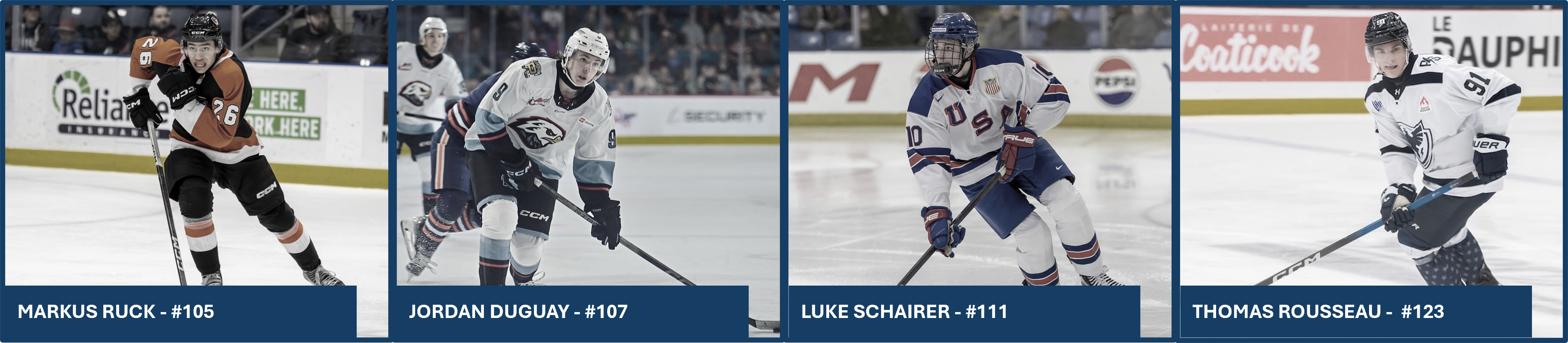
#97 - Joe Iginla - Vancouver Giants - F - WHL
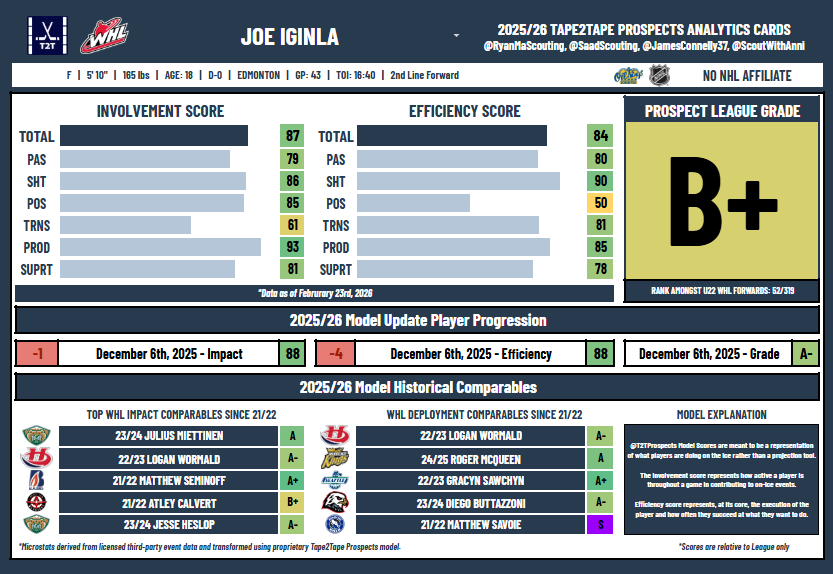
Games Tracked:
03/15/26 vs Seattle
02/21/26 vs Portland
01/01/26 vs Red Deer
ELEVATOR PITCH
Iginla is an inconsistent winger who shows flashes of power, skill, and chaos. He mixes in strong puck battles, occasional net drives, and creative dekes that make his profile super exciting, but WAY too often disappears shift-to-shift due to lapses in engagement and defensive work rate. While his toolkit and bloodline keep him intriguing as a long-term bet with offensive upside, the lack of consistent intensity and reliable off-puck impact makes his NHL projection uncertain beyond that of a developmental forward.
Joe Iginla is a frustrating player to watch because you see flashes of what looks to be a really promising player, but the consistency and shift-to-shift impact ultimately leave you waiting for more. Someone had to be the worst between Joe, his brother Tij, and their father Jarome. Unfortunately for Joe, it’s evident that it’s him.
There are flashes of the good old Iginla genes in Joe, though. I saw a handful of times below the goal line where that physical hard edge came into effect, and Joe will really use his stick and shoulders to work at pucks along the lines. There were even a few plays on the forecheck where Iginla would get this burst of motivation and come in flying, using his stick and strong, compact frame to muscle pucks away from defenders and work it into the slot.
Iginla also has some really chaotic moments, between driving the net hard or sometimes just deciding he’s going to absolutely blow up an opponent in the neutral zone with an open-ice hit. You get a wide range of moments with Iginla. There are some times where he shows nice hands in tight to navigate through traffic in the high slot to get his shot off and he really does have flashes that look quite impressive. He loves this between-the-legs stride deke too; sometimes, he can absolutely embarrass his opponent and make his way through multiple defenders, and sometimes he’ll mishandle it and flub it into the corner.
There are also some moments of intelligence and awareness, navigating space on entries, stopping up and threading passes into the middle of the ice for the trailing forward, or alertly recognizing when an opponent is trying to do too much in the offensive zone and pouncing on the opportunity by double-teaming him.
Unfortunately, despite the wide array of skillsets that Iginla has shown, and the stocky and compact frame that absorbs contact well, the shift-to-shift impact from Iginla is just not where it needs to be to be considered a top prospect like his brother. Tons of coasting in the defensive zone, and he won’t really lift a finger to help unless he thinks it will lead to a potential odd-man rush the other way.
Offensively, there are far too many shifts where I legitimately wonder if Iginla is on the ice. A non-factor in most puck battles and inconsistent passing vision, I just wonder if his existing package, with just good (not great) skating and average size, is super projectable if the physical support game doesn’t come to the forefront as a priority in his on-ice approach.
Iginla is worth drafting if only for the NHL bloodline, but there are moments, bits and pieces that stitch together a vision of what this player could be as he gets further into his development timeline. As one of the younger players in this year’s draft (August birthday), with a long development runway, I’m willing to make a bet that the high-event, chaotic, fun version of Iginla has a chance to eventually outshine the mundane ghost that plagues his tape most shifts. I think I ultimately there’s a fun player here with some nice traits, but I do question the NHL translation if he continues to play at this current level of intensity.
#98 – Alessando Di Iorio – Sarnia – C – OHL
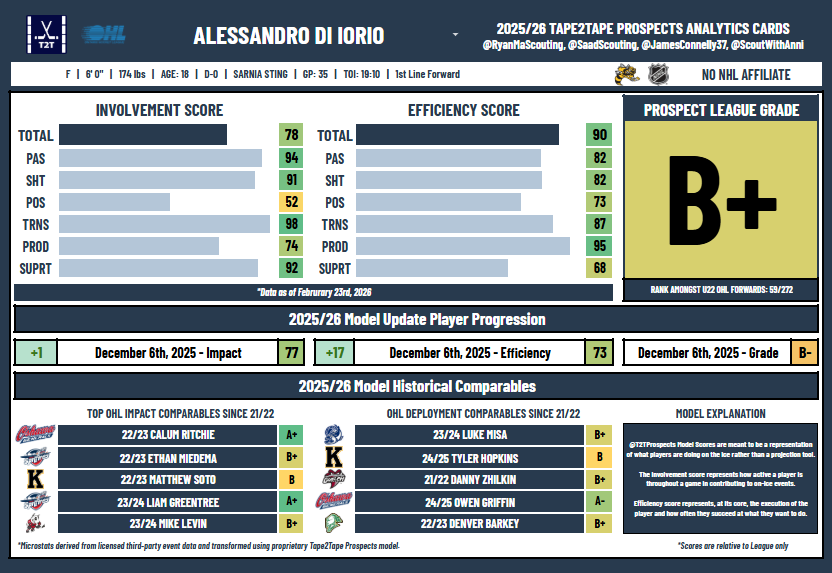
Games Tracked:
03/01/26 vs Ottawa
02/06/26 vs Oshawa
01/09/26 vs Erie
ELEVATOR PITCH
Di Iorio profiles as a hard-working, defensively responsible, physically engaged forward wwhose game is driven by an active stick, strong board play habits, and simple, low-risk support offense along the perimeter. While he shows occasional flashes of direct, power-forward-style rushes, his below-average skating, clunky puck skills, and limited ability to consistently threaten inside lanes cap him as a likely depth/energy projection unless there’s meaningful skill and mobility improvement.
Alessandro Di Iorio is... a guy. I don’t want to call Di Iorio’s playstyle cookie-cutter, but I do think that’s the most apt description of him. At 6’1”, 190 lbs, Di Iorio is exactly what you think he is. He’s a solidly built player who works hard, handles contact well and plays a heavy game.
Di Iorio’s best trait for me is his stick. He uses it really actively along the wall, in the slot to tip away pucks and cover passing lanes, and also just in general to tie up opposing players. It’s a really strong stick that doesn’t get batted away super easily, and when you couple this with his work ethic, doggedly chasing his man in coverage defensively, it makes him a mostly good man-on-man defensive player that can take pucks away. There are some moments where he gets caught flatfooted with quick changes of direction from more agile opponents, but the reach is long enough that he can still take away passing lanes to recover.
He’s also a player who’s positionally responsible on the forecheck and on breakouts. He floats in as the F3 and stays above the puck at all times, even sometimes picking off errant pass attempts. I would love to see him read the play and step in more often to kill breakouts along the walls, but he has great backchecking habits, and I think overall it’s more good than bad, albeit conservative. In the defensive zone, he’ll come down low on board battles if his defensemen get board-played and help get the puck moving up the boards. I would like better eye discipline, though. Di Iorio can get caught staring or drawn into the corner, and it can lead to him leaving the slot uncovered for scoring chances against.
Offensively, Di Iorio keeps it pretty simple (for the most part). Very vanilla perimeter passer who doesn’t threaten the middle of the ice and will defer to his defenseman or move it down low. Also prefers to play along the half walls and behind the net with the puck and doesn’t drive enough shots from the high-danger areas of the ice against a set defence. In transition, Di Iorio’s a player who gets credited with a lot of controlled entries along the right-hand side, and he will often try to use his size and weight advantage to drive the net in direct lines. A lot of the time, he gets funnelled into the corner where the puck will then get flung along the end boards to the other side.
This is ultimately the issue with Di Iorio. The skating is slightly below average, and with his physical profile, he looks really heavy out on the ice. The hands are also clunky, and while there’s some real confidence to carry the puck, which is nice, there are also some really ugly mishandles, too. There was one behind his own net against Ottawa under no pressure, where he just missed the puck and nearly cost his team a goal against.
That confidence, in conjunction with the fact that he’s got some pretty adventurous ideas, is when Di Iorio starts getting in trouble. His brain is trying to cash cheques that his hands and feet just can’t cash, which can lead to turnovers. He’ll have these audacious charges through the neutral zone (like his 4 on 3 chance against Ottawa), where he’ll show a nice flash of explosiveness and cut through multiple defenders, using his frame and contact balance to shield the puck, but he never ends up being able to get that last stickhandle off to shoot the puck before it gets poked off his stick.
All in all, Di Iorio is a hardworking player who helps move play the right way and uses an effective stick to be an engaged player on the defensive end. The skating and hands will need to improve for him to get to an NHL projection, but if both of those skill sets can improve just a tick, I think there might be a player here.
#99 - Axel Elofsson – RHD – Orebro U20 – U20 Nationell
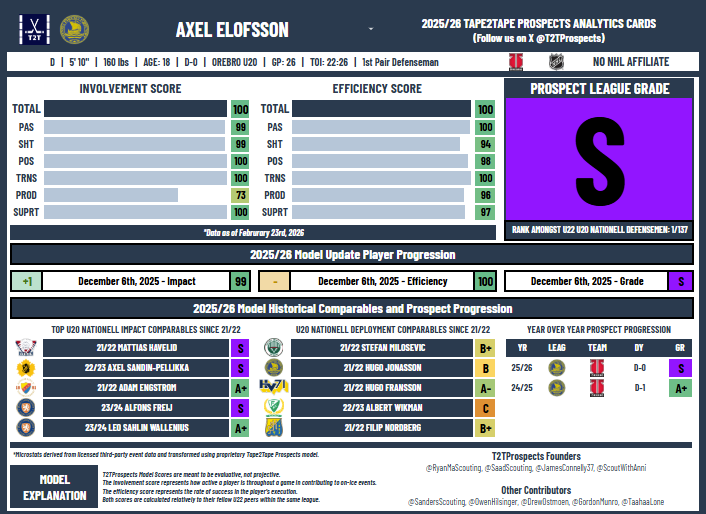
Games Tracked:
10/17/25 vs Linkoping HC U20
11/22/25 vs HV71 U20
02/14/26 vs Sodertalje SK U20
ELEVATOR PITCH
Elofsson is a highly mobile, confident puck-moving right-shot defenseman whose offensive tools, skating, and willingness to carry and manipulate the puck make him an intriguing transition driver. However, his overly aggressive defensive mindset, inconsistent puck management under pressure, and lack of control on pinches and gap situations create real concerns about reliability, leaving him as a flawed prospect who needs significant defensive structure and decision-making refinement to translate to higher levels.
I came into this year with pretty high expectations for Axel Elofsson. I’d heard some good things on the timeline, and the 5’11” RHD for Orebo had an eye-watering 100th percentile efficiency score and 99th percentile involvement score per our @T2TProspects model.
Let’s start with the good. Elofsson is a good four-directional skater (like most Swedish defensemen), with good hands and more than enough confidence to deploy both skills when he has the puck. Elofsson will carry the puck through the neutral zone, using his legs to protect the puck, and then try to split defenders with his hands as he approaches the line.
He also uses those tools really effectively when holding the blueline with the puck under pressure. He’s unfazed and has tons of confidence to navigate that pressure through his skating. There are some really slick moves going downhill where he can get himself into high-slot areas for shots.
However, puck management and defensive discipline are issues. Elofsson approaches defence at times like a strong safety in the NFL. Too often, his mind triggers into attack mode. As one of our @T2TProspects contributors, Owen Hilsinger (@owenhilsinger) has mentioned
“Defensively, (Elofsson) attacks rushes with urgency instead of control, overcommitting like a madman.”
In the games I watched with Elofsson, there were some really rough defensive diagnostics:
1) Bad pinches at the offensive blueline on loose pucks
2) Over pursuits along the boards that left him on the backside of the opposing forward
3) Recklessly jumping too far up into the play and getting scored on with the ensuing counterattack when his teammate turned the puck over at the offensive blue line
Owen credits Elofsson for his intensity, which I generally agree with. As a smaller defender, it’s nice to see him go into corners and board battles with an edge. However, the best plays Elofsson makes in his own end are when he maintains gap discipline and positioning.
Additionally, for as much good as Elofsson does with the puck, his puck management in his own end leaves some things to be desired.
He’s not a super cerebral or high-level passer, but some of his passes do show a good understanding of time and space; lobs off the boards under pressure to spring his wingers, nice bump passes along the wall to his center to break pressure. He’s a crisp passer who plays at his own pace on the puck. This can get him into trouble at times, when he skates himself into pressure and turns clean exits into turnovers by hanging onto the puck too long.
Ultimately, there are some very good tools to work with here for Elofsson, but the hockey intelligence in his own end and at high speed needs some serious recalibrating. The puck movement pace on both ends needs to pick up, especially for a defenseman at his size; he needs to be able to quickly transition plays north through his passing. He’s also a bit too chaotic defensively and needs to learn to play a more structured and dependable game in his own end.
#100 – Callum Croskery – Soo – LD – OHL
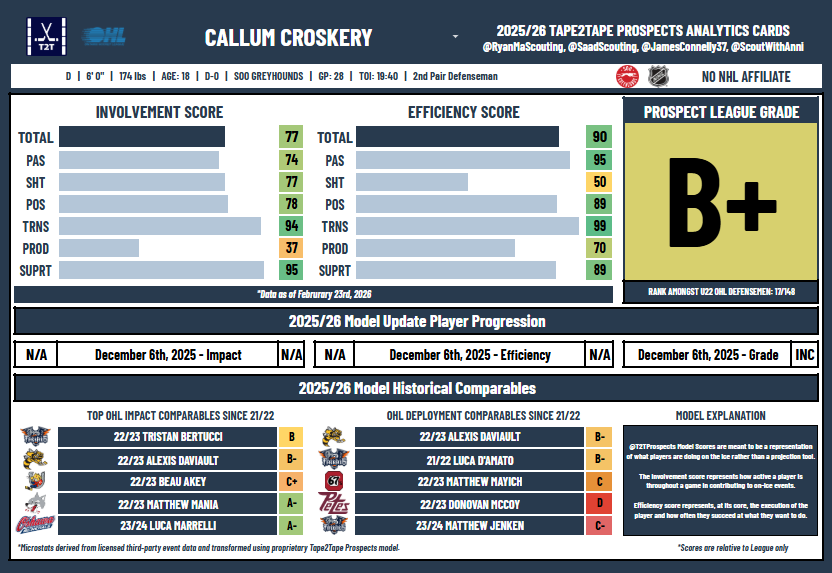
Games Tracked:
03/20/26 vs Sarnia
03/06/26 vs Kitchener
01/29/26 vs Niagara
ELEVATOR PITCH
Croskery is a mobile, puck-moving defenseman whose value comes from strong skating, proactive transition play, and the ability to push the puck north with pace and occasional high-end breakout passing. However, his game remains inconsistent and fairly vanilla overall. There are concerns with his shaky defensive awareness, limited physical engagement, and underdeveloped puck skills, making him more of a mid-round developmental project than a polished two-way defender.
Croskery is quite mobile as a defenseman… he gets around the ice really well, and I think that gives him the runway to grow into an even better version of what he currently is. The overall product is mostly pretty vanilla, but you can see the flashes of that potential with his game against Saginaw (albeit one of the worst teams in the OHL this year). He was way more active jumping up into the play, willing to take more risks on exits to use his skating to get involved in the play, and much more willing to try to hold the puck at the blueline and make a move. He had a nice play where he drove the puck down into the corner, and did a nice, quick turnaround cutback to shake the defender and sauced a backhand pass into the slot for a scoring chance.
He’s also, I think, my style of defenseman. He’s aggressive with the puck, willing to claim open ice in front of him on exits, and he’s always, always looking to move the puck north. He had a few beautiful passes in my viewings, going from blueline to blueline, springing his teammates for rush chances on net. I find that the more willing he is to use his legs and get moving forward with the puck, the more dangerous he is.
Croskery is, of course, far from a finished product. He had a really terrible play early in the game against Saginaw, where he completely lost his head, didn’t know what he was doing while defending a rush and let himself get dragged into the corner and completely abandoned the left side of the ice. I don’t usually do screen grabs, but how Croskery ended up here as the left defenseman is beyond me.
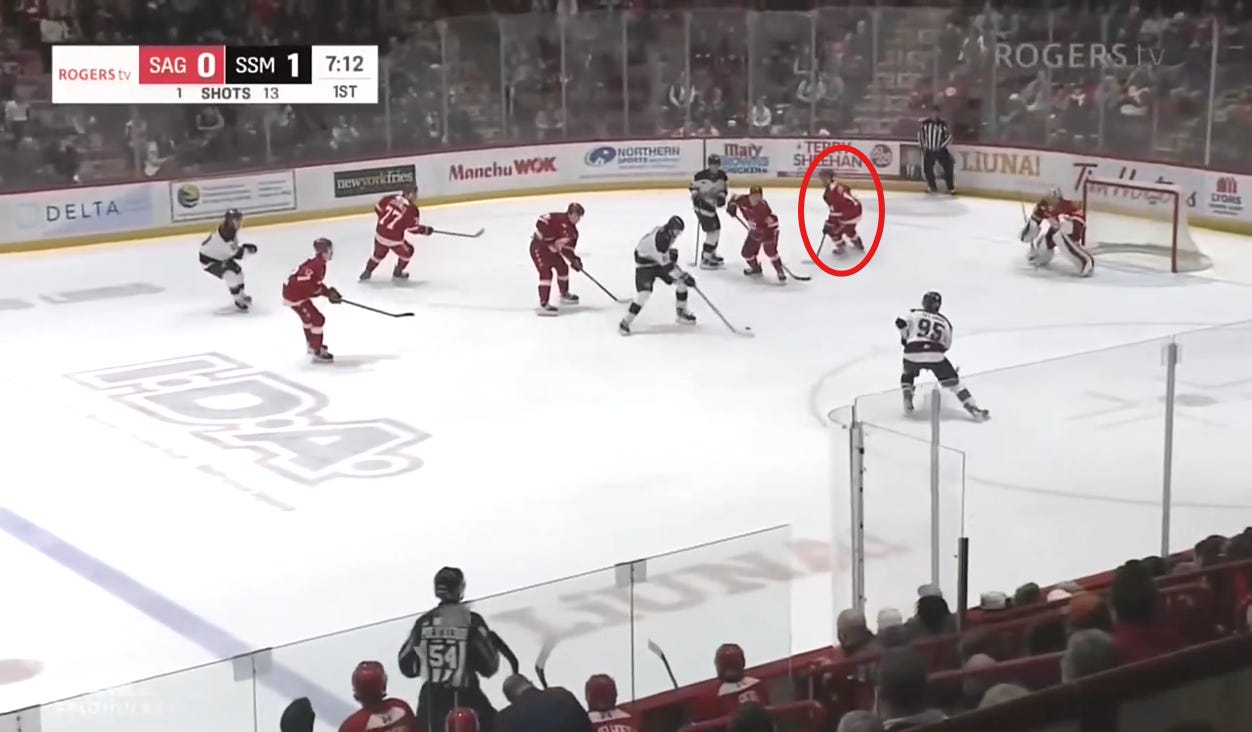
In general, I find Croskery’s defensive motor is inconsistent and generally just average. He’s not super physical and relies more on his size to just be in the way in the net front rather than actively boxing out and moving bodies out of the crease.
Out on the perimeter, his range and reach allow him to rely mainly on his stick to break up plays, but I find myself wanting to see more of a nasty edge in the player. He’s not like an Alaluri, who can just remove guys from the puck; Croskery instead blankets them with his stick and tries to funnel them to the boards, but he just isn’t a play killer at this stage in his own end.
The hands, deception and offensive zone decision-making are also still very much a work in progress. Even when Croskery tries to walk the line and evade pressure with lateral movement, the puck skills don’t match, and he’s forced to sift these awkward, floaty shots on net at the last minute. He’s not someone at this stage who’s comfortable using his skating and size to create advantages on the puck in the offensive zone, preferring to defer back to his defence partner whenever he gets the puck.
All in all, Croskery is an imperfect player, but I think the mobility and breakout passing will make him a worthy developmental project in the mid rounds of the draft. I think that if he can learn to use his frame more effectively on both ends of the ice, there’s a guy who (in the pre-NCAA movement) could’ve developed into a lower-end OHL powerplay quarterback while anchoring a top pair role by his D+2.
#101 - Matvei Kotkov - Loko-76 Yaroslavl - F - MHL
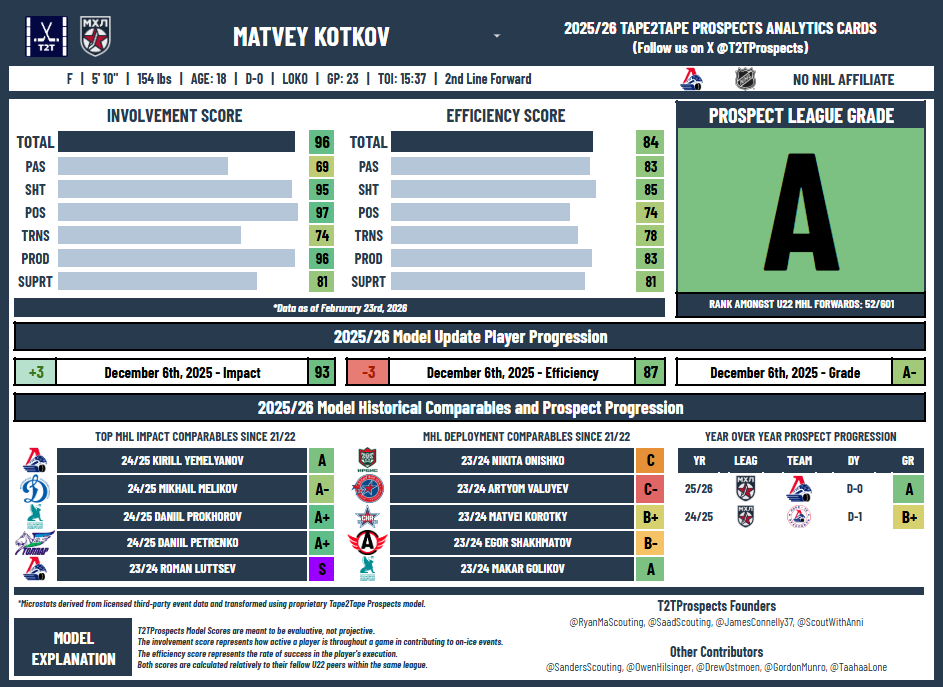
Games Tracked:
04/06/26 vs MHC Dynamo Saint Petersburg
02/12/26 vs MHC Spartak Moskva
01/06/26 vs Dinamo-Shinnik
ELEVATOR PITCH
Kotkov is a super fun developmental forward whose value comes from creative puck skills, chaotic offensive flashes, and active stick work that can generate transition chances, particularly off the rush. However, his unrefined skating mechanics, weak engagements along the boards, and inconsistent contact balance make him heavily reliant on space and momentum, leaving him as a long-term project who needs significant development to become a viable NHLer.
Kotkov is an intriguing developmental project that I think could develop into a depth player if enough things go right.
For the sake of transparency, a lot has to go right for Kotkov, the skating is super weird, and when he’s trying to get up to full speed he’s hunched over at the waste and it looks like he’s dragging a tire behind him. The key for Kotkov, if he ever wants a chance to sniff the NHL will be to seriously rework some of his skating mechanics, getting more knee bend into his stride so he can generate more power and also change direction more sharply.
Kotkov has some intriguing passing and shooting skills, he moves well off puck, locating areas in the high slot to receive passes to let his shot go. There’s flashes of an really skilled on-puck game where he uses a wide array of puck handles and dekes through traffic to get into the super high danger areas of the ice before finding his teammates for scoring chances.
The movements are super jerky but he does well to mix in a wide variety of plays to become a dual threat with the puck. Between the leg passes into the slot at a standstill, power moves to the net before saucing a pass through the slot, cutting inside off a drop pass before letting one rip from distance... Kotkov’s got the natural puck skills and feel with the puck to work it through traffic and create plays.
This also makes Kotkov an extremely chaotic player. His skillset relies a ton on his reach, and I don’t believe for a second that he’s actually 5’11”, he’s got to be closer to 6’1”. He works hard and skates hard through the neutral zones, and his use of his stick is super effective. He can disrupt passing lanes and poke at pucks, he’s always buzzing in and around the play.
Unfortunately, Kotkov’s contact balance when he doesn’t have forward momentum with the puck is hit or miss, and he’s not super effective at outright winning puck battles at his size. Kotkov does a great job of using his stick to pick off passes or steal pucks off of overzealous defensemen to turn into transition chances for himself, but along the boards he struggles with leverage and moving players off the puck. This means that Kotkov is primarily an off the rush chance creator and he struggles to maintain an effective cycle game, or the ability to stop and start to shake coverage.
All in all, the puck skills and self creation flashes are certainly there for Kotkov who’s just 3 weeks away from being a 2027 NHL Draft eligible. He’s got a lot more runway than a lot of other 2026 Prospects, but he also has a lot more distance to cover if he wants to become an NHL player one day. The flashes are nice but not highly translatable, and he needs to seriously overhaul his skating mechanics and become a far more effective player along the boards. If Kotkov can take major steps in both areas, the NHL team that takes a chance on him could become very pleasantly surprised.
#102 - Zac Olsen - Saskatoon Blades - F - WHL
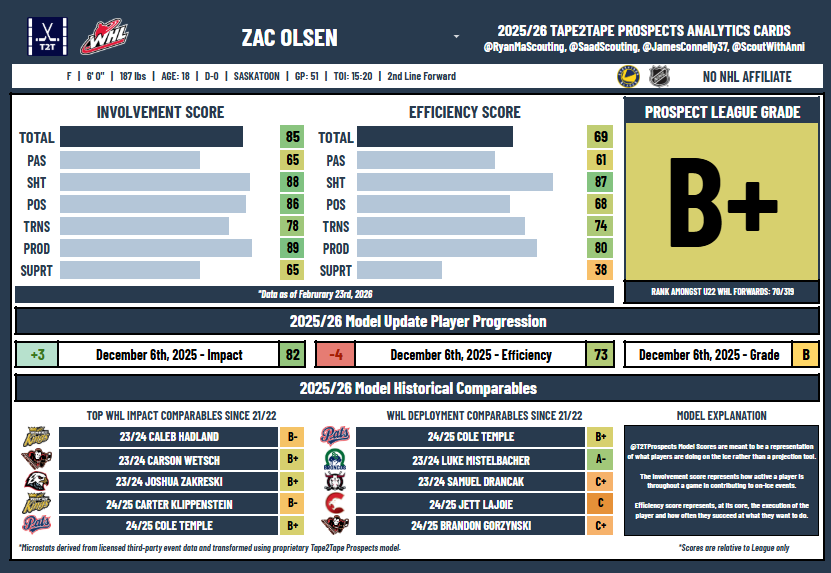
Games Tracked:
03/27/26 vs Edmonton (Playoffs)
02/13/26 vs Swift Current
01/31/26 vs Prince Albert
ELEVATOR PITCH
Olsen projects as a pro-sized, high-energy support forward whose value comes from relentless forechecking, physical engagement, and net-front activity. While he brings effort and a straightforward shooting mentality that can translate into a bottom-six energy role, limited puck skill, inconsistent puck pursuit effectiveness, and a lack of refinement with respect to on-puck creation make him more of a late-round depth bet than a clear cut NHL projection.
Zac Olsen plays his role well, but I wonder if there’s enough here for him to reach the NHL ceiling as a 4th Line energy forward. Some NHL team will draft Olsen, maybe even higher than where I have him ranked, and I’ll understand it even if I don’t necessarily agree.
Olsen has pro size, skates hard all over the ice, and has never seen a hit he doesn’t like to finish. His role on the puck is very much tertiary on his line, with very few puck receptions, very few entries and very few exits as a forward. His role is to get the puck for his more offensively created teammates and finish his chances when they arrive.
Olsen plays this role moderately well; he’s constantly applying pressure on the forecheck or off of turnovers, never giving the opposing team a clean breakout, even if I think his actual ability to win the puck back is just average. There are a few nice second-effort plays in the net front, poking at rebounds and going after loose pucks. He’s a very simple player in application, doesn’t really have the vision as a passer, and so when he gets the puck in decently dangerous scoring areas, his default is just to shoot and then shoot again if he gets the rebound.
He does have some moments, though, that I think suggest he WANTS to be more than his prescribed role. There are times when he’ll drive the net on his strong side (usually just results in a weak sharp angle shot into the goalie’s pad), or when he’ll charge into the zone or through the slot with the puck, trying to split 3 or 4 defenders. It rarely works, and he comes off a bit out of control, banging and crashing into bodies, knocking himself off balance as he fights to keep control of the puck. The best way I can describe him is a bit like a bull in a China shop.
Olsen’s off-puck movement is also hit or miss. Sometimes, he can sneak his way into the slot for scoring chances, or drive the net in transition to put the finishing touches on an odd-man rush, but I find that sometimes he really just likes charging into straight lines irrespective of whether he’s crossing into a teammate’s lane. I also think that his hands and feel with the puck need improvement. A few plays where he just overskates pucks. He needs to learn to keep his stick ON THE ICE, work his way into the crease more consistently and just be a more clinical finisher if he wants to fulfill his NHL projection.
All in all, Olsen’s a fun, gritty, physical player who has good intentions, but I’m not sure the tools are all there for a slam dunk NHL package. Worth a crack with a fourth-round pick if your team has a few in this range.
#103 - Quinn McKenzie - RHC - Soo Greyhounds - OHL
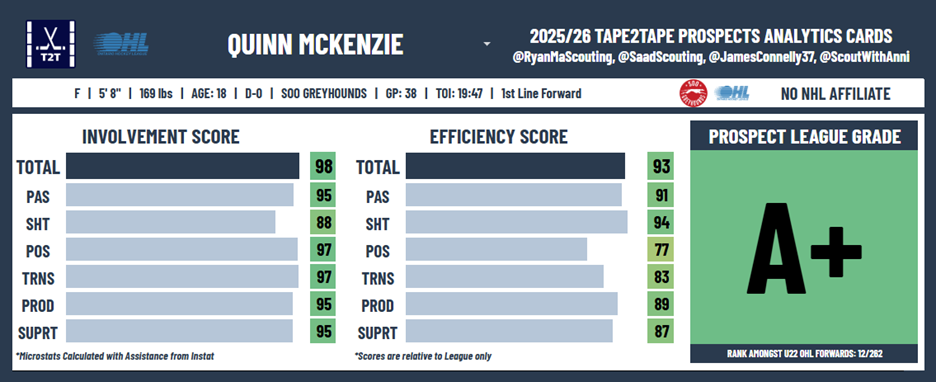
Games Tracked:
11/05/25 vs Flint
12/07/25 vs Sarnia
01/10/26 vs Niagara
ELEVATOR PITCH
McKenzie is a high-motor, two-way support center whose game is built around relentless work rate, defensive reliability, and constant off-puck activity. While his undersized frame and limited ability to win board battles or consistently drive offense caps his ceiling, his penalty-kill usage, active stick, quick decision-making, and net-oriented habits give him a credible path as a mid-round depth/energy NHL option.
I have time for a player like Quinn McKenzie.
The 5’10” RHC has found himself as a relied-upon member of the Soo Greyhounds this season, used a ton in the defensive zone and on the penalty kill, and is still driving great results in the offensive zone.
McKenzie is small in stature, and he gets rubbed off the puck easily along the boards, but he’s the definition of a worker bee. I don’t love the hunched-over stance he has when skating, but he’s constantly in motion, buzzing all over the ice, influencing the game in positive ways for the Soo.
On the forecheck, even though he doesn’t win the puck back at a super-efficient rate, his stick is super active, poking and prodding, trying to pry pucks away and effectively disrupting breakouts.
Defensively, he commits to getting into shooting lanes, with great scanning habits as the weakside defender. He hasn’t been super involved in transition in my viewings, but I find him to do a lot of his best work with short area passes. Bump passes on exits, soft dumps off the boards for his teammates on entries, McKenzie isn’t some super dynamic on-puck player that can manipulate and move defenders with his eyes, but he’s quick and decisive with the puck on his stick.
The long-distance cross-seam passes could use some work; a good share of them get deflected en route, but he makes up for it by digging in hard for loose pucks and being super active in the offensive zone without the puck. He’s constantly in motion in the offensive zone, looking for open ice and charging the net front to create traffic and rebounds.
He’s also got a whippy snapshot that he’ll utilize off the rush that can beat goaltenders clean, which is a weapon I’d like to see him use more.
The size and struggles of handling physical play along the boards mean some NHL front offices will shy away, but McKenzie is a fun player with a relentless motor who works hard in all three zones to go with some good tools to work with in the offensive end. Maybe not a player that will get a ton of love through the first 96 picks of the draft, but there’s more than enough here to take a flyer on in the 4th – 7th round. Something tells me he won’t fall past Pittsburgh’s 5th Round Pick this year.
#104 - Vladimir Dravecky - Brantford Bulldogs - RD - OHL
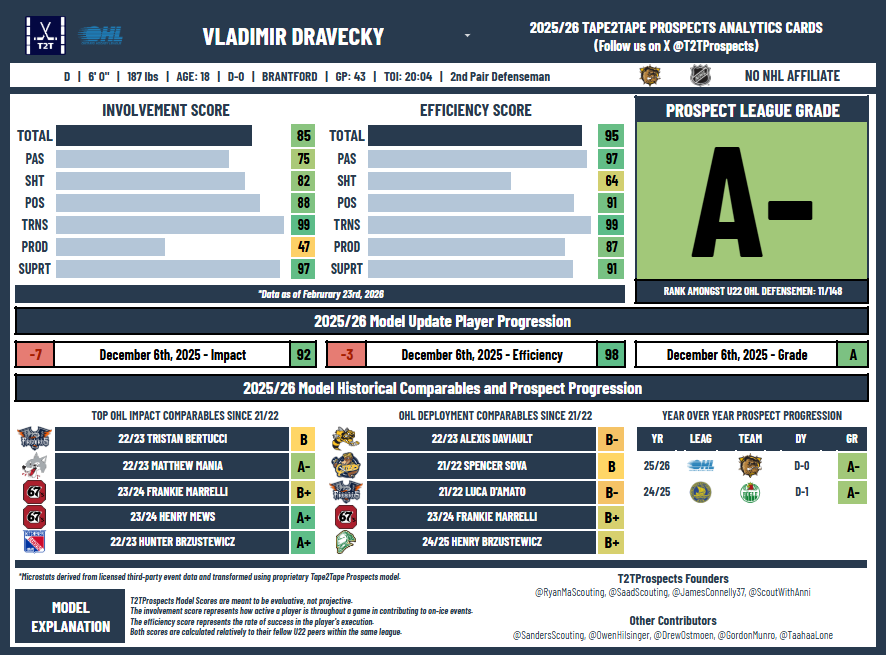
Games Tracked:
03/31/26 vs Sudbury (Playoffs)
02/21/26 vs Barrie
01/22/26 vs North Bay
ELEVATOR PITCH
Dravecky is a puck-moving defenseman whose value comes from proactive, north-driving transition play, quick puck movement, and occasional creative passing flashes rather than shutdown defending. However, inconsistent defensive engagement, passive rush coverage, and a lack of physicality significantly limit his projection, leaving him as a fringe top-100, developmental puck-mover who needs major growth in defensive intensity to carve out an NHL role.
Vladimir Dravecky, was another guy I thought heading into the year was going to be knocking on the door for the 1st Round, but is another player whose season and overall body of work just hasn’t lived up to expectations.
There are some moments from Dravecky, he’s got some nice passing ideas in the offensive zone, with a few no-look cross-seam passes, and on breakouts, there are a few moments where he’ll try a little head fake and use some change of direction to shake forecheckers. He’s not afraid to jump up into the play to add numbers in transition, and I find that overall, the main central focus of his game is to constantly keep the puck moving forward. Lots of quick chips up the boards to his teammates, mixed in with a few long passes up the boards to the center line, as well as some nice use of his hands and skating to maneuver and diagnose pressure. Dravecky generally does a good job keeping play moving the right way when his team has the puck, and that’s where the projection is going to be for him as a player: a smart, confident play-pushing player.
This mindset does get him into trouble at the offensive blueline sometimes. He got caught a few times making bad pinches trying to hold the zone, leading to odd-man rushes the other way, and a few times where he just bobbled or mishandled an opponent’s clearance attempt and had to hit the desperation recovery button to get back.
Defensively, it’s just not all there yet. Dravecky is far too passive defending rushes, ceding ice and allowing the opposing puck carrier to get in and around the circle. I also find that the motor and intensity in his rush defence are lacking, with late recognition of who he’s responsible for, and even though he gets low and his stick out to challenge the opposing puck carrier, he doesn’t really take away passing and shooting lanes. The feet are also just okay defensively in my opinion, they come off a bit awkward and leave him looking off balance as he enters physical engagements at times.
Dravecky will trigger out aggressively towards perimeter puck carriers when defending in-zone, but again, he needs to do a much better job of cutting down the puck carrier’s space with his stick. While Dravecky actually does have an active stick along the boards, he needs to be willing to use his size and frame to engage more physically in puck battles instead of trying to only use his stick to poke it away.
All in all, Dravecky has some intriguing puck skills and passing traits. I’m not fully sold on the mobility, but it’s good enough for him to sustain his north-pushing playstyle. The defensive intensity and mindset need tons of growth for him to project at the next level. He ends up just outside my Top 100, but there are worse swings for upside you can make from the back end in this year’s draft.
#105 - Markus Ruck - Medicine Hat Tigers - F - WHL
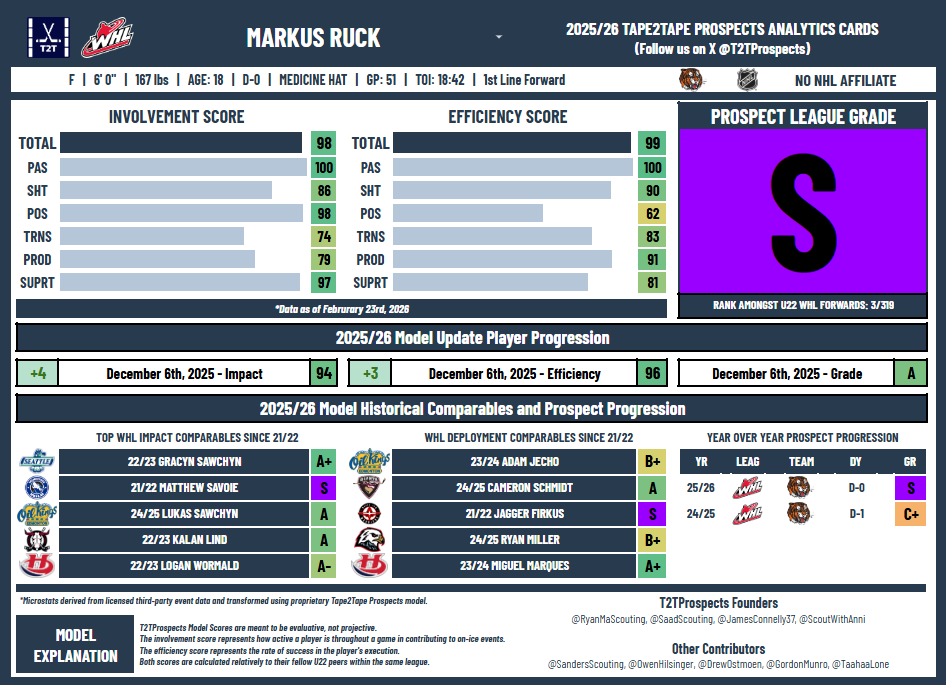
Games Tracked:
04/29/26 vs Prince Albert (Playoffs)
03/31/26 vs Regina (Playoffs)
02/21/26 vs Lethbridge
ELEVATOR PITCH
Markus Ruck projects as a passive, perimeter-oriented winger who lacks the pace, urgency, and physical engagement to consistently drive play, with most of his offense coming from secondary touches and quick slot-area passes rather than self-created advantages. While he does show legitimate passing instincts, with some sharp reads into soft ice off the rush and occasional layered feeds, his inability to sustain pressure, manage pucks cleanly under duress, or actively impact retrievals are real concerns. Overall, there are enough flashes of touch and connective playmaking to keep him on the board, but the low-engagement, low-pace style makes him more difficult to project at the next level.
Markus Ruck… I just don’t think I see it with this player. A lot of the shifts I watched felt very perimeter-oriented and passive, and despite playing on a really strong line and team environment, I rarely came away feeling like he was actually driving much of anything himself.
The biggest issue with Ruck’s game is that there just isn’t enough pace, engagement or advantage creation. He’ll have little sequences where he makes a nice touch pass into the slot or extends a cycle with a quick give-and-go, but so much of his game feels reactive rather than proactive. He’s not really manipulating defenders, attacking space dynamically or creating pressure consistently himself. Instead, a lot of his offensive involvement comes from soft perimeter touches, quick slot feeds and moving pucks along after someone else has already created the advantage.
To his credit, there are definitely some decent passing instincts here. I thought he showed nice commitment to getting the puck into the slot and there were multiple flashes where he sifted passes through layers of sticks and bodies to his teammates. One thing I actually liked quite a bit was some of his playmaking off the rush. There were sequences where he identified Liam darting behind defenders into soft ice and threaded some really nice feeds through traffic. He also flashed a few good cross-ice passes and some clever little backhand distributions into dangerous areas that showed that there is some offensive awareness and touch here. Along the boards offensively, there were a few moments where he executed quick cycle plays nicely too.
A big frustration for me was his puck management on retrievals in his own end. Ruck has this tendency to retrieve pucks in the corner and immediately turn back INTO pressure trying to hold onto possession rather than simply making the easy play up the boards. Sometimes he can protect it momentarily with little stick plays, but far too often it just slows the play down unnecessarily and creates turnovers. There were multiple sequences where he’d make a decent defensive touch or force a turnover along the wall, only for his feet to completely stop moving afterward.
That lack of secondary effort and urgency showed up in a lot of areas of his game. The skating effort itself actually isn’t terrible but the problem is that he rarely pairs it with actual physical engagement or a disruptive stick. He doesn’t consistently use his body to separate opponents, doesn’t pressure particularly hard and often just kind of exists in the vicinity of the play without actively impacting it.
Offensively, I also thought his puck execution under pressure was pretty underwhelming. There were several moments in dangerous scoring areas where he simply fumbled pucks in the high slot and killed opportunities before they could develop. He’s not really a crafty enough handler to create offense for himself in tight spaces and I don’t think there’s enough pace or deception to consistently beat defenders one-on-one either. A lot of the offense boils down to simple reads: pass to the slot if it’s available, otherwise get the puck toward the net and continue the cycle.
That’s ultimately why I struggle to project much upside here offensively. With Ruck, I just didn’t see enough consistent engagement or play-driving habits to fully buy into that role projection long term. All in all, there are some decent connective offensive habits and flashes of passing touch here, particularly around slot distribution and quick-touch playmaking, but the overall profile felt way too passive and perimeter-oriented for me. Between the lack of urgency, underwhelming physical engagement and limited self-creation ability, I had a hard time seeing him as much more than a depth complimentary offensive piece, which is why he settles much lower on my board in the 100s range.
#106 - Benjamin Cossette-Ayotte - Val-d’Or Foreurs - RD - QMJHL
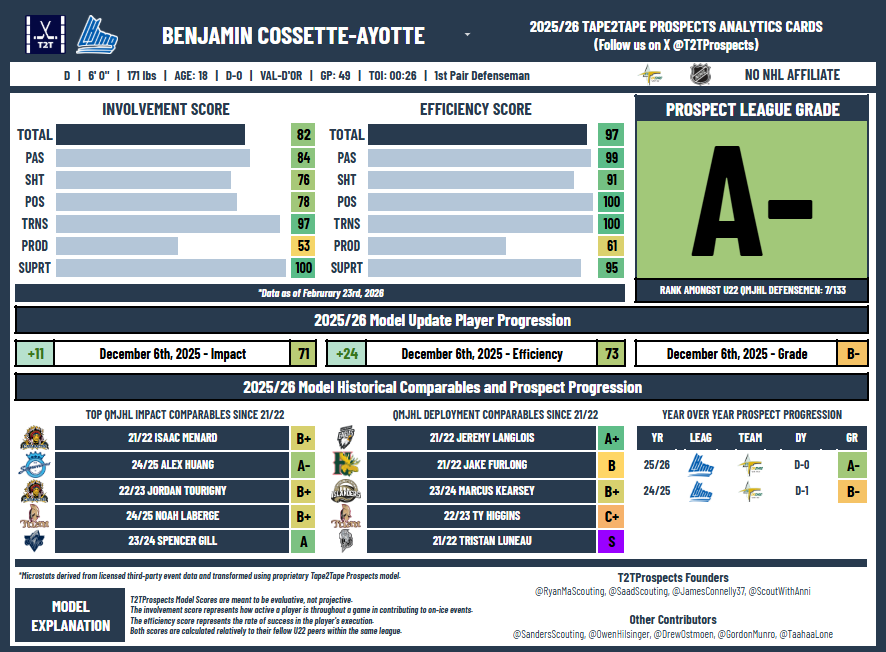
Games Tracked:
03/20/26 vs Rouyn-Noranda
02/26/26 vs Moncton
01/29/26 vs Rimouski
ELEVATOR PITCH
BCA profiles as a mid-round developmental right-shot defenseman with a clean, organized breakout game and enough size and straight-line skating to project into a pro frame, but his defensive consistency remains a major concern. He’s effective when stepping up aggressively at the blue line and can drive transition efficiently, but his habit of overextending himself and his lack of awareness in net-front coverage lead to repeated defensive breakdowns.
BCA’s not a bad mid round developmental defenseman. He’s got his certain tendencies that he sticks to for better or for worse, but overall I think there’s enough of a package here for a team to invest in and try to develop.
The hallmark of BCA’s game is a very clean breakout game. Nice, quick, decisive passes up to his teammates and also shows some nice patience when facing pressure. Not rushing decisions but skating away from the pressure into open space before finding a teammate. It’s very organized, tidy and he’s a central engine in the transition game to get Val-d’Or going the right way.
BCA has good size at 6’1”, and he’s a strong athlete who skates well in straight lines. He’s shown a willingness to jump into the play offensively and has a really aggressive style defensively. When defending the blue line he’s very aggressive in stepping up and taking away time and space at the blue line. Sometimes it works, and he’ll force the puck carrier to fumble the puck, but sometimes he’ll take a swipe at the puck, miss and get caught overextended.
My big issue with BCA is the in-zone defending is lacklustre, which to be fair, is a criticism that I could put out about a lot of QMJHL defensemen. When he’s out chasing guys on the perimeter he’s actually got an aggressive stick that he uses to dislodge pucks pretty well, and then he finishes plays with a bit of an edge, shoving guys before getting back to the net front. That’s when the issues arise. It’s almost like BCA’s brain turns off the second he gets in front of the crease. Gets caught just standing around and puck watching. He doesn’t tie up sticks in front, doesn’t take the body to move guys out of the way or even take away passing lanes. Tons of goals against in my viewings where anytime there was traffic in front of his net there was around a 50% chance for a goal to be scored.
I think BCA mainly just struggles to read plays at times without the puck. Defensively he can be late to react whether it’s defending the net front or realizing when he has to get out to a player to defend. In the offensive zone, he gets really low at times for no reason and just adds a ton of congestion along the half walls that could be avoided.
Overall I think BCA is an aggressive minded defenseman, with good physical tools and the capability to drive play out of his zone efficiently. I think the next steps for him will be too improve his net front defensive habits, improve his shot selection, and learn to dial the risk tolerance a little bit by feeling more comfortable with the play coming towards him when appropriate rather than triggering forward no matter what.
As I mentioned at the start there are worse bets you can make in the middle rounds on a confident puck moving RHD with pro size. I’d have him neck in neck with where Dravecky is right now. Not quite in the Top 100 but I am intrigued and I think there’s a development opportunity to be had here if he can secure a NCAA commitment.
#107 - Jordan Duguay – LW – Portland Winterhawks – WHL
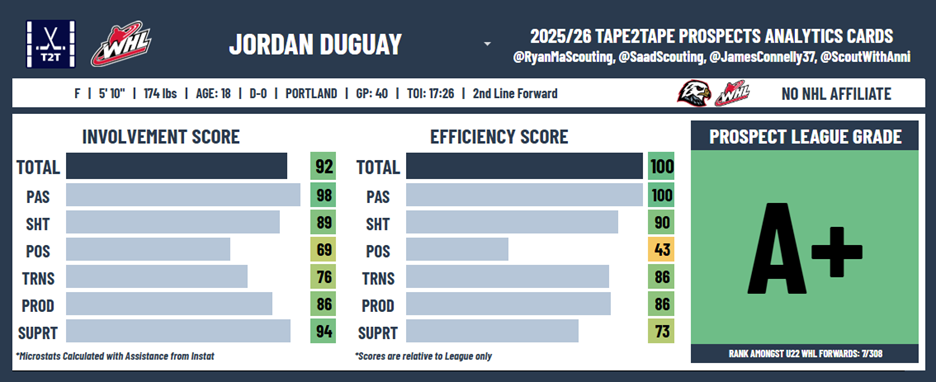
Tracked Games:
01/13/25 vs Moose Jaw
11/28/25 vs Regina
12/14/25 vs Penticton
4/1/26 vs Everett (Playoffs)
ELEVATOR PITCH
Duguay is a supporting winger on his line, whose skating limitations restrict his ability to forecheck, defend, and drive play consistently, leaving him mostly off-puck and reliant on others. However, he shows intriguing flashes with the puck, where he does most of his best work. Strong contact balance in possession, quick short-area passing, and a fast, accurate shot which all suggest he could still project as a useful complementary offensive piece if his off-puck engagement improves.
Jordan Duguay is an interesting player.
On a line with Vegas 6th Round Pick Alex Weiermair and Penguins 5th Round Pick Ryan Miller, Duguay often plays the third fiddle on the line. He’s not super involved in transition, and most of his shifts are spent off-puck.
The big issue for Duguay is his skating. His mechanics are fine, but there isn’t really a top speed to speak of for him, and it means that while he’s off puck a lot, he isn’t the type of player that can barrel in for retrievals or forecheck super effectively. His impact without the puck is mainly predicated on his off-puck movement, intelligently finding pockets of empty ice (but even then, he’s less active than you’d hope).
Defensively, he shows bursts of effort on the backcheck where he will stick-lift opponents from behind, but the lack of speed limits his effectiveness in that area as well. I also find that he’s really guilty of puck watching while defending in the zone.
Despite these apparent shortcomings that make me question his NHL projectability, the @T2TProspects model rates the player highly, and after some viewings, it’s not too difficult to see why. The things that the left shot forward does well for the Portland Winterhawks are really valued by the model.
What makes Duguay interesting is that even though his current role is predominantly off-puck, I would argue his best and most impactful moments are when he has the puck on his stick.
He’s not dominant along the boards, and I don’t see him winning tons of puck battles for loose pucks, but in possession, he has great contact balance, which buys him enough time to make quick and decisive short-area passes to his teammates that frequently result in shots on goal.
He also has a quick, nifty release when he’s stationed on his strong side (whether that’s on the power play or when the team has established offensive zone time). He gets it off quickly and accurately, which generates second-chance opportunities for teammates.
All in all, Duguay is a fun little supporting player who will need to really improve his game off the puck for me to gain more confidence in him, but it did look like it was coming together when I checked back in on him during Portland’s short playoff run.
#108 - Mans Josbrant - Lulea HF U20 - LW/RW - U20 Nationell
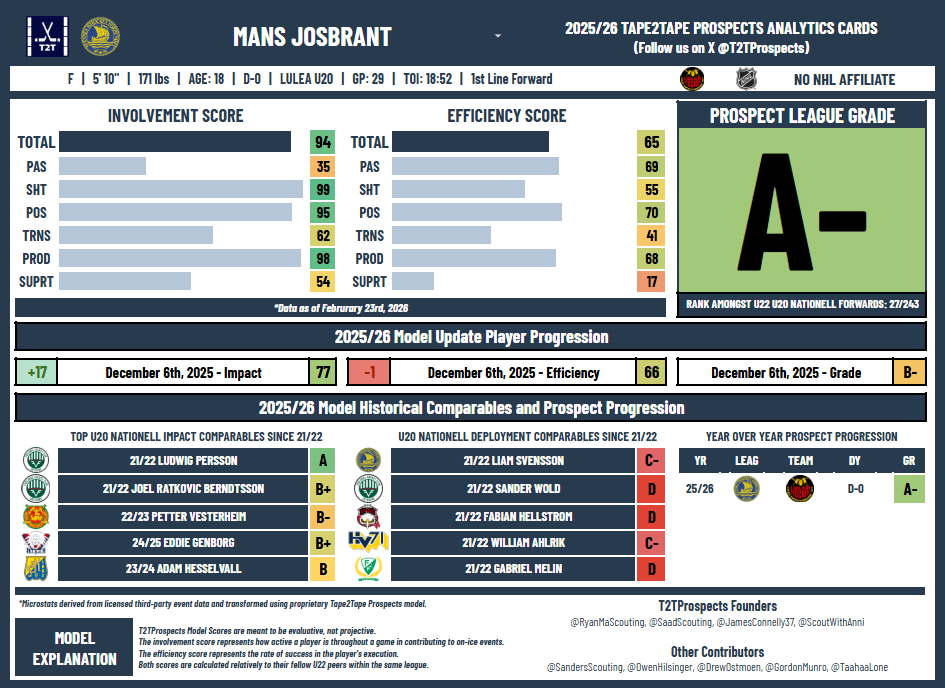
Games Tracked:
03/19/26 vs Brynas IF U20 (Playoffs)
03/01/26 vs Bjorkloven U20
01/25/26 vs Timra IK U20
ELEVATOR PITCH
Josbrant projects as a smart, slippery winger who consistently finds the right defensive spots and shows strong puck reception skills, with enough dexterity to handle pucks cleanly in traffic and occasionally attack the middle with creativity. However, his lack of explosive separation and limited ability to get shots off once he enters dangerous ice caps his ability to generate consistent high-danger offense. His path to the NHL will be one as a bottom of the line up creator, but for that to stick he’ll need to improve the motor significantly.
Mans Josbrant is such an interesting player, and while I do like him, I just have a hard time envisioning what his projection to the NHL will be, and is ultimately why he will not be in my Top 100.
Josbrant’s a smart and aware player who gets to the right spots defensively and picks good moments to step up into the play and try to pick off break out attempts to hold the zone as a winger. He’s got very good dexterity with the puck, picking them very cleanly out traffic, with great touch to receive passes cleanly. He can be audacious with the puck, willing to string together dekes to make his way into the center of the ice, although he does lack the puck protection and that explosive skillset to create enough separation to consistently get his shot off once he makes his way into the heart of the defense.
Where Josbrant lacks in explosiveness, he makes up with by being a very slippery player. He showcased a few times where he was able to side step defenders out to the perimeter to create space for himself. Makes some quick plays while facing coverage with the puck, and maximizes his ability to quickly change direction when given space by the defender. It’s how he scored his playoff goal against Brynas IF U20, he broke the defender’s ankles with a quick turn and change of direction in the corner before showing some nice creativity by going for the wrap around.
That’s what Josbrant’s playstyle is all about. He’s extraordinarily willing to be a creator. Whether that’s using an array of side steps or taking the puck behind the net for wrap arounds and passes to the slot or carrying the puck over the blueline, Josbrant’s a fun player who’s always looking to create. He even showed some edge along the boards, getting into a bit of a shoving-scrum match, but I can’t help but wish he’d take that feistiness and translate that to his on-ice impact, not just his after play shenanigans.
All in all, Josbrant’s a smart player, a creative player, and a guy who generally gets to the right spots. He’s in position defensively, he gets in and around puck battles as the 2nd man in, and he’ll flash across the net front in the offensive zone looking for tips. I ultimately think that there’s just not enough of a hard edge to his game. The flashes of creation are nice, but not something I expect to translate very well at the next level, especially when he has less ice to skate into to find space. I would just love to see a much higher intensity as a forechecker and support player.
His NHL future rests on him being a bottom six creator of some sort, but he’ll seriously need to learn to make and finish the hard force plays along the board and be willing to work harder than everyone else on the ice. Bottom line, the motor needs to get a whole lot better. It’s why he ends up in that Holmertz, Iginla, Kotkov group of players where there’s enough skill here, but I need to see much more to be convinced it’ll work at higher levels.
#109 - Rasmus Orenas - Leksands IF U20 - C - U20 Nationell
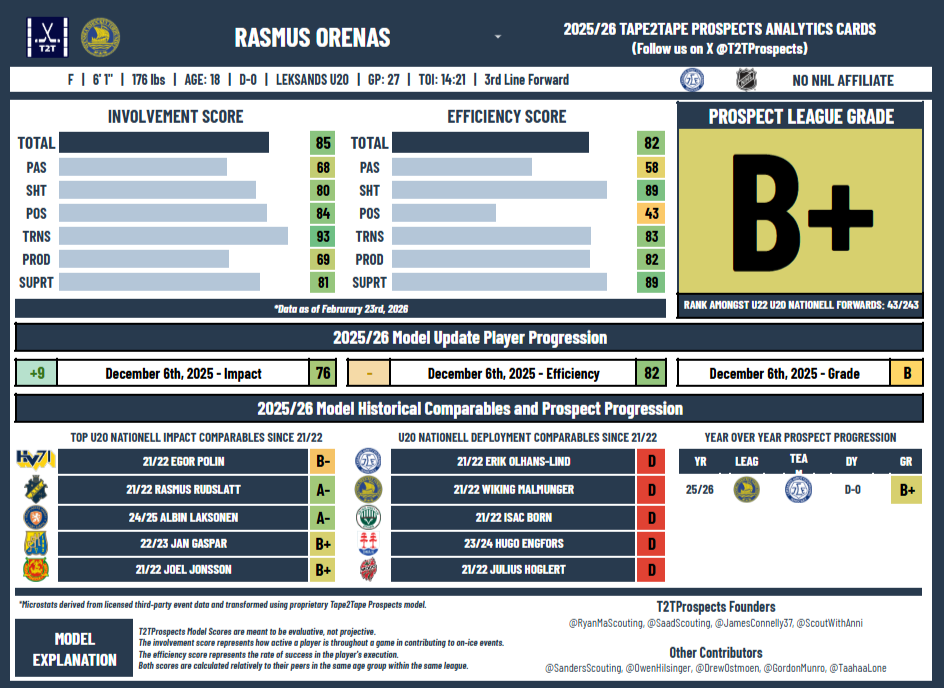
Games Tracked:
03/29/26 vs Mora IK U20
03/15/26 vs AIK U20
02/01/26 vs Brynas IF U20
ELEVATOR PITCH
Orenas is a 6’2” explosive skater who shows real flashes of puck-carrying ability, patience, and half-wall creation, with some intriguing rush and power-drive moments, but his inconsistent hands and underwhelming physical engagement limit how often those tools actually translate into impact. He projects as a mid-round developmental power-forward type whose value will hinge on whether he can turn his skating and activity level into a more purposeful, hard-edged puck-winning and forechecking package.
Rasmus Orenas wasn’t on my watch list initally, but after being generally pleased with what I saw from Pax Kleffner, I was left wondering who #67 was on his line that kept flashing on my screen in the background.
Orenas is far from a perfect player, and I think there’s a lot of development to be had in terms of growing his on-ice involvement, but there are real flashes with this player, and they excite me. Orenas is 6’2” and moves really well, building up speed with and without the puck, and I think that can be a real asset for him as he continues to figure out the rest of his game. What drew me to Orenas was the flashes of on-puck confidence where he would go on these charges through the neutral zone with the puck. Great explosiveness to blow past opponents, and when he gets his legs moving, he’s like a deer galloping through the blue lines. The hands and skill aren’t really there, and so he hasn’t been able to figure out how to beat defenders at the offensive blue line just yet. When he can gain a step and get a defender on his back hip, there are some nice power moves towards the center of the ice.
He’s also got some really underrated patience and puck protection with the puck. Kleffner gets far more puck touches than Orenas, but I do think that Orenas has better ability to create for himself with the puck from the half wall; he just doesn’t do it enough. He had an amazing play against AIK U20 where he showcased poise while being pressured along the boards in the offensive zone close to the blueline, where he didn’t panic and proceeded to shake the defender with a quick cutback before driving through sticks into the slot for a prime scoring chance.
Orenas is also a super active off-puck mover, constantly trying to get open for his teammates in the mid to high slot, and charging into the net front as well. The timing and understanding aren’t really there, like it is for Kleffner. I find Orenas doesn’t really actually get open very often, but I appreciate the effort level and activeness.
My big gripe with Orenas is that I need him to make harder plays on the puck. He’s smart on the forecheck as the F3, picking great times to jump in to pick off passes or try to force takeaways, but at his size, I think it couldn’t hurt for him to be less puck-oriented on some of those pinches. He often makes really weak reaches with the stick instead of taking the body, and opponents just skate through his stick, and he gets caught out of position and flatfooted. Orenas, in general, for a bigger guy who can skate as well as he does, and also skates as much as he does all over the ice, just isn’t super physical and dominant in winning puck battles... he can come off as busily not making meaningful impacts for stretches of games.
All in all, Orenas is a big, explosive skater with some really nice flashes of being a higher-end self-creator offensively, but he needs to find that edge in his game to be a true difference maker. He’s fun, with good potential, but the off-puck game is something I want to continue to see improvement from. He has the tools and fitness to do it... the application lags. I think I like him more than Oscar Olsson as my “mid-round developmental power forward” bet.
#110 - Jan Daron - EV Zug - F - NL/ Swiss U21-Elit
Games Tracked:
03/18/26 vs HC Davos U21
02/04/26 vs Finland U18
11/29/26 vs HC Ajoie
ELEVATOR PITCH
Daron is a high-energy, puck-hunting winger with strong straight-line pace and consistent involvement in board battles, plus some flashes of neutral-zone carries and slot-area distribution that hint at some potential offensively. However, his struggles handling contact and cleanly receiving hard passes limit his ability to sustain those moments against higher competition, making him a developmental project whose NHL chances hinge on significant playstrength improvement and improved puck carrying under pressure.
Jan Daron’s another exotic David Saad (@SaadScouting) recommendation and while he’s not someone who blows me away, there’s a nice overall pace and energy to his game that I like, and I think with some strength improvements there could be a guy who maybe gets a cup of coffee in the NHL at some point in his career as a depth call up.
Daron looks like a very good player against his peers in the Swiss U21-Elit. He plays with pace, and works really hard all over the ice. Constantly in board battles, picking pucks loose, lifting sticks, he’s just all around the puck in the offensive end trying to win pucks back for his team. With the puck, there’s some nice flashes. A few nice plays where he’ll attack the center lane in the neutral zone and crossing the offensive blueline where he’ll use a few quick stick handles to maneuver through some sticks before saucing a pass to the flank to a driving teammate or wristing a shot on net. There’s also some nice slot oriented passing where he’ll drag pucks back to wait for the passing lane to open up and flick pucks into the slot area from the wall or behind the net.
Against higher levels of competition like his game against Finland’s U18s, the results were less spectacular. Daron was still a player who worked hard in the offensive zone trying to win puck battles, bringing a bit of an edge and he had a few nice plays on breakout attempts where he timed his pinches super accurately and was able to steal the puck.
Unfortunately, a minor issue in Switzerland for him looked a bit more prominent here... Daron really doesn’t handle contact well. He got bodied a bunch against Finland, couldn’t maintain possession or his balance against more physical coverage and just couldn’t work his way into the center of the ice as often. I’ve also found that while he has flashes of nice puck handling, he doesn’t handle passes with pace very well at all, he struggles to corral them at times, with the puck bouncing off his sticks and skates into traffic.
All in all, I think Jan Daron is worthy of an investment here by NHL teams. He has the straight line skating and the attitude to potentially project as a depth NHL piece one day, but he will need to improve his edgework and contact balance to achieve that projection. His 6’0” frame will help that along, as he grows into his body, hits the weight room more and learns how to make some of these plays through contact.
#111 - Luke Schairer - USNTDP - RD - USHL
Games Tracked:
03/29/25 vs Cedar Rapids Roughriders
ELEVATOR PITCH
Luke Schairer is an athletic, rangy defenseman whose combination of size, mobility, and textbook rush defense makes him highly effective at shutting down attackers in open ice. However, his limited puck-moving ability, inconsistent physical engagement, and struggles processing defensive coverage rotations in-zone leave his NHL projection a bit of a mixed bag.
lLuke Schairer is a really weird profile. At first glance, his size and counting stats suggest he’s a stay at home defenseman, and those were indeed what appeared to be the case early in the game. Schairer’s main strengths are his powerful strides that allow him to get moving quickly, and his rush defense. His technique is near textbook in that sense, great gap control, very rangy, doesn’t overextend himself by getting overaggressive. He mirrors opponents well with good hip mobility, and a really accurate and timely poke check. The NTDP gave up tons of rush chances as a team and for the most part Schairer did a really good job defending them especially when he’s defending the puck carrier.
It looked like the NTDP was playing a zone defense, and I’m not sure that caters to Schairer’s strengths or preference. On the goal against in the game against Cedar Rapids had, Schairer was not defending the puck carrier, and instead just continued to give ground as he settled into his zone on the right hand side of goal. Issue is, in a scramble he gets lost, the puck goes off the back boards and back into the crease before getting banged in for a goal. It was a general issue in general for Schairer who often had difficulty handing off coverage, and didn’t seem to do to well with keeping up with the play around him. He feels like a much more effective man coverage defensive player where he can let his skating and reach do most of the heavy lifting.
Breakouts were a mixed bag for Schairer, he threw a back hand pizza up broadway on a shift when he was under pressure, and he seems to just opt for the hard chip up the boards on his forehand. I don’t think he’s super comfortable with his hands in tight, so he opts for the simplistic approach. It’s not a bad thing persay, but it doesn’t look like he projects to be a valuable contributor when it comes to exits.
As the game wore on, he got more and more willing to jump up into the play. He had a nice individual rush in the third period, but outside of that he wasn’t truly impactful. His skating allows him to easily join rushes, but he rarely drives the net hard and instead will hover in the slot for a few seconds before peeling back.
Schairer is a pure athlete who’s great at defending the point of attack on rushes but needs to improve his understanding of in-zone defending within a zone system. I’d also like to see him engage physically with more regularity instead of relying solely on his stick work. He’s a draftable talent with his size and skating, but not someone I’ll pound the table for.
#112 - Jackson Marthaler - USNTDP - LD - USHL
Games Tracked:
03/20/26 vs Waterloo
02/22/26 vs Lindenwood University
01/23/26 vs Cedar Rapids
ELEVATOR PITCH
Marthaler projects as a defense-first, bottom-pair type with strong rush defending, good gap control, and a physical edge that he uses effectively when closing space, even if his decision-making on when to finish hits can occasionally pull him out of position. His offensive impact is limited outside of the occasional end-to-end push, but his breakout passing and ability to handle pressure with simple, well-weighted exits give him a credible NHL pathway as a stay-at-home defender if the development trend holds.
I like Jackson Marthaler as a potential bottom pair defensive defenseman if the development hits right.
Marthaler is the classic, defense and athlete oriented defensive prospect. Very good rush defending from Marthaler which holds up against NCAA comp. He gets into a low stance, and does a great job crowding and taking away passing lanes and space away from opposing puck carriers as they cross the blueline. There’s a bit of edge from Marthaler too, where sometimes when he closes the gape, he will look to finish the play physically. It’s good to see him showing that physical edge given the profile he will have to play if he makes it to the NHL, but there needs to be more discipline in choosing when to go for those hits. He has to make sure that going for the hit doesn’t take him out of the play when his team needs him to get back to defend the rush chance.
Marthaler does have some nice moments of carrying the puck from end to end, but he mainly relies on his natural athletic package and length where he really just takes it into the zone and below the goal line before getting board played. He’s not an incredible offensive zone distributor, and doesn’t get a ton of touches in the offensive zone. Marthaler won’t offer you much in the offensive zone besides a few shots and cycles down low, but that’s not the value he brings.
An aspect of his game that does enthuse me about Mathaler’s game projecting to the next level is his breakout passing. He handles pressure well, using his skating to get into open space, and using well weighted flicks off the boards to clear the puck when under pressure to his teammates for breakouts. The high end projection for Marthaler is to eventually become a defense-first defenseman who has a good enough first pass out of the zone where you don’t need to be too worried about him getting hemmed in the defensive zone.
Overall, Marthaler isn’t a perfect prospect. He does get turned around at times with start and stop moves from the opposing player, but he weaponizes his reach very well to use his stick in recovery to knock the puck away and allow him to re-gain his bearings. The offensive toolkit is very limited and outside of the few end-to-end rushes, he likely will never contribute much on that half of the ice.
The upside is not extremely high with this player, and the fact he’s a left shot and not right shot will likely diminish his value to NHL front offices, but I think he might be my 2nd favourite USNTDP defenseman this year and neck in neck with Luke Schairer.
#113 - Oscar Olsson – RW – Orebro U20 – U20 Nationell
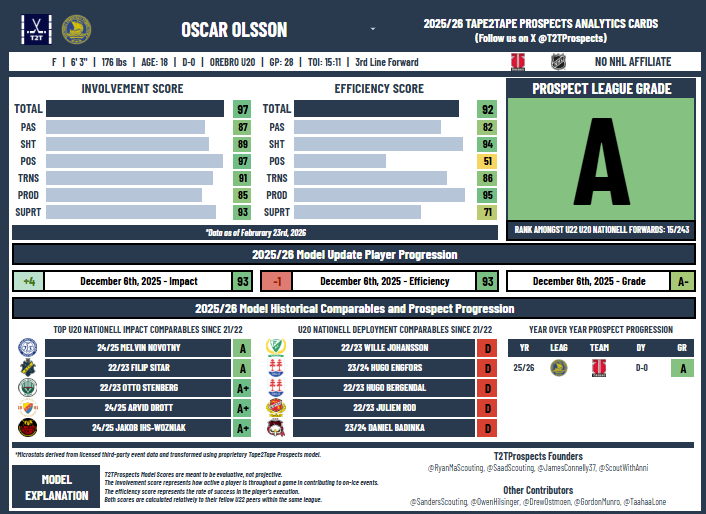
10/25/25 vs Vaxjo Lakers HC U20
11/29/25 vs Rogle BK U20
01/10/26 vs Frolunda HC U20
ELEVATOR PITCH
Olsson is a raw 6’4” power-forward type who brings straight-line speed, physical edge, and strong net-front involvement, with his best work coming from puck protection, forechecking, and driving to the crease for high-danger chances. However, rough edgework, inconsistent puck receptions, inaccurate passing under pressure, and inconsistent backchecking (potentially due to conditioning) are limiting factors that ultimately make him a mid round developmental project pick.
Oscar Olsson is one of the lesser-known players from Sweden in this year’s draft. After watching him a few times, I think there could be something here.
Olsson is a big boy at 6’4”, and you can tell, especially at the U20 level, that he wants his opponents to know it every time he’s on the ice. He’s got a mean streak, finishing checks, and upending opponents. He’s a very good straight-line mover at his size, which means he can really land some punishing hits on the forecheck. He’s also a player who plays with effort in the offensive zone and is constantly fighting into the net-front to utilize his size as a screen.
With that said, he’s not a great four-directional skater. This isn’t a Tage Thompson situation, where he can button hook and evade defenders or pressure with his skating. Olsson’s game on the puck is predicated on his puck protection, with his size and reach. He’s clearly well aware of this and really leans into that identity. His go-to move with the puck is to lean his shoulder into the defender, create space, and drag the puck along with him, protecting it.
Unfortunately for Olsson, even though he’s a big boy, he’s still learning how to take as good as he can give. There are times when he’ll get pushed off balance and crunched into the boards by similarly sized opponents, and even smaller defenders can get the best of him when he telegraphs his intentions with the puck. There were times I saw a smaller defender sidestep his shielding arm and poke the puck off his stick.
However, Olsson’s size, speed, and puck protection combination can make him look very, very good at times, especially against smaller, less physically mature U20 opponents. In my first viewing of him against Frolunda, he had two goals. One that started with a nice job protecting the puck along the boards, and cycling it down low, before shaking off his man, driving the net hard and snapping in a goal short side. His second goal was even more impressive. He picks off a breakout pass on the penalty kill, drives the net hard, keeps the defender on his back side and cuts across the goalie before tucking it in for a goal.
The biggest drawback to Olsson’s game right now, in my viewings, is his passing and puck management. These two weaknesses are keeping Olsson’s ceiling for me in the 3rd to 4th round. He really struggles to settle hard rims or breakout passes from his teammates, often bobbling them off his stick. For a player who doesn’t have super dynamic skating or puck handling, becoming a more efficient transition player will be key to his projectability at the pro level.
The passing accuracy is also a real problem under pressure. With time and space, he can make the typical first passes, but there were lots of cross-ice passes in the neutral zone or entries that were behind his teammates, who ended up off balance trying to recover back to receive it.
The backchecking with Olsson is also inconsistent, and I think part of it may be that he expends a lot of energy in the offensive zone, especially when having to chase after defenders when the team loses the puck.
All in all, Olsson is a super raw power forward who builds up speed well and plays with a real edge. The majority of his contributions come with his puck protection, net-front battling and high-danger shooting. The puck skills will need some real work, but there’s certainly a compelling package to work with here for an NHL development staff.
#114 - Filip Novak - HC Sparta Praha - F - CZE
Games Tracked:
03/26/26 vs HC Dukla Jihlava
03/09/26 vs VHK Vsetin
02/02/26 vs HC Plzen
ELEVATOR PITCH
Novak profiles as a low-event, structure-driven two-way center who mainly functions as a connector rather than a play driver, relying on short-area passing, board support, and disciplined positioning to keep play moving in the right direction. While his skating and defensive awareness are solid enough for a supporting role, limited puck skill under pressure and a lack of dynamic creation or finishing ability cap his ceiling, making him a mid-round dart throw at a potential depth player.
Filip Novak got loaned out towards the end the season and so I didn’t get as many actual Czech Division 1 men’s league games as I wanted given I value more recent viewings than older ones.
I had Novak on my watch list early in the year and never got around to him until now, and while I think there’s a smart, detailed, supporting center with a bit of physicality and edge to his game, I don’t think I was missing out on a whole lot.
Novak is a low-event player who plays well within structure and focuses mainly on being a connector of play rather than a driver of events. Lots of quick short area passes for the most part, and when he does hold the puck, he’s working along the boards, he’s not really looking to create offense for himself, rather looking to make plays to teammates who can create more dangerous opportunities with it. Just not a real driver of offense at this stage and plays more of a support role on his lines.
The skating is fine, and good enough that he has spurts where he will carry the puck through the zone, but it’s not dynamic and he’s not a player that will pull out sharp changes of direction. It limits his ability to execute his ideas at high speeds under pressure at higher levels as he doesn’t really have a counter for heavy pressure and his hands are not up to snuff with his intentions and ideas.
Defensively, Novak is also fine. He protects the slot is generally in sound position and doesn’t allow himself to be dragged out of structure. I’d like him to force the issue a little bit more though, he tends to react to plays, rather than making the hard force plays that force mistakes. There are intentions to be physical all over the ice for Novak, who will finish checks and get involved on the forecheck but he’s not physically mature enough yet to consistently win puck battles and gain leverage on stronger players.
All in all, Novak is a fine bet for an NHL team to take a chance on in the middle rounds. He’s got a good enough motor, a good size at 6’1” and good fundamental habits as a connective player. Not a great creator of individual offense and his shot is not what I’d consider a strength, but I think the overall package is compelling enough for me to take in this range. He’s probably near the top of the range of other prospects I like in a tertiary role but who just don’t offer enough of a package as a primary creator.
#115 - Blake Zielinski - Des Moines Buccaneers - USHL
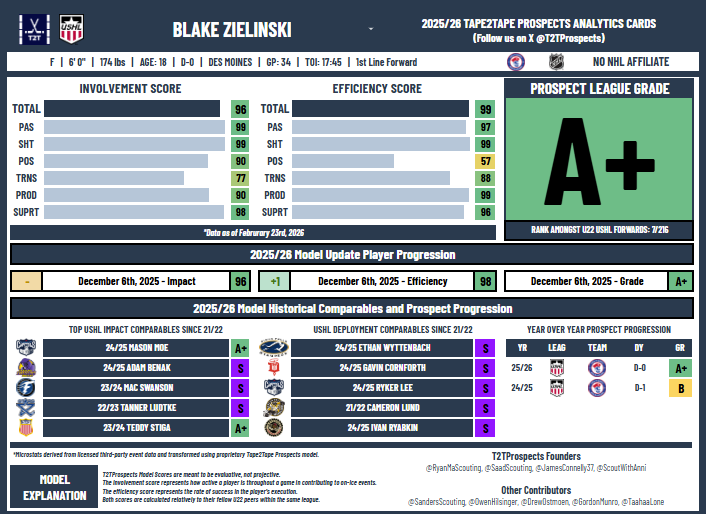
Games Tracked:
04/11/25 vs Omaha Lancers
ELEVATOR PITCH
Zielinski’s value is built around a great shot and strong off-puck instincts, allowing him to consistently find dangerous scoring areas and capitalize on opportunities without needing to dominate possession. While he’s generally a smart passer who supports play well and showed improved effort later in the season, he can be overly scripted with the puck, lacks consistent engagement in battles, and tends to default to perimeter shooting when plays break down, making him more of a complementary finisher that doesn’t have the impressive physical tools or athleticism that other players of his ilk have.
An incredible nasty shot and understanding of off-puck movement highlights most of what Zielinski’s game is about. It makes him an incredibly useful and effective player but also means that he doesn’t pop up in viewings or showcase the high end traits you would be typically looking for.
He has moments where he shows good understanding of leverage to get position and win loose pucks, and he was relatively consistent with coming down low to receive the pucks from his defenseman to alleviate pressure. He was a big part of Des Moines’ team last season, featuring on both PP1 and the 1st Line.
On the powerplay, he was situated on the right hand side halfwall, and he was just very stationary. Wasn’t involved in as many puck battles as I would like, he was often the third man in. The passing has some extremes, he’s generally a very accurate passer and Des Moines made sure he got lots of puck touches last year but that also means bad viewings like his April 11th game against Omaha end up looking really ugly.
Good effort level on the backcheck where he would get a sneaky stick lift in on the opponent and create scoring chances in the chaos that ensued. Zielinski isn’t a selfish player, and he’s very willing to play off his teammates with short area passes, but he’s a very on-script player. It looks like a lot of his decisions on the puck are pre-made and his default when he doesn’t see an immediate pass is to shoot the puck from distance.
Overall, I’m not over the moon impressed with Zielinski but I think there are enough tools here with an improved motor and intensity in the back half of the season that I’m willing to take a stab at him in this range.
#116 - Cooper Williams - Saskatoon Blades - C - WHL
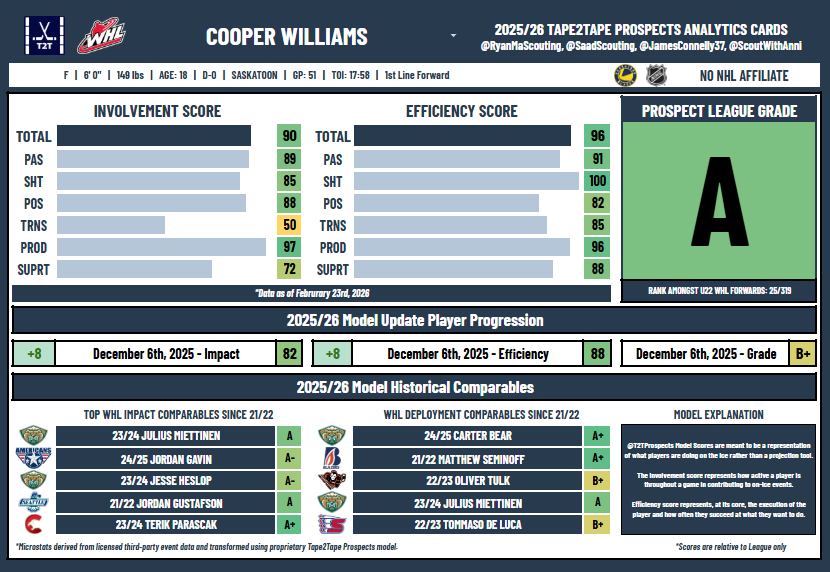
Games Tracked:
03/20/26 vs Prince Albert
02/03/26 vs Calgary
01/02/26 vs Brandon
ELEVATOR PITCH
Cooper Williams is a defensively responsible center who competes around the net front, shows solid hand-eye coordination and flashes of silky smooth hands, but generally makes smart, simple plays that help maintain structure at both ends of the ice. However, his awkward skating mechanics, inconsistent pace and involvement, and limited ability to create offense off the rush leave questions.
Cooper Williams is fine and certainly a draftable talent, but nothing really excites me about this player to the extent that I would pound the table for a team to take him.
Let’s start with the good. Williams isn’t afraid to put in the work in the defensive net front, constantly getting tangled with opponents in the slot, taking away sticks. I’d enjoy his body of work in that area better if he were more proactive in getting low and boxing guys out of the slot, but I suppose I can appreciate the diligence with which he commits to his net front coverage as a center. He doesn’t get dragged out of position often, and he really does make it a key point of emphasis to be in his spots defensively. His general strategy I find in the defensive zone is to board play whenever he can. When he’s on the forecheck, chasing his own dump and chase, his preference is also to push opponents up against the boards rather than using his stick to steal it.
The hand-eye coordination and intelligence are also good, albeit unremarkable, and in tandem, it leads to a few nice takeaways a game at the offensive blueline where he can knock down clearing attempts and hold the zone. The hands don’t really flash much with the puck in transition, but there was that one really nice Tkachuk-style goal he scored early in the season when he got the puck all alone in front of the net, and he was able to tuck the puck backwards and shoot it between the legs.
Unfortunately, I don’t really like the skating from Williams. It’s super weird and clunky, and I just have a hard time describing it. It looks like he’s coasting with these long strides that almost look like he’s lunging his way around. The mechanics force these really lazy strides, and so he doesn’t ever change directions with real explosiveness or urgency. The motor, as a result, comes off inconsistent because it just looks like he’s chasing the play a lot of the time in transition defensively, and just skating around mirroring guys with a lazy stick to take away passing lanes.
I also find Williams’ passing really interesting. He loves these almost fadeaway-esque passes, where he looks like he’s leaning back and just “sling-shot” sweeping pucks into the slot or to his teammates on breakouts. Not a whole ton of dynamic ability or appetite to hold the puck through the neutral zone, often opting to make quick passes towards his wingers outside instead.
The scoring chance conversion rates for Williams are good, but his goals aren’t anything special for the most part. Lots of pucks deflecting off of him in the slot, a few back-door tap-ins, a long-distance wrister through traffic... the most impressive goals that he scores with consistency are those high slot tips where that hand-eye coordination comes into play again.
In summary, Williams is a really confusing player who I think has redeemable traits, but not enough to excite me. The shot and flashes of higher end skill intrigue me, but he doesn’t package it together consistently. Just a really weird player that doesn’t really fit into any boxes, but I think the flashes justify his ranking in this range.
#117 – Ondrej Ruml – LD – Ottawa 67’s – OHL
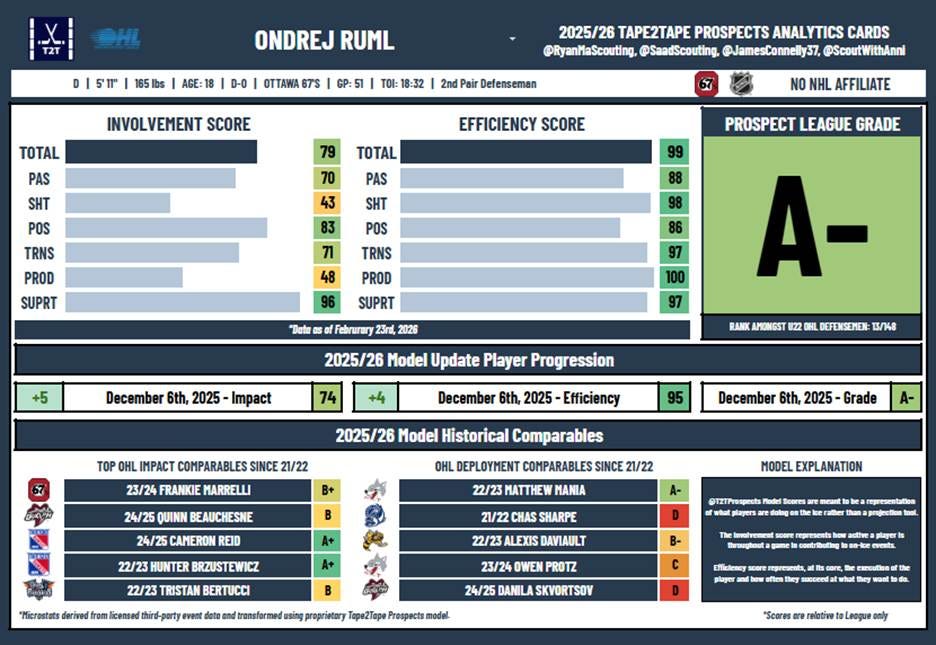
Games Tracked:
03/05/26 vs Peterborough
01/24/26 vs Oshawa
11/19/25 vs Kingston
ELEVATOR PITCH
Ondrej Ruml is an opportunistic, offense-minded defenseman whose aggressive stretch passing, smart off-puck instincts, and ability to find scoring areas make him an entertaining and productive player despite some chaotic tendencies. While his skating base, physical play, and defensive anticipation remain concerns, his active stick, special-teams utility, and flashes of transition creativity give him enough upside to warrant consideration as a developmental bet.
Ondrej Ruml is a guy I really want to like, but I’m not quite sure I’m sold yet…
It’s quite funny because the on-ice results for Ruml are quite good, but I have a hard time connecting the process to the result.
Let’s start with the good.
Ruml is a really fun player. When he sees a chance, he loves to try to bomb these passes up the ice to try to spring his teammates for a rush chance. The success rate is very hit and miss, but after watching three games of Ola Palme, I can appreciate some adventurous spirit, even if a lot of the time the result is the equivalent of a dump-in. It can feel like watching a bipolar poker player at times with Ruml; it’s either all in or a tepid check. No such thing as value betting or raising, it’s either a Hail Mary bomb pass down the ice, or a pass/rim to his defence partner.
He doesn’t do this often, but when he has the puck and is feeling the pressure, there are moments where he can hit another gear to his skating and separate to create some room for himself. The hope is to see this aspect of his game more often in the build-up of play and transition, as it may help create that in-between option on his breakouts that he’s currently missing.
Ruml also really loves these tight turns in close quarters to try and shake coverage in the offensive zone, or when he gets pressured out of the zone. When it works, it looks nice, and he looks like a player who can reliably use it to create space for himself and keep plays alive along the boards. When it doesn’t work, there are some bad turnovers that show up on tape that he’ll want back.
What I can say about Ruml, is that he has a great understanding of finding open ice to create scoring chances. In transition, or in the flow of the offence in the offensive zone, he can get himself lost in coverage, sneak into the high slot and then unleash a wrist shot for a goal. Or he’ll come in as the trailing player in transition and clean up the garbage after a chaotic odd-man rush. He’s got great intelligence in recognizing when he should go join the rush, but also shows restraint in his decision-making on 50/50 pucks when trying to hold the line.
Now the not so good... I don’t love the feet when he’s defending. It doesn’t look like a strong base; he often looks off balance, and I think at higher levels he could get exposed. Just not an amazing natural athlete and the tools are just average.
What saves Ruml is a really good stick that doesn’t get brushed off easily and that he can use to poke pucks away at the last minute. This is key for him, because I do find his play in his own end a little bit reactive at times. Instead of reading where the puck will go, he often reacts at the last minute when the puck ends up on the stick of the opponent in the slot.
I’ve also found that he struggles physically defending the net front. He works hard, but as a shorter defender, he gets worked over easily by bigger players, and you can tell that he begins labouring after some extensive battles in the net front.
All in all, there’s a fun player who reads the play in the offensive zone really well and is a super opportunistic scoring defenseman. There’s a lot of chaos in his breakout game, and I’d like his reads defensively to be more pro-active, but he’s got a great stick and is relied on by his team on both special teams units (as well as baby sitting a D-1 defense partner).
#118 - Alexander Grunin - Sibirskie Snaipery Novosibirsk - LD - MHL
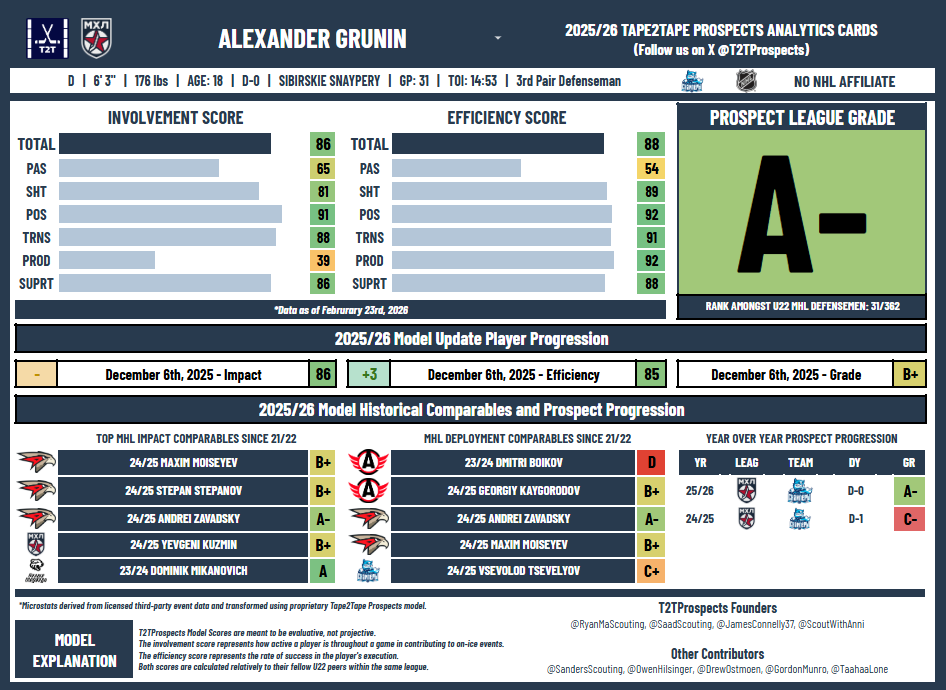
Games Tracked:
03/14/26 vs Krasnoyarski Rysi
02/01/26 vs AKM Novomoskovsk
12/22/25 vs Snezhnye Barsy Astana
ELEVATOR PITCH
Alexander Grunin is a high-upside project defender whose combination of size, fluid mobility, aggressive rush defense, and flashes of puck-carrying ability make him an intriguing developmental swing. His defensive reads, physical engagement, and offensive-zone decision-making remain raw, but the athletic tools and developmental runway give him a chance to grow into a much more impactful player if the processing catches up to the raw tools. Very fun player with a pretty low floor at this stage of his development.
Alexander Grunin is by every word of the definition a project defenseman.
The polish is not there, but the individual tools suggest that there’s a really fun developmental upside to this player. You’re definitely betting a lot on the MHL and Russian developmental program to build him up (which has produced mixed results depending on the team), but Grunin has a lot of the raw tools that NHL front offices will be enthused by, even if his application of said tools has lots of distance to cover to catch up.
The great news for Grunin is that, at his size, he’s very fluid as a skater. He’s got good feet and hips which allows him to challenge defenders aggressively. He leverages this mobility all over the ice, closing gaps along the wall and trying to be a stopper of play in the neutral zone defensively. He gets a bit too aggressive a lot of the time though, he’s trying to be proactive and break up the play or hold the zone, and while most of the time he’s able to get the initial stop, he doesn’t have the overwhelming physicality to win the puck. The secondary battle is often won by the opponent and as a result, he’s thrown his team’s defensive structure into disarray and then has to try and hustle back to relieve his forward that’s trying to cover for him.
I’d also like to see him have better recognition of the play developing in front of him in the defensive zone. There’s times when his line is hemmed in that he defaults to taking away the slot. Instead of closing out to the perimeter player and pressuring them, he tries to take away the slot pass but fails to recognize the off puck players taking advantage of the space at the neat post and goal line.
Defensively, the mobility helps him have a few nice moments on zone exits in terms of outskating pressure and finding clean exits, but I find that in the offensive zone, Grunin struggles with some of his playmaking decisions. He doesn’t have very good pre-scanning habits before passing, and it leads to turnovers at the blueline where he’s flipping pucks into skates. Tons of perimeter, floaty snap shots offensively from him, but when Grunin can walk down into the high slot with some time and space he can absolutely rip pucks. There’s also a few flashes of Grunin showing some flair and swagger with the puck, willing to take open ice in front of him in the offensive zone, but the passing skillset is still a work in progress and means he’s kept the perimeter.
All in all, Grunin is an uber-mobile, 6’4” defenseman who’s got an aggressive mentality defending the rush, and leans on his skating ability to make some splash plays with the puck on breakouts. He’ll need to really improve his play recognition defensively, grow into his frame physically, and learn how to be an effective puck distributor in the offensive zone. He’s got a ton of developing to do, but as a late June birthday he does have the runway to improve. He could end up being nothing more than an average KHL defenseman, but I still think he’s fun and worth taking a chance on at that size and frame.
#119 - Olivers Murnieks - Saint John Sea Dogs - C - QMJHL
Games Tracked:
04/21/25 v Lincoln Stars
ELEVATOR PITCH
Murnieks is a big, role-heavy center whose USHL tape showed a fairly passive, inconsistent game, with only flashes of effective puck support and simple offensive facilitation when given time and space. While he can win faceoffs, break pucks up defensively, and make the occasional smart outlet or delay play, his awkward skating stride, limited engagement level, and lack of consistent impact in all three zones make him more of a depth projection at this stage.
Murnieks made the move to the QMJHL but frankly in the games I watched he just looked like he really struggled to keep pace. After finding out he’d been dealing with an injury for the entire year, I thought it made more sense to put up my write up on his D-1 USHL tape (which I think is the more difficult league to play in anyways).
I had high hopes for Murnieks, given how big of a role he played for Sioux City this year, but given the entire team only had 17 shots, maybe tonight was just an off night. Just a pretty weak performance all around for the LHC, he was decent on the faceoff dot, and his in-zone positioning defensively was fine, but he didn’t look all that engaged in this game. The skating stride looks awkward, not a ton of depth to his stride, but he gets around okay. He had a few nice break-ups in the slot defensively, and I liked his ability to build speed through the neutral zone at times with the puck when he had time and space, but for the most part, I thought he was a pretty passive passenger in all three phases of the game.
There were some positive flashes offensively, he had a nice delay with the puck on a breakout where he was able to evade pressure, buy some time and hit his teammate in motion. There was another play where he warded off pressure from behind the net, played through contact and tucked a pass into the slot for his teammate. When he was engaged along the boards, he was proficient at winning pucks back, but he also had two really rough plays with the puck. One was a really ugly, careless turnover in his own end that caused everyone’s anxiety levels to spike. The other one was in the last minute of the game with a 6-on-5, where he won back a puck and then proceeded to send a pass into the back of his teammate’s skate, which ended up outside of the zone.
#120 - Tyus Sparks - Spokane Chiefs - F - WHL
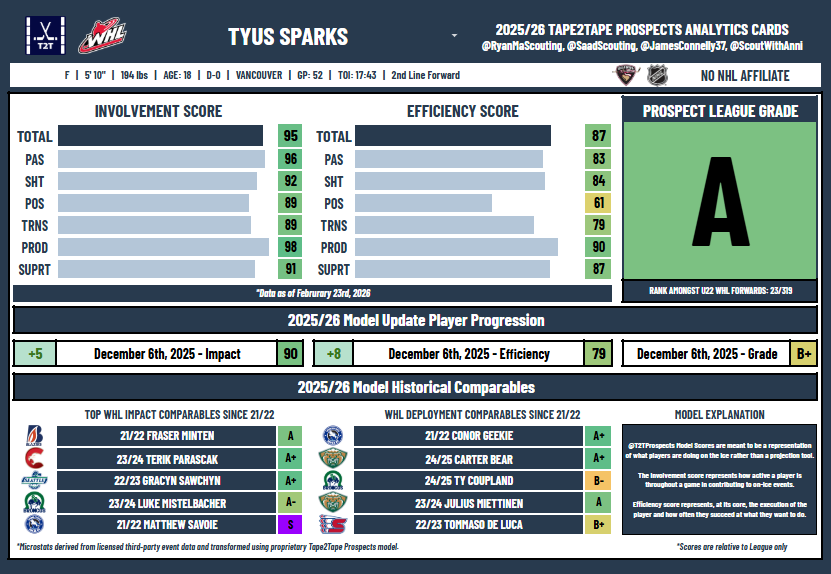
Games Tracked:
03/13/26 vs Seattle
02/20/26 vs Vancouver
01/10/26 vs Victoria
ELEVATOR PITCH
Tyus Sparks is a high-energy winger whose relentless motor, active defensive stick, and flashes of quality transition passing make him an intriguing mid-round developmental option. While his off-puck awareness, anticipation, and puck execution under pressure need significant refinement, the combination of work ethic, straight-line speed, and playmaking instincts means there is a path for him if the details come together.
I like Tyus Sparks, and I think there’s certainly a draftable talent here. He was one of the T2T Model’s bigger WHL score raisers among draft eligibles from December to March. While my first viewing of him against Victoria in January was a bit rough, his games against Vancouver and Seattle give me some optimism that this is a player who’s starting to figure it out.
What’s consistent through all viewings is that Sparks plays with a ton of effort. He’s constantly trying to get to the puck carrier on the forecheck or off turnovers, all over the backs of opposing puck carriers on the backcheck, and he’s got a very good defensive stick that he uses to cut off passing lanes, tip pucks, and hassle opponents. He’s a bit chaotic and all over the place recovering on defence, and he tips and gets his stick on a lot of pucks, but I find that they don’t often result in a change of possession.
David (@SaadScouting) has referenced that he’s not a fan of Sparks’ mental mapping, and I find myself agreeing, especially after his game against Victoria. It just felt like he was chasing the game the entire time. Against another not-so-great team in Seattle, where Spokane controlled much of the game, I thought the issues were less prominent, but there are certainly lots to improve still. Sparks plays more reactively than proactively in his forechecking, reacting very quickly when the puck changes direction to pressure the puck carrier, but his skating when it comes to change of direction is uninspiring. As a good straight line skater, I think better anticipation ahead of time on where the puck COULD go will help him be far more effective than just chasing guys all over the ice.
There are some redeemable traits here, though, for Sparks. I think there are some truly nice ideas with his playmaking, but his hands just need to keep up when receiving and making passes in quick succession under tight quarters. Lots of great ideas, trying to tuck pucks into the slot, but especially when at a standstill, I find he fumbles the puck a lot on passes and shots. Lots of double-clutching and late passes that either split teammates or get blocked and shut down en route.
The passing and overall play in straight lines is encouraging, though. Sparks does a great job using his reach to extend the puck away from coverage and find teammates in transition for exits, and also is a great cross ice and slot passer from his strong side, where he can thread passes through the slot with zip and accuracy. He had two of those plays against Seattle in the third, setting up his teammates for two gorgeous scoring opportunities (one of which was converted for a goal).
I would like him to threaten the middle of the ice; his mould clearly leans more towards a speedy, straight-line playmaker, but I think he can improve his off-puck movement a LOT. Too often, he drifts towards his teammate with the puck in the offensive zone instead of trying to locate open areas of ice to receive the puck. When Sparks does shoot, it’s lots of low-danger perimeter shots that come when he doesn’t see an immediate passing option.
All in all, Sparks is a hard-working, high-energy player who does his best work when the puck is moving forward. The off-puck intelligence needs a ton of work in all three zones, but there’s an interesting project here for NHL teams to take a look at in the 4th Round to see if they can iron out the details and mental mapping.
#121 - Pavel Denisov - Omskie Krylia - LD - VHL/MHL
Games Tracked:
04/12/26 vs HC Yugra Khanty-Mansiysk
01/17/26 vs HC Mamonty Yugry
12/19/25 vs AKM Tula Region
ELEVATOR PITCH
Pavel Denisov is a physically mature, aggressive 6’2” defenseman whose gap control, rush defending, and board play translated reasonably well against men, giving him a credible defensive floor. However, his overly aggressive pinching, inconsistent puck-moving under pressure, and underdeveloped passing game limit his projection, leaving him as a raw, defense-first project worth a mid-round developmental swing
Pavel Denisov was someone I had really high expectations for given his stretch of VHL games at 6’2”.
While I left the viewings ultimately slightly underwhelmed, I think there’s a boardable talent here.
Denisov’s physicality and physical traits stand up to the test of a men’s league. He doesn’t look particularly out of place, doesn’t get pushed around easily, and will play with an edge. He boxes out the net front pretty well in his own end, and there’s good enough skating for him to hang at the NHL level if he ever gets there.
Denisov is a very aggressive player who tries to jump up and pinch really high up the ice to try to kill plays along the boards. It’s a little bit aggressive for me, especially given his ability to actually kill the play and turn the puck over is very hit or miss. However, when he’s not recklessly triggering up ice to lay a hit, I find his ability to defend rushes and maintain gap discipline at the blueline is very good. He ushers players wide and then closes them off along the boards.
In his own end, it can be a bit much for Denisov at times. He leads with physicality along the boards, leaning on guys, trying to get his shoulder to wedge players off the puck, but when the puck starts moving around from side to side and the play gets a bit scrambly the feet stop moving and he can get lost. When he’s locked in, Denisov is a very capable defender that can start and stop with forwards out on the perimeter and use his long reach to disrupt plays.
In the offensive zone, Denisov has flashes of being a self creator but hasn’t unlocked the passing to be a truly effective offensive zone weapon. Loves to shoot the puck when he gets it with some space at the offensive blue line, and there are some moments where he will side step a close out from a defending opponent and drive it down towards the slot. Unfortunately, the passing intelligence remains a work in progress and he’s not really someone who can drive in and find a pass, instead he’ll hang onto the puck for too long and get funneled outwards.
The defensive zone breakouts are also not super amazing which is why his final ranking will lag behind a guy like Marthaler. He struggles to make plays on breakouts under pressure, and in the VHL he looks to be heavily sheltered in that aspect. They don’t ask him to do too much on break outs, and so his breakout reps are often when there’s minimal forecheck pressure and lots of space. When that is the case, Denisov can hit some nice stretch passes, but overall the passing skillset is a work in progress.
All in all, Denisov is a raw athlete who has a good base for rush defense and one-on-one defending, but will need to dial back his aggressiveness. The play with the puck as a playmaker and decision maker will need to improve, but he’s held his own in his games at the VHL level and while he’s far from a perfect player I think he’s worth a late 4th Round investment.
#122 - Eelis Uronen - HIFK U20 - LD - U20 SM-sarja
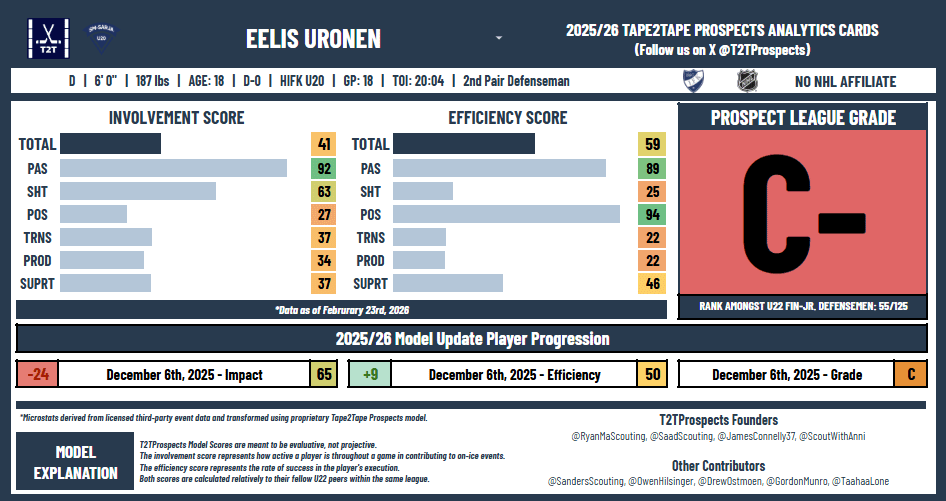
Games Tracked:
04/24/26 vs Latvia U18
11/21/25 vs KooKoo Hockey
11/14/25 vs Kiekko-Espoo U20
ELEVATOR PITCH
Eelis Uronen is a poised, methodical 6’1” Finnish defenseman who plays a calm, structured game with decent puck-moving instincts and the confidence to execute under pressure. While his lack of high-end athletic tools and average pace limit his ability to consistently create separation or defend higher end skaters, his defensive positioning, mobility flashes, and composed breakout game give him a chance of developing into a depth NHL option with time.
Eelis Uronen is your classic Finnish defenseman.
He’s got a good frame at 6’1”, he’s a very calm and poised player with the puck, and just very methodical.
I think that while there’s not enough that excites me, and there are a few hang ups I have with the player, this is definitely a player I could see surprising me down the line and getting a cup of coffee someday in the NHL.
Uronen is a generally pretty vanilla player, but there are some truly nice moments of confidence on the puck. He’s mobile and willing to skate it out from behind the net in order to create zone exits with his feet, and without the puck he activates very well, jumping up into the rushes and getting down towards the weak side.
In the offensive end, I also think he does a good job mixing up his plays with the puck. He’s capable of just making the simple plays, the usual D-to-D pass, a dump down the boards, he’s just not really a player who gets flustered and speeds up under pressure. He’s very comfortable staring a forechecker in the face as they bear down on him with his back to the offensive blueline and saucing a pass just past the stick even if watching it does give me a heart attack. On the other hand, there’s also a willingness from Uronen to pick his spots to attack downhill with the puck, usually when he thinks the defender is coming at him off balance and he has a chance to get a step on him. Unfortunately, Uronen is not the greatest athlete and so he struggles to really create and maintain seperation.
I do think the pace and decision making speed could be better. For a player who doesn’t really try to really move the defense with lateral movements, head fakes and cross seam passes I think I’d like Uronen to move the puck way quicker in the offensive zone. Eventhough he didn’t get punished for his pace in the offensive zone in my viewings, I wouldn’t be shocked if it did, because he did have a couple of gaffes in his own end when trying to break the puck out. He needs to learn to make plays quicker and stronger, there were a few times where he just got his stick tied up on a breakout attempt because he was guilty of not making the quick play out of the zone when he had the chance.
I did think Uronen did a good job defensively for the most part. He uses his body well to gain leverage and push guys towards the walls and the perimeter instead of letting them work their way into the slot when defending in-zone. I would, however, really like to see him try and utilize his mobility more when defending the rush. He gives up too much ground at times, gives up the angle and can get beat wide pretty easily.
All in all, Uronen is a smart, poised player who doesn’t necessarily have the most amazing tools to execute all the ideas he has but there’s a fundamentally sound player with a good pro-sized frame to fill into. He’s also pretty young as a June birthday and there’s some fun moments with this player but he’s far from a sure thing.
#123 - Thomas Rousseau - Sherbrooke Phoenix - RW/C - QMJHL
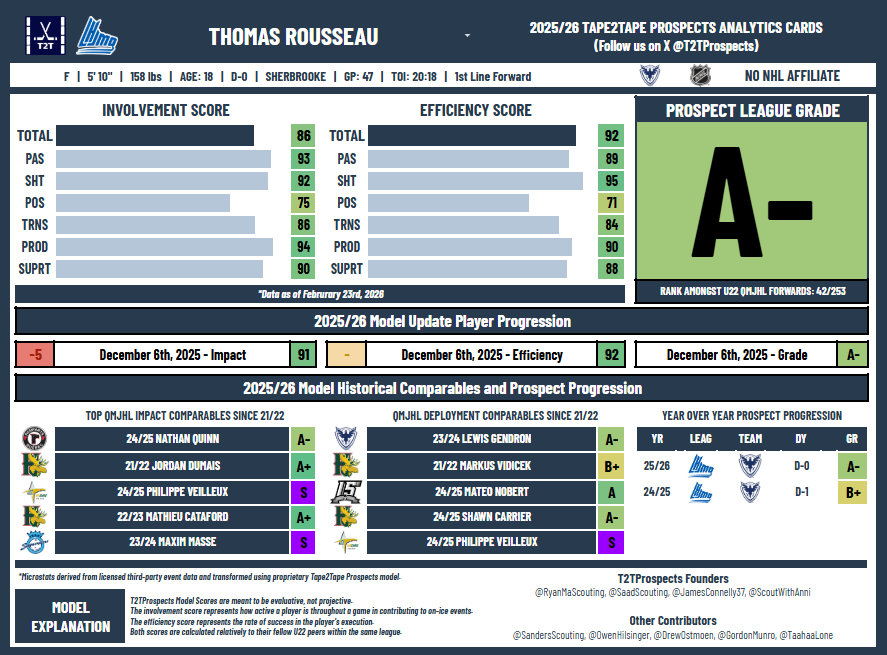
Games Tracked:
04/03/26 vs Shawinigan (Playoffs)
03/15/26 vs Quebec
02/01/26 vs Halifax
ELEVATOR PITCH
Thomas Rousseau is a high-effort, detail-oriented winger whose value comes from forechecking, defensive engagement, and net-front battles rather than high-end skill or transition creation. While his skating and puck skills are fairly average and limit his ability to drive play or consistently attack the middle of the ice, his work ethic and willingness to do the defensive and supporting tasks suggests there’s at least a complementary middle-six support forward at the NCAA level and some optimism that there could be an NHL future if his development goes perfectly.
I can appreciate some good old Thomas Rousseau puck. It’s an honest, hardworking style of puck in a league in the QMJHL that needs more players like him.
Rousseau breaks the mould of most high-end T2T Model scorers in the QMJHL. His game is not bookended by flashy plays off the rush or an uncanny ability to exploit the time and space that is available to him in the QMJHL. Rather, he’s a player who flashes on your screen because of his willingness to forecheck hard, to really get out defensively to challenge shooters, and hound opposing puck carriers on the backcheck to try and win pucks back.
The work ethic and commitment to doing the small, less glamorous, difficult areas of the game are what draw me to Rousseau. He’ll battle in his own net front, cross-checking and trying to move players away from his goalie, and he’ll come down to help break pucks out instead of flying the zone looking for a transition chance.
Unfortunately for Rousseau, the high-end skill and skating are just not really there. When Rousseau carries the puck into the zone, he’s rarely looking to attack or create an advantage for himself to get to the inside. Lots of looping back towards the blueline to try and settle the play down and find teammates. His passing is also pretty direct; he sees open lanes and passes into them instead of looking to create passing lanes with his eyes or movement. The puck skills are average, and he doesn’t always handle pucks the cleanest, sometimes fumbling passes or leaving the puck behind when going to pick it up.
I think Rousseau certainly has the work ethic and off-puck skills in terms of finding space for himself without the puck, but I just wonder how high the ceiling is with a player like him. In a league where there’s not a supreme focus on defence, and the higher-end players can exploit a lacklustre defensive structure with relative ease, Rousseau’s unwillingness or inability to be a playdriver worries me when looking at his future outlook. If he’s already a complementary skillset forward player at the QMJHL level, are his off-puck details and athleticism good enough for him to bring the same amount of impact at the pro level?
Rousseau screams of a player who will move to an average NCAA program in the next few years and excel in a middle-six role as a supporting player on a line with more impactful creators. I think there’s enough to like to rank him alongside the other complementary forwards I like which makes this the perfect range for him.
#124 - Nikita Ovcharov - Quebec Remparts - LW - QMJHL
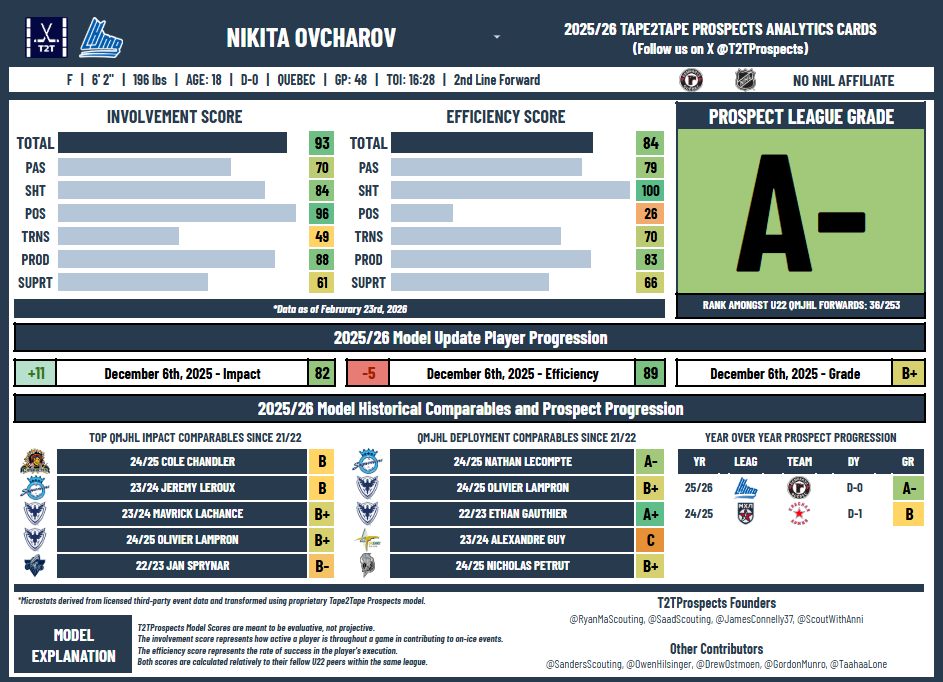
Games Tracked:
04/11/26 vs Chicoutimi (Playoffs)
03/15/26 vs Sherbrooke
02/19/26 vs Baie-Comeau Drakkar
ELEVATOR PITCH
Ovcharov is a straight-line, effort-driven depth projection whose value comes from his work rate, net-front presence, and active defensive stick. While his stiff lower-body mechanics, limited agility, and passive offensive engagement cap his upside, he still shows enough translatable habits and occasional flashes of puck skill to justify a mid-round developmental flier.
Ovcharov is a pretty straightforward projection bet for me at this stage. There are a couple of translatable habits and some decent tools that make him worth tracking later into the draft, but overall I thought the limitations in his skating mechanics, offensive involvement and processing pace capped the upside pretty significantly.
The biggest issue with Ovcharov for me is the lower-body mechanics. He’s a pretty stiff mover and the balance can get rough at times, especially when plays become more reactive or require quick changes in direction. In straight lines, the skating is honestly decent enough and he can build okay speed through open ice, but once he has to stop and start, mirror attackers or react quickly defensively, things start to fall apart a bit. There were multiple sequences where he’d aggressively trigger outward to pressure a puck carrier only to immediately get sidestepped because his feet just couldn’t stop and redirect quickly enough afterward.
Defensively, I actually thought the effort level itself was fine. Ovcharov works hard closing out on opponents and showed an active stick trying to take away passing lanes while pressuring the puck carrier. The problem is that the mechanics and awareness don’t always support the aggression. One sequence that kind of summed him up for me was him EXITING the defensive zone entirely after attempting to close out on a point shot, only for the play to continue developing behind him. There are definitely moments where the reads, recovery instincts and tools just lag behind the effort.
Physically, I thought he was at least willing to engage. He’s not a punishing player or anything, but there’s decent enough physicality here and he’ll finish checks or lean into contact situations along the walls. Combined with the straight-line speed, that at least gives him a workable baseline for a bottom-six style projection.
Offensively though, I found him a bit too passive. Ovcharov doesn’t really look like a player actively demanding touches or driving possession consistently in the offensive zone. A lot of his game revolves around supporting plays underneath the puck, getting to the net front and making simple connective touches rather than actually creating offense himself. In transition, he showed some okay short-area passing ability from the half wall into supporting teammates to keep play moving north, but nothing especially dynamic.
When he does get time and space with the puck, there are at least occasional flashes of skill. Maybe once or twice a game he’ll confidently carry the puck through the neutral zone, cross the offensive blueline, attempt a move and fire a shot from distance. The hands themselves are honestly decent enough in controlled situations and there were also a few nifty little passing ideas in tight areas below the goal line where he’d quickly slip pucks into dangerous spots for teammates. Those flashes are intriguing enough that I don’t think the offensive skill is completely nonexistent.
The problem is that he just doesn’t seem to actively want the puck enough offensively. Too often he’d defer immediately after entering the zone or settle into a support role around the perimeter and net front rather than trying to consistently attack with the puck himself. Even when he got to the net front effectively, which he actually did quite often, his role was strictly screener more so than being a real option to receive the puck maybe to the side of the net.
That passive playstyle makes his projection difficult because there isn’t really one standout tool driving the profile. The skating has limitations, the offensive creation is pretty minimal and the defensive reads are inconsistent despite decent effort. At the same time though, there are enough small translatable habits here with his straight-line speed, active stick detail, willingness to get to the crease and occasional flashes of puck skill that I think I’d be ok taking a late round flyer on him.
All in all, Ovcharov feels like a raw depth projection whose value currently comes more from effort, straight-line pace and supporting habits than actual offensive play-driving. The skating mechanics and lack of offensive assertiveness caps his upside pretty substantially, but there are just enough flashes of skill and competitiveness here that I’d still keep him on the radar at this point of the draft.
#125 - Danil Sysoyev - Stalnye Lisy Magnitogorsk - C - MHL
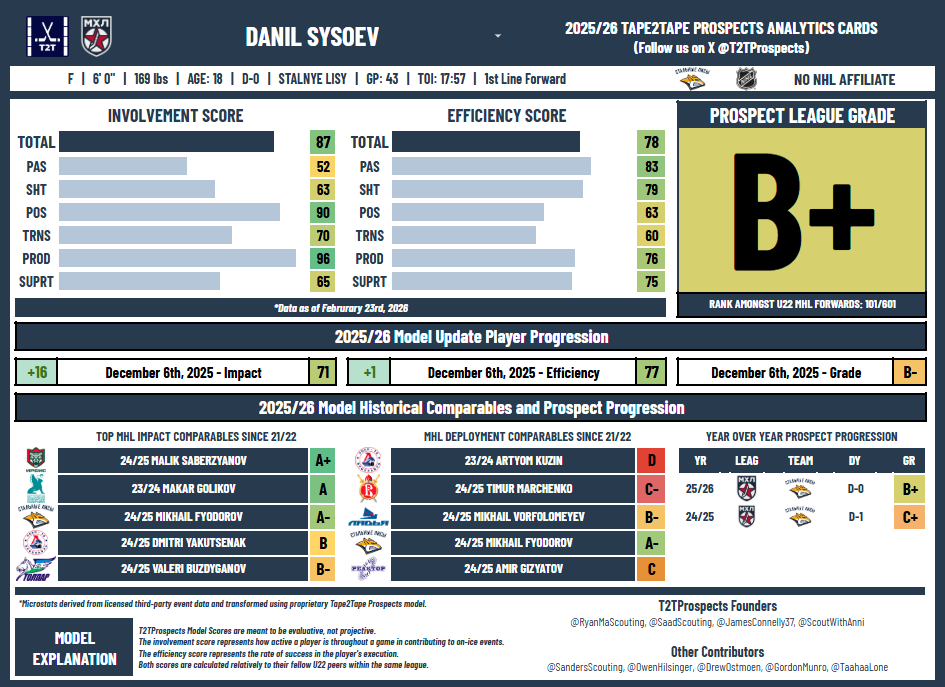
Games Tracked:
04/14/26 vs Avto Yekaterinburg
03/14/26 vs HC Mamonty Yugry
02/21/26 vs Loko-76 Yaroslavl
ELEVATOR PITCH
Danil Sysoyev is a pro-sized centre with solid passing vision, decent puck skills, and responsible defensive positioning that give him a chance of becoming a two-way depth projection. However, his lack of pace, inconsistent motor, limited physical engagement, and absence of explosiveness or agility make it difficult to project him confidently, leaving him as an intriguing mid-round investment.
I like Danil Sysoyev but I think after watching him I’m ultimately left wondering what his role in the NHL will be.
There’s certainly a lot of things to like, Sysoyev’s got an NHL frame and plays C, and that be default will get him some looks from NHL teams. I think he’s got really nice passing vision from the half wall, looking to get pucks cross seam when set up in the offensive zone or into the slot. There’s a good hard shot that he wields, and he’s even for some nifty moves off the rush where he’ll try to take guys on and then look to work the puck to his teammates in the slot.
The fundamentals are all there for Sysoyev, who also is a positionally sound defensive player who gets to his spots and comes down low to support his defensemen. Again, there’s certainly laudable traits and that makes him a player I think a team should be willing to make an investment on. However, on the other hand, if his potential projection at the pro level is one of a more defensive-minded, playmaking, two-way guy I’m not sure Sysoyev has the pace, physicality or the motor to play that role.
Sysoyev uses his upper body way too much when trying to win battles on the forecheck. He’s trying to lean into guys and take the body with the hopes that he can rub them off track and tie them up along the boards. He needs to learn to use his stick more effectively in these spots, a lot of the time he just flings his stick out there, but he needs to use it more pro-actively to try to attack the puck carrier’s stick or lift it. He’s also just bullied really easily along the boards all over the ice and lacks that edge and physicality to handle the more physical dilemma’s thrown at him.
I think the skating is good enough, but as I’ve mentioned the motor is very hit or miss, especially on the backcheck as a C. He’s just lacking that tenacious effort level I want to see from a player of his mold. He’s got a super wide base, and is very patient with the puck in the neutral zone, willing to slow things down and circle back, but it means that he’s not really a super pacey player either. His skating allows him to keep up, but there’s no explosiveness or agility or change of pace. He’s just a very linear pace player with the patience to wait for openings and then try to use his hands to work through it. The success rate is very much hit or miss there and when he has the puck in the offensive zone there’s also lots of plays where he’ll glide from down low, move back to the blueline with the puck before cycling it back down low or passing it to his defenseman in the center lane.
All in all, Sysoyev is a pro sized C with good defensive details and a good amount of puck touches and passing ideas. He’s missing the work ethic, physicality and pace to his game that will allow me to project him to the next level, and while he’s willing to attack with the puck when gaps open up, he’s not a particular dynamic or elusive player in that facet of the game. An interesting dart throwfor sure at this stage of the draft.
#126 - Max Laatikainen - Kiekko-Espoo U20 - RD - Liiga/U20 SM-sarja
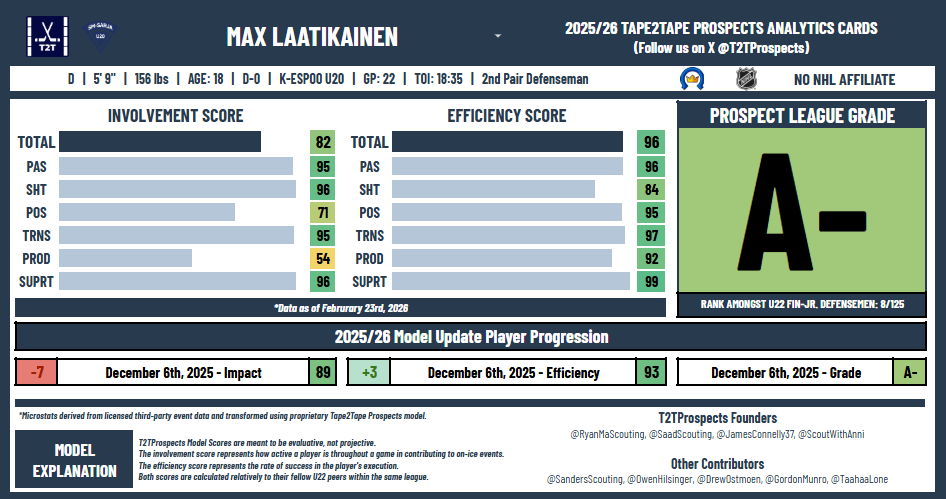
Games Tracked:
04/22/26 vs Norway U18
12/27/25 vs TPS
12/13/25 vs Pelicans Lahti
ELEVATOR PITCH
Max Laatikainen is a calm,Liiga defenseman who plays at his own pace for better or for worse. His appeal is mostly tied to his composure, short-area passing, and defensive “keep everything in front of him” habits rather than any real standout tools or offensive dynamism. He projects more as a depth, systems-dependent defender whose North American future hinges on whether his passing touch and internal clock can sharpen enough to survive higher-pressure environments.
Max Laatikainen is just a chill guy.
The 5’11” defenseman, for good and for bad, plays at his own pace regardless of the pressure that swirls around him. He’s just a chill guy. What makes me nervous about Laatikainen’s projection given this playstyle of staunchly staring into the face of pressure with a blank face is that while he’s a good skater, he’s not a guy with amazing top speed or explosiveness to skate his way out of trouble. If you were to ask me, the skating and overall movement skills are JUST good enough given his size.
Laatkainen’s puck movement is all about short area passes, and making them look smooth. He plays at his speed, and he’s a very smooth looking operator from the back end, just doesn’t look fazed at all, you’d almost call him non-chalant at times with the puck. He loves that “look right, pass left” cross body play on breakouts when he can skate the puck out from behind the net in the build up of play.
Unfortunately, there are a lot of passes of his that bounce of his teammates stick, and so if he’s going to invite pressure with his slower build up pace, I think there needs to be improvement with his touch on passes so that if he beats that first layer of pressure, his teammates can actually benefit from it.
Laatikainen spent much of the year hurt, but he clearly has some fans in the org, playing a ton of Liiga games in his very shortened season. After coming back, I thought there was some more fun tape for Finland at the U18s. Just a higher level of confidence to jump up into the play in transition and he even had a nice play where he activated down the wall, got the puck, deked past a defender into the slot before trying to find his teammate backdoor.
Most of the time however, Laatikainen’s offensive zone contributions were predominantly about sifting point shots on net. It’s not a super accurate shot he can use to pick corners as a goal threat, or a super hard shot for that matter, but I think he does a good job sifting it through traffic and allowing his teammates to try to get a piece of it.
Defensively, Laatikainen is all about keeping the play in front of him. Given his smaller frame, he’s never going to be a guy who can step up at the line and just kill rush chances, and it’s clear he’s playing a more prevent-style of rush defense that prioritizes not getting beat inside. However, I do think he maintains a good job, and exerts enough pressure that he can discourage opponents from trying to drive the puck towards the slot on him.
All in all, Laatikainen is really quite vanilla, and there was 100% a world where he might’ve ended up in the honourable mentions range. Luckily for Laatikainen, while his tape wasn’t the most inspiring, there’s something to be said about a player who was literally a week away from being in the 2027 NHL Draft holding his own in Liiga. Would I be shocked if Laatikainen spent the rest of his career in Finland and never got the call to come to North America? Not really, but there’s a TON of development runway left for him and he’s clearly got people who believe in him at his club and will give him every opportunity to become the best version of himself that he can be.
#127 – Braidy Wassilyn – London – LW – OHL
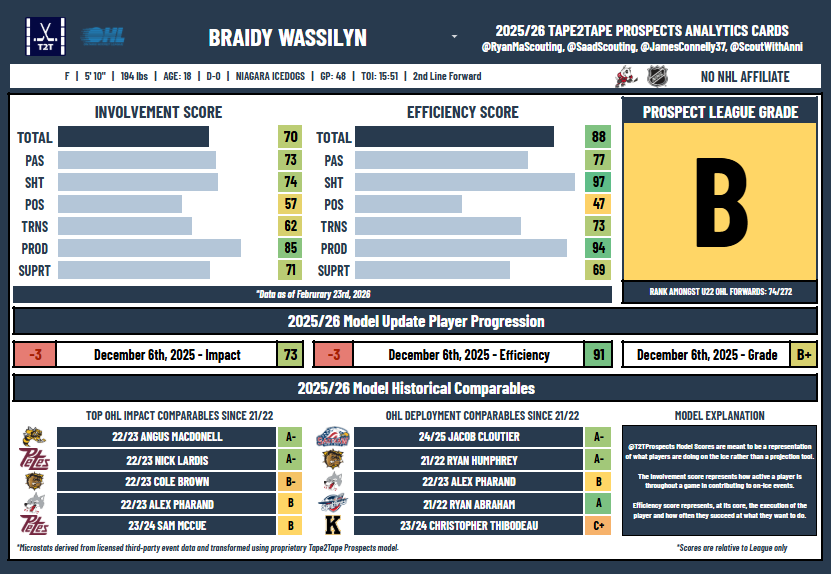
Games Tracked:
03/20/26 vs Windsor
02/22/26 vs Sudbury
01/23/26 vs Sarnia
ELEVATOR PITCH
Braidy Wassilyn has real high end finishing ability with a quick-release shot and slick hands in tight, but his disengaged off-puck game, struggles along the boards, and inconsistent competitiveness make him more of a fourth-round boom-or-bust scorer than a reliable two-way projection at this stage.
I’m kind of out on Braidy Wassilyn compared to consensus.
He has the Boston University Commitment for next season, but I foresee there being a ton of growing pains for him to get ice time in college if his tape this year has anything to say about it. I think he’s actually probably better off staying in the OHL if that’s an option for him.
Let’s start with the good. Wassilyn has some fun traits and undeniable skills. There’s a shot that is lightning quick; he can shoot it through traffic, and it’s compact enough that he can curl and release through defensive coverage and sticks. A few very nice slot goals this year, where the puck was off his stick in a flash before going top bins. The hands and skill also flash in and around the net, with quick successive dekes in tight before tucking it in, and a few plays where he’ll finesse pucks through sticks to find a teammate. Wassilyn is a very dangerous player with the puck when he gets around the net, and he can let his hands and shot work their magic.
The issue for Wassilyn has been the other facets of the game. Of late, he’s tried to round out his game a bit more. You’ll get a bit more intent and physicality on the forecheck, where he’ll finish the play with a shove or a hit. Unfortunately, the plays where he gets in quickly and can actually make a play on the puck are far and fleeting. Elsewhere off the puck, Wassilyn really is a guy who just coasts in and out of the game and while I think the skating is just ok at his size, if he would show more energy without the puck and a more willingness to apply himself to the effort plays and 50/50 pucks, there could have been a player that snuck into that Top 96.
His play in the cycle game is honestly pretty weak; he struggles to protect the puck, and the boards are honestly his worst enemy. He gets sealed off super easily, whether it’s on entries or below the goal line. Wassilyn hasn’t really developed a plan to handle physicality along the boards. He doesn’t keep his feet moving under duress along the walls and will either bail out on entries with a dump-in, or get boardplayed and lose the puck.
In the defensive zone, again, a lacklustre effort. Doesn’t fly to the boards to help his defensemen on exits, and honestly, too much standing around waiting for the puck to find him so that he can break it out. There’s some nice quick connective passing in the defensive zone and neutral zone to get pucks out, but frankly, the off-puck game is just so disengaged for the most part that there’s not much to sugarcoat.
All in all, Wassilyn will be a good junior hockey player. He has the skating and physical tools to translate to the pro level, and I think there’s some really nice short-area plays all over the ice, but his game needs a lot of growth everywhere else from just a competitiveness perspective. A 4th round guy for me, but he’s not without some redeemable traits.
#128 - Max Isaksson - LW - Vaxjo U20 – U20 Nationell
Games Tracked:
09/14/25 vs Rogle BK U20
10/11/25 vs Frolunda HC U20
01/31/26 vs Sodertalje SK U20
ELEVATOR PITCH
Max Isaksson feels like a very structured,dependable two-way winger whose value is built on positioning, simple puck movement, and stick detail rather than any real ability to consistently tilt the ice or create inside pressure. The skating and defensive habits keep him playable, but the lack of middle-ice threat and limited offensive creativity make it hard to see much more than a safe European pro.
I’m still hunting for the Max Isaksson game that will corroborate his score in the @T2TProspects model and in Tony Ferrari’s Top 32 Ranking from December.
I just don’t see it with this player.
Maybe I’m picking bad games, or I’m just not appreciating the simplicity of his game, but that is exactly how I would describe Isaksson.
There just isn’t a whole ton happening on the ice with him in the three games I watched. The skating looks good, but it’s not anything special per se, and I haven’t really seen the impressive grit or motor that I’ve seen circulated.
Isaksson’s stick is his main weapon. He’ll chop at pucks in the defensive zone to try to clear it, and going into board battles, he goes stick-first instead of trying to move the other player off the puck with his body. I actually don’t see a super amazing defensive player here, which is another aspect of his game I’ve seen lauded.
He’s in position most of the time, and I can appreciate his ability to support his defenders in moving pucks out of the zone, but I just haven’t seen him make the hard plays along the boards and in passing lanes for me to consider his play in the defensive zone a strength. Offensively, in my viewings, just too much perimeter passing. I guess he’s a good connector of play in the offensive zone, but it’s just a lot of passes down low, and back to the point… he just doesn’t threaten the middle of the ice enough at all.
As a left-hand shot, he’s on his off-wing a lot, but I haven’t seen him just cork a one-timer very much. When he does decide to let it go, however, it is a bullet. His shot doesn’t need a whole lot of wind-up, and it gets off his stick with good velocity.
All in all, there’s a good European pro here at the very least in Isaksson. He skates well, has good fundamentals, and he’s a positionally sound player who knows where to go on the ice. I wonder about the upside of the player, who to this point hasn’t really shown me an expanded toolkit of skills that suggest there’s more than meets the eye.
HONOURABLE MENTIONS (RNK #129 - #171)
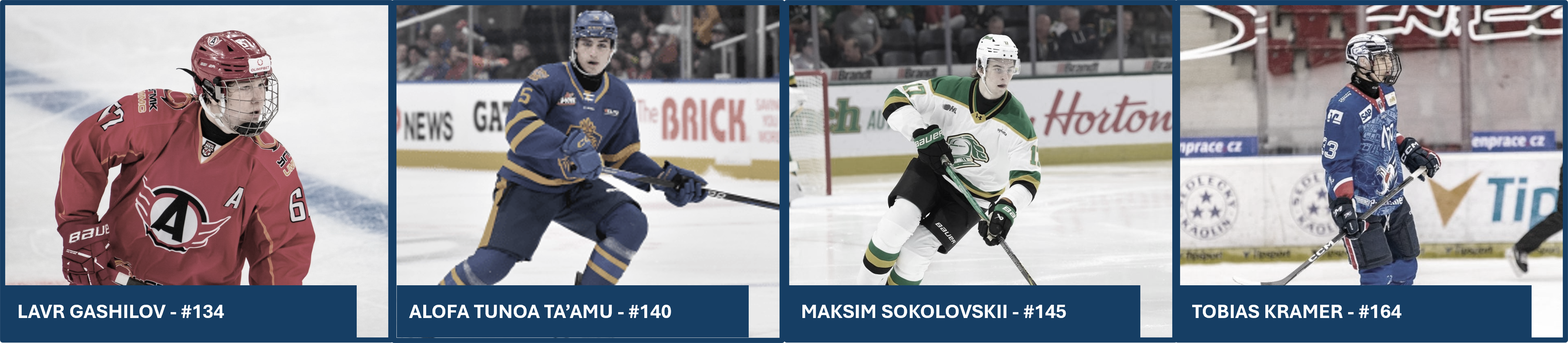
#129 - Adam Nemec - Sudbury Wolves - F - OHL
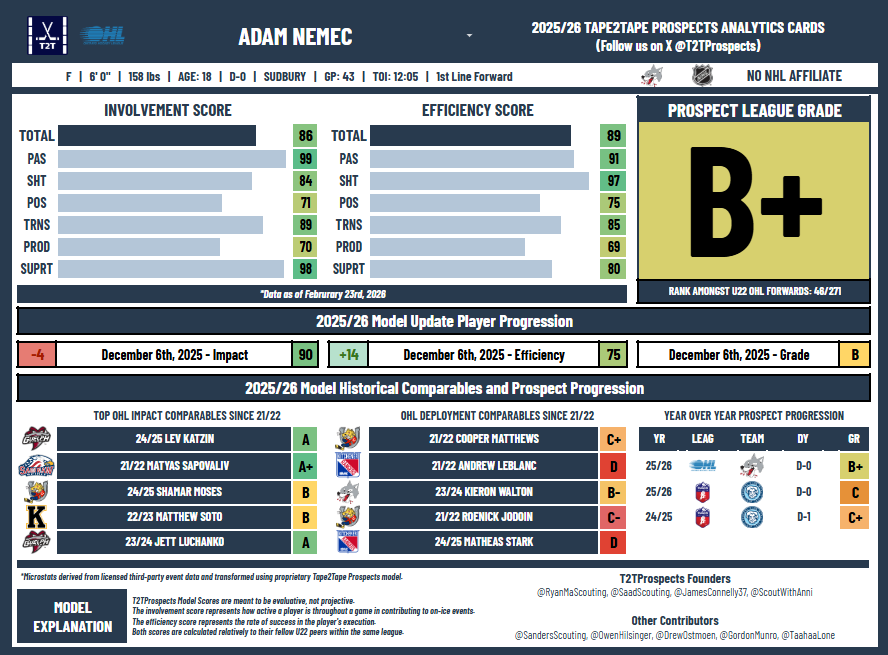
Games Tracked:
03/27/26 vs Brantford (Playoffs)
03/06/26 vs Oshawa
02/01/26 vs Ottawa
ELEVATOR PITCH
Adam Nemec profiles as a pass-first, transition-oriented winger with strong cross-ice distribution and PP vision, but the limited skating, pace, inconsistent engagement off puck, and lack of sustained play-driving ability make his impact feel situational rather than projectable.
Adam Nemec was a potential 1st Round pick in a lot of “way too early” mock drafts (including my own), but his development and play this year fall painfully short of expectations.
Nemec is 6’1”, has experience playing pro hockey in Slovakia but even then, the games I’ve watched of him this year with Sudbury of the OHL lead me to believe I’m not in line with consensus rankings, which usually have him as a fringe Top 64 player in the class.
It’s a mixed bag with Nemec, who I don’t think has any glaring weaknesses to his game, per se, but I really struggle envisioning exactly what he will do at the NHL level someday if he were to make it. Nemec’s best work is done with the puck when he’s moving forward. He makes tons and tons of cross-ice passes in the neutral zone, in the offensive zone, on the power-play, and on power-play zone entries. He does a great job of getting the puck to his teammates on opposite wings, to give them space to try to exploit the defence.
That’s Nemec’s most outstanding trait, but I find that these passes come more from happenstance with quick reaction plays when the puck ends up in his possession. Nemec wants to make quick passes, but I think he’s not super comfortable making plays through traffic or contact. There are times when he feels the pressure bearing down on him, and he makes these super lazy, risky, no-look passes that get picked off.
This kind of playstyle just hasn’t really worked out for Nemec, given his foot speed. He doesn’t have great top speed, he doesn’t start and stop well, and so while he likes playing a more high-tempo, pass-and-go kind of game, I don’t think he can play at high enough speeds to be an effective off-puck player.
Defensively, I think he’s a bit too soft on pucks in the neutral zone and on the forecheck. He’s positionally sound, but he doesn’t fully commit to going for pucks and would rather just stay above the puck carrier, providing minimal pressure outside of waving his stick in the general vicinity. There are moments after offensive zone turnovers or when he’s within proximity of a defender trying to break the puck out, where Nemec has flashes of aggressive stick lifts and a willingness to make some of the hard plays, but it’s often just a flash in the pan.
Nemec gets out to take away perimeter shots, and he gets into enough board battles, but there’s just not enough all-around industriousness and energy off the puck defensively, nor the high-end play off the puck as a shooter in the offensive zone. The connective playmaking flashes to spring teammates in transition or to find cross seam passes in the offensive zone on the power play are really quite nice, but I’m left wondering if that one skill is enough. For me it’s not, and that’s why he’s in my Honourable Mentions.
#130 - Nate Yellowaga - Red Deer Rebels - LD - WHL
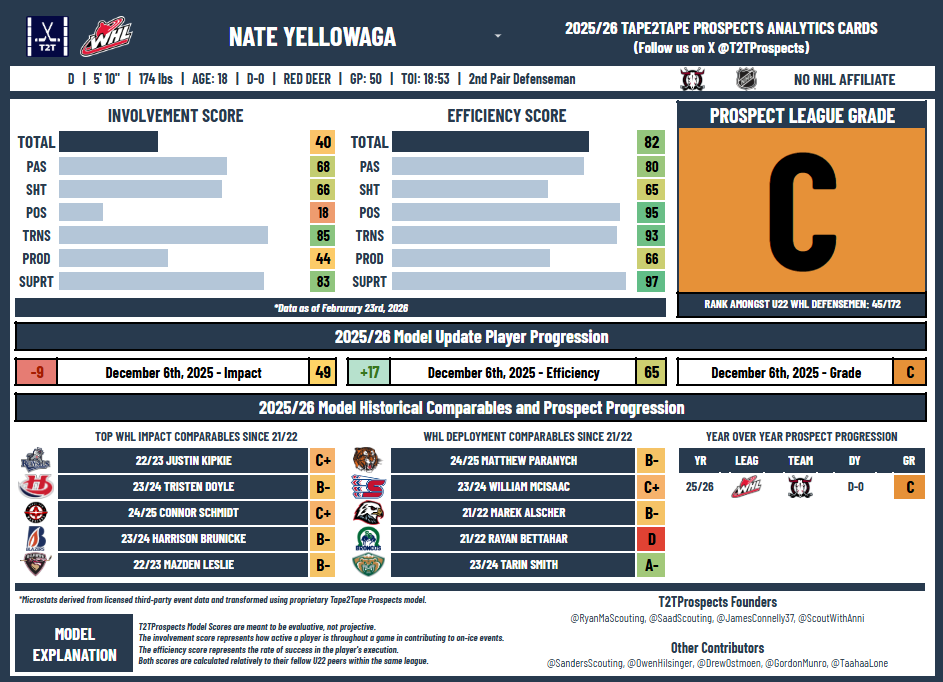
Games Tracked:
04/01/26 vs Prince Albert (Playoffs)
03/04/26 vs Saskatoon
02/16/26 vs Medicine Hat
ELEVATOR PITCH
Yellowaga is a smooth, transition-driven defender with clear puck-moving upside and strong evasive skating under pressure, but the inconsistent defensive engagement, mixed reads in coverage, and overreliance on reach-first defending keep him firmly in the developmental dart-throw category.
For transparency, I added Yellowage to my viewings because I saw significant late-process hype for him from several people. My mindset was, if I’m going to watch and write about 170 people, might as well make it 171, right?
Yellowaga is one of those players I can understand people getting intrigued by because the skating base and puck comfort are pretty obvious right away, but the defensive engagement and processing still feel a long way off for me. There are some genuinely exciting transition flashes here and enough mobility to justify a late-round swing, but the defensive habits make him more of a mid to late-round project than a hidden gem.
The biggest appeal with Yellowaga is how smooth he is with the puck. He’s very comfortable handling pressure, and there are flashes where he can really explode through space offensively. Off the rush, he showed some nice ability to slice through defenders with quick changes in directions and small bursts of explosiveness. Against set defences, though, he struggled more to consistently attack inside ice and create advantages when he couldn’t just weaponize his skating.
I also liked how calm he looked, managing pucks at the offensive blueline. He handled pressure pretty well, trying to hold the zone and didn’t panic when defenders closed on him quickly. On retrievals, the puck confidence flashes too. He’s comfortable spinning away from pressure in the corners and buying himself extra time before making plays. Below the goal line defensively, there were some nice quick-touch passes behind the net to get the puck out, and he looked very poised with the puck on his stick. Combined with some crisp breakout passing, there’s definitely a foundation for a transition-focused puck mover here.
The issue is that the defensive game still needs a lot of work.
In-zone defending was below average for me... just way too much standing around and watching the play develop. On breakouts, especially, I wanted way more proactiveness from him, considering how well he skates and how effective he is when he gets the puck in those spots. Unfortunately, too often he’d simply stay stationary higher in the zone instead of coming down low to support his defence partner on retrievals.
Man-on-man defending was probably the biggest concern for me. He reaches way too often with his stick and can get overeager trying to take the body in open ice, which leads to him getting blown by pretty easily. There were also multiple sequences where he got his coverage assignments mixed up, trying to hand plays off once attackers got past him. At the blueline, I did at least appreciate that he tries to play aggressively and step up early, but the reads and execution just aren’t consistent enough yet.
Overall, Yellowaga feels like a dart throw type of pick where you bet on the skating, puck handling and transition flashes, which are good enough to keep him on the radar. However, the defensive awareness and engagement level still need a lot of refinement. Top 135 for me, and I like him more than guys like Laylin and Thompson in terms of translatability, but he’s got more than his fair share of warts in the defensive end.
#131 - Alexander Ivanov - Bars Kazen - LD - VHL
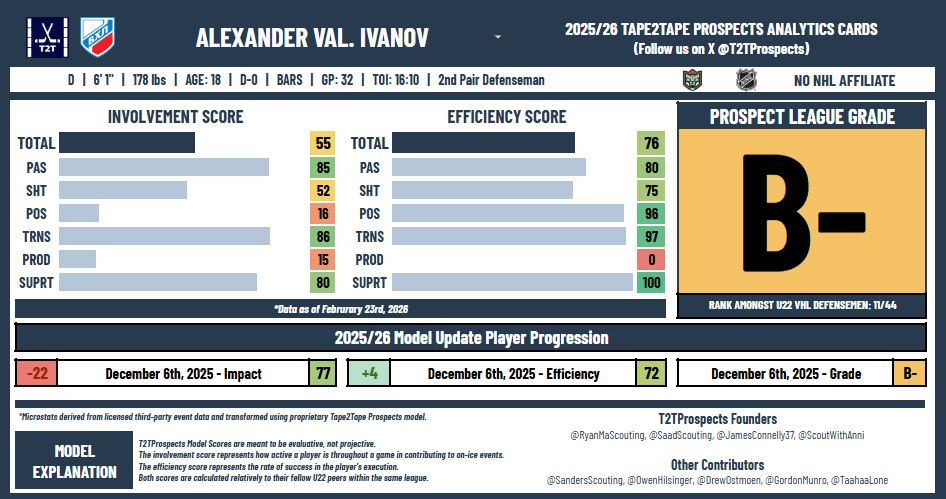
Games Tracked:
03/16/26 vs Rubin Tyumen
01/24/26 vs HC Sibir Novosibirsk
01/07/26 vs HC Dynamo Saint Petersburg
ELEVATOR PITCH
Alexander Ivanov is a physically mature, defense-first VHL depth defender who projects primarily as a player who leans on his length and physical maturity to play a shutdown role, but his limited puck confidence, underdeveloped breakout decision-making, and generally uninspiring offensive involvement make him more of a long-term projection.
Alexander Ivanov is a tough one to asses because I think there is a value to a player stepping up into a decent men’s league for a whole season (even if it’s just the VHL) and holding their own.
Ivanov’s tape is pretty uninspiring, and off of raw film alone, I don’t think I like him as much as some other of the lower end defensemen I’ve watched this year, but factoring in that he’s playing a sizeable role in the VHL this year, I do think that he deserves more of a benefit of the doubt even if he hasn’t showcased a super complete package.
Ivanov’s big and sturdy and his calling card is his play in the defensive zone. He uses his reach and strength well to push opponents wide, using his long stick to takeaway shooting and passing lanes and funneling opponents away from the slot. Just a big body who’s done an admirable job this year winning more than his fair share of puck battles against men. He battles hard in the slot and net front area, cross checking opponents trying to screen his goalie and just doing everything he can to keep the puck away from the slot. The physical maturity is there for a player who’s got a pretty late birthday for this draft class. He won’t turn 18 until 2 weeks before the draft and so while the details in his game need a ton of ironing out, he does have the developmental runway to get there.
The mobility is nothing to sneeze at either at his size, I do think he has stiff hips and his ability to flip those hips in order to go from back skating to forward skating on retrievals isn’t the best, but he’s got good depth to his stride and I think he’s certainly a good enough skater moving forward. On the puck and offensively, Ivanov isn’t quite there though. Lots of dump outs and just trying to flip the puck away when he has it in his own end. I just don’t think he has a plan or idea of what he wants to do when he has the puck except to get it off his stick as soon as possible.
That in essence, is what Ivanov is. A young, physically mature defensive defenseman who’s been challenged this year between the VHL and KHL. His play on the puck has lead to more turnovers than positive plays and his impact in the offensive zone has been miniscule but I do think that with the right development and more empowerment from his coaching staff next year for him to be more aggressive and confident to make decisions with the puck ,could do wonders for him. I’ll stick him into the honourable mentions and closer to the top, but a ton of it mainly comes down to a potential projection based on his height and longer development runway. The current package itself is uninspiring for the most part, but I’m willing to put most of it down to a 17 year old playing in a men’s league and bet on the physical tools to make some headway next season.
#132 - Oleg Kulebyakin - LW - Halifax Mooseheads - QMJHL
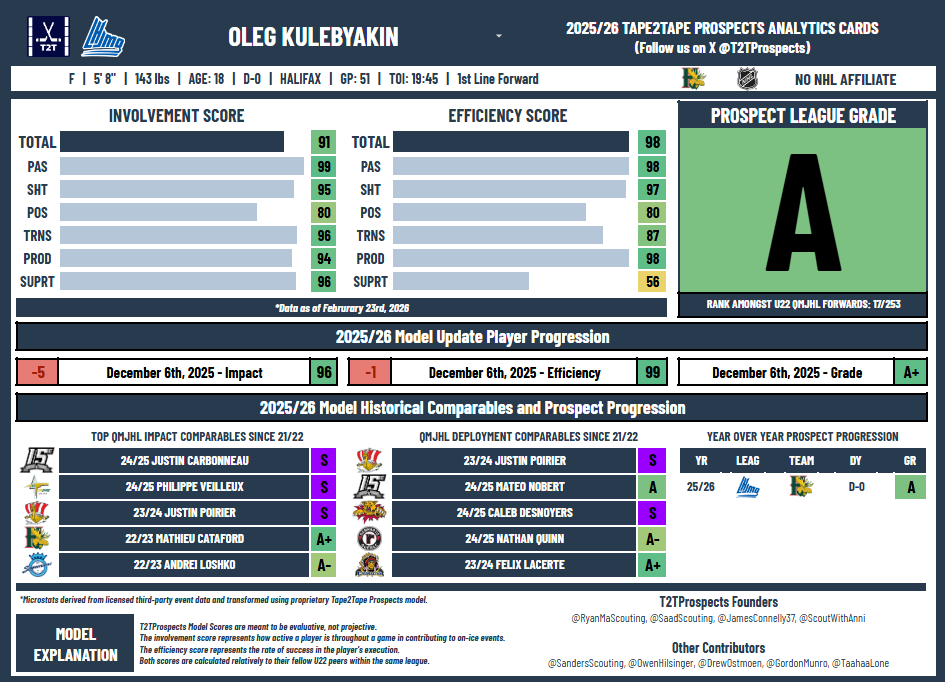
Games Tracked:
11/01/25 vs Val-d’Or
12/17/25 vs Saint John
01/22/26 vs Cape Breton
ELEVATOR PITCH
Oleg Kulebyakin is a highly skilled rush attacker with real playmaking ability and pace in transition, but his consistently woeful defensive engagement and off-puck effort make him a polarizing prospect whose NHL projection hinges entirely on whether he can revamp almost every aspect of his off-puck game.
I try to be fair and objective when it comes to my assessment of players, but man, I really do hate watching QMJHL hockey.
The criticism I’m going to levy against Oleg Kulebyakin could apply to a lot of the talented draft-year eligibles from the QMJHL, but at just 5’11” and given that he’s not an incredibly agile skater, Kulebyakin will get far less grace than some of his QMJHL counterparts.
My friend James (@JamesConnelly37) summarizes Kulebyakin’s game perfectly.
Oleg is one of the most skilled players in this class. With the puck on his stick, he’s able to outplay any defender in the QMJHL. On skill alone, he is a first-round pick. His off-puck play may make him go undrafted entirely.
The bad for Kulebyakin is honestly really bad. He dead legs his way around the defensive zone, doesn’t close out on defenders, puck watches, and lazily waves his stick at passing lanes. There was even a play in the defensive zone I saw where he did a fly by into the slot, waved half-heartedly at a pass and then watched as it went through him and to an opponent.
It’s clear he has no intention to really play defence, and while QMJHL forechecks are generally more lax and less intense than their OHL and WHL counterparts, even by those standards, Kulebyakin stands out in a bad way. I saw constantly that even when the opponent was in a bad spot, caught flat-footed, trying to settle a bouncing puck, instead of attacking the player for a takeaway, Kulebyakin will INTENTIONALLY skate away and instead “close off the wall”.
Just a complete lack of effort in making any of the hard plays around the ice, and without some real adjustments, I continue to find it difficult to project his game at the NHL level from that aspect alone.
What makes it very frustrating is that Kulebyakin will have 5 shifts of just completely coasting in the defensive zone, and the moment his team has a rush opportunity, he will shoot out like a rocket to receive the puck and attack.
It’s in these moments (off the rush) where he shines the most, beating defenders wide and driving the net, saucing soft backhand passes through traffic to teammates driving the middle. Kulebyakin is a talented playmaker and transition threat, there’s no doubt about it. When he gets opportunities to attack, he takes them, showing a real appetite to attack multiple defenders at once.
The straight line speed is excellent in bursts, but he’s not the most agile skater, and I think he’s a bit weak on his edges. It makes his overall projectability tough to assess. He generates tons of dangerous opportunities off the rush. He’s a talented playmaker who can sift passes through sticks and into high danger areas.
The question is whether he will be able to find a complementary secondary skillset to give him a viable path to the pros.
The thing is… I’m not sure I have an answer to that question.
#133 - Olle Tideman - Vaxjo Lakers HC U20 - LD - U20 Nationell
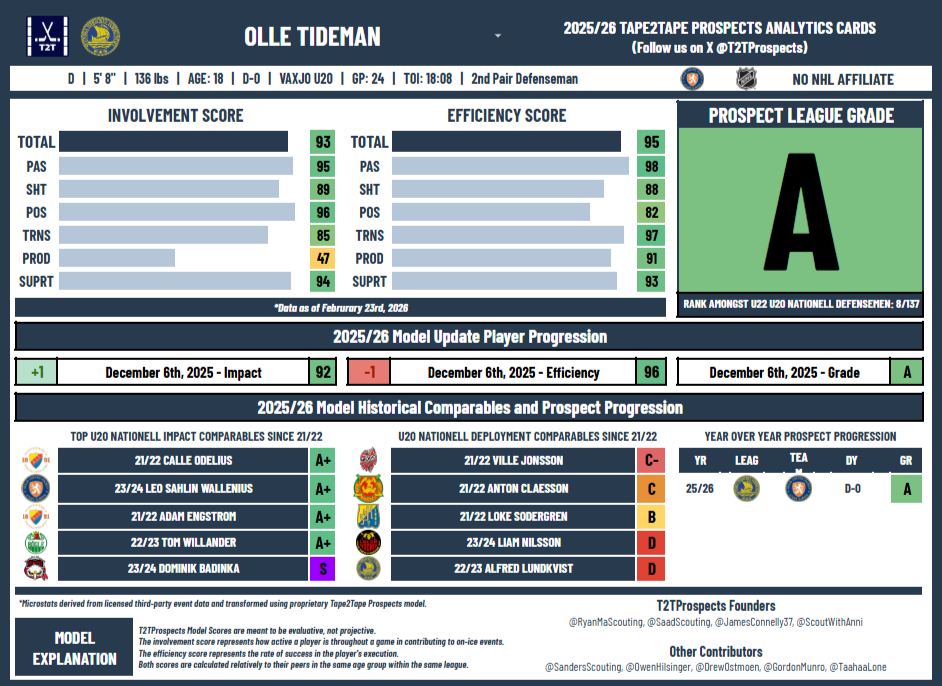
Games Tracked:
03/21/26 vs Frolunda HC U20 (Playoffs)
02/25/26 vs Malmo Redhawks U20
12/10/25 vs HV71 U20
ELEVATOR PITCH
Olle Tideman is an effective transition-first puck mover who excels at pushing the play up ice with aggressive stretch passing and forward-focused breakouts, but his limited agility, weak pivots, and inconsistent defensive reads make his projection more akin to that of a high end European Pro.
Olle Tideman is a fun little player that I think has some redeemable traits, but ultimately has some real flaws to his game that will need some cleaning up.
Tideman’s strength comes when he has the puck, and Vaxjo need to get the play moving the other way. His teammates trust him, and he’s a focal point in their transition game in terms of progressing the puck from the defensive zone into the neutral zone. Tideman’s preference is to get the puck as north as quickly as possible. He rarely bumps the puck to the center or his defence partner when he has the puck in his own end. His eyes are zeroed in on his wingers up ice, and he has pretty impressive consistency in terms of hitting these medium to long distance stretch passes up the boards.
There are a few misfires that lead to icings, but there are also some really nice diagonal passes and quick plays with a forecheck in his face that lead to his teammates getting the puck with space in front of them to charge through the neutral zone. When Vaxjo can get some sustained offensive zone time, Tideman’s passing chops also come to light. He doesn’t want to settle for the easy passes and instead will make these diagonal skip passes to try to drastically get the defensive coverage moving. Lots of point shots as well that he will float in on goal, looking for tips through traffic.
Unfortunately, Tideman’s work going back the other way is very much a work in progress. He’s a good enough skater in terms of getting around the ice, but his pivots are rough, and he’s not particularly explosive or strong on his feet. When defending, he relies mainly on an active stick to pester opponents, but he’s not really strong enough to make real plays to break up plays or force turnovers. The feet are also just not good enough. He’s super aggressive when trying to trigger out to attack puck carriers, whether it’s on entries or in scramble plays, but his ability to shift weight and get moving the other way isn’t great, and it means he either gets caught flat-footed and blown by, or he gets caught chasing the defender at a bad angle.
I also think the defensive IQ is a bit hit or miss, tons of frantic head scans, but not really processing and adjusting to the play based on what he sees from the head scan. There are some moments when the opposing team has sustained offensive zone time where he looks a bit lost, double covering guys, chasing the play, watching the puck, and late and lazy stick tie-ups. On the flip side, other times, he’s cross-checking guys in the net front, getting into shooting lanes and trying to cut off opponents with the puck from behind the goal line.
All in all, Tideman’s a player who’s efficient with the puck moving forward, but doesn’t really showcase the dynamic edges and movement skills that you’d want to see from a player of his profile. There’s a potential bottom-pair puck-moving defenseman here, but the feet and strength really need to improve defensively. The odds lean more heavily towards a long-time European pro, and ultimately why he ends up in my honourable mentions.
#134 - Lavr Gashilov - Avto Yekaterinburg - C - MHL
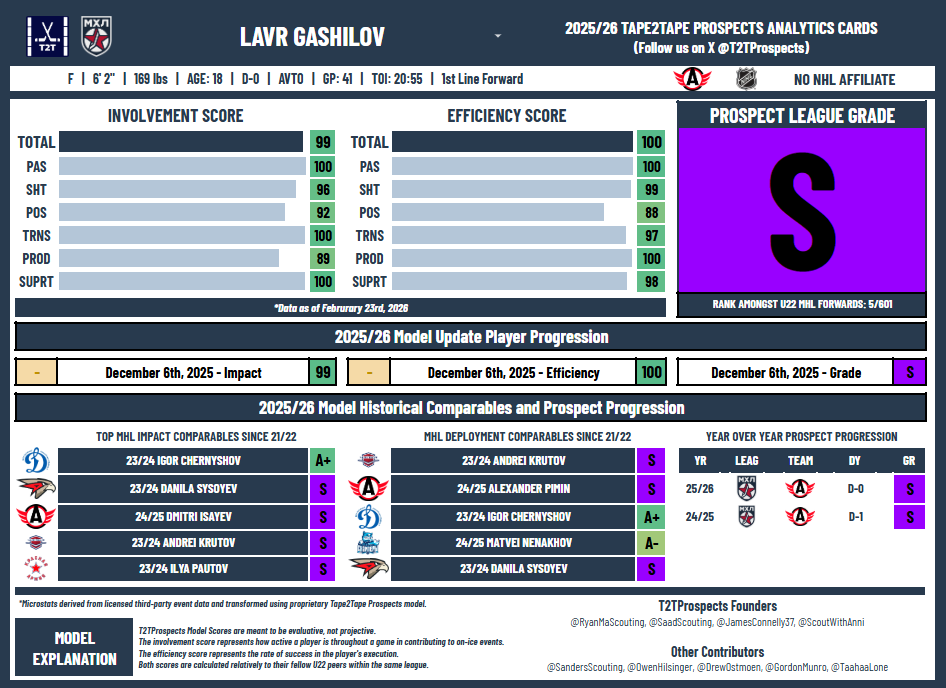
Games Tracked:
04/26/26 vs MHC Spartak Moskva (Playoffs)
03/11/26 vs HC Chaika
02/10/26 vs Snezhnye Barsy Astana
ELEVATOR PITCH
Gashilov is a productive MHL center with an NHL frame and solid board strength, but his slow pace, limited self-creation, and inconsistent off-puck awareness lends to real translatability concerns. Ultimately, his offense feels more opportunistic and a product of his environment in the MHL.
I thought I was late to the party on Gashilov who saw a lot of early season love from tons of sites.
Even with the gaudy score in our T2T Prospects Model, I just don’t see it and I think this is the most disappointing viewing I’ve had so far this reason relative to expectations.
Let’s start off with the good, Gashilov plays C, he’s got an NHL frame and he was one of the most productive MHL players this season. You’ve got to be doing something right to be yielding those results, and in Gashilov’s defense, the things he does well at the MHL level are contributing to offense for his team.
Gashilov is strong and sturdy with the puck along the boards where he’s able to protect the puck and look for passing opportunities into the slot. He does also get guilty of trying to hold it along the perimeter for too long though, carrying it to the blueline before having it knocked off his stick to clear the zone. However, when he does have pockets of space on his strong side, or on an odd-man rush where he can just attack, he does like spamming this stride deke to get into the slot. Sometimes it works, other times not so much.
Gashilov’s also got a good, hard shot, that he can use to pick corners even when he’s at bad angles on the ice as long as he has some time and space to get it off. He’s also got decent hands in terms of being able to pick out pucks through traffic. Gashilov also has some nice long distance passing to try and push the pace, but I think he really leans more patient. He loves regrouping and slowing the play done, moving it back to his defenseman and I wonder how much of it is smart decision making and not forcing plays and how much of it is his skating limitations.
That’s ultimately my big hang up with Gashilov. He’s a step behind his fellow MHLers and he’s just a slow, low pace player. There’s no real intent to apply puck pressure defensively in the neutral zone or on the forecheck. I don’t think he reads plays well or showcases great spatial awareness, lots of crossed wires and skating into his teammate’s paths when he’s off puck.
I also just don’t think he’s a self creator in any way. The majority of his goals this year at even strength came from a lot of really bad defensive zone plays that speak more volumes about the MHL than him as a player. Scoring off one timers from defensive zone turnovers, bad rebound control by goalies where he can poke the puck in, or just him floating into the slot area after some chaotic sequences or terrible defending and just being able to tap the puck in.
Ultimately, I just think the overall package isn’t compelling enough. Not enough skills on the puck, and I think his production comes more off of him being an opportune player off puck than anything he’s truly creating. Those hang ups, in addition to his play off the puck defensively, leaves Gashilov with an honourable mention ranking. He’s near the top of that group but I think there’s just a lot left to work on here. Gashilov is still going to appeal to some NHL front offices though, he’s big, plays C and was extremely productive in his league this year and well, that’s not nothing.
#135 - Julien Maze – LW – Calgary Hitmen – WHL
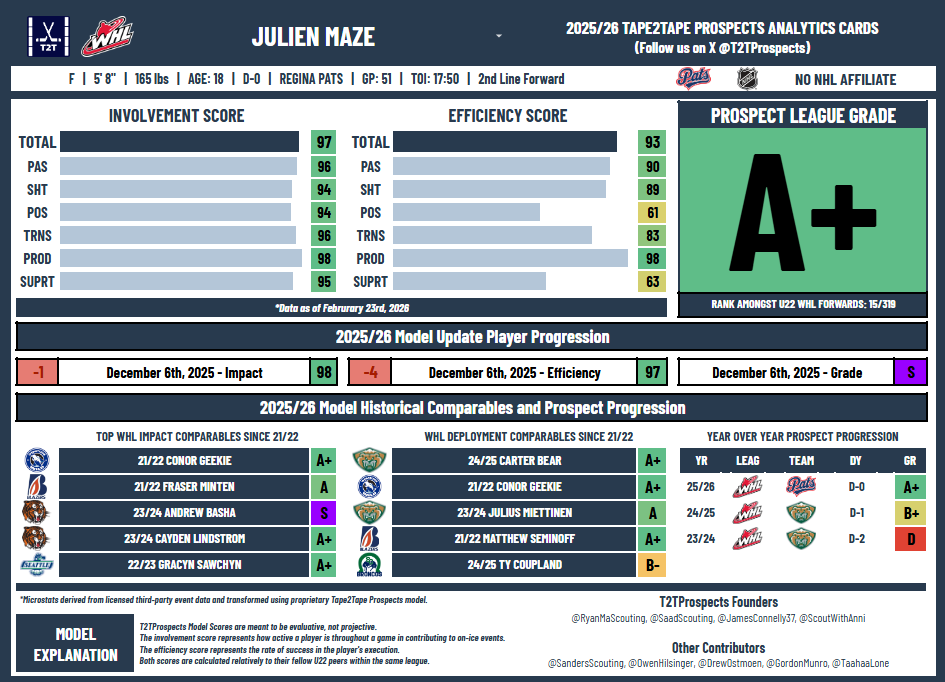
Games Tracked:
11/15/25 vs Moose Jaw
12/17/25 vs Swift Current
01/10/26 vs Seattle
ELEVATOR PITCH
Julien Maze is a dynamic transition winger with excellent edgework, deceptive skating in the neutral zone, and real passing/shot threat off the rush, but his 5’10” frame combined with inconsistent defensive urgency and limited off-puck engagement makes his skillset appear better suited for junior hockey.
It’s a shame that Julien Maze is just 5’10”.
The former Everett Silvertip, who was traded last year to Regina for Cole Temple and then again to Calgary this season, isn’t a perfect player by any means, but with a bigger frame, I think the existing tools would’ve bought him some grace with scouts and talent evaluators.
In the neutral zone is where Maze does the majority of his handiwork, where he lets his skating, with cutbacks and quick changes in directions, do the talking. Quick cross-overs to generate momentum through the blue lines, and constantly looking to breakout with the puck, Maze is always involved in the transition of play for Calgary.
Off the rush, he’ll show off his playmaking acumen, with nifty drop passes and lead passes through traffic to teammates driving the net. Off the puck, there’s a concerted effort (despite his size) for him to crash the net front and drive lanes.
The shot is nasty as well. His power-play goal against Swift Current showcases the deadly release that he can use to pick corners through traffic. It’s a whippy shot that he can get off without a ton of time or space.
Maze’s goal in the offensive zone with the puck is to get it towards the slot area as much as possible, at times to an obsessive extent. The bad games for him will showcase tons of forced passes into the slot into traffic that get broken up easily, but the good games result in pucks in dangerous areas for teammates to pounce on.
Maze is a disciplined player, which helps his support game score in our model at T2TProspects, and he does get to a fair amount of loose pucks as well. However, for a player of his size, for NHL front offices to be convinced that there’s a projection, I think there just needs to be a ton more off the puck in his own end.
The head scanning is okay, but Maze plays with a real lack of urgency in his own end in my viewings. He’ll chase down loose pucks and make force plays along the boards to poke loose pucks out of the zone, but his coverage and commitment to pressuring and closing out opponents in the perimeter are lacklustre, and the body language is often far too lax.
Maze also isn’t super involved in the forecheck, and he’ll let his linemates, Andrei Molgachyov and Caine Wilkie, do the heavy lifting in that regard. At the end of the day, Maze is a super-talented, shifty skater who dominates in transition and plays a perimeter-centric passing game. The skillset is undeniable, but at his size, the motor and effort levels away from the puck are likely just not consistent enough for NHL front offices to buy in right now.
#136 - Aiden O’Donnell - Oshawa Generals - F - OHL
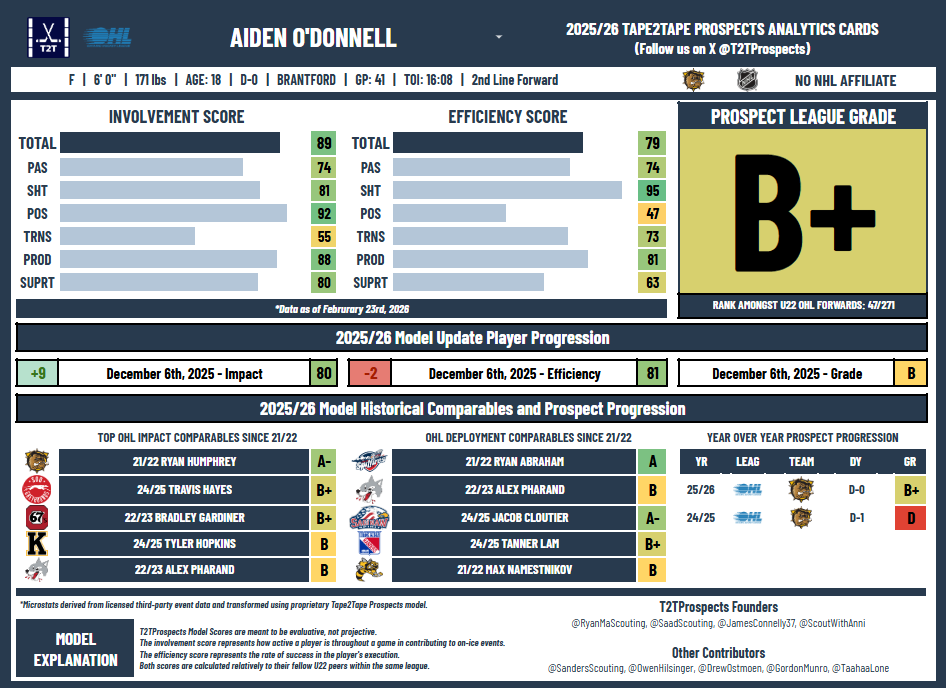
Games Tracked:
02/11/26 vs Ottawa
12/20/25 vs Saginaw
10/29/25 vs Barrie
ELEVATOR PITCH
Aiden O’Donnell is a versatile, effort-driven forward with an active defensive stick, decent board engagement, and a direct net-first mindset, but his stiff skating mechanics, poor contact balance, and limited puck security under pressure given his real injury concerns will put a significant damper on his NHL projection
Aiden O’Donnell is a nice player that does a little bit of everything on the ice, just usually never at the same time and his skating mechanics and his inability to protect himself when receiving contact does worry me a little bit if I were an NHL front office.
Let’s start with the good for O’Donnell. He’s a decently hard worker who picks and chooses high leverage moments to turn up the temperature on the backcheck or battle for pucks in the neutral zone. He’s generally pretty involved in a lot of board battles in my viewings of him, but he’s struggled at times with puck coordination and doesn’t really win these engagements at an efficient clip. Sometimes he’ll win a board battle, look to bring the puck out of the corner and fumble the puck or overskate it.
What I do enjoy about O’Donnell is he’s got a great active stick and good anticipation skills when defending in the neutral zone. Lot’s of nice plays where he’ll step up into a passing lane to steal the puck, or trigger aggressively to the side boards on his size of the ice to turn the puck over and head the other way.
O’Donnell’s not super crafty with the puck, but there is a net-oriented approach. It doesn’t matter if it’s along the goal line, at a sharp angle, in the high slot, when there’s an opportunity to get the puck to the net he will take it. It can lead to some wild scrambles in front, but I’d love to see O’Donnell be a more patient player who can play more of a connector role. There’s also a bit of feistiness to O’Donnell’s game; when he gets stonewalled at the line or just misses out on a 50/50 puck, he’s not afraid to give the opponent a nice forearm shover.
The hang up becomes the skating. O’Donnell doesn’t have a great top end speed which limits his effectiveness as a forecheck, he’s got really stiff hips that don’t allow him to really stop and start, and he’s honestly quite weak on his edges. His mechanics are super upright, and it means he doesn’t have great contact balance. He ended up on his butt a few times when I watched him play just going for loose pucks and without a more dynamic skillset or skating ability, the contact balance needs severe improvement.
I also believe it’s part of why O’Donnell’s missed multiple longer stretches of games this season to a lower body injury. It looked like he went into the boards awkwardly against Erie, which ended his season. Just a few weeks prior he has another similar play against Peterborough that cost him 2 weeks of his season as well. The skating mechanics and contact balance need serious growth for O’Donnell for him to have a real shot at the next level.
All in all, I think there’s enough of a work ethic, and enough hockey smarts for O’Donnell to be player but the injury concerns and a huge red flag and what bump him down into the Honourable Mentions.
Side Note: I’ve recently found out from a reader (who’s a Gens fan) that he actually tore a ligament in his ankle back in December and tried to play through it before re-injuring it and getting shut down for the year. This does add a ton of context to what I was seeing with regards to a really weak lower body. He ends up low on my board, but I did bump him up 2 spots with this new information. He’s a guy I think could make some waves if he can heal up and get back to speed after a wasted year of development.
#137 - Alexei Vlasov - Victoriaville Tigres - LW - QMJHL
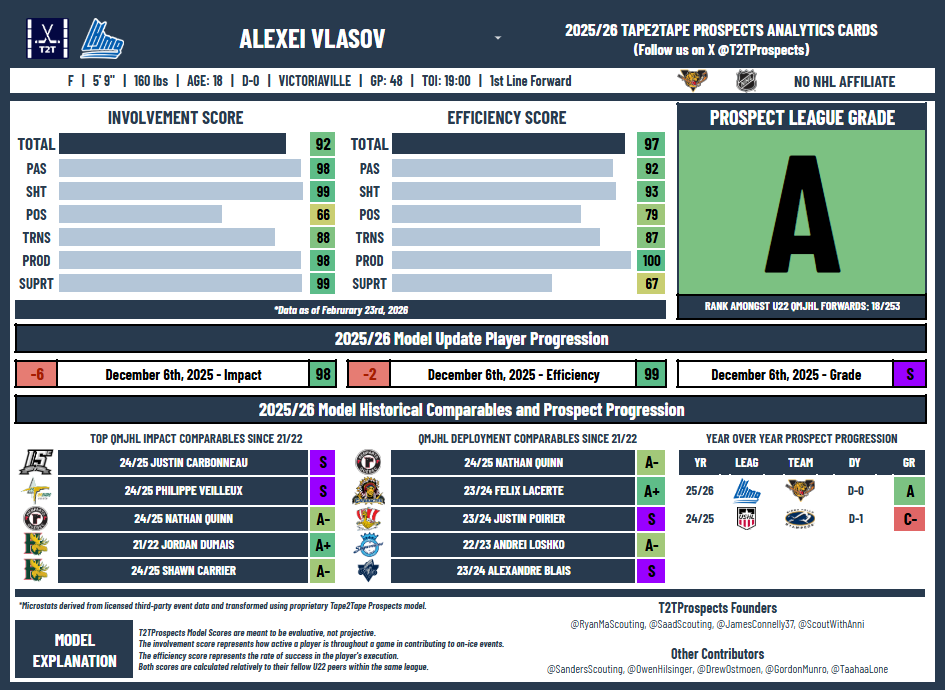
Games Tracked:
03/07/26 vs Baie-Comeau
02/13/26 vs Cape Breton
01/16/26 vs Drummondville
ELEVATOR PITCH
Alexei Vlasov is a small, low-mobility winger whose shot is his only true standout trait, while limited skating, average puck security under pressure, and mostly vanilla passing makes him a tough projection to ever be able to make the NHL jump.
Alexei Vlasov is cool but I’m overall not convinced that there’s a high probability for a future NHL package here.
Vlasov is small but his skating isn’t very good given his size and as a result he’s not some super dynamic, pacey player. Instead, Vlasov plays far more off-puck, relying on his linemates in Shilov and Korneyev to do most of the heavy lifting in transition. When Vlasov does get the puck, he makes clean direct passes. He rarely holds onto it, not really a player who is looking to get the defense moving with his eyes. I saw a few passes where he threaded the needle through traffic to get it backdoor, but most of Vlasov’s passes are generally quite vanilla; back to the point man, sometimes down low… I just wish that for a smaller player with below average skating mechanics that the creativity as a playmaker would’ve been better. I think it ultimately comes down to his struggles handling pucks through pressure and traffic. He fumbles pucks when attacking defenders across the blue line, and the puck protection given his diminutive frame is not amazing.
The best part of Vlasov’s game is his shot, which gets off his stick in a flash. He’ll drag it in-tight to him with a back leg loaded release, and when he let’s it go off the rush in the high slot it’s a beauty to see. That shot will play at the pro level and it’s probably what gives me enthusiasm that there’s something to work with here. He’ll need to tighten up that shot selection though, Vlasov has a bit of a bad habit of spamming point shots at times. I’d like to see him use those puck touches at the top of the blueline to explore more passing options rather than just snapping one on goal.
Away from the puck, Vlasov is hit and miss. He’s got a bit of a scrappiness to him, motoring around all over the ice, trying to finish checks but the skating holds back his ability to consistently pressure puck carriers. Despite his willingness to try, his ability to make recoveries or take away pucks is hit or miss, Vlasov doesn’t have the outright pace or strength to will these puck battles in his favour and his best forechecking shifts are when he can intelligently determine moments of vulnerability by the puck carrier to explode out and catch them in bad spots.
Defensively, Vlasov looks engaged, but he comes down too far low into the zone at times and then gets lost as the play evolves around him. There were a few shifts in the defensive zone where he looked like he was playing LD, just hanging around to the left side of the net.
All in all, Vlasov has one pro quality trait, which is his shot, and there does seem to be a good all around motor. Ultimately, Vlasov will need to either seriously revamp his skating or learn to develop counters to pressure and coverage if the skating doesn’t improve. The goal scoring intrigues me but at his size and mobility it’s just not enough and why he ends up in the honourable mentions for me.
#138 - Kalder Varga - Red Deer Rebels - F - WHL
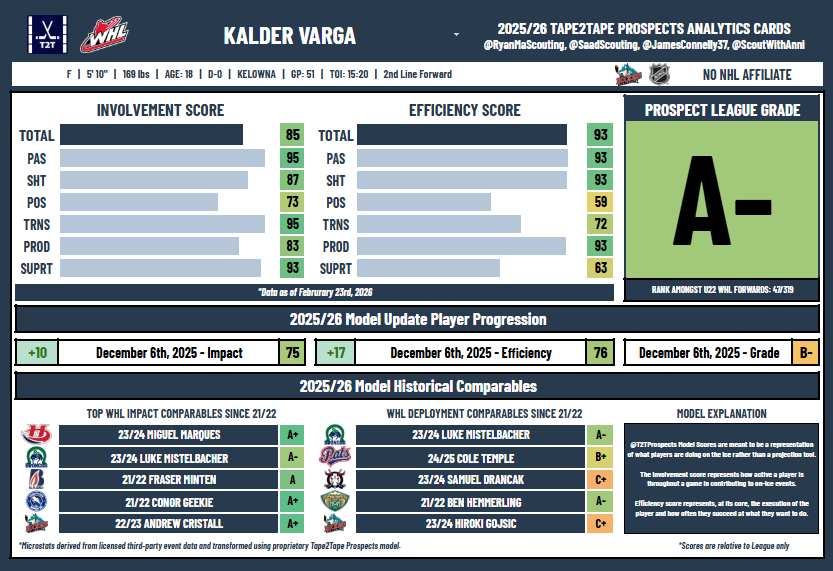
Games Tracked:
03/28/26 vs Prince Albert (Playoffs)
03/14/26 vs Calgary
02/07/26 vs Moose Jaw
ELEVATOR PITCH
Kalder Varga is a skilled, pacey attacker with strong edgework and real self-creation flashes off the rush, but a very inconsistent motor, weak physical engagement, and poor defensive buy-in severely limit his NHL prospects despite the clear offensive talent.
Kalder Varga was one of the biggest risers in the T2T Prospects model, jumping up from a B- all the way to an A-, and he’s the perfect case study of why no model is perfect, and how we still need to watch the games.
There are obvious reasons to like Varga that also explain his jump in the T2T model. He’s undeniably skilled, comfortable holding the puck in the offensive zone and while not explosive with the puck, he really uses his edges well to play a twitchy, stop-and-start style of play to buy time and space once he crosses the offensive blue line.
Varga’s playmaking is one of the model’s favourite aspects of his game, and while the volume in my viewings wasn’t super noticeable, I do think that there’s a nice slot-oriented approach to his passing. I feel a more accurate assessment of Varga is more of a straight-line, self-creator. Varga doesn’t explode at a standstill, but he builds speed really quickly, and his ability to meld his hands with his skating at high speeds makes him a handful for opponents to handle. He had a beautiful play in tight where he sidestepped a defender, maneuvered into the slot and released a nasty bar-down goal for his 2nd of the night against Calgary.
Unfortunately, I don’t think the rest of his package really works with his good traits to create a clear NHL projection. Varga will have some flashes of intensity in the offensive zone, charging in to try to win back pucks off his own dump and chases or when his team loses an offensive zone draw, but the motor is inconsistent, and Varga isn’t the strongest on his feet. He’s easily upended by defensemen on these plays when trying to swim underneath them. Most times, he’s super passive, opting to make the easy play to cut off the boards instead of applying any meaningful pressure to the puck carrier.
Defensively, Varga is a bit of an eyesore to watch. Outside of a tendency to gently “interfere” with opponents when defending zone entries and defensive retrievals in order to hold up forecheckers for his defensemen, there’s very little intensity in his own end. He doesn’t get into board battles and just does a ton of floating in the top left of the zone waiting for his teammates to get the puck so they can go the other way. It’s no surprise that in games where Red Deer is trying to hang onto a 1-goal lead, Varga doesn’t find himself on the ice for 7-8 minute stretches. There’s a lack of trust in the player from a competitiveness perspective, and just not a lot of willingness from him to buy in on the defensive end. It’s not a skillset issue of having slow feet or being a smaller player that gets outmuscled... It’s a work ethic issue for Varga, and he’s just not skilled enough or dominant enough with the puck to justify that mentality away from the puck.
As my friend David (@SaadScouting) puts it,
Vargas’ best work is done with the puck, but he doesn’t get it often enough. He wants to attack with an advantage, but never contributes to gaining possession in even basic ways
All in all, Vargas is a pacey player whose offensive skillset with the puck has pops and flashes on the screen that make him look like a potentially dangerous self-creating scorer at the pro level, but the off-puck habits and competitiveness are just nowhere near good enough for a player of his skill level to project to an NHL role. There’s some serious work to be done with Vargas, and while he’s decently fun to watch, he’s likely one of those players players who are fun but unlikely to translate given their existing tools and playstyle.
#139 - Will McLaughlin - Portland Winterhawks - LD - WHL
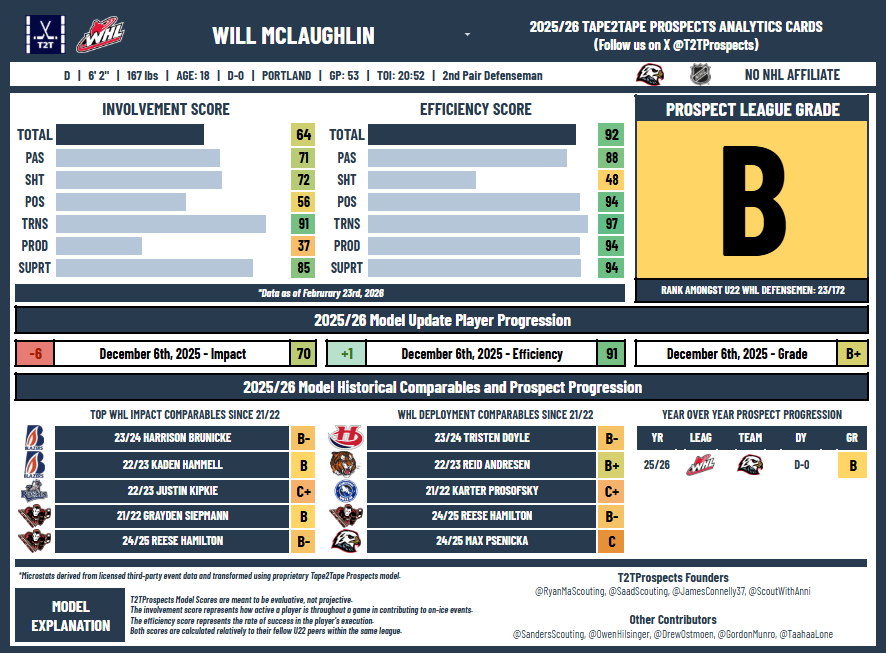
Games Tracked:
03/21/26 vs Seattle
03/08/26 vs Tri-City
02/03/26 vs Kelowna
ELEVATOR PITCH
Will McLaughlin is a pro-sized, mobile defender with clean breakouts and occasional deception on retrievals, but his inconsistent defensive urgency, average decision-making on pinches, and limited overall involvement in play make him a mostly vanilla player whodoesn’t project to be a real needle mover.
Will McLaughlin was someone who wasn’t really on my radar at all, but after watching him break Lukas Kaplan’s ankles behind the net when watching Portland vs Everett for Jake Gustafson, I thought he was at least worth a look.
Unfortunately, this isn’t a situation where I found a guy I think is super underrated or overlooked. Will McLaughlin is fine, and an average to above-average WHL defenseman, but I’m not sure if he does enough good things to warrant a Top 120 spot on my draft board. McLaughlin has one patented move in his own end on breakouts, and it works for him. He’ll approach the puck on a retrieval, fake one way, and then suddenly go the other, sending the charging forechecker the wrong way and opening up some time and space for himself. He reminds me of Travis Dermott in a lot of ways (although I may be a bit influenced by the aforementioned shoulder check and head fake move).
McLaughlin has some nice stretch passes from his own end up the boards to his wingers and generally makes pretty clean plays in his own end. He’s comfortable skating the puck in and out of the zone to generate entries and exits, but I’d like to see him more constantly involved in the play. I find Psenicka and Niko Tsakumis were the more active players on the puck (McLaughlin rotated between the two as his defence partner in my viewings), and I think that the skating and passing are there for McLaughlin to be more consistently involved. McLaughlin is also more than willing to jump into the play to create numerical advantages, but I’m not fully sure that he really judges lanes very well, and oftentimes, he’s just an extra body in the crowd before he hustles back to cover his point.
McLaughlin is also willing to try and hold the puck at the blueline to make plays, but the execution isn’t quite there, and he did turnover a few pucks that led to odd-man rushes. I think there needs to be a more aggressive approach to McLaughlin’s game at times, especially defensively. He showcased a few nice plays on rush defence, closing the gap on the opponent perfectly and sealing him off against the wall. However, most of the time, it almost looks like he’s trying to avoid being the point of attack defender, sinking further into the slot and gesturing for his defence partner or wingers to push out to the puck carrier instead.
There’s decent competitiveness in defending the net front and tying up sticks, but I ultimately want to see more physical and energetic defending from McLaughlin. A lot of standing around in the slot, just taking whoever is close to him and not really being proactive in reading the play to get out and pressure players.
All in all, McLaughlin reminds me of a slightly more put-together version of Zigge Bratt. A mostly vanilla product at a pro-size, with some willingness to skate with the puck, but needs an improved motor and intensity defensively and to learn when and when not to try the more adventurous ideas they have with the puck in the offensive zone. The size and mobility will carry his draft stock, but he’s just an honourable mention for me.
#140 - Alofa Tunoa Ta’amu - Edmonton Oil Kings - LD - WHL
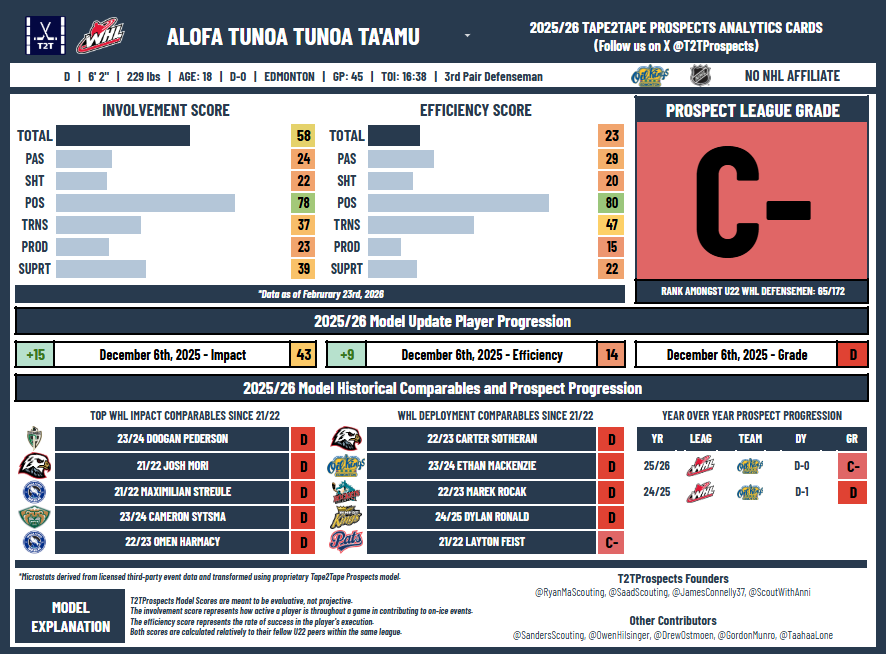
Games Tracked:
04/03/26 vs Saskatoon (Playoffs)
03/15/26 vs Calgary
02/20/26 vs Regina
ELEVATOR PITCH
Ta’amu is a heavy, physically dominant defender with strong net-front presence and solid straight-line mobility, but his delayed puck decisions, clunky hip mechanics, and inconsistent puck security under pressure limit his projection and makes him likely a long term developmental project for an NHL Team.
I’m not sure what to make of Ta’amu. There’s a certain appeal to his game; he’s big, heavy set, and doesn’t get pushed around (like at all) when defending the net front. Being one of the heaviest players in the draft will do that for you, and his mobility at that weight is honestly quite good and makes his potential intriguing if he can continue to develop and learn how to harness his unique physical profile.
Ta’amu closes space well when defending the rush to break up plays. He’s got a good reach that he uses to cut across to cover for his teammates that get beat, sweeping in like a safety net to save the day. There are a few nice moments in a game where he will receive the puck with some time and space and gallop through the neutral zone, trying to beat the first layer of defence to make a play.
I do wonder how Ta’amu’s current skill set will fit in at higher levels of hockey. He’s not a player who drives forward in his own end to make stretch passes, preferring to have the puck with space behind him that he can retreat back into so he can make breakout passes. He’s looking to hit the short man either in the center lane, who can then receive the puck and turn up ice or up the boards to a winger who can make a quick play (either with a tip into the offensive zone, or a play off the boards to the center). With this style of play, Ta’amu is actually able to be quite clean with his breakouts and his possession numbers with Edmonton this year are good, as he’s not really stuck defending in his own zone for too long.
Despite this passing preference, Ta’amu isn’t a clinical, quick, short-area passer like Ben Macbeath. Instead, he’s methodical, with a little hitch or pause to his passing motion, where it looks like he’s almost hesitating before letting the pass go. It’s clear to me that he wants to play the game at his pace, but I do have concerns about how he will adjust to more tenacious forechecks that force quicker decisions.
I also would love Ta’amu to use his body more efficiently to defend the puck. He does a great job defensively with his size, using it to cut players off at the boards and separating them from pucks, but when he tries to skate with it through the neutral zone, it’s too easy for smaller opponents to stick lift him and knock the puck loose into traffic. He also fumbles pucks when receiving them in motion, overskating them or taking his eye off the puck to get going with it before actually controlling it.
Overall, Ta’amu is a big, heavy-set defenseman who moves well in straight lines but has clumsy hips and below-average start-and-stop ability. He has flashes of wanting to be a two-way creating defenseman, but lacks the refinement and puck skills to play that style of game. There’s a developmental bet here, even with my real concerns about his ability to play at high speeds, but I just don’t see enough to get excited to move him out of the HMs.
#141 - Brayden Klimpke - LD - Saskatoon Blades - WHL
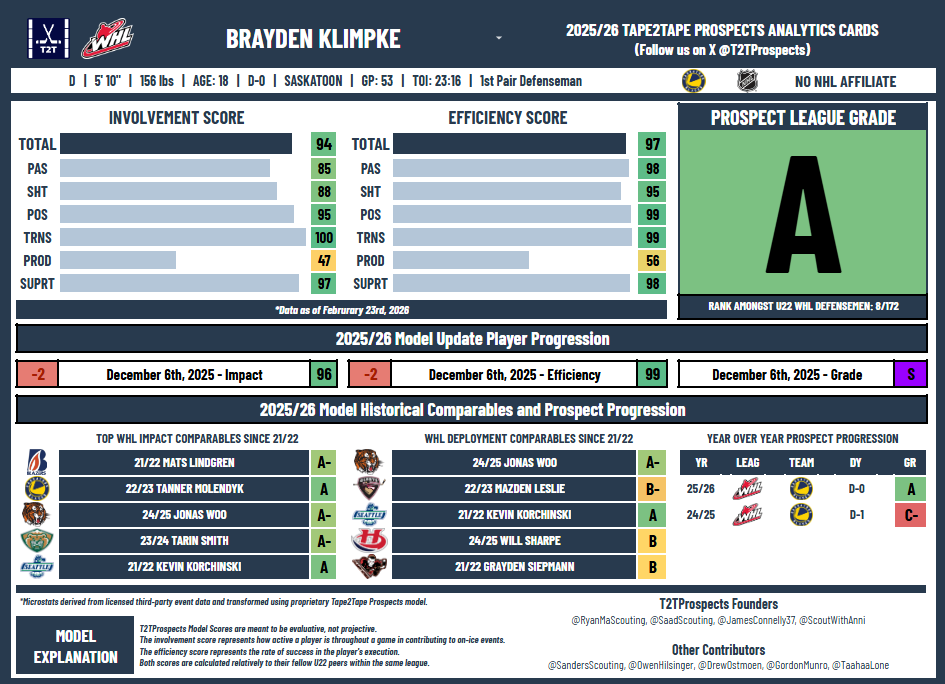
Games Tracked:
11/08/25 vs Calgary
12/12/25 vs Lethbridge
12/28/25 vs Regina
ELEVATOR PITCH
Klimpke is a smooth, intelligent two-way defender who stands out for fluid four-direction skating and strong rush denial, with occasional flashes of offensive creativity off the puck, but his relatively vanilla style of game at his size makes his NHL translation a very difficult one.
Klimpke is an interesting one for me.
I was pretty high on him after my first view viewings of the year but as the season progressed he’s just continued to fall more and more down my board. His game is built on his intellect and being in the right place at the right time, so it’s easy to look at his 6’0” frame and assume his game is often too vanilla.
I think it also shows how little the defenseman has put a foot wrong this season in a big role for the Saskatoon Blades. I can see a bit of Klimpke in one of his alma maters, Tanner Moldenyk. Like Moldenyk, Klimpke may be another Blade where skating, intelligence and two-way play are the real tools that help the overall NHL projection.
Skating is a real strength for Klimpke. While he doesn’t have this elite top-end speed that will allow him to knife through defenders, he might be one of the smoothest four-directional skaters I’ve seen this year. Super fluid hips that make him look like he’s just gliding out there and allow him to shut down rush plays with ease.
Even with the smooth skating style, there is a bit of twitchiness to his game when he gets the puck in the offensive zone. Out of nowhere, he’ll shake an opponent with a nice stop and cutback in the corner, or sauce an absolute beauty no-look pass cross-seam for a one-timer. I still think it’s a mostly pretty vanilla product, but if you add those flashes of flair on the puck with more regularity, you might end up with a vanilla-based Sundae that tastes pretty good.
With all that said, unfortunately for Klimpke I just doen’t think he moves the needle for me at this point of the year. There are more physically imposing defensemen in this class, more dynamic defensemen in this class, and certainly defensemen in this class with a higher ceiling… and also those who can offer a similar skillset while being bigger. Even a guy like McLaughlin who may not be the natural mover Klimpke is, or the falshes of on-puck prowess in the offensive zone likely has an easier road to the show on account of his size and frame alone.
#142 - Zigge Bratt - Frolunda HC U20 - LD - U20 Nationell
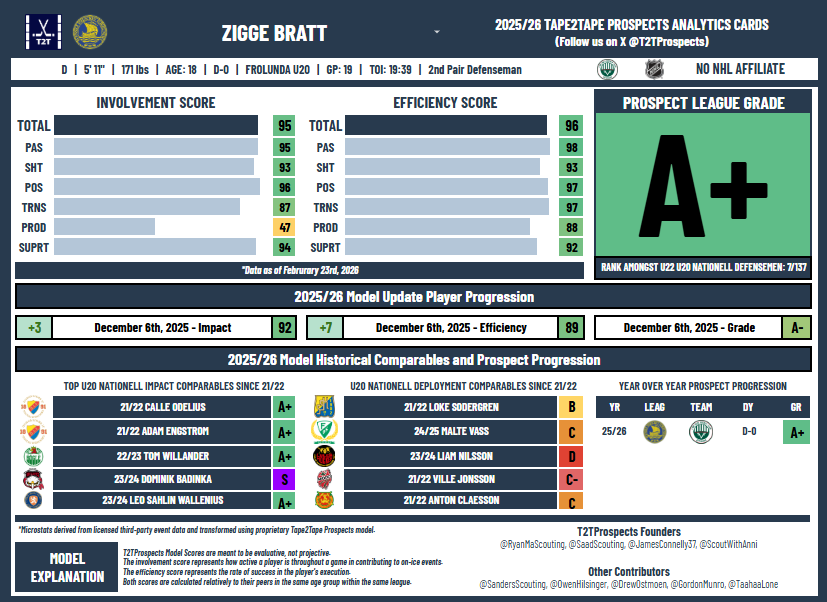
Games Tracked:
03/25/26 vs Farjestad BK U20 (Playoffs)
03/18/26 vs Vaxjo Lakers HC U20 (Playoffs)
09/20/25 vs HV71 U20
ELEVATOR PITCH
Zigge Bratt is a strong four-direction skater who shows real intent to carry pucks and activate in transition, but his inconsistent puck security, passive defensive engagement, and overconfidence regarding his skating and puck skills limit his ability to consistently drive play, leaving him as a highly mobile but ultimately underwhelming projection who may struggle to translate his current style to North America.
I leave these viewings of Zigge Bratt wholly unmoved, and it’s unfortunate because the T2T Prospects Model suggested that there was a player here worth looking at, and it was just an underwhelming viewing session overall.
There are some pros. Bratt’s a strong four-directional skater who gets around the ice well. He’ll jump up into plays, and when he gets the puck, he loves skating with it. I think the issue is that Bratt overestimates how elusive his skating really is and how much space he can make for himself with the skating. There will be times in the defensive zone where he’s twisting and turning with the puck, trying to shake opponents, and they can poke it off his stick or lift his stick, get leverage and steal the puck away.
Defensively, Bratt is just okay. I’d like to see more effort from him in terms of clearing the crease and getting out to pressure opponents. He’s got a long, slow poke in board battles where he almost uses one hand to try to hold the guy in place, and the other hand with the stick to try to poke at the puck. I’d like to see him board play guys, and then get both hands on the stick to try to pry the puck loose. I think there’s just too much passive play from Bratt in his own end, and he’s not engaged enough defensively in terms of takeaways and getting into these board battles.
In transition, I would also like to see more involvement from him. Maybe it was just bad viewings, but the puck just wasn’t finding him a ton, with teammates opting to go up the boards or to someone else instead of him. He had a few nice stretch pass attempts that misfired, but attempts that I thought were good ideas nonetheless.
In the offensive zone, there’s a willingness from Bratt to handle the puck and try to delay and hold onto the puck, hoping for a better passing opportunity. Unfortunately, the puck skills aren’t really in sync with his feet, and despite the willingness, I don’t think he has the goods to beat opponents with his skating alone. It’s good that when Frolunda has the puck in the offensive zone, he’s also willing to make quick one-touch plays to teammates from the point so there are still positive contributions despite the turnovers.
The puck protection is also a big issue with Bratt, especially for a defenseman who wants to be as much of an on-puck catalyst as he does. I don’t think he has the strongest base, and it can lead to him getting bounced around and pushed around in scrums, in front of his net, and also when he has the puck.
I think there are some things to work with here. Bratt’s got a hard, accurate wrister, a willingness to skate with the puck to try and make plays, as well as some quick, decisive passes in the offensive zone to let his talented playmakers like Bosse Meijer shine. The play and habits in the defensive zone, his contact balance and his hands will need work, and I’m just not convinced this is a playstyle or package that will translate well to North America.
#143 - Eddy Doyle - Halifax Mooseheads - LD - QMJHL
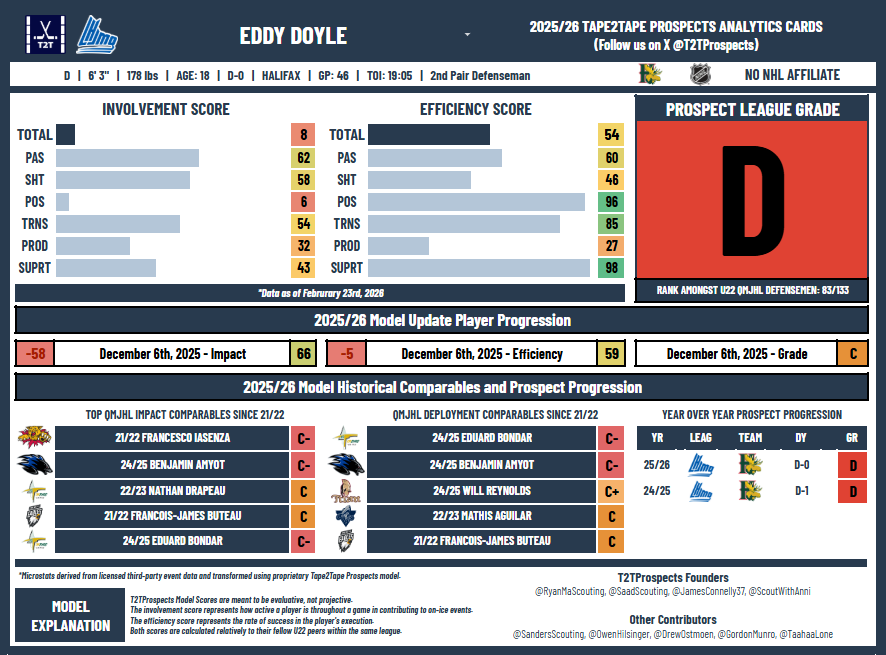
Games Tracked:
02/22/26 vs Rimouski
01/17/26 vs Charlottetown
12/23/25 vs Moncton
ELEVATOR PITCH
Eddy Doyle profiles as a low-ceiling, high-floor defensive defenseman with a strong net-front presence and reliable gap control who defends primarily with reach and positioning rather than physical dominance or mobility, while his limited puck play and awkward pivots keep his projection capped as a mostly likely organizational depth.
Eddy Doyle in a nutshell is the left handed Diet-Brandon Carlo of the QMJHL (post concussion The Maple Leafs version of the player that is).
There are striking similarities in playstyle, although Doyle is not nearly tall as the behemoth Toronto Maple Leaf. Doyle is an alert defender in front of his own net, with a focus on clearing the front of the crease for his goalie. I can always appreciate a defenseman who prioritizes that, although I do think Doyle gets confused at times when the opposing team begins zipping the puck around in his end… just a bit delayed in tracking and reacting to the movement of the puck.
Doyle’s defense reminds me a ton of Carlo in the sense that it’s mainly about maintaining a good gap and using your reach and good stick placement to deter players from attacking inside and to keep them towards the outside. The idea is that by forcing the opponent to go the long route, the deficiencies Doyle has as a skater can be masked. Let there be no confusion here, Doyle’s skating is not bad going forward, but his pivots are very awkward and he struggles to flip his hips to mirror opponents at times. This means that while he’s a good rush defender, he’s not dominant at it, there aren’t many plays of him being able to close the gap, crush the opponent into the boards and just end the play. Doyle’s preference is to ward the player along the perimeter behind the goal line where they have no choice but to come to him, where he can then board play them and look for reinforcements to come.
With the puck is where I ultimately get my Diet-Brandon Carlo comparison. Doyle isn’t going to do much with the puck, as you’d expect with a player of his profile. When he gets it in his own end, he looks to immediately get rid of it, on a few occasions you’ll get a nice short outlet pass to a teammate, but a lot of the time it’s him flipping the puck in the air in the general vicinity of a teammate. It serves as a potential pass, but really Doyle is just trying to punt the puck out of the zone every chance he gets.
A score of D in the T2T Model feels harsh for Doyle, but it does still highlight what he does well. He’s not going to lay a bunch of hits a game or win tons of puck battles, but he’s effective at funneling plays away from the net front, and making sure that when he’s on the ice that Halifax doesn’t spend too many pro-longed stretches in their own end.
All in all, as an older player in the draft class, Doyle is the definition of a high floor, low ceiling prospect. I think he’s certainly a player worth drafting even if the skillset isn’t super exciting. There’s some parallels between him, Ta’amu and Aura, and while Doyle’s current package is the most refined of the three, I think Ta’amu likely edges him out with the potential upside and flashes of puck skills that Doyle hasn’t shown a willingness to try. Then again, NHL teams that draft him will probably look for him to continue getting even better at what he’s already good at, rather than trying to develop his on puck game.
#144 - Bode Laylin - Tri-City Storm - RD - USHL
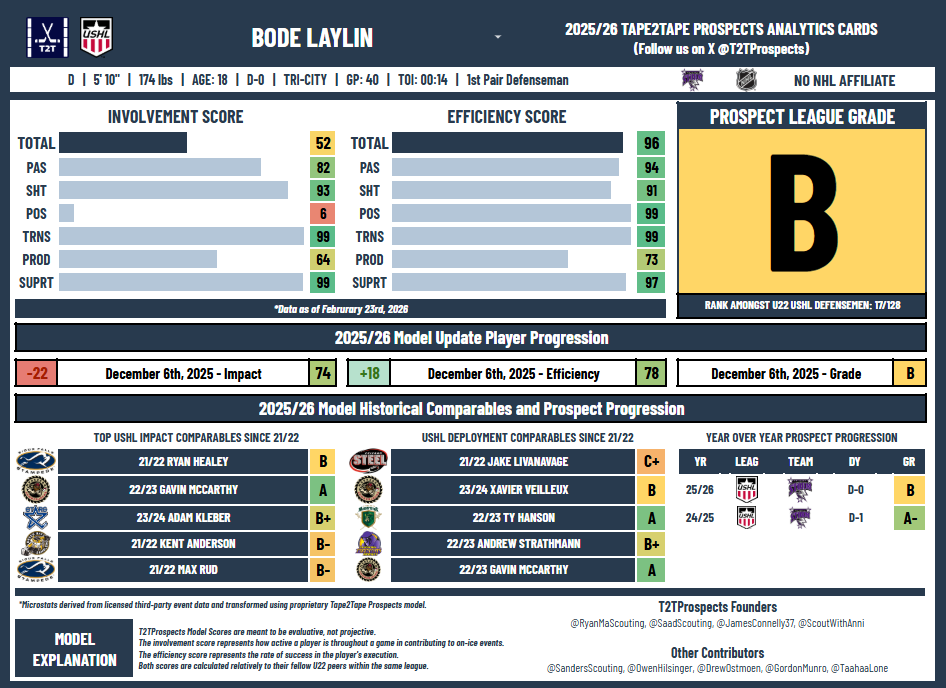
Games Tracked:
04/03/26 vs Fargo
02/27/26 vs Lincoln
12/31/25 vs Sioux City
ELEVATOR PITCH
Bode Laylin is a highly mobile, aggressive defenseman whose fluid skating and desire to push play creates intriguing upside, but his decision-making, defensive engagement, and overall execution are still so raw that any team that takes him needs to take a long term horizon approach when it comes to his development.
Bode Laylin is so all over the map after watching three games of him I’m still not sure if I think he’s a super interesting developmental prospect or someone I just think is not very good.
Laylin’s one of the more natural, fluid skating defensemen I’ve seen in this draft and that’s always a positive for me. He’s got fluid hips and clearly wants to be up and involved in the play. In transition he wants to get up in the rush and activate. In the offensive zone, he will roam very aggressively and get himself into the slot, or he’ll circle down really low in the offensive zone. It’s clear Laylin wants to play a tempo pushing style of game, where he can either break the first level of pressure with his skating, or receive the puck higher up the ice where he can join rush opportunities as an extra body.
I just think that the existing skillset is just too raw and underdeveloped for him to play the game he envisions. He tries to do too much with the puck on breakouts, getting cute trying to evade pressure and flick quick passes up to teammates that get picked off enroute. His neutral zone roaming is also far too aggressive, there should never be a reason why he is ever the last man back as a defenseman off a neutral zone turnover.
Funny enough, despite this really aggressive play in the first two thirds of the ice, Laylin’s puck play in the offensive zone is pretty vanilla. Quick simple passes, and he doesn’t try to use his skating to outmaneuver and probe for openings to exploit the defense. This reliance on making quick passes to beat defenders can come back to bite him, he had a brutal turnover against Fargo where he forced a no-look D-to-D pass that was clearly covered which led to a goal.
Defensively, Laylin was just not good enough. Outside a few nice shot blocks or retrievals where he initiated contact to bump the forechecker off-line to buy himself time and space, there just wasn’t enough of a motor or effort level defensively for me. Looked disengaged, floated around, and didn’t do a good job clearing the crease or showing awareness of off puck threats. While defending the rush, I’d also like him to be more aggressive with taking away space... I just think he could use his stick better to hassle defenders.
All in all, Laylin has some nice tools, and a real assertiveness in his play that I can appreciate. He wants to push play north and get involved, and there are plays where he can execute very nice passing ideas and pick spots when jumping up into the zone to get chances off. Unfortunately, the package really is super raw and he’ll need a lot of time to develop better habits and figure out how to harness his skating and ideas into a consistent positive contributor.
#145 - Maksim Sokolovskii - London Knights - LD - OHL
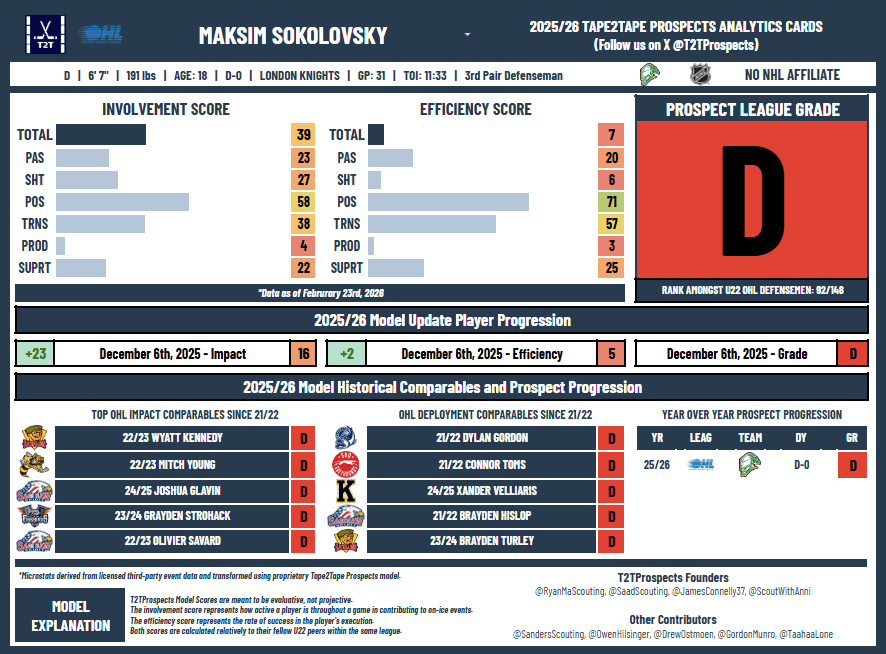
Games Tracked:
03/27/2026 vs Soo (Playoffs)
03/01/26 vs Kitchener
01/30/26 vs North Bay
ELEVATOR PITCH
Sokolovskii is an enormous, physically imposing defender whose reach, mobility for his size, and nasty edge will attract NHL interest, but his limited puck skills, inconsistent defensive processing, and struggles handling quick, skilled opponents make him a highly raw projection whose value rests almost entirely on his physical tools and developmental runway.
Sokolovskii was nowhere NEAR my watchlist, but some tweets on my timeline about his games against the Soo in the OHL playoffs piqued my interest, and so despite one of the worst T2T Prospects Draft Year Cards I’ve seen so far this year, I decided to give the 6’8” London Knight a chance.
Sokolovskii is big, rangy, and he executes to those strengths. He keeps it simple, uses his reach to poke pucks away, and he will bury players into the boards and crosscheck them while they’re down just to remind them he’s bigger. I think that an NHL team could totally do what the Senators did in 2024 with Eliasson and draft this kid way too high because of the size, physical edge, and above-average movement skills.
His puck touches are SUPER vanilla, as some may expect for a player of his physical prototype. For the most part, he hates having the puck on his stick on retrievals, and his goal is always to just rim it up the boards to his winger. He’s tall and has a long reach, so his go-to move when facing extreme pressure on a retrieval is to basically eat the physicality from the opposing player, protect the puck with his frame and rim it up the boards.
The one time against the Soo, where he tried to corral the puck and make a play, Quinn McKenzie jumped him and nearly forced a turnover behind the net. Speaking of which, McKenzie (all of 5’10” by the way) really gave the 6’8” Sokolovskii some fits in the playoff game I watched. A few plays on the forecheck where he forced quick plays that turned into 50/50 puck battles, another one where he got under Sokolovskii and leveraged inside position to screen the goalie, where a point shot then squeaked in for a goal. Sokolovskii also got his ankles toasted in the corner on a quick head fake and then cut back move by Brady Smith.
I also think Sokolovskii’s defensive diagnostics are kind of delayed in terms of recognizing and sorting hand-offs in coverage off the rush. There was a three-on-two where, after getting out to challenge the defensive puck carrier, he didn’t turn and hustle back to the net front, where the third forward driving the net nearly got a chance all alone.
All in all, Sokolovskii can move well enough at his size, his man-to-man coverage in transition is mostly good due to his size and reach, and he plays with a bit of a nasty edge. Ultimately, though, I think he’s a player who doesn’t diagnose coverage well, struggles to defend in tight, has some bad decision-making on pinches, doesn’t offer much in the offensive end of the game, and can’t consistently win pucks off of smaller players in the defensive zone.
If Sokolovskii makes it to the pros, it will be as a defensive defenseman, but despite the intriguing physical traits, I think the current package is way too raw and uncoordinated for me to be willing to take a chance on him with any sort of confidence. I do say this while still acknowledging that his size and late birthday will mean he gets a ton of rope with NHL front offices.
#146 - Rylan Singh - RD - Guelph Storm - OHL
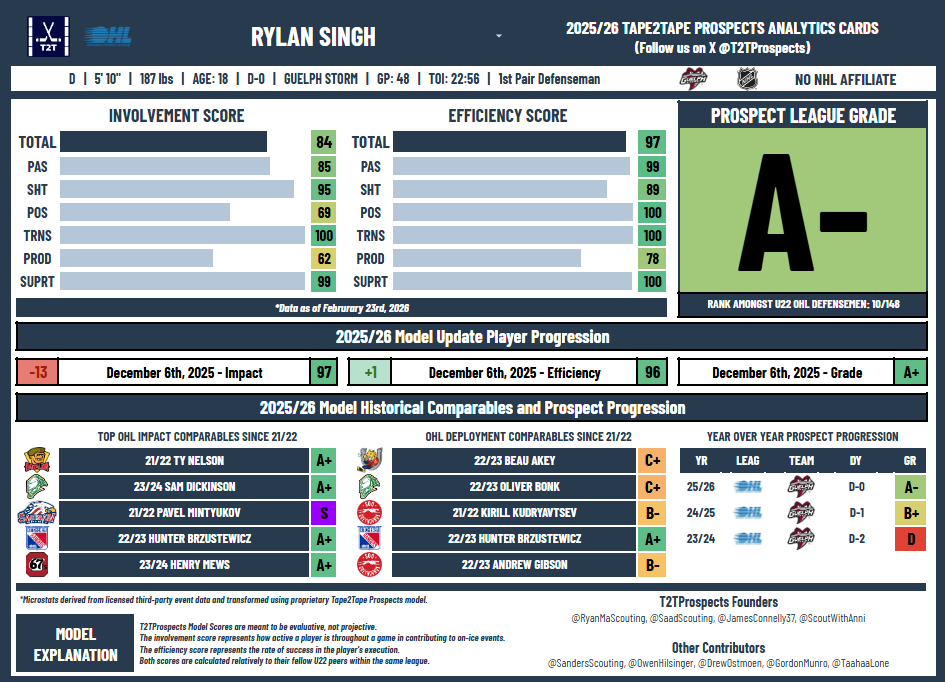
Games Tracked:
11/08/25 vs Flint
11/18/25 vs Kitchener
12/30/25 vs Ottawa
ELEVATOR PITCH
Rylan Singh is a high-usage, raw two-way defenseman who flashes real confidence with the puck, especially when he can skate into space and protect it along the walls, but he’s inconsistent under pressure with turnovers and missed plays at the offensive blue line. His aggressive, high-risk defensive style and average skating lead to big impact plays both ways, but also breakdowns, making him more of a developmental pick.
Rylan Singh is an interesting one. The model loves him, and he plays a lot of minutes for Guelph, but I think he’s a raw product that has more to give than he’s shown at this stage of his development.
With time and space, you can see that there is some real confidence with the puck, where Singh will claim the open ice in front of him to generate entries and exits. In the offensive zone, he has some almost power forward-like skills, where he will shield away defenders to make a play in tight along the wall.
He’s a super high-volume player for Guelph, and the puck touches his stick a lot, which means that while there are plays like above, there are also missed pass attempts and turnovers at the offensive blue line, where he stick handles himself into trouble at a standstill.
There are some nicely timed activations on film, where he gets up into the play and drives lanes hard to help create off the rush, but the average skating holds back his projection there at the next level.
He’s a super aggressive, “reachy”, rush defender for good and for bad. When he wins, he blows up the play, forces offsides, or gets the puck moving the other way, but when he misses, he gets caught flat-footed and can be made to look like a turnstile.
I do like the competitiveness of the player who has pretty good in zone defending, and I think he makes some solid breakout passes while in structure. The biggest red flag for me is that he will lose his head in scramble drills or when the play breaks down. He gets caught frozen in place at times, as the play devolves around him.
#147 – Ola Palme - LD – Vaxjo Lakers HC U20 – U20 Nationell
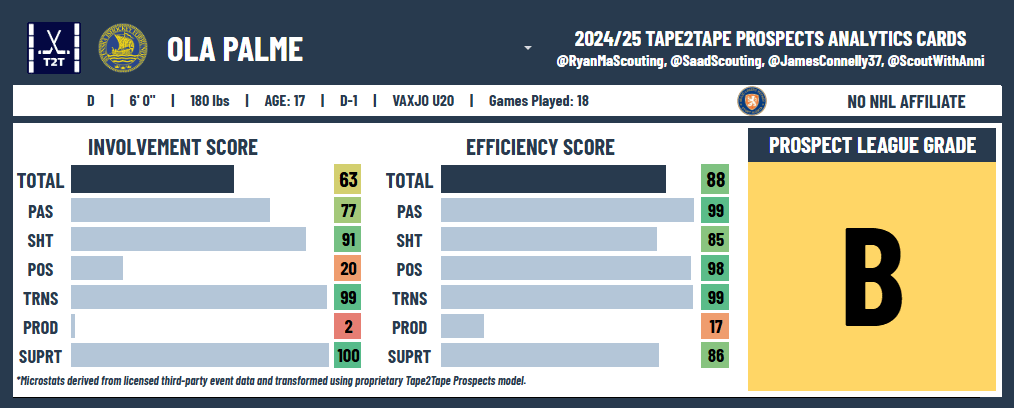
Games Tracked:
02/15/26 vs Linkoping HC U20
12/20/25 vs Imra IK
10/12/25 vs HV71 U20
ELEVATOR PITCH
Palme is a steady, pro-style defenseman with good size, solid distribution skills, and an aggressive defensive stick, but his risk-averse approach and stiff mobility limit his ability to drive play or create offense. There are enough positive fundamental traits to warrant interest, though the overall package doesn’t invoke much excitement.
There are some things to like about Palme. He’s a good size at around 6’2”, and he has some decent distribution skills with the puck when given some time and space. He’s capable of finding teammates on zone exits, where he’ll skate towards the blue line, see the forechecker closing in, and feather a nice pass to the center of the ice for his forward to turn and burn. There’s not a whole lot of deception, but he’s capable of making passes between the lines and has shown some willingness to carry the puck through the neutral zone if there’s open ice in front of him.
Palme is relatively risk-averse for a defenseman, and so while he will pick his spots to very occasionally jump up into the play and roam, most of his offensive shifts are spent at the top of the blue line. There was some chatter after the U18s that there could be some offensive playmaking to unlock with this player, but since returning to his club, it looks like Palme’s identity has focused primarily on playing what many would consider a pro-style game.
Lots of perimeter shots for tips, cycling the puck down low, dumping it in on entries, and a focus on not being beaten on counterattacks. In his own end, there are lots of pokes and backhands either up the wall to his winger or around the net to his defence partner. There weren’t a lot of moments where he’d take the retrieval behind the net and try to skate it out or break the first line of pressure with a pass.
It’s a safe approach, but often he will get hemmed in as he handcuffs his teammates or defence partner in their own end, and they can’t get the puck out. It’s a very vanilla product, and while steady, there’s nothing that excites me to this point about his profile.
It doesn’t help that when he does try to experiment, he doesn’t look particularly dynamic. Unfortunately, I do think the mobility is too stiff for Palme at this stage for him to project into what he is trying to be. He’s too upright, and there are mishandlings with the puck that I think come from that; his stance makes stickhandling and shooting an awkward proposition, where he’ll often mishandle a puck or occasionally fan on a shot.
I do like the attitude when defending. Palme is SUPER aggressive with his stick, and he’ll launch into opponents both when defending the rush and in the zone. He’s super energetic, poking away with his stick, pushing the opponent, trying to force them into the boards and off balance so he can poke the puck away.
I don’t want to write off Palme, who has redeemable traits that NHL teams will value, and is potentially a few mechanical tweaks away from unlocking a different style of play.
#148 - Cooper Soller - Sioux Falls Stampede - F - USHL
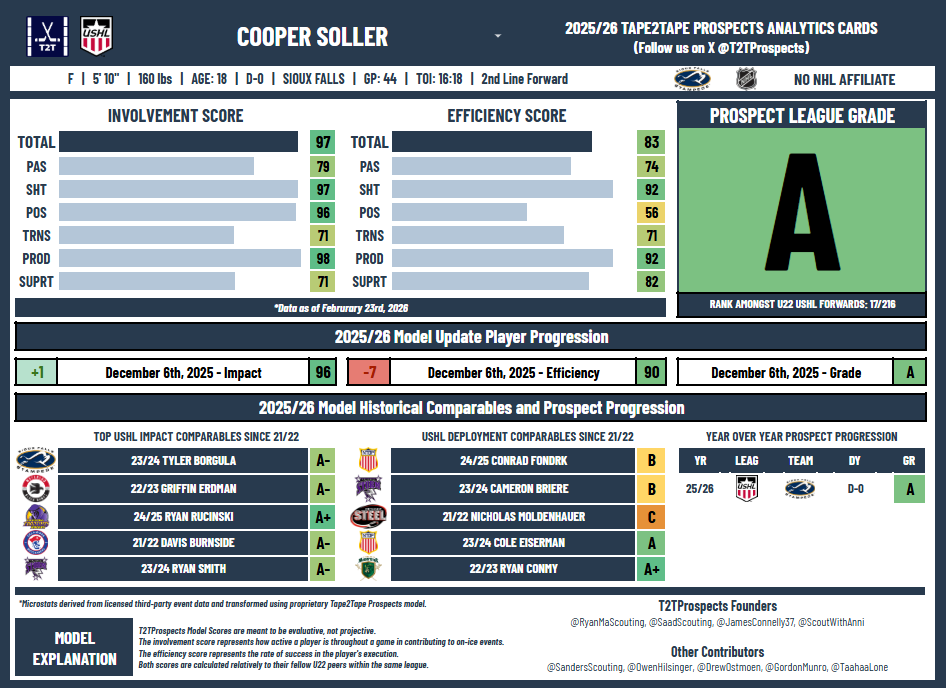
Games Tracked:
03/21/26 vs Sioux City
02/22/26 vs Fargo
01/18/26 vs Lincoln
ELEVATOR PITCH
Cooper Soller is a high-motor, net-front USHL forward who consistently gets to the right areas and creates chaos around the crease despite limited size and strength. His game is built on straight-line drives, timing off-puck reads, and relentless battling in tight, but he lacks the edge work, contact balance, and puck skill to generate much offense.
Cooper Soller is good.
I think the 5’10” forward has some obvious strengths, and equally obvious weaknesses but when you consider that he has an August 2008 birthday, there’s tons of time for him to continue growing and developing.
Let’s start with the good, Soller is a diligent player in his role, which is to get the puck in the net front area and create havoc. He gets into the crease, battling defenders trying to find space and get in the goalie’s eyes. Off rebounds or passes into the slot he gets low, digging at pucks between sticks and skates, jamming away at the puck to try to push it in for a goal, or to pick out and pass to a teammate in the slot.
Ultimately, Soller is another one of these third-fiddle forwards that have some cool tendencies and traits that give me some notion that there’s reason for optimism from a development standpoint. He drives his lanes well in transition, and has some nice timing plays on the forecheck and neutral zone where he will read the play and cut off breakout attempts. Soller will even have a few attempts off the rush where he will try to get low, leverage his lower center of gravity and drive the net.
Unfortunately, I do think the contact balance and strength are a weakness here. Soller isn’t super strong on his feet and doesn’t work through contact very well, he fell a decent amount of times throughout games. In the net front he works hard, but I find especially in terms of taking away the goalie’s eyes and battling defenders, he struggles to gain traction in the crease and instead has to rely on disengaging from the defender and trying to skate around to a different angle.
Soller also isn’t a very dynamic player on his edges and as a result a ton of his plays with the puck when he holds it are very straight line oriented. If he has open ice to skate into, he will claim it, looking to pass or drive the net, but always moving forward. There are close to no use of delays or cut backs to generate time and space for himself. He will skate along the boards until he runs out of real estate and then make a long distance pass to the other side. I’m sure this is part of Sioux Falls’ system, as tons of players were doing lateral cross-ice passes in these viewings, but Soller’s ability to hit on these pass attempts was inconsistent.
Overall, Soller is a mainly off puck player who works hard in his role, has some decent off-puck intelligence and flashes of intending to attack with the puck. Unfortunately, his contact balance and size are limiting factors, and he will need to learn to improve his ability to change pace and direction with the puck to translate to higher levels. He’s certainly not in the same tier of tertiary support players that I like in Duguay, Sparks, Olsen or Rousseau buthe does end up decently high in my honourable mentions. He gets to the right areas of the ice offensively and he’s got good enough straight line speed and intelligence for me to take a flyer on him at this stage given how much development runway he has left.
#149 - Hunter Aura - Calgary Hitmen - LD - WHL
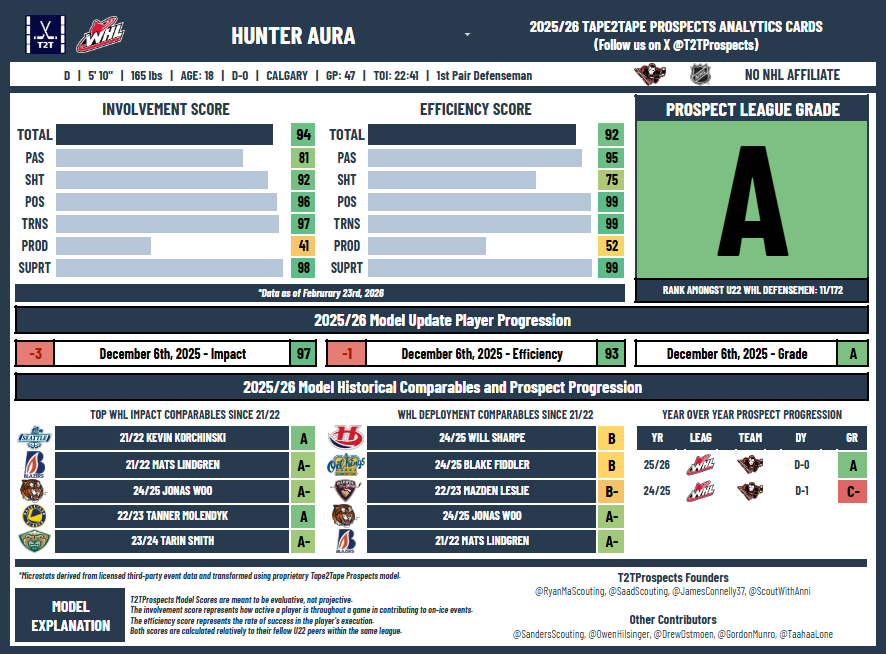
Games Tracked:
03/18/26 vs Edmonton (Playoffs)
03/04/26 vs Swift Current
02/03/26 vs Saskatoon
ELEVATOR PITCH
Hunter Aura is a physically solid, risk-averse two-way WHL defenseman who leans on puck protection, quick outlets, and frequent point shots rather than creativity or tempo control. The issue is that his below-average skating and inconsistent puck handling under pressure will limit how well his simple, direct style will translate against faster forechecks at higher levels.
Hunter Aura is a guy who’s graded well in the T2T Model this season pretty consistently, and while there are things to like about the overall package, I’m just not fully sold that there’s an NHLer here.
In Aura’s defence, he spends a lot of time playing on his offside for Macbeath, and I think that’s worth mentioning as it’s definitely a tougher role to play than being consistently on your strong side. Overall, the Macbeath-Aura pair generates positive possession and xG numbers for Calgary when they’re on the ice and hasn’t really been split up all season.
Aura’s fully aware of what skillsets he brings to the table, and sticks to those strengths rather than trying to be something he’s not. He’s a well-built defenseman who handles contact well, and that’s what he leverages consistently. Aura wants to help push play north, but the success rate is currently pretty hit-and-miss. He uses his frame to protect the puck, using his back to seal off forecheckers to buy himself time to make passes. He’ll also, at times, fade towards his left just to give himself a better angle to sift pucks north. Sometimes it will work well, and he can tuck in these short area passes to his supporting center or locate a winger along the boards while under pressure, but other times he gets the weight completely wrong and misfires it past his teammates entirely.
It’s also why Aura’s most comfortable making plays when he gets it and can immediately find an outlet pass or shot. He gets a ton of point shots off every game, where if he can spot a shooting lane or gets the puck after some nice in-zone passing from his team, he will wrist it on goal, looking for tips. He tries not to hold onto the puck and delay unless an opponent is pressuring him, and is really looking to get the puck up to his wingers in transition and on the net in the offensive zone.
I think some of that mindset comes down to average puck skills and feel, as he often fumbles pucks when trying to make quick plays during scrambles or going for 50/50 plays. Lots of plays where if the puck is bouncing or fluttering on him a bit, he will struggle to make solid contact and control it.
Defensively, his skating is below average. Just doesn’t have that next gear he can hit, and it means he gets beat on a ton of dump and chases by forechecking forwards. I don’t love the pivots or his ability to keep up with opponents attacking him off the rush. Aura relies predominantly on well-timed pokes to dislodge the puck and force the opposing player to slow down and settle the puck.
Ultimately, Aura is going to be a very good WHL defenseman who’s reliable, minimizes mistakes and will always have solid shot contributions. He’s a simple player who looks to get the puck off his stick quickly and relies on his puck protection as a counter to pressure, which I’m not super confident will translate at higher levels. It’s a likely honourable mention for me at this stage, as the foot speed and lack of physicality given his playstyle leave me wondering what his niche will be as he tries to carve out an NHL future.
#150 - Jiko Laitinen - Ilves U20 - F - U20 SM-sarja
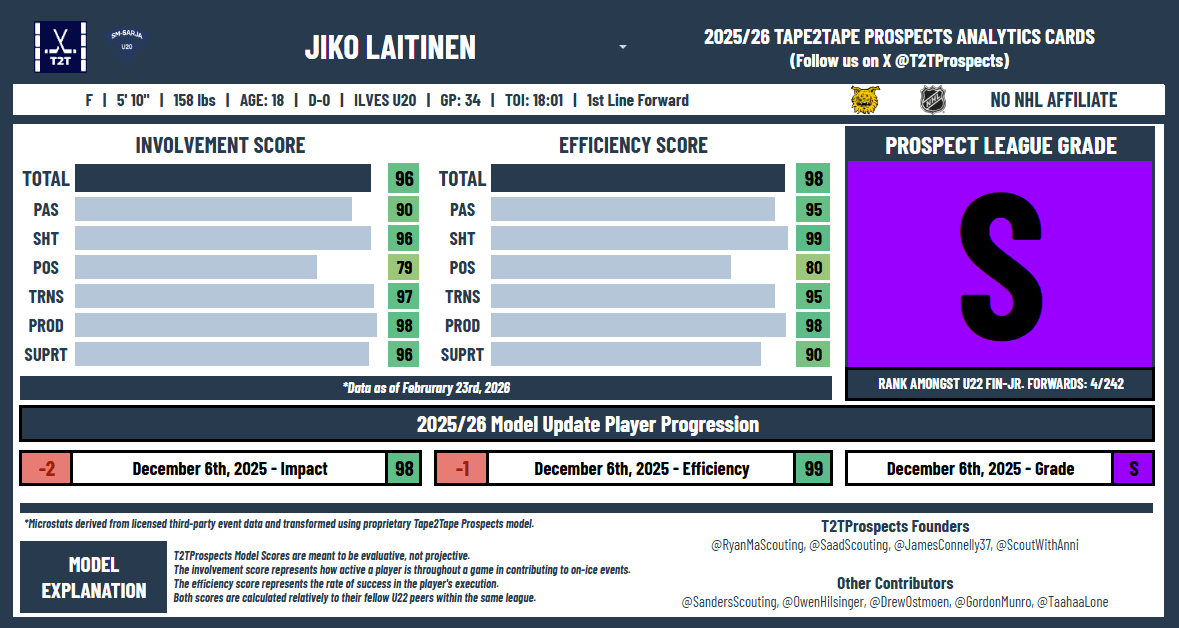
Games Tracked:
03/26/26 vs HPK Hameenlinna U20 (Playoffs)
02/12/26 vs TPS Juniorit U20
01/23/26 vs Karpat Oulu U20
ELEVATOR PITCH
Laitinen is a small, fairly passive winger who flashes skill in transition and around the net but too often defers to teammates and plays in spurts rather than driving shifts himself. He projects more as a useful European pro as he lacks that standout tool that he can be confident in translating to North America.
I had heard some good things about Jiko Laitinen heading into my viewings, and unfortunately, I don’t think the tape met the hype.
Laitinen is fine, but there’s just frankly not anything about his game that really excites me as a smaller player who plays a softer game. He had a few nice plays on exits where he was able to find cross ice passes to teammates on a wide open wing to attack into open ice. For a player with some gaudy transition numbers, I was expecting tons of entries carrying the puck over the blueline and taking defenders one-on-one. Outside of a few entries where he showed nice patience with delays or stop-and-starts to gain the zone and reset the play back to his defenseman, I thought he was honestly someone very comfortable deferring to his teammates.
Offensively, flashes are what it comes down to for Laitinen. There are a few flashes of him picking out pucks through sticks and navigating pressure along the boards, but I find that they never show up enough to impress me. It’s mainly splash plays for Laitinen, who relies on change of pace and direction for his moments of skill and creativity on the puck to open up space for himself; his goal against Roki U20 back in January was beautiful, where he faked going back to the point, spun back and drove the net, cutting across the goalie. I just don’t think it’s a super translatable skillset, and he doesn’t employ other skillsets to allow him to be a consistent driver of play.
The big issue with me for Laitinen comes down to motor; there are flashes where he will get on his horse for a back check or crash in on a forecheck to try to win a puck battle, but it comes in spurts and leaves me looking for more. I honestly think his production and model score ultimately come down to Ilves being an absolute power house team this year, and him getting tons of touches on the power play and in and around the net. Just not enough of an effort for him to go and win back pucks and plays for his teammates. I find that he generally benefits more from the hard work of his teammates rather than being a dangerous creator himself.
Overall, there’s a player that will be good in Europe; he’s got a few tricks up his sleeve that are working for him at the U20 level, and he’s got good fundamentals to his game. I feel there’s a lack of an outstanding trait that I can picture him leveraging at the NHL or AHL level to create advantages consistently. There’s good mobility, a good nose for the net, and clinical finishing around the net, which makes Laitinen a prospect with redeemable traits.
#151 - Brayden Thompson - Youngstown Phantoms - RD - USHL
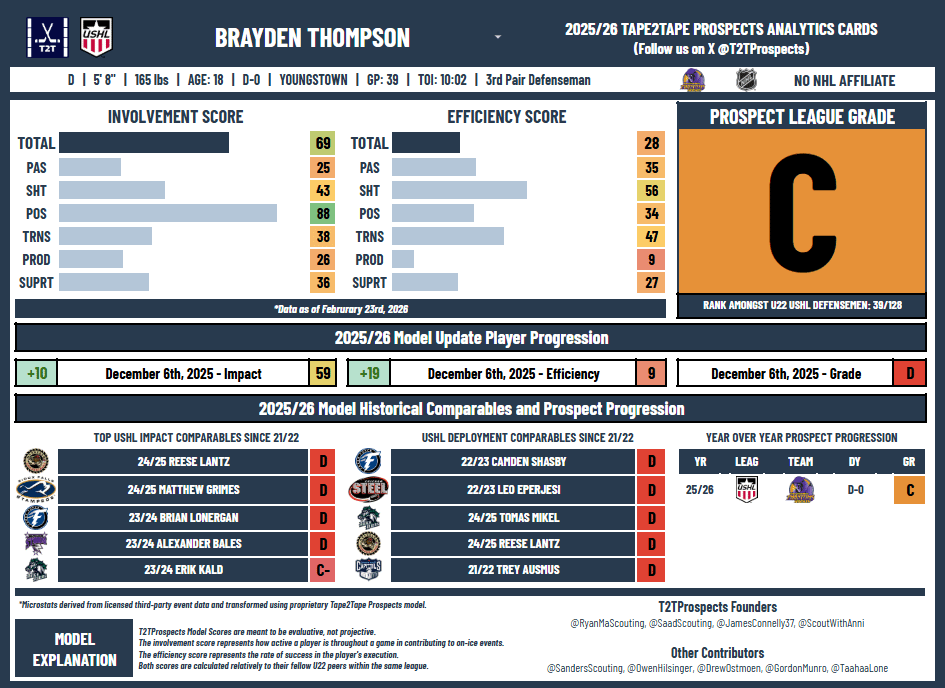
Games Tracked:
03/07/26 vs Madison
02/15/26 vs Muskegon
01/14/26 vs USNTDP U17
ELEVATOR PITCH
Thompson is a mobile, intelligent 5’8” puck-moving defenseman who defends the rush well, moves pucks cleanly in exits, and understands his limitations, but he’s too passive offensively and rarely turns his skating into consistent zone creation. The skill and mobility are worth tracking, but the lack of assertiveness and dynamic offensive involvement keeps him in the honourable mentions tier.
Brayden Thompson is a fun little player.
Thompson doesn’t see a whole ton of ice time with Youngstown, and so the overall sample size I’ve seen of him is on the lower side. Ultimately Thompson’s game comes down to nice, fluid skating that allows him to motor all around the ice with ease. He understands gaps very well when defending the rush, maximizing his mobility but closing down space along the walls proactively to try and force dump-ins from bigger forwards instead of letting himself get boxed in.
Thompson works hard behind the net in board battles, and has a nice, crisp pass that he uses to help Youngstown break out of the zone. There are flashes of him using his low-to-ice center of gravity to shield the puck to escape pressure, but I’d like to see him use this skillset more often and be a more consistent engine in transition and to look for more vertical passes. On the other hand, I do like that he does understand his physical and size limitations and doesn’t try to tempt fate by holding onto the puck for too long like other players at his size may try to do in order to overcompensate for their smaller frame.
I also think there’s more to give in the creativity tank for Thompson, who seems to be a bit worried about making costly mistakes in the offensive zone and seems less willing to take risks with the puck at the offensive blue line. Tons and tons of shot volume from Thompson from the point given the little ice time he gets. I’d like to see him use shot fakes, or head fakes to create space for him to attack the slot with either his skating or passing. It’s a bit too perimeter focused right now for me.
All in all, I think Thompson’s a fun little player who blends his elite mobility with an astute understanding of his strengths and weaknesses. He certainly plays with a bit of tenaciousness and is willing to handle some contact which is always encouraging for an undersized prospect like him on the back end. Ultimately, I think he just doesn’t do the dynamic and fun things required of a player of his stature even close to enough.
There’s a good chance for him to become a high-priority NCAA free agent signing someday (similar to Vincent Borgesi this past offseason), but his passing involvement and contact balance and strength will need to continue to be areas of real growth. A guy who will unfortunately end up in my Honourable mentions simply due to his 5’8” frame , but I think there’s something to work with here... he is by no means a lost cause. NHL teams may not draft him, but check back in 3-4 years time and that interest-level may be drastically different.
#152 - Elia Pedrotti - Malmo Redhawks - LD - SHL
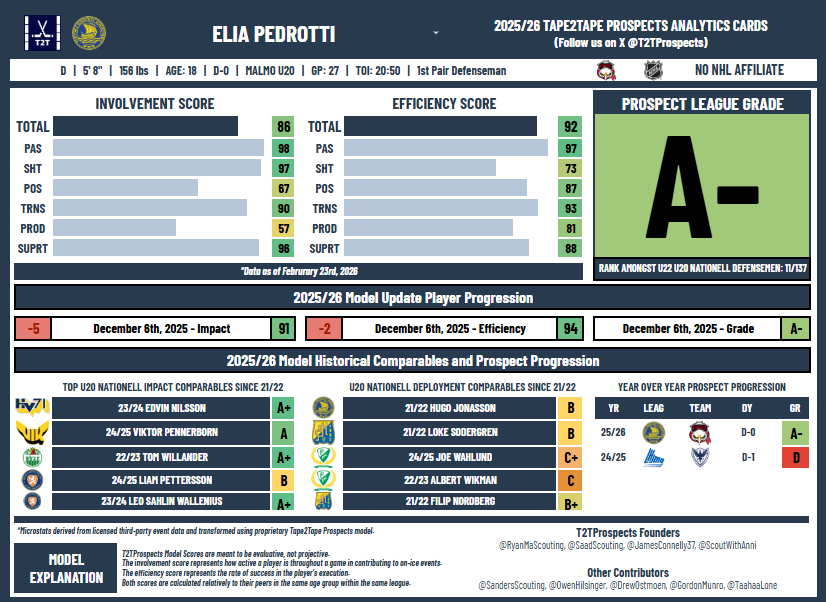
Games Tracked:
03/27/26 vs Skelleftea AIK (Playoffs)
02/26/26 vs Orebro
12/20/25 vs Lulea
ELEVATOR PITCH
Pedrotti is a short but stocky SHL rookie defenseman who holds his own physically and defends the slot well, but plays a very simple, sheltered game with limited puck involvement or offensive impact. His size, passive perimeter defending, and lack of offensive or puck-moving upside make him more of a safe European depth projection but NHL teams could see a developable Bottom Pair/7th D.
Elia Pedrotti getting into a ton of SHL games in his D-0 is impressive stuff. The diminutive left-shot defenseman didn’t find a ton of success in his D-1 in Quebec and has held his own in a super sheltered and limited role for Malmö this year.
Pedrotti doesn’t do much in his SHL games, so his write-up will probably be one of the shorter ones. Pedrotti is short, especially for a defenseman, but he’s stocky, well-built and handles contact very well. Doesn’t get worked over often in the net front area, where he gets low and works hard to box bigger and taller players out of the way. He’s also a defensively aware player who puts a lot of emphasis on defending the slot. Doesn’t overpursue defenders behind the net and will stay parked at the post protecting the net front instead.
Pedrotti’s a fine skater, but given his height, I think NHL teams would want to see him be way more dynamic and quick. There’s nothing wrong with his skating; he gets to his spots well, and he’s mobile enough that he can stay in front of opponents when defending entries.
My big issue defensively for Pedrotti is that he lacks that proactiveness and active stick that I need out of these undersized defensemen who aren’t super dynamic. There’s too much cushion when he’s defending guys out on the perimeter off the rush, and he’s got a shorter reach, which makes it more difficult for him to effectively apply puck pressure.
When he gets out and has to cover guys one-on-one, I think he does a good job, pushing and shoving at just trying to keep the opponent to the perimeter, but he still lacks the size and strength to really force changes in possession. Generally in his own end, Pedrotti does a good job taking away the slot, and he works extremely hard to overcome his size limitations in that area, but I think his reach and size will continue to be a hard cap on how effective he can be on that end.
On breakouts and in the offensive zone, Pedrotti doesn’t really do much either. His teammates tend to keep the puck away from him on breakouts (perhaps to protect the rookie), and his contributions in the offensive zone are generally tons and tons of shots from the point where he’s looking to get a tip on the way in, or a shot off the end boards to try to get the puck in the net front indirectly. He keeps it very vanilla, and it explains why his SHL score (when we still had one for him in December) was a D.
All in all, Pedrotti is what you’d expect from a mid to late round talent playing in the SHL in his draft year. Not super involved, physically mature, and someone who plays a really tight and simple game. At his size and given his skillset, I couldn’t justify putting him in my Top 120, but he’s going to be a really good European pro, and I think that he could be a guy that NHL teams give a shot in a few years, either as an overager or as a free agent signing. Any NHL team that takes Pedrotti this year will be hoping that the hard-nosed approach from Pedrotti in his SHL games will allow him to eventually translate into a Troy Stecher type at the NHL level
#153 - Jake Gustafson - Portland Winterhawks - F - WHL
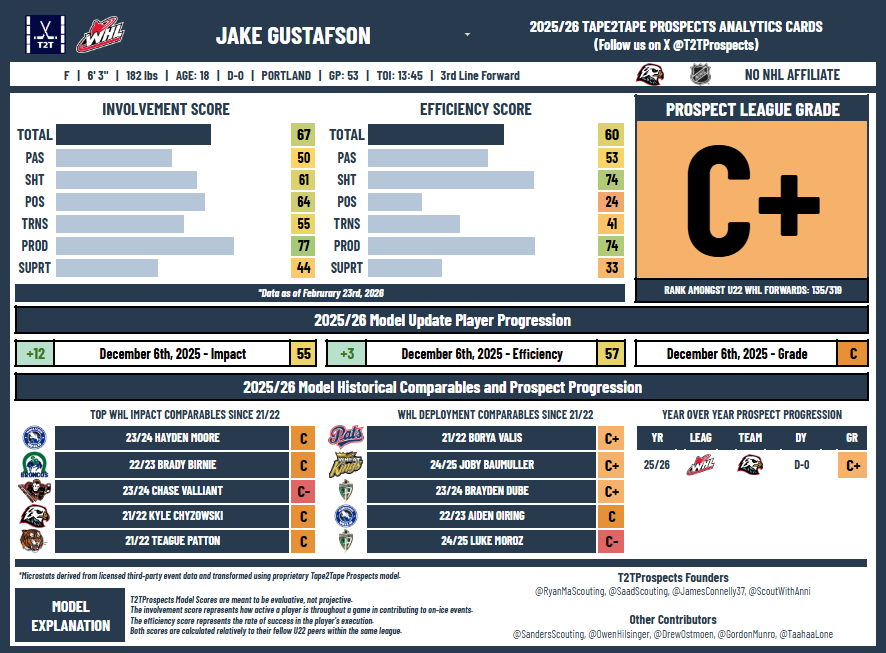
Games Tracked:
03/28/26 vs Everett (Playoffs)
02/20/26 vs Seattle
01/30/26 vs Wenatchee
ELEVATOR PITCH
Gustafson is a big, straight-line power winger who can skate and play physical, with some flashes of smart short-area passing off the rush. But he lacks a clear identity or standout offensive tool, making him strictly a moldable mid-to-late-round project pick.
Jordan Gustafson is a powerful straight-line player who can fly when he gets a head of steam, and is certainly an intriguing mid-round developmental project for NHL teams to sink their teeth into.
There’s a good fundamental base for an NHL team to work with here in Gustafson; he’s big, skates well, and plays with a bit of an edge. He finishes his checks, gets sticks into passing lanes, and works hard in board battles. Watching Gustafsson, despite the T2T Model analytics, I do think he’s a better passer than shooter. At his size, there are some really nice small-area passes that lead to quality chances for his teammates. A nice little drop pass after taking a defender with him to clear the lane, a little lead pass through traffic to a teammate driving the net, Gustafson has shown that there’s potential for him to become a connective playmaker on a line.
Defensively, I think Gustafson generally does a good job; there’s a good motor that he uses to get out and apply real pressure to perimeter shooters, and even though sometimes he gets guilty puck watching and then has to scramble back to get into shooting lanes, I think that he’s got enough of a work ethic in the defensive zone (or at least the right attitude) to work with. I’m sure this might be a system thing, but Gustafson does fly the zone quite a bit, and I haven’t really noticed him generating many meaningful transition entries with that mindset, and I think that ties into my overall hang-up on the player to this point.
I’m not sure Gustafson has an identity or a real idea of what he wants to be as a player. At this point, he feels very much like a player who really is most comfortable playing off the rush when he can let his speed and size be an asset, but he’s not a self-creator at all, and doesn’t have any outstanding secondary skillsets to help him attack the inside consistently. There aren’t flashes of higher-end puck skills, or a laser beam shot... I just feel he’s missing that tool that will allow him to be a more dangerous player.
At this stage in his development, Gustafson is an extremely moldable player, but that also means that there’s a lot of work for him to do to carve out his future identity and role. He’s already a smart playmaker who can make some smart small-area passes, but he’ll need to learn to leverage his frame and mobility to be far more impactful in the other aspects of the game. There’s potential here, and the development pathway is there for him. If he can build confidence in a bigger role next season in Portland before going to Colorado College to refine his physical game, there could be a player here eventually.
#154 - Nils Bartholdsson - RW - Rogle BK U20 - U20 Nationell
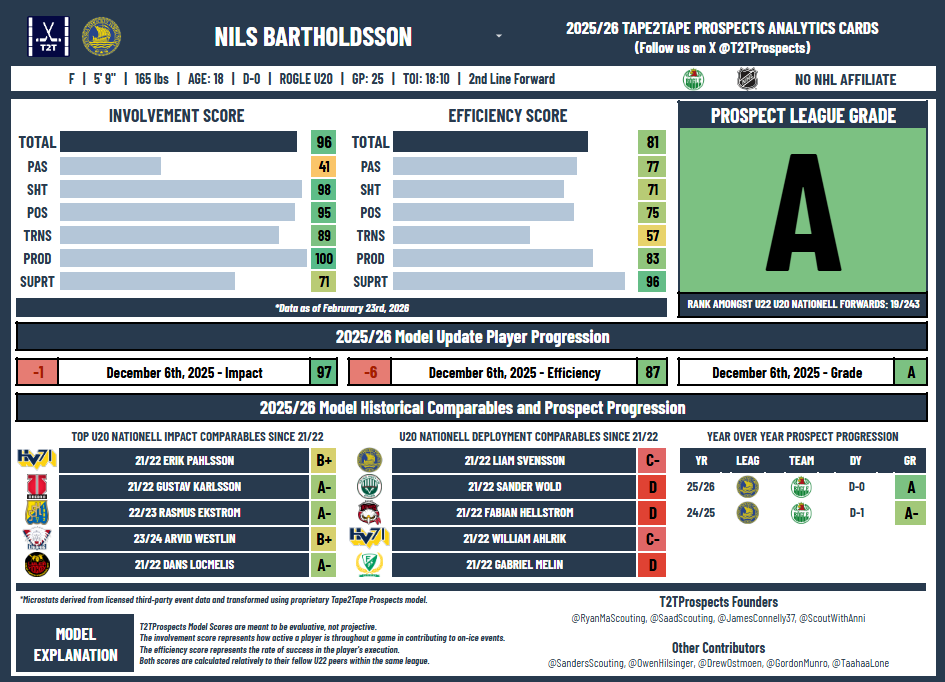
Games Tracked:
10/26/25 vs HV71 U20
01/24/26 vs VIK Vasteras HK U20
02/13/26 vs IF Malmo Redhawks U20
ELEVATOR PITCH
Bartholdsson is a crafty, high-skill U20 winger with elite puck protection, creative passing, and a dangerous snap shot that makes him an offensive focal point at his level. The concern is his smaller frame and lack of pace/explosiveness, which will severly limit how effectively his methodical, puck-dominant style translates to pro hockey in North America.
Nils Bartholdsson is a fun player.
The size will undoubtedly be a mitigating factor, and that’s why, despite his tape showing some strong characteristics, I’m hesitant to be bullish on the player.
Bartholdsson is a crafty playmaker who finds super creative ways to get the puck to his teammates in dangerous areas. No-look backhand passes into the slot, cross-seam passes through sticks on the power play, and a few short-area give-and-goes.
There’s a bit of a tendency for Bartholdsson to hold onto the puck when he gets it, which may be why his passing involvement score is lower. It’s hard to fault him for this; Bartholdsson leverages his lower center of gravity and does a great job of puck protection in the offensive zone, calmly taking on pressure along the perimeter until an opportunity for a pass or a scoring chance materializes.
The combination of puck protection, slick hands in tight, creative playmaking ideas and an absolute rocket of a snapshot make Bartholdsson a helio-centric, offensive powerhouse for Rogle at the U20 level in the offensive zone.
At this level, with his skill set and confidence, he can methodically slice through defending players on the puck.
Off the puck, he does a great job of finding soft areas on the ice to get his wicked snap shot off.
What I don’t see, which is something noted a ton by other scouts, is the pace or speed. Bartholdsson isn’t a burner; he’s enough of a strong skater that he can beat a defenseman in a straight line with a head of steam, but I find his game more methodical than pacey.
Bartholdsson’s skating strength for me comes down to his work in the offensive zone and along the half wall when he has the puck. Sharp turns along the boards, shaking defensemen onto his backside, where he can use the puck protection skills to buy time and space.
The off-puck support game is hit or miss for me, but there’s enough of the good where it’s a level of compete for me to buy in on the player. He isn’t a super physical player, and he doesn’t really commit to getting into shooting lanes. (He sure looks like he is, but I’ve noticed a lot of shying away at the last minute. Gets guilty puck watching at times, but is generally in the right spots defensively. Most importantly, he’s not flying the zone a ton, and he’ll get in on board battles.
All in all, with a bigger frame and more explosive skating off the rush, I think I’d be fully bought in to Bartholdsson. The concern for me is that with a slower, more cerebral approach to his offensive game, which I find is quite reliant on his puck protection, I’m not confident it’s a style that will translate on a smaller ice in North America against pros.
#155 – Alex Mclean – Kingston Frontenacs – F – OHL
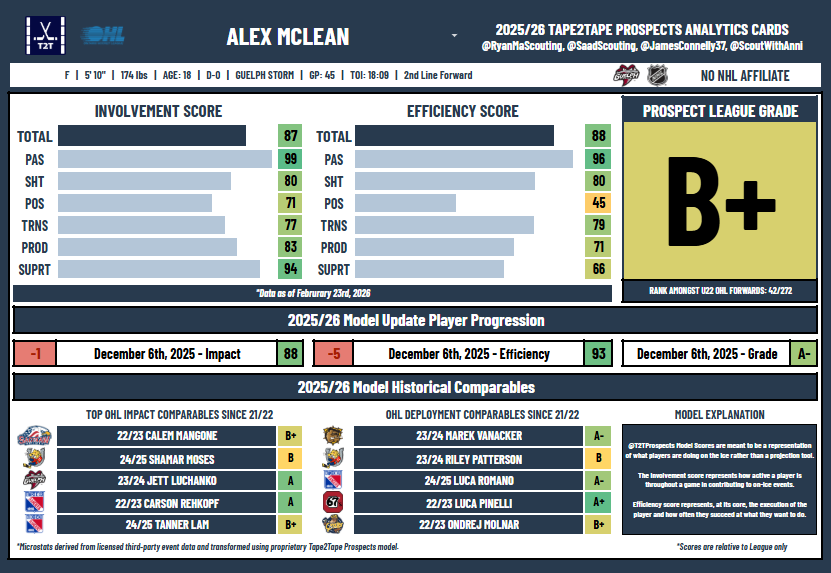
Games Tracked:
02/13/26 vs Kitchener
01/23/26 vs Saginaw
11/14/25 vs Windsor
ELEVATOR PITCH
Alex McLean is a pass-first OHL forward whose best trait is his ability to quickly move pucks into the slot and connect simple, accurate plays in transition and the offensive zone. However, limited separating ability, lack of creativity with the puck, and low engagement off the puck make it difficult to project his game translating at the next level.
I think Alex Mclean will be a fine middle-six OHL player for his career, but I’m not sure there’s anything here that tells me he’ll become an NHLer one day.
The tracking data loves Mclean’s passing, and in all fairness, that is most definitely his best skill set at this stage. The best plays I’ve seen from Mclean in the three games I watched were when he’d snap these diagonal (or cross-ice) passes to get his teammate into open space as they entered the zone. There were also a few nice no-look short area touch passes in transition and in the defensive zone to get pucks to his teammates quickly.
The T2T Model also loves the slot passing, and there are some nice plays here and there of him driving the net with the puck on a two-on-one, or sweeping a pass into the slot on the power play. Ultimately, Mclean’s predominant strength in the offensive zone lies on him getting the puck and trying to find passes into the slot area, but I fear that the way he gets the puck into these great danger areas is ultimately not super translatable. He doesn’t have great hands or vision, and while his passes are accurate and well-placed, overall, I think he plays a too direct and simple game with the puck. This isn’t a Wyatt Cullen situation where he can create something out of nothing or use his eyes to create passing lanes.
I also find that for a player whose passing is his biggest strength, Mclean has some real pace concerns. He doesn’t push play north with the puck on his stick, often opting to slow the game down and playing the puck back to his defenseman to reset. Even when he’s trying to progress the puck forward, a lot of the time it’s lateral cross-ice passes to the opposite wing. I ultimately think it comes down to Mclean not having the greatest skating. The mechanics are fine, but he generates little to no separation in straight lines and lacks the hip fluidity and edgework to be elusive in tight spaces. It leaves him super reliant on getting pucks off his stick and to a nearby teammate quickly whenever he gets the puck in traffic… which he does with very inconsistent levels of success.
The skating also holds him back from being a super impactful forechecker, and while I think he mostly does a good job of getting out to take away shooting lanes, his motor and willingness to make plays on the board are seriously lacking. Very low puck battle involvement, no takeaways, and he doesn’t really engage physically around the ice.
A lot of the goal scoring comes off broken plays or rebounds, and I have yet to see a goal this year from him where he actively created a chance instead of benefitting from a bad turnover, or a scramble out front. You would think this means he has really good awareness when he’s off the puck to be able to pounce on these moments, but he’s a player who constantly looks like he’s chasing the play. Passes will already be in his feet in transition by the time he looks back to check if he’s receiving a pass, and overall, I think he’s just not the cleanest puck handler.
All in all, Mclean is an average OHLer who will probably go in the mid to late rounds. The passing skillset is not dynamic nor creative enough for me, and the rest of his game is something I struggle to see translating at the pro level. Most certainly a guy who’ll be a decent OHLer, but someone I struggle seeing a path for him past the AHL/ECHL.
#156 – Adam Levac – Peterborough – C – OHL
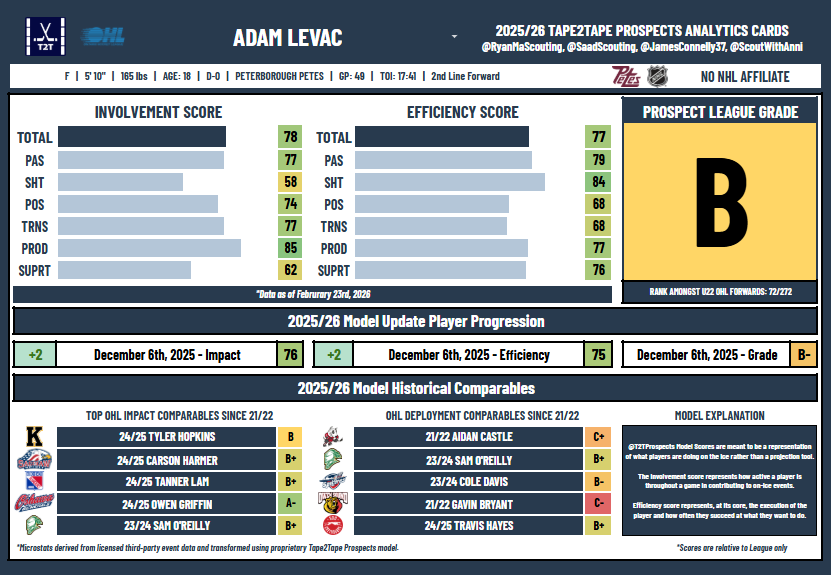
Games Tracked:
03/15/26 vs North Bay
03/06/26 vs Niagara
01/30/26 vs Ottawa
ELEVATOR PITCH
Adam Levac is a dependable, OHL forward with average tools, who plays a structured two-way game, gets to his spots, and chips in physically without ever really driving play. The issue is the complete lack of a standout trait, leaving him as a low-ceiling depth type with limited upside.
For better or for worse, Adam Levac is going to be most well-known for his slewfoot takedown against the Ottawa 67’s back in February. The 6’0” RHC for the Petes has logged significant minutes as the season has progressed.
After watching him and Kolarik in quick succession, Levac has failed to move me. There are some flashes of physicality early in games, trying to set the tone, finishing checks... but ultimately, Levac is a fine Swiss Army Knife OHL player who does a lot of things at an average level, but not really anything at a good to great level.
He’ll likely continue to serve in a top-six role throughout the rest of his OHL career as a dependable glue guy, but I’m not so optimistic about his skillset translating into a role in an NHL organization one day. Levac is average-sized at around 6’0”, 170 lbs, and the skating is good. He gets around on the ice smoothly, but there isn’t really an explosive top gear to speak of for him, unlike a player like Ryder Cali. On the forecheck, he has his moments. As the F3, he does a good job of keeping the play in front of him, but a really passive player who doesn’t read plays at high speeds to insert himself to disrupt the flow of the opposing team trying to break it out of the zone. When he finds himself as the F1, there are some nice moments of physical play, and he can win some puck battles before trapping it along the boards to await his teammates to rally to the puck.
In the defensive zone, Levac is a good positional defender, but I wouldn’t call him super high-motor. There’s some puck watching, but he generally does a good job of keeping the slot covered and joining board battles at appropriate times to fish pucks out. He’ll also cut out wide to present a passing option to his defensemen along the boards if his wingers aren’t where they need to be, and because of his general awareness and positioning, he does a pretty good job getting to loose pucks and getting in the way of passing lanes for takeaways.
Offensively, Levac has his moments of physicality and a hard work ethic, pushing and trying to win back pucks. Unfortunately, I do think Levac’s skill set with the puck as a creator is genuinely non-existent. He never tries to attack the middle of the ice with the puck, struggles to navigate and hold onto the puck under pressure and generally looks to dump the puck, get it off his stick, or allow himself to get board played when he faces any sort of opposition. His goals come from either broken plays, rebounds, or the occasional rush chance.
Overall, Levac lacks that X-Factor trait, something that he truly excels at, something that NHL teams can look at and go: That’s something that will play at the NHL level. There’s just nothing here that makes me really excited. He’s dependable, predictable, and gets to his spots on the ice, but I just don’t see that eye-popping trait.
#157 - Doman Kristof Szongoth - KooKoo U20 - C - U20 SM-sarja
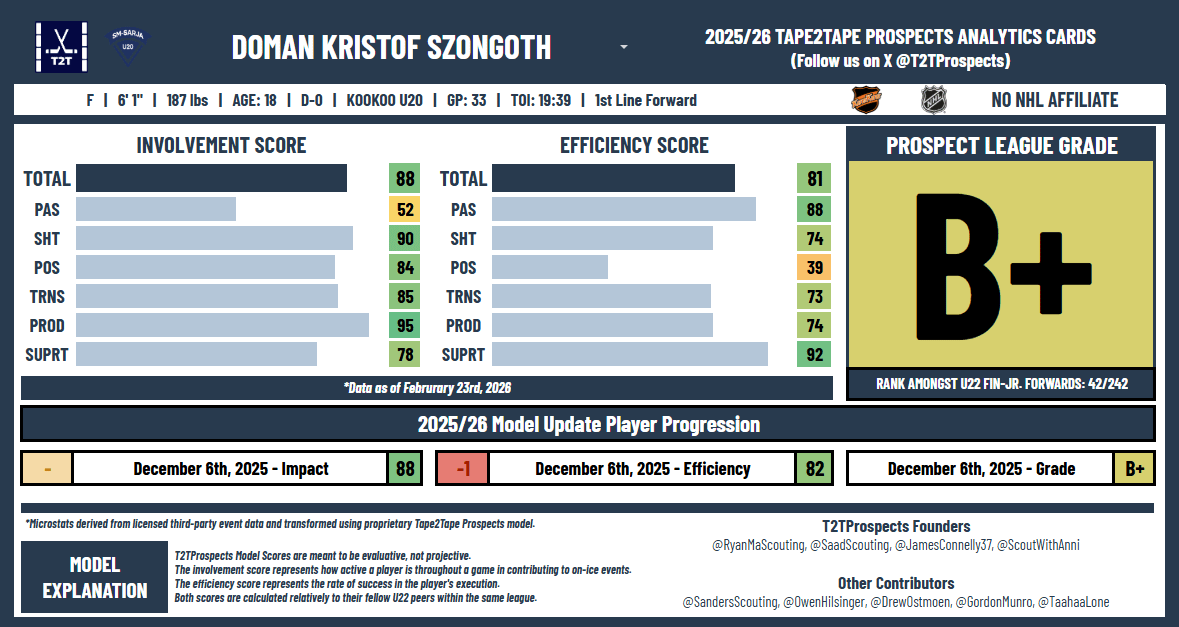
Games Tracked:
03/06/26 vs Roki U20
01/30/26 vs Ilves U20
12/04/25 vs Saipa U20
ELEVATOR PITCH
Kristof Szongoth is a hardworking, physical player who shows good effort, awareness, and simple passing instincts, but his extremely limited skating (poor acceleration, heavy strides, and weak agility) prevents him from consistently creating or escaping pressure. He projects as a low-ceiling depth player unless his mobility takes a major leap, as his current tools are too constrained to translate to higher levels.
I was recommended to watch Doman Kristof Szongoth, and I’m sure he’s got much better games than I’ve seen, but I just don’t think there’s an NHL future withhis current level of skating.
The best way I can describe the aforementioned skating is Bambi on ice. The strides are choppy and heavy, he struggles to accelerate or to change direction, and it means that he really has no real counters to pressure and defensive coverage outside of throwing out a shoulder or an arm to try to ward guys off of him. He uses this when entering board battles, relying on his upper body to leverage and wedge himself into plays to try and create space to get in on pucks.
It limits how much of a creator Kristof Szongoth can be in the offensive zone. His top speed is actually pretty good, but he can’t really use it to gain a step because of the aforementioned acceleration, and his puck protection isn’t amazing either, which means he can’t delay or hold onto the puck. Instead, you’ll see lots of long snap passes in the offensive zone.
What I can appreciate about Kristof Szongoth is that he’s aware that he can’t really stop or change direction, and he’s just very willing to eat contact to make plays. Getting forearm shivers to the chest to get the puck out, getting absolutely plastered in the corner on offensive zone retrievals, and getting stonewalled when trying to skate through traffic in the neutral zone. He takes a ton of punishment out on the ice, but he never lets it stop his feet from moving, and he’s always getting out and giving a good, hardworking shift.
There are some good ideas from Kristof Szongoth. He’s generally in the right spots defensively, and he’s got a good feel for the game in terms of where he needs to be on the ice. There are some occasionally nice touch passes in transition and off the rush, and he motors around the ice trying to break up plays and win pucks.
Overall, Kristof Szongoth is a hard-working player with good physicality and some nice potential ideas as a passer, but the skating is a HUGE roadblock to his potential pro projection. It’s probably one of the shortest write-ups I will do this year, and while it may look like this is a pretty negative outlook, I think there are ideas that he wants to be able to execute, but are being limited by his skating. I might not even give him an honourable mention with his current tape, but I believe that with some real growth in his skating, there could be a player worth taking next year as a re-entry.
#158 - Dayne Beuker - F - USNTDP - USHL
Games Tracked:
02/22/25 vs Chicago Steel
ELEVATOR PITCH
Dayne Beuker is a high-motor, straight-line forward whose best attributes are his speed, relentless forechecking, and active stick, allowing him to consistently pressure puck carriers and force turnovers. While he plays a responsible, detail-oriented game and shows a willingness to engage physically, he lacks the offensive creativity and standout skill needed to project as more than organizational depth
Dayne Beuker is just a very vanilla player. As a Leafs fan, he reminds me a ton of a budget Calle Jarnkrok in a lot of ways. They both have these spurts where they look like they’re skating really hard. That is a pro of Beuker’s game; he has the ability to get from Point A to Point B in a hurry. The big pro, however, I would say in this game from Beuker was his incessant motor; he really is always around the puck, and that’s not because he’s a heliocentric playmaker, but rather because he’s always pressuring the puck carrier defensively.
Like Jarnkrok, he’s not this nasty, super physical player, but his stick is super active, and he just swarms you and takes away space. He forced three or four turnovers in the offensive zone this game just with his effort level, cutting off passing lanes and space with his forechecking. It’s also nice to see that he is willing to try to take the body along the boards on the forecheck, and he does a really good job using his body to slow down opponents in transition. He’s too small to effectively move anyone off the puck, but it’s encouraging to see that he’s at least willing to engage physically.
Defensively, he’s fine. Not super engaged by any means, but I did see moments of him covering the slot, coming down low to support his defensemen, and he understands what lanes to fill in transition and on rush opportunities. Outside of that, there wasn’t much to speak of; he didn’t show any high-level manipulation as a passer, doesn’t shoot a ton, and his line didn’t have a ton of offensive zone time, so I never got to see how he held up against physicality along the boards as a puck carrier. I just don’t think the tools and skillsets are there for him to be a true difference maker at the next level at this stage of his development.
I’m sure Beuker is a player any NHL team would draft as organizational depth with the hopes that he could develop a defining trait offensively. He’s a fine low-upside player, but given his playstyle at his size, I don’t think he’s someone I’d even consider until late in the draft.
#159 - Dylan Dean - LW/RW - Edmonton Oil Kings - WHL
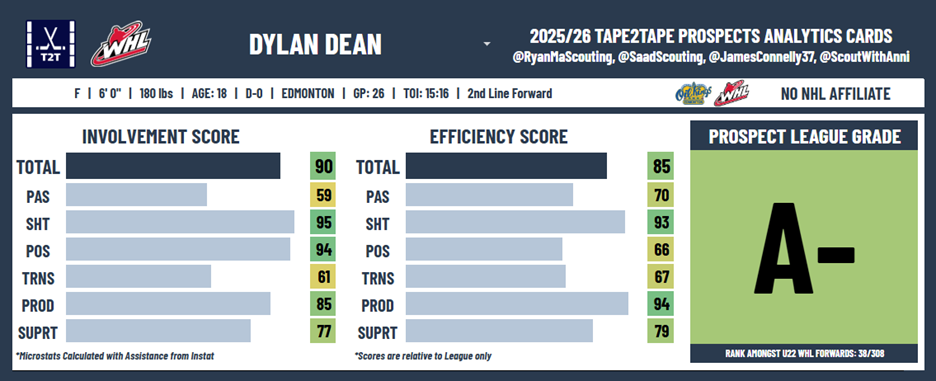
Games Tracked:
10/06/25 vs Medicine Hat
10/18/25 vs Prince Albert
01/01/26 vs Red Deer
ELEVATOR PITCH
Dylan Dean is a low-risk depth forward who plays a pro-style, straight-line game with strong net-front habits, good defensive awareness, and consistent engagement without the puck. His lack of speed, unspectacular tools, and inability to consistently attack inside lanes makes his projection a difficult one.
For the most part, Dean’s game shows up pretty pedestrian on tape. Nothing much about his game stands out. He’s jumped around the lineup a lot this season on an Oil Kings team with a ton of depth. Some nights, he’ll play almost 20 minutes a game; other nights, he’ll be on for around 10 minutes and some change.
At the risk of sounding repetitive, Dean feels like a quality depth piece. His skill set, for the most part, is average across the board. His skating stride is smooth, but he’s not particularly fast or explosive. He’ll finish his checks on the forecheck, but that physicality is inconsistent, and he often gets to his marks late, whether he’s the F1 or F2.
I don’t think it’s a lack of effort on his part. Dean does try to get to his spots, and he has good scanning habits defensively and on breakouts, where he’ll make sure he’s where he’s supposed to be in order to support his defensemen.
In transition, he’ll take the open ice in front of him when he gets on a loose puck off a bounce, but for the most part, he defers to his linemates. Dean is ultimately a generally direct, straight-line player who doesn’t quite have the speed to profile as a Pierre Engvall type. The few times I saw him try to attack the inside usually resulted in a stick lift and the puck going the other way.
However, the pro habits are 100% there for Dean. He drives the net hard and stays engaged in net front battles, crashing the net at every opportunity on shots. The goals I’ve seen him score this year have all been in the general vicinity of the crease, where he’s banging at loose pucks in the scrum and just being a general nuisance for opposing defenders to handle.
On the puck, there are some real flashes. While Dean struggles to attack inside lanes, he has some smart ideas as a passer and puck handler, especially around the goal line. Knowing he doesn’t have the speed or power to take the defender off the rush, he’ll pull up, fake the pass to a trailing teammate, and drag the puck down with him as he pivots, drawing the defenseman out of position and onto his back hip. Below the goal line, he has some impressive no-look backhand passes into the slot that could have led to goals if his teammates were able to get on the receiving end or the same page as him.
All in all, the limited natural skillset and athleticism for Dean likely mean his NHL projection is capped, but there’s a smart, detail-oriented player who works hard in the net front and has flashes of plays that suggest there maybe more than meets the eye.
#160 - Nikita Koltsov - Tolpar Ufa - C - MHL
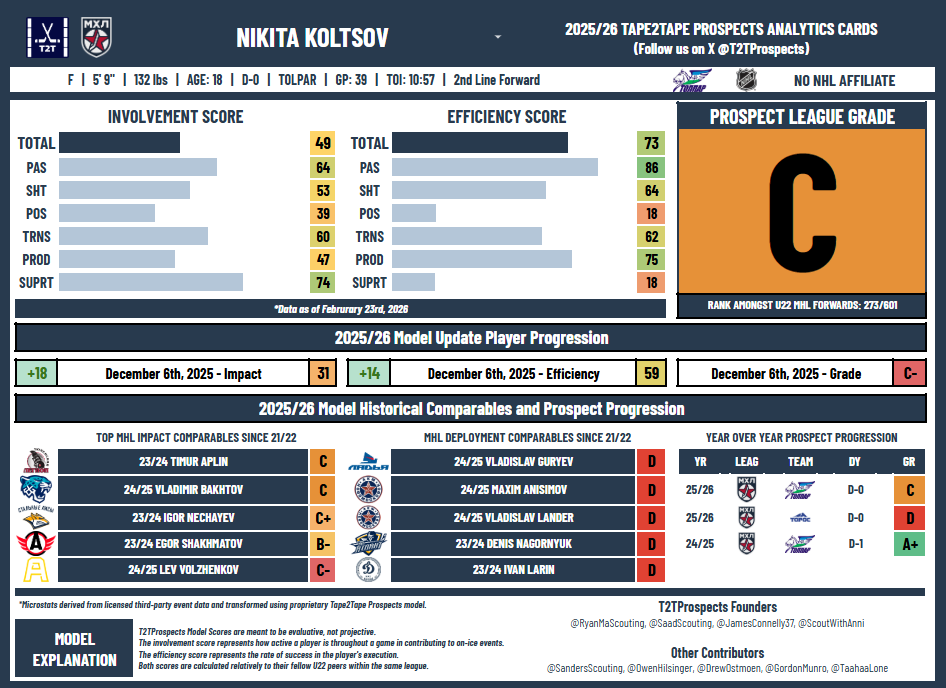
Games Tracked:
04/03/26 vs Avto Yekaterinburg
03/07/26 vs Krasnoyarskie Rysi
01/25/26 vs HC Belye Medvedi
ELEVATOR PITCH
Nikita Koltsov is a fundamentally sound, mobile winger with occasional flashes of transition skill and small-area passing, but his game lacks consistency, physicaity, and creation. He’s a fine player who treads water at the MHL level but the profile and skillset suggests long time KHL pro.
Nikita Koltsov is an interesting player, but ultimately like a guy like Jiko Laitinen, I’m just not sure there’s a future NHLer here.
Koltsov was one of the model favourites last year in his D+1, which earned him some early season stints in the VHL. Despite being one of the older players in the class, his viewings in the VHL were pedestrian and after his return to the MHL has ice time has continued to shrink as the season’s gone on.
There’s nothing particularly wrong with Koltsov, he’s got fine skating at his size, is willing to finish a few checks on the forecheck and he’s got a few nifty passes in small areas to get it away from pressure and to his teammates after crossing the offensive blueline or in the neutral zone. There’s certainly good fundamentals here for a long time European pro. Koltsov didn’t show it in the VHL, but in the MHL he actually has a few flashes where he will build up speed through the neutral zone and try to slice through the defense off the rush and go end-to-end. He had a nice play against Avto Yekaterinburg where it worked and he looked incredible, but there were equally as many turnovers at the blueline where he got knocked off balance and lost the puck.
In the offensive zone Koltsov is also fine. Good off puck movement to try to find open pockets of ice, and he will flash through the slot as a screen despite his smaller size. With the puck he struggles to get it to the center of the ice, and his puck protection is very hit and miss. When defenders give him a bit of room to operate off the half-wall he will weave left and right to try to shake them, but when the distance closes and he get’s hit with contact there isn’t really an ability to counteract that. Lots of passes into the slot and shots from sharp angles that don’t really generate quality chances.
Koltsov does do a good job reading rims in both ends of the zone, and rushing to cut down breakouts in the offensive zone or cycles in the defensive zone, but the engagement and activity elsewhere the intensity and commitment lags. Not enough intention to cut down angles and passing lanes in the center of the ice, doesn’t close out on point shots, and he doesn’t really stay in structure in the defensive zone where there’s too much roaming. As the center he doesn’t support his forechecking teammates enough in terms of making the hard physical plays to force puck carriers into tough decisions.
All in all, Koltsov has a few nice flashes offensively that ultimately come down to the quality of his league, and while he has a fine fundamental skillset to not lose his minutes on the ice, I don’t think there’s real NHL upside here.
#161 - Caleb Pittsley - Madison Capitals - F - USHL
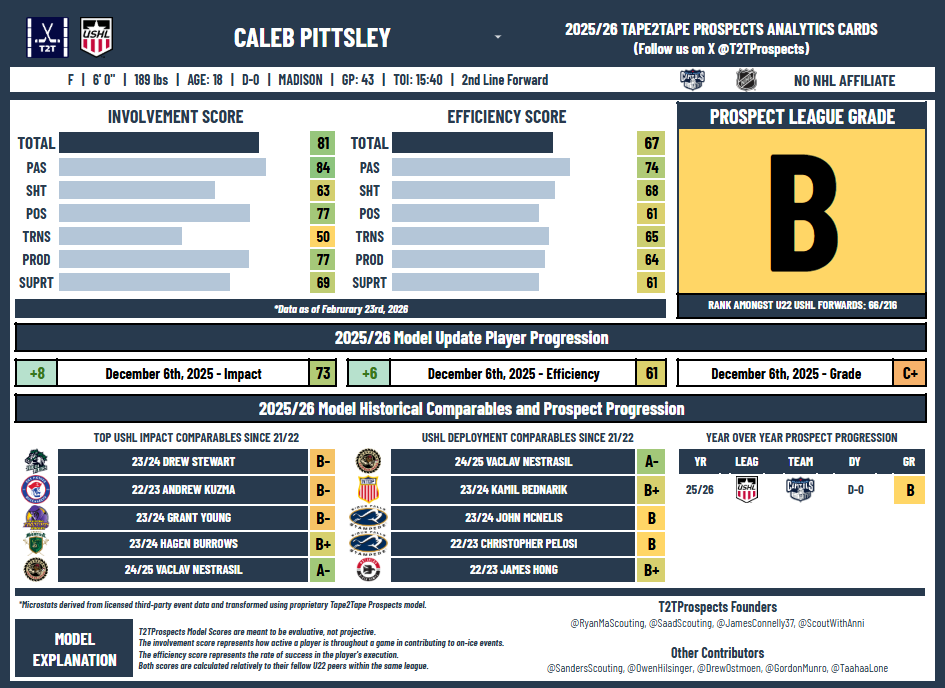
Games Tracked:
03/28/26 vs Sioux City
03/06/26 vs Youngstown
02/20/26 vs Des Moines
ELEVATOR PITCH
Pittsley is a 6’1” winger with some flashes of finesse passing and short-area connectivity, especially along the offensive blue line and half-wall, but his execution falls apart under pressure and over longer sequences. Combined with inconsistent effort away from the puck and limited physical engagement, his pro hockey outlook is murky.
I complete my viewings incredibly unmoved by Pittsley despite him being one of the biggest growers in the model from December to March.
Pittsley is a 6’1” winger who’s skillset resolves far too much around finesse given his skating and skillset. The finesse plays do have moments that show up nicely on film, Pittsley thrives when receiving the puck along the boards near the offensive blue line. He has some clever plays, making quick drop passes off the boards, a few nice little bumps to the center of the ice for his teammate to skate into. There’s some nice ideas and dexterity from Pittsley at times that will point to him possibly evolving into a short-area connector of play down the line.
Unfortunately he struggles to make these same plays when he tries them over longer distances. Pittsley has ideas where he wants to be able to hold the puck and make delays to find cross ice passes, but he often leaves the puck too far out away from his body and then struggles to execute his ideas through contact and pressure when smaller, quicker players pounce on the lightly protected puck.
In the offensive zone against a set defense, Pittsley does get lost in the play for stretches. His primary role is to get to the net front, but unlike Soller he’s not doggedly getting into the crease area trying to wreck havoc. Instead Pittsley relies on smaller defenders not trying to tie him up, and to attempt these soft tips off point shots to drop it between the goalie’s blocker and pad.
Overall, I just think for a player who’s offensive contributions with the puck are rather hit or miss, Pittsley doesn’t work hard enough everywhere else. Little to no physicality along the boards for a player of his size, doesn’t drive the net hard in transition, and his feet are very meh in the defensive zone. Lots of standing around on the penalty kill, where instead of driving out to cover a point shot and force a pass to the flank, Pittsley will just stand in the mid slot area and try to block the shot, not even attempting to cut down the shooting angle.
The backchecking effort from Pittsley is also not my favourite. Lots of changes when the play goes the other way, and lots of him hanging around in the neutral zone on the backcheck to see if there’s a pass that can spring him. When he is the first forward back, just very poor recognition in terms of locating the backdoor net drivers. Too much puck watching and not enough proactiveness nor attention to detail.
All in all, Pittsley is an older prospect with a physically mature frame but lacks the overall motor and effort level you would expect to see. The passing and connective play I think is a skillset that shows promise and can be developed, but I’m just not sold on the overall package. There are ideas offensively, and good ones, but I don’t think the toolkit will be good enough to ever execute the plays to the levels in which his ideas aspire them to be.
#162 – Andrew Robinson – Windsor – LD – OHL
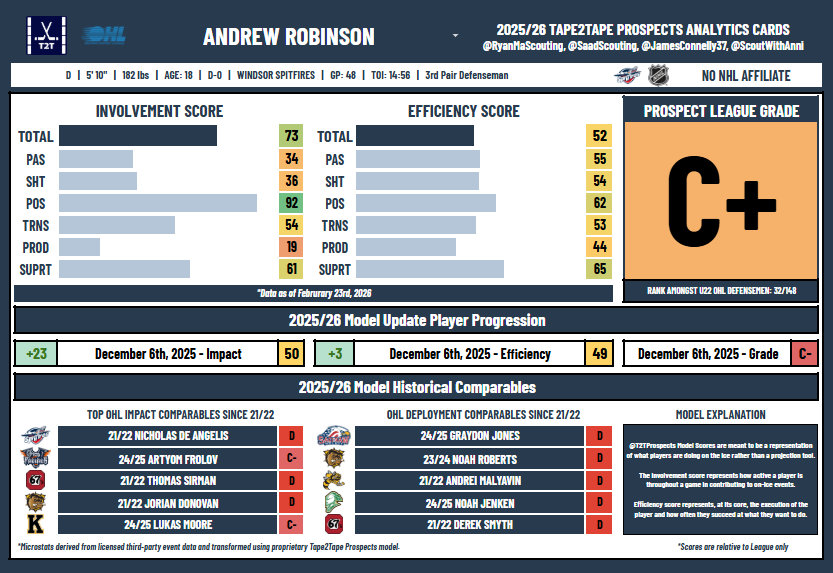
Games Tracked:
03/22/26 vs Soo
02/14/26 vs Saginaw
01/30/26 vs Kitchener
ELEVATOR PITCH
Andrew Robinson is a mobile 6’0” LHD who defends the rush well with good gap control and stick detail, and adds value as an aggressive off-puck joiner on the rush with some PP skills. The concern is that his in-zone defensive consistency and limited on-puck creativity/carrying ability make his NHL pathway difficult to envision.
I’ll admit that Robinson wasn’t on my watchlist until I saw he scored a hat trick against London, and suddenly the 6’0” LHD found his way into this batch of viewings. After watching him, Andrew Robinson is fun enough as a player and I think there’s a future OHL PP1 QB here, but I’m left wondering what his roadmap to the pro level would look like.
Robinson’s a good skater, and he’s a very good rush defender. Not the smoothest feet but he’s got good knee flexion and it allows him to maintain good gap discipline and also explode out to attack puck carriers with super accurate pokes and stick checks while also being able to ride them into the perimeter and away from the net.
On retrievals and exits from the defensive zone, Robinson keeps it simple. Lots of quick rims around the end boards to his defense partner or quick outlets into the slot for his centerman. Robinson likes getting the puck off his stick and into the center or opposite lane so that he can do what he does best, which is join the rush on the backdoor.
Against London his first goal was him jumping up into the play and driving the backdoor discretely where he was left uncovered. Against the Soo, a nice bump pass to his teammate at his own blueline before driving the center lane where he was able to get behind the defense for a break after a nice sauce pass.
Because this is the defining trait of Robinson’s game there aren’t a ton of carries out of the offensive zone… which I would like to see more of, but he does have a few plays where he will take the puck down low in the offensive zone as a defenseman and look for passes.
Unfortunately the in-zone defending is hit or miss. I find Robinson soft in the net front area when it comes to defensive coverage. Some nice stick tie ups but lots of standing around and last second pokes. Aganst the Soo he didn’t stay with his man rotating from the corner to the net front and nearly allowed a goal against because of it.
All in all, Robinson’s a fun off puck transition player that does give me some distant shades of Ruml, but I find the natural puck skills and creativity lacking for a defenseman of his size and the effort level in the defensive end is too inconsistent.
#163 - Moussa Hackert - RB Hockey Juniors - RD - AlpsHL
Games Tracked:
04/03/26 vs Slovakia U18
03/20/26 vs HC Gherdeina
02/05/26 vs KHL Sisak
ELEVATOR PITCH
Hackert is a simple, low-risk 5’11” defenseman who holds his own against better competition with aggressive rush defending, solid gap control, and a willingness to win board battles through effort rather than size or skill. Offensively he’s very conservative, relying on safe outlets and low-risk puck movement. This makes him a reliable but fairly limited player to try and project.
Hackert is fine. I honestly can’t speak to the quality of the AlpsHL since I hadn’t watched it before today but Hackert held his own against the Slovakia U18 team as well as one could expect and so I think at the very least there’s a player worth putting on the board.
Hackert is a good aggressive rush defender who steps up to break up passes to players trying to stretch the ice vertically. He gets low in his stance when defending rushes and generally has good enough skating and hips to turn and chase down players that do manage to gain the zone. He’s not the most physically imposing player, and he’s small for the position but he throws his entire weight and upper body into board battles to effectively pin more strong and explosive players to the boards.
There’s a nice simplicity to Hackert’s game which is to focus on getting pucks to his defense partner or his re-loading center. He doesn’t really push the needle as a vertical passer, nor does he really try to do anything particularly exciting with the puck. It’s a workman like shift, break the puck out, cycle the puck down low in the offensive zone, get back and defend the blueline and try to gate the opponent towards the perimeter where he can then board play them along the end boards.
It’s a fine, very vanilla product, and he’s clearly good enough to hang with the higher levels of talent better than a guy like Kramer who struggled mightily against the same team but I wonder how much more developmental runway there is for this player who doesn’t boast the most outstanding physical or athletic traits and plays a very safe and simple game at 5’11”.
#164 - Tobias Kramer - Jungadler Mannheim U20 - RD - DNL U20
Games Tracked:
03/28/26 vs ERC Ingolstadt U20
02/05/26 vs Slovakia U18
12/13/25 vs Krefelder EV 1981 U20
ELEVATOR PITCH
Tobias Kramer is a 6’6” RHD with intriguing straight-line mobility and some on-puck confidence that lets him push through weak DNL U20 pressure and even attempt end-to-end rushes, giving him real “tools-based” upside at first glance. However, his decision-making, defensive details, and ability to handle structured forechecks collapse against higher-level competition, making him a high-risk project pick who looks far from a reliable pro projection right now.
I really did not want to add a DNL U20 player to my already way-too-long watch list, but as part of a deal with (@SaadScouting) where he agreed to watch Rasmus Orenas, this was my end of the bargain. It didn’t seem like a very fair trade to me, but alas here we are.
Tobias Kramer is a big fish in a small pond, and when I say a big fish I mean literally. The 6’6” RHD is clearly and noticeably the best player on the ice in his domestic league and if you were to watch only his tape in the DNL U20, you’d think this kid deserves a spot in the 1st Round.
Unfortunately for Kramer, that’s not quite how this process works and the disparity between his DNL U20 tape and his game for Germany against Slovakia at the U18s was far more telling and influential to his final ranking than both his domestic games combined.
Let’s start with his tape in the DNL U20 though and start on a positive note. Kramer is tall and wiry, but compared to his peers, he has pretty high end skating given his size. There’s a ton of confidence from Kramer to skate with the puck in his own end, using head fakes and turning back and forth with the puck, confident that his reach and mobility will allow him to work through forechecking pressure.
When it works, and Kramer is able to exit the defensive zone with the puck, he’s not shy, slicing through the neutral zone with long strides, even mixing in some attempted power moves where he goes on these end to end rushes to the net. He’s tall and thin and the moves can come off a bit gangly and un-coordinated, but it does mostly work, at least at this level. When it doesn’t work however, it can get real ugly. His over-confidence means he has a tendency to try and go through forecheckers and sticks insetad of taking the open space behind him, and there are times where he’ll get stonewalled, moved off the puck and have really ugly turnovers.
Kramer also shoots a TON in Germany, almost to a point where I would say he almost shoots too much, with not enough accuracy and from way too far out. He telegraphs his passing in the offensive zone, and at least in the DNL U20, doesn’t really show a ton of intention to work that hard defensively. Very inactive in the net front, and he needs to learn how to use his stick far more effectively as a rush defender. While there are obvious warts to Kramer’s game, the on-puck almost power forward-esque traits could make him an enticing draw.
Unfortunately, his game against Slovakia showcased that he truly is a huge project for any NHL team to undertake. For Germany, he struggled mightily against Slovakia’s forecheck. He wasn’t afforded clean retrievals, and his usual one-man-army breakout style didn’t work when everyone on the other team was just a good of an athlete as he was. His stretch passing even in Germany was suspect but it became glaringly obvious in this game, tons of missed stretch passes and generally un-coordinated play. Defensively, he was forced to be far more engaged but he lunges a lot with the upper body to try and push guys off the puck, doesn’t keep his feet moving and usually instead of effectively taking away possession, just got beat wide. There was a nice nastiness to his game though, where he will just dump players to the ice.
All in all, Kramer is fun and against his compatriots he looks like Tage Thompson being forced to play defense. Unfortunately, he has a long long way to go to be able to do that against higher quality of competition at the junior level, let alone pro. Anyone drafting Kramer will need to have a smart development plan in a better league where he can really improve his details and hockey IQ to match his natural tools.
#165 - Cruz Pavao - Tri-City Americans - F - WHL
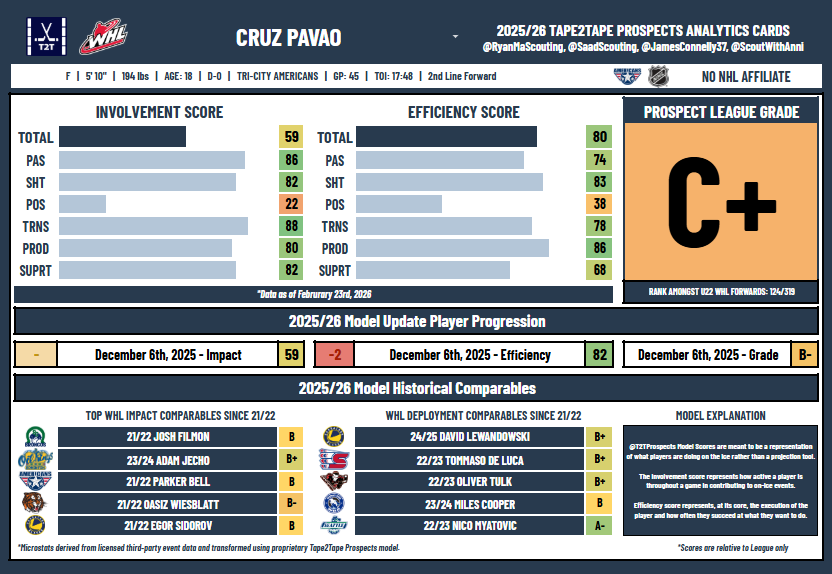
Games Tracked:
02/21/26 vs Spokane
02/01/22 vs Everett
01/09/26 vs Vancouver
ELEVATOR PITCH
Cruz Pavao is a small, decent-skating WHL forward with a strong shot and occasional flashes of board work, but his lack of separation speed, inconsistent engagement, and limited puck skill make him more of a “does a bit of everything, but not enough of anything” type. Outside of his high-slot shooting threat, there aren’t enough reliably translatable traits right now to see a clear NHL projection… more likely a depth junior player or re-entry candidate.
I’m not sure what to make of Cruz Pavao, and I think Pavao himself is also trying to figure out what he is or wants to be. It’s certainly difficult in an environment like Tri-City for a player like Pavao to really find his niche or role... every game I watched out of Tri-City was just a smorgasbord of bobbled pucks, defensive zone mishaps, and chaos.
Pavao’s on the smaller side, and he’s a good skater but not a great one. His smaller stature means it’s harder for him to pull away from taller, rangier defenders, and he’s not super shifty, which means he’s not someone who can dance around the perimeter with the puck to create chances. Pavao is usually in and around the play on the forecheck, but he’s never really truly IN the play. He’s only in the 60th percentile amongst WHL forwards this year in puck battles, and he’s just not like a Ryan Brown or Kolarik, or even Quinn McKenzie, who are all super disruptive to the opposing team, even with the size limitations.
Pavao is a player who’ll do a bit of everything, but usually not consistently enough at any of it for me to consider it a strength. There was a nice play along the boards one time where he walled off an opponent and allowed his teammate to fish the puck out. He finished a check here and there. There were a few plays where he charged the net front for a loose puck, but again, nowhere near consistently enough for it to be considered part of his identity.
Defensively, Pavao isn’t super engaged, a little bit like Wassilyn, where there are a few nice connective passes here and there, but really, he’s just waiting for the puck to come to him rather than trying to make a play to win the puck back for his team. I THINK Pavao wants to spring teammates with quick passes in transition and create a ton of chances off the rush, but the stickhandling and explosiveness aren’t really there for him to execute that vision on the puck, and he doesn’t drive his lanes with enough intent or purpose to contribute to that idea off the puck.
The best part of Pavao’s game is his shot, where he’s very dangerous when he gets the puck in the high slot and has a few strides worth of space to skate into. He puts his whole body into it, with a beautiful curl and release that he picks corners with.
I think Pavao is just a fine WHL player who could find a niche on a better team in his D+1 that will allow an NHL team to reconsider him as a re-entry, but I’m not sure there are any truly discernible traits for me to justify ranking him any higher.
#166 – Cole Emerton – Barrie – RD – OHL
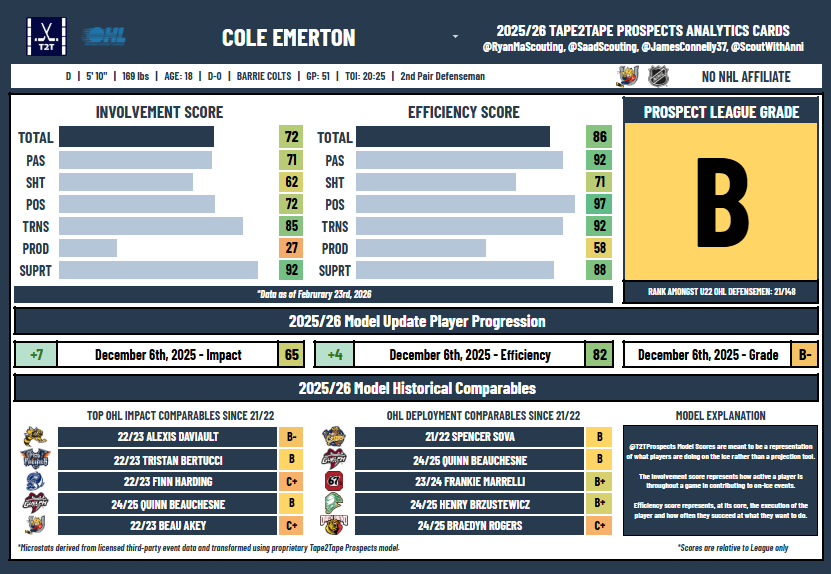
Games Tracked:
03/15/26 vs Oshawa
03/05/26 vs Brantford
02/16/26 vs Ottawa
ELEVATOR PITCH
Cole Emerton is a mobile undersized defenseman who shows some puck-moving flashes and strong shot placement from the point, but most of his game defaults to safe, low-difficulty options like rim-outs, deferment to his defense partner, and soft point shots. While he defends with effort and decent angles, his lack of size-driven puck-winning ability and limited impact in transition make him a low-upside, depth-type projection unless a secondary skillset develops.
Cole Emerton is an undersized defenseman who has flashes with the puck in the offensive zone, but ultimately leaves you wanting more.
Emerton is a good skater who’s comfortable walking the line and making moves with his back to the blueline, looking to buy time for a passing lane to open up. However, despite these flashes with the puck, he’s ultimately a very vanilla player. He almost always either:
1) Defers to his defence partner after drawing some attention to himself with the puck
2) Sifts a soft shot on goal, looking for a tip or rebound
3) Tries to shove it down the boards to his winger
I will give credit where it’s due, though. Emerton places his shots really well, and even though I don’t think it’s a shot that will threaten for goals at a meaningful rate at the NHL level, I do think it’s a very teammate-friendly shot when it comes to being able to tip and get sticks on the pucks. It floats and hangs in the air and can create some havoc in the slot area when it’s batted down.
Ultimately, as a defenseman at his size, you want Emerton to be a standout in transition in terms of breaking down pressure with his movement skills and vision, and I don’t think that’s a skill he’s figured out yet. There are stretches in a game where he fades into the background. When your defence partner in some of these games is Gabe Eliasson, you should be the standout puck mover on the back end and he just isn’t.
As a rush defender, Emerton understands angles well and will cut off opponents in races for the puck, lowering a shoulder and looking to beat the opponent to the spot and out-leverage him to keep the puck along the boards… just trying anything to disrupt the opponent from having a clean entry into the zone with the puck. He weaponizes that with a nice active stick that he uses to knock pucks away and take away passing lanes. Unfortunately, Emerton is almost forced to do this; his size is unfortunately what it is, and he has a very difficult time winning puck battles or moving guys off the puck along the boards.
It’s why Emerton opts to do these soft dumps into the neutral zone in his own end when he faces pressure. I don’t think he trusts his hand and speed coordination to outmaneuver bigger, stronger and rangier opponents, and when he gets contacted along the boards, he’s almost automatically forced into a board battle that he has trouble winning.
The effort is certainly there on defensive zone retrievals for Emerton, but the size continues to be a limiting factor, and he struggles to make clean recoveries that he can use to drive play north. At his size, the defensive zone habits are inconsistent. Some really nice box outs in the net front area, but there are also some coverage lapses where he won’t tie up sticks, or he’ll lose his man and get caught puck watching.
Ultimately, Emerton is a mobile defenseman who works hard and has nice shot placement, but just hasn’t figured out that second trait that will help make his package a pro-level projection.
#167 - Tobias Tomik - Vancouver Giants - C/RW - WHL
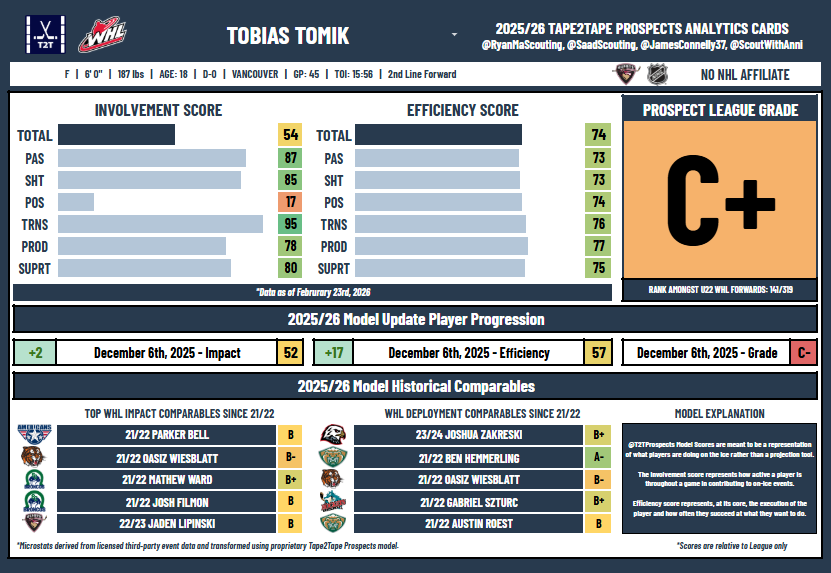
Games Tracked:
03/21/26 vs Kamloops
02/16/26 vs Seattle
12/13/25 vs Victoria
ELEVATOR PITCH
Tobias Tomik is a straight-line, high-tempo winger who plays with clear physical intent and speed, but his lack of play strength and inefficient contact balance undermine the “power-forward” identity he tries to impose. Without enough impact in board battles, defensive detail, or puck protection under pressure, he profiles more as a potential pace-based organizational depth forward
Tobias Tomik is a speedy, straight-line player who wants to play a “grown man amongst boys” style game, and I’m not sure it’s really working for him.
I have to give credit where credit is due, Tomik wants to play the game like he’s 6’3”, 225 lbs, but his strength and contact balance make him look like he plays even smaller than his listed 6’1”, 190 lbs. I was shocked seeing his listed height on Elite Prospects because after I watching him, I would’ve guessed he was around 5’11”, 175 lbs.
There’s an inherent edge to Tomik, who tries to finish every check he can. When I say every check, I really do mean EVERY check. He’s very quick in straight lines, and I feel he should be a better forechecker given his mentality than he ends up actually being. The issue is, he’s not really all that strong, and so instead of these board-rattling moments of physicality, Tomik will bounce off guys without actually inflicting any pain. Defensively in his own end, Tomik really tries to use his body to pin guys against the boards, but again, he gets brushed off super easily, and I think his stick work could use some work.
Tomik has a strong stick that he can use to dispossess opponents or snag pucks away, but I find a lack of understanding of leverage and effort in his defensive zone work. Lots of hunched-over, reachy attempts to pull or push pucks away. It works enough for him at this stage, but I want him to really get into these board battles with his legs and move guys off pucks.
The intensity for me lags around the defensive zone, too, just not the greatest details and awareness. Not tying up sticks in the slot, not really closing out with purpose on the perimeter, Tomik, I think, wants to be a speedy, straight-line, wrecking ball player who can work some magic off the rush, but the overall play strength and intelligence just need a lot of work, in my opinion.
Even on breakouts, Tomik really wants to show puck protection skills and make firm, controlled plays with the puck, trying to ward off guys and hang onto the puck in the face of pressure. Unfortunately, the play strength issues rear their heads again, and he just doesn’t have the contact balance to be able to absorb the pressure and make plays. He’ll need to either play with more pace when moving the puck out or learn to add more elusive skillsets on the puck in his own end.
Tomik isn’t the greatest creator of offence or facilitator (more of an off-the-puck shooter/ transition net crasher), and a lot of the time when he tries to create, he’ll get stonewalled and bodied off the puck, but I can appreciate the willingness to experiment and try. There are a few nice toe drag releases from the left side that have resulted in goals this year for Tomik, and in general, the straight line play in transition has been Tomik’s bread and butter this year.
All in all, I don’t think I see it with Tomik. He so clearly wants to be a PWF type, but hasn’t really figured out how to do that with his existing skillset besides running into people on the forecheck. He’s an above average straight-line rush attacker both on and off the puck, but ultimately, the details and work ethic just aren’t good enough at this stage for him to be anything like the player he wants to be.
#168 - Tyler Challenger - Sarnia Sting- LW - OHL
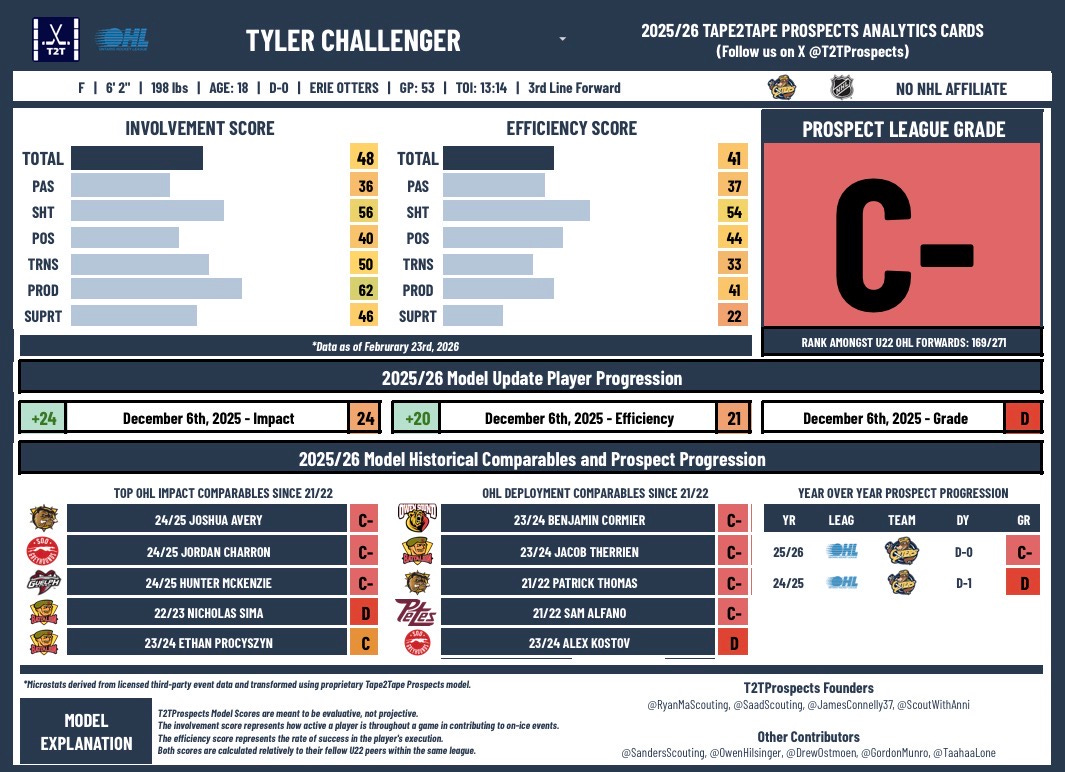
Games Tracked:
03/18/26 vs Erie
02/18/26 vs Guelph
01/16/26 vs London
ELEVATOR PITCH
Tyler Challenger is a raw, big-bodied power forward with enough size and board strength to stay involved physically, but his skating, processing speed, and lack of consistent puck touches mean he rarely imposes himself on games. At this stage he looks like a long-term project with minimal defined offensive or two-way identity, driven mostly by potential growth.
I’m struggling to see the vision with Tyler Challenger. I watched 3 games of him, one of which he scored 2 goals in, and yet I still have no clue what his game is or what his strengths are.
After almost 50 minutes of watching Challenger, I just frankly have no real notes and this may genuinely be the shortest write up that I do. Challenger is a big, heavy set power forward who is about as raw as it gets. There’s some good strength and intensity in terms of keeping plays alive along the boards, and an edge to his game that pairs well with his physical frame, but I think he really struggles to consistently impact the game given his current package.
The skating stride, while powerful, is a bit clunky and awkward for Challenger who does actually shows flashes of being a plus puck handler but can’t use it to consistently accentuate his on-puck game. Add that his willingness to attack downhill being almost non-existent, Challenger is a limited self creator. I also find that despite playing tons of PK and being lauded as a two-way forward, Challenger struggles to react when the puck gets zipped around. The feet stall during moments of uncertainty and he lags in-terms of recovering and rallying to the puck. I just think for a player who doesn’t drive play in any real meaningful way, I was frankly hoping for more intensity and activity from Challenger in his own end.
Offensively and in transition, Challenger really fades into the background. Beckham Edwards drove the transition bus on that line and as a result Challenger got very few puck touches, didn’t really do anything with the limited touches he did get and I don’t think has refined the details in his game to be an efficient and cerebral off puck mover. There were a few nice passes in the face of pressure to exit the zone, and Challenger can handle pressure and use his hands in tight to sneak passes into the slot area but there’s just not enough of a body of work there for me to confidently project anything as a definite strength at this point.
All in all, Tyler Challenger is a pure project pick for me. The size and natural raw athleticism means that there’s a really moldable prospect here and that will likely be the draw for an NHL team. He doesn’t do a whole ton at this stage but at 6’4”, with average movement skills and a few whispers of being able to navigate sticks and pressure in tight he’s also a player that probably gets a ton of patience and rope from NHL front offices. There’s a reasonable chance that Challenger could be left undrafted given his current body of work and that if he were drafted that his road to the pro’s would be a significantly longer one than most prospects.
#169 - Rhys Jamieson - Everett Silvertips - F - WHL
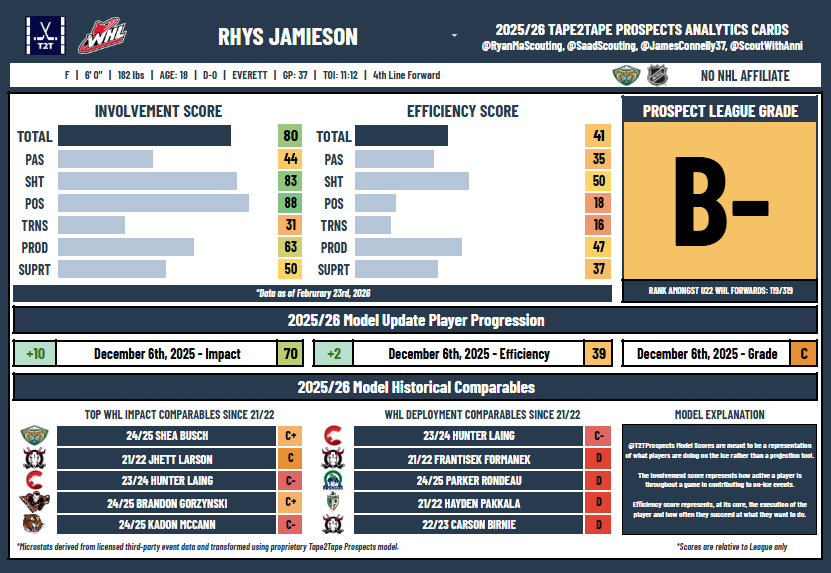
Games Tracked:
03/28/26 vs Portland
02/28/26 vs Seattle
01/20/26 vs Spokane
ELEVATOR PITCH
Rhys Jamieson is a straight-line, fourth-line energy winger whose game is built almost entirely around net-front chaos, simple shooting mentality, and riding momentum off his skating rather than creating plays himself. While he consistently gets to the right areas and produces some finishing value, his limited puck skill, poor agility in tight, and lack of forechecking disruption make him more of a role-dependent CHL depth player at this point.
Rhys Jamieson was one of the highest graded junior league 4th Liners in the T2T Prospects Model, and so I thought I’d give him and his 11 minutes a game a quick look.
After watching three games that all honestly looked extremely similar, it’s easy to see why the model likes him disproportionately to what he actually is. Rhys Jamieson is a fourth-line energy guy at the WHL level, and that doesn’t really bode super well for his NHL chances, but I do think there’s some room to grow here for him where he can fill a serviceable complementary role in an OHL Top 9 with some tweaks here and there.
Jamieson is a straight-line player who crashes the net, is in his spots defensively, and shoots the puck a ton, given how often he’s on the ice. It ultimately comes down to his role and Everett’s philosophy for that line. Jamieson is a good skater in straight lines when he can build speed or has any sort of positive momentum moving forward. It allows him to barrel his way to the net front in transition and lets him keep up with his more creative teammates.
His goals are mainly scored by just getting to the net front and banging in rebounds, tips, and backdoor tap-ins. I think Jamieson could become an even more clinical finisher, but I find that his hands are below average, and he fumbles a bunch of pucks when under pressure. More confidence and a stronger bottom hand on his stick could lead to a lot more fluid connective play for Jamieson, who isn’t super comfortable with the puck unless he can receive it in motion with space.
I think a big part of that is that Jamieson is not so good at changing direction or getting his feet moving from a standstill. It makes it difficult for him to be an effective forechecker against shiftier opponents, and his inability to keep his feet moving and move through disruptions or contact will limit how effective he can be in that facet of the game if he ever hopes of making it to the pros. It also might be why when he’s trapping it up in the neutral zone, he rarely attacks the wingers along the boards. I don’t think he trusts his ability to not get beaten inside if he’s too aggressive.
Ultimately, the way Jamieson’s line plays explains the high model score. Everyone on that line shoots whenever they get a chance, and it’s all quick-strike offence where Everett’s star-studded backline does a ton of the heavy lifting to make clean retrievals and breakouts and lets this fourth line hunt for net front chaos and rush opportunities.
There’s a really long-term development horizon for and NHL team that would be willing to take a shot at Jamieson, who needs to really improve his feel and touch with the puck and also improve his agility as a skater. Even then, the best-case scenario is likely a replacement-level fourth liner.
#170 - Kyle Heger - Lethbridge Hurricanes - LD - WHL
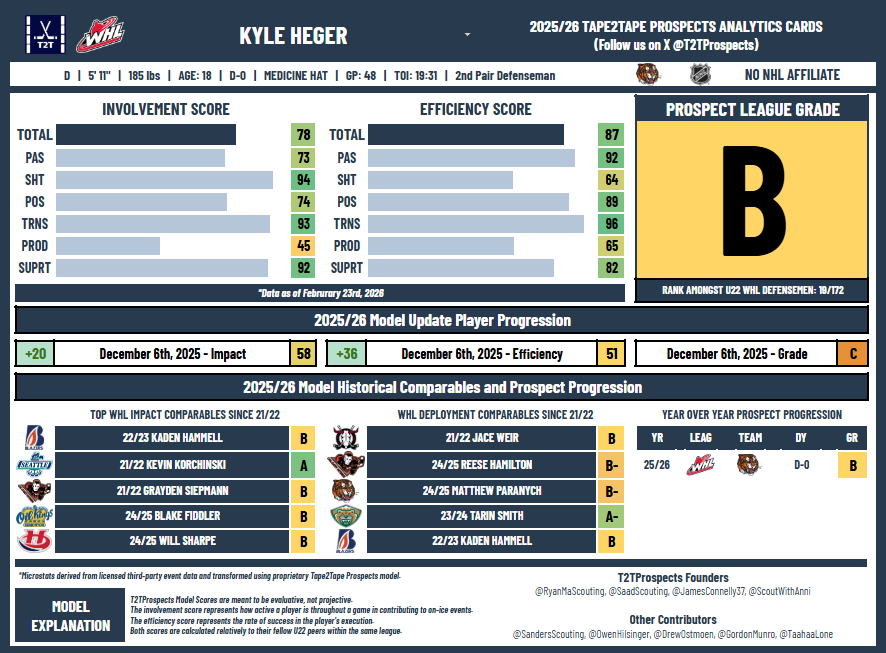
Games Tracked:
03/14/26 vs Medicine Hat
02/25/26 vs Moose Jaw
01/17/26 vs Red Deer
ELEVATOR PITCH
Kyle Heger is a simple, low-event 6’1” WHL left-shot defenseman who plays a safe, structured game focused on quick exits and perimeter puck movement, without much creativity or offensive push. He defends adequately through positioning and stick pressure but the feet, physical engagement, and recovery ability are all weaknesses, projecting him more as just a reliable junior-minute eater at his best.
Kyle Heger was one of the model’s biggest risers from December to February, and a lot of it ultimately comes down to him playing a much larger role for Lethbridge than he did for the powerhouse Medicine Hat Tigers earlier in the year.
Unfortunately, I’m just not super enthused by the overall package that the 6’1” LHD brings to the table. Heger plays a super simplistic game and doesn’t bring any real willingness or showcase the ability to be a more dynamic player from the back end. There are no real creative counters that he can bring to the table in the face of pressure, and a lot of his plays are just dump outs or slapping the puck up the boards in hopes one of his wingers will be there.
Defensively, I don’t love the feet. He doesn’t keep them moving, and there appears to be a lack of urgency. He’s not heavily involved in getting into board battles and winning pucks back for his team, and although he has moments where he will tenaciously work at pucks with his stick, I find the overall willingness to engage physically lacking. In the net front, really light shoves to the back, but he doesn’t tie up sticks, and he doesn’t get low to try to move guys away from his goalie’s line of vision.
Off the rush, Heger uses an aggressive stick to pester opponents to keep them to the outside, but the back skating is very meh. He gets caught flatfooted easily when opponents attack him at full speed and struggles to turn his hips to recover.
Heger is a positionally sound player who gets the puck out of the zone, can make a few nice stretch passes when given time to operate and doesn’t lose his minutes on the ice. He has all the hallmarks of a 4-year CHL pro, and he’ll continue to play big minutes on some of the middling teams in the WHL, but I just don’t see a separating skillset that will allow him to carve out a role at the NHL level.
There’s a good, responsible player here in Heger who will be given some tough defensive zone deployment at the junior level, and become a reliable player on whatever WHL team he’s on.
#171 - Jonas Kemps - Chicago Steel/USNTDP - LD - USHL
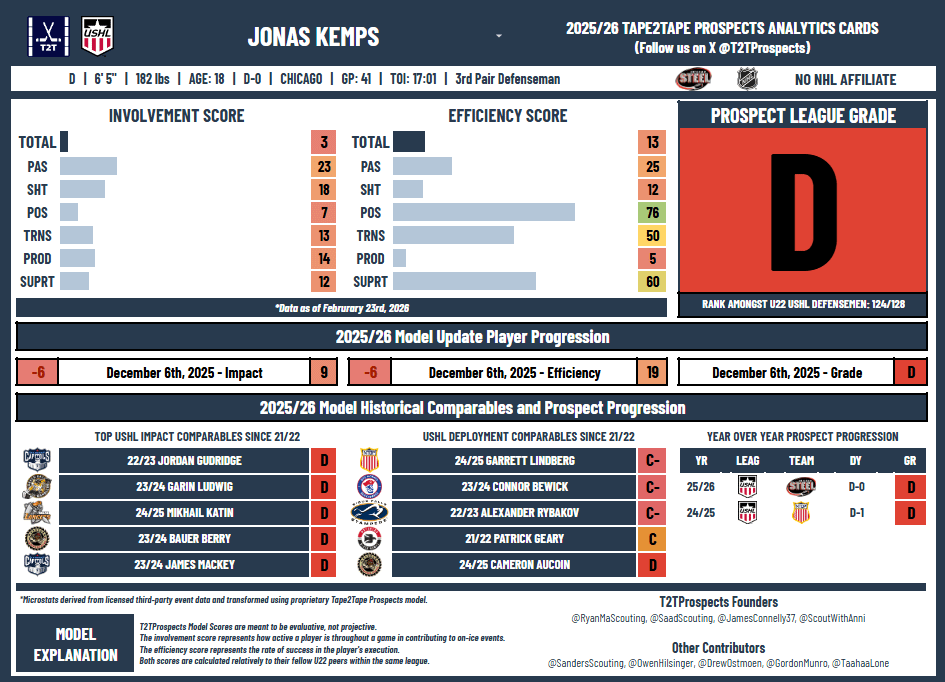
Games Tracked:
04/12/25 vs Youngstown Phantoms
ELEVATOR PITCH
Jonas Kemps is a massive, stay-at-home defenseman whose size and reach allow him to be a serviceable rush defender, but he currently falls well short of maximizing the advantages that come with a 6’6” frame. Despite intriguing physical tools, his passive defensive style, inconsistent coverage recognition, limited puck-moving ability, and lack of physical dominance leave him looking more like a project than a true shutdown defender at this stage.
Jonas Kemps was a disappointing watch for me. I always get super excited to watch super tall defensemen because my imagination takes me everywhere. Is he super mobile? Does he have a booming slapshot? Does he light players up defensively? Is he an elite rush defender? The answer, unfortunately for Kemps was no to all of the above. Kemps is the definition of “He’s 6’6” every time he steps on the ice.” It’s a bit frustrating because at his size, I think there’s a lot more that he could be doing. Firstly, he’s a fine rush defender, decent enough gap, and he does well to use his reach to push opposing forwards outside, where he then tries to close them out into the boards. The issue is, he’ll often overpursue, reaching with his stick and becomes super susceptible to cutbacks. With his range and length, I think he could be a far more effective rush defender than he showed in this game.
Offensively and on breakouts, he wasn’t super involved. His best moment was when he used his size to absorb the forecheck before chipping the puck over to his defense partner to get the breakout going. Most of the time it was blind one-handed chips up the boards that were often cut off by opposing forwards. 0 individual rushes with the puck, it’s clear his MO is to be a stay-at-home defender. However, like Schairer, I think Kemps really struggles diagnosing coverage in this NTDP zone system. Lots of times, he overpursues a player and leaves his zone wide open for a back-door tap-in. He’s lucky that Youngstown wasn’t able to connect on a few of those in this game, but I was left very unimpressed.
I also think that Kemps should be way harder to play against in the defensive zone. He had a few nice net front clearances, and one nice play where he removed a player from the puck behind the net with his size, but far too often, he’s letting his stick do all the work. I think I’d have left this viewing a lot higher on him if he was able to consistently punish opponents in the cycle behind the net and along the boards, but for a 6’6” defenseman, he wasn’t very difficult to play against.
I’m left wondering if perhaps it’s simply the zone defense he’s playing that leads to this very passive style of defending, but he’s not mobile enough in tight spaces to rely on stick checking alone to defend. There’s potential here at his size for Kemps to be a rangy, defensive defenseman, but I’ve yet to see anything in his game that leads me to believe he can fulfill that potential. Whether it’s a system change or a mental adjustment needed, I remain unimpressed.
MISSED THE WATCHLIST
I’m only one guy with only so many hours in the day and so inevitably there will be quality players that I just didn’t get to this year. I’ve heard great things about Yaroslav Matyev, Vesvolod Matveev, Jakub Floris, Rian Chudzinski, Parker Vaughan, Samuel Eriksson, William Sorbrand and Lucian Bernat but I never feel comfortable ranking a player I haven’t watched, so here’s the list of guys that I’ve missed but would’ve watched if I had the time. Note that this is NOT a ranking but just a list of players that I thought could’ve been interesting to take a look at.
JUST MISSED THE CUT
Yaroslav Matyev - LD (MHL)
Vesvolod Matveev - RD (MHL)
Jakub Floris - RD (U20 SM-sarja)
Colin Fitzgerald - C (OHL)
Rian Chudzinski - RW (QMJHL)
Jayden Kurtz - RD (USHS)
Parker Trottier - LW (USHL)
Parker Vaughan - RW (OHL)
Samuel Eriksson - LD (U20 Nationell)
Myles Brosnan - RD (USHS)
Sean Burick - RD (WHL)
Charlie Morrison - LD (QMJHL)
Kayden Lemire - RW (WHL)
Jiri Kamas - RD (WHL)
David Bosco - RW (USHL)
Joseph Salandra - RW (OHL)
Brody Pepoy - RW (OHL)
Caelan Joudrey - C (WHL)
Caden Harvey - RW (OHL)
Pavel Martinu - C/LW (USHL)
William Sorbrand - C/W (U20 Nationell)
Lucian Bernat - W (U20 SM-sarja)
Spencer Bowes - C (OHL)
Layne Gallacher - C/W (OHL)
THANK YOU
Thank you again to everyone who’s supported my work this year!
What a year it’s been…
It’s been a heck of a grind to get through 171 players this season and I don’t think I’ve ever watched this much hockey in my life but I truly appreciate everyone who has ever liked, commented, subscribed or followed my coverage this year of the 2026 NHL Draft.
This account has been a solo passion hobby that I’ve carved out time for while also working a 9-5 and trying to get my certifications for work. I’m not an Elite Prospects or McKeen’s who has dozens of people working and editing… it’s a one man operation over here.
So if you’ve enjoyed the content this year or found this draft guide useful, please take a minute to share it with your friends. It would mean the absolute world to me!
I have some really exciting news that will be out in the next month or so as we head into the 2027 NHL Season, so if you’re not following me on X at @RyanMaScouting make sure you do that!
SHOUTOUT MY BOYS (and my girl)
A special shout out to my boys over at T2T who I’ve had some of the most insightful and fun conversations with this year. Between getting strong-armed into Wiggo Sorensson tape, our divisive opinions on Daxon Rudolph and trading a Rasmus Orenas for Tobias Kramer viewing… this entire year would not have been half as fun as it was without you guys.
If you don’t follow them already on X, please do! I’ve included their tags down below.
Charles (@SandersScouting)
David (@SaadScouting)
Drew (@drewostmoen)
Gordon (@GordonMunro)
James (@JamesConnelly37)
Owen (@owenhilsinger)
Taahaa (@TaahaaLone)
And last but certainly not least, I’d like to thank my girlfriend, who’s been my number 1 fan since the start (like literally, she likes and restacks all my Substack Posts and reads them even though she has no clue what I’m talking about). Your support means the absolute world to me ❤️